A 3.82 L volume of gaseous ammonia, NH3 (g), at STP is bubbled through 100.0 mL...
Homework Answers
Request Answer!
We need at least 10 more requests to produce the answer.
0 / 10 have requested this problem solution
The more requests, the faster the answer.
Add Answer to:
A
3.82 L volume of gaseous ammonia, NH3 (g), at STP is bubbled
through 100.0 mL...
Consider the reaction that occurs when gaseous ammonia reacts with solid copper(ll)oxide: 2NH3(g) + 3Cu(s) –...
 Consider the reaction that occurs when gaseous ammonia reacts with solid copper(ll)oxide: 2NH3(g) + 3Cu(s) – N2(g) + 3Cu(s) + 3H2O(g) What volume (in mL) of NH3 is required to completely react 45.2 g of CuO at STP? Enter your solution as a numerical value with no units. NumericAnswer
A sample of 8.00 L of NH3 (ammonia) gas at 22 degrees and 735 torr is bubbled into a 0.500 L solution of 0.400 M HCl (hydrochloric acid)
A sample of 8.00 L of NH3 (ammonia) gas at 22 degrees and 735 torr is bubbled into a 0.500 L solution of 0.400 M HCl (hydrochloric acid). The Kb value for HCl is 1.8x10^-5. Assuming all the NH3 dissolves and that the volume of the solution remains at 0.500 L, calculate the pH of the resulting solution. (need some help kinda dont know where to start)
Solution Worksheet Name 1.12.5 g of NaCl is dissolved in enough water to make 0,683 L...
 Solution Worksheet Name 1.12.5 g of NaCl is dissolved in enough water to make 0,683 L of solution: a. What is the molarity of the solution? b. How many moles of Nail are contained in 0.0100 L of the above solution? What volume (L) of this NaCl solution would contain 0.150 moles of NaCl? 2. 255 g of NHCl is dissolved in enough water to make 7500 ml of solution What is the molarity of the solution b. How many...
A solution of household ammonia is 3.0 % NH3(aq) and has a density of .98 g/ml....
A solution of household ammonia is 3.0 % NH3(aq) and has a density of .98 g/ml. What is the molar concentration of the NH3(aq)? Given that the Kb for NH3(aq) = 1.8x10‒5, what is the predicted pH of this solution? Thank you in advance
Ammonia, NH3 , reacts with oxygen to form nitrogen gas and water. 4NH3(aq)+3O2(g)⟶2N2(g)+6H2O(l) If 3.15 g...
Ammonia, NH3 , reacts with oxygen to form nitrogen gas and water. 4NH3(aq)+3O2(g)⟶2N2(g)+6H2O(l) If 3.15 g of NH3 reacts with 4.73 g of O2 and produces 0.750 L of N2 at 295 K and 1.00 atm , which reactant is limiting? a. O2(g) b. NH3(aq) What is the percent yield of the reaction? percent yield: %
2. You are in the lab; you dissolve 12.0 g NiCl2-6H2O (nickel chloride hexahydrate FW=237.69 g/mol);...
 2. You are in the lab; you dissolve 12.0 g NiCl2-6H2O (nickel chloride hexahydrate FW=237.69 g/mol); you add a large excess of ammonia (NH3) in the form of concentrated ammonium hydroxide (NH4OH) and bring the solution to the mark in a 250 mL volumetric flask. The following nickel-amine complexes can be assumed to occur in the solution along with free nickel ion. Ni(NH3)2+ Ni(NH3)22+ (aq) Ni(NH3)3 2+ (aq) Ni(NH3)42 (aq) Ni(NH3)2+(aq) Ni(NH3)62+(aq) (a) Write a mass balance on Ni (for...
1- What mass (in g) of AgNO3 is required to make 100.0 mL of a 0.100...
1- What mass (in g) of AgNO3 is required to make 100.0 mL of a 0.100 M solution? 2. You are preparing 2.00 L of a 1.00 M solution of hydrochloric acid. You have a stock bottle of concentrated acid (12 M). How much 12 M acid do you need to make your dilution in mL? 3-What volume (in mL) of 0.125 M AgNO3 is required to react completely with 35.31 mL of 0.225 M Na3 PO4? The balanced reaction...
Question 7 (1 point) A sample of gaseous neon has a volume of 68.2 Lat STP....
 Question 7 (1 point) A sample of gaseous neon has a volume of 68.2 Lat STP. How many moles of neon are in the sample? 0.328 moles 3.04 moles 68.2 moles 1530 moles 4.11 X 1025 moles Question 8 (1 point) The temperature of a gas at 1.00 atm and 8.00°C is increased to 20.0°C resulting in a change of pressure. Which equation would you use to calculate the new pressure? P: V1 = PzV2 OP/V1 = P2/V2 O P₂...
Determine the volume of 12.5 g of ammonia, NH_3, at STP. (R=0.0821 atm * L/mol*k) how...
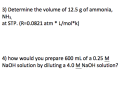 Determine the volume of 12.5 g of ammonia, NH_3, at STP. (R=0.0821 atm * L/mol*k) how would you prepare 600 mL of a 0.25 M NaOH solution by diluting a 4.0 M NaOH solution?
A 1.00 liter solution contains 0.34 M ammonia and 0.44 M ammonium bromide. If 0.110 moles...
A 1.00 liter solution contains 0.34 M ammonia and 0.44 M ammonium bromide. If 0.110 moles of barium hydroxide are added to this system, indicate whether the following statements are true or false. (Assume that the volume does not change upon the addition of barium hydroxide.) _______TrueFalse A. The number of moles of NH3 will increase. _______TrueFalse B. The number of moles of NH4+ will remain the same. _______TrueFalse C. The equilibrium concentration of H3O+ will remain the same. _______TrueFalse...
 Consider the reaction that occurs when gaseous ammonia reacts with solid copper(ll)oxide: 2NH3(g) + 3Cu(s) – N2(g) + 3Cu(s) + 3H2O(g) What volume (in mL) of NH3 is required to completely react 45.2 g of CuO at STP? Enter your solution as a numerical value with no units. NumericAnswer
 Solution Worksheet Name 1.12.5 g of NaCl is dissolved in enough water to make 0,683 L of solution: a. What is the molarity of the solution? b. How many moles of Nail are contained in 0.0100 L of the above solution? What volume (L) of this NaCl solution would contain 0.150 moles of NaCl? 2. 255 g of NHCl is dissolved in enough water to make 7500 ml of solution What is the molarity of the solution b. How many...
 2. You are in the lab; you dissolve 12.0 g NiCl2-6H2O (nickel chloride hexahydrate FW=237.69 g/mol); you add a large excess of ammonia (NH3) in the form of concentrated ammonium hydroxide (NH4OH) and bring the solution to the mark in a 250 mL volumetric flask. The following nickel-amine complexes can be assumed to occur in the solution along with free nickel ion. Ni(NH3)2+ Ni(NH3)22+ (aq) Ni(NH3)3 2+ (aq) Ni(NH3)42 (aq) Ni(NH3)2+(aq) Ni(NH3)62+(aq) (a) Write a mass balance on Ni (for...
 Question 7 (1 point) A sample of gaseous neon has a volume of 68.2 Lat STP. How many moles of neon are in the sample? 0.328 moles 3.04 moles 68.2 moles 1530 moles 4.11 X 1025 moles Question 8 (1 point) The temperature of a gas at 1.00 atm and 8.00°C is increased to 20.0°C resulting in a change of pressure. Which equation would you use to calculate the new pressure? P: V1 = PzV2 OP/V1 = P2/V2 O P₂...
 Determine the volume of 12.5 g of ammonia, NH_3, at STP. (R=0.0821 atm * L/mol*k) how would you prepare 600 mL of a 0.25 M NaOH solution by diluting a 4.0 M NaOH solution?
Most questions answered within 3 hours.
-
Where is the error in this code sequence?
String s1 = "Hello";
String s2 = "ello";...
asked 11 months ago -
Financial data for Joel de Paris, Inc., for last year
follow:
Joel de Paris, Inc.
Balance...
asked 11 months ago -
Consider this reaction:
Al2(SO4)3 (aq)+ BaCl3
(aq) Al2Cl6 (aq)- +
3BaSO4(s) . What is the...
asked 11 months ago -
Suppose that Savneet is considering increasing her
recent random sample from 20 car rentals to 40...
asked 11 months ago -
Trucks arrive at an unloading terminal at an average rate of 120
per hour.
Trucks arrive...
asked 11 months ago -
Why are methanol and ethanol completely soluble in water while
octanol is not very little soluble....
asked 11 months ago -
A facilities manager at a university reads in a research report
that the mean amount of...
asked 11 months ago -
When the CuSO4 is rehydrated by adding water to the anhydrous
compound, is this an endothermic...
asked 11 months ago -
A ray of sunlight is passing from diamond into crown glass; the
angle of incidence is...
asked 11 months ago -
A block of mass 0.249 kg is placed on top of a light, vertical
spring of...
asked 11 months ago -
how do the kidneys compensate in the presences of acidosis
a) trigger hyperventilate
b) reserve acid...
asked 11 months ago -
Question 501 pts
The rental rate of capital to the firm increases. Which of the
following...
asked 11 months ago