
Homework Answers
Recursion:
The recursive function calls to itself and a terminate or base condition is specified which breaks the infinite execution of the recursive call. When the function call to itself then it works like a continue statement and the control goes to the starting of the function with updated argument value.
The stack data structure is used in recursion for storing the intermediate value when each function call is made.
In a recursive function, two cases are mentioned:
- Base condition
- Recursive call
Base condition:
A terminate condition or base condition is specified which breaks the infinite execution of the recursive call.
Recursive Call:
The function will call to itself and this is known as a recursive call.
The required function is given below:
def ackermann(m,n):
if m==0:
return n+1
elif n == 0:
return ackermann(m-1,1)
else:
return ackermann(m-1, ackermann(m,n-1))
The screenshot of the above source code is given below:

The complete program source code including above method for testing is given below:
def ackermann(m,n):
if m==0:
return n+1
elif n == 0:
return ackermann(m-1,1)
else:
return ackermann(m-1, ackermann(m,n-1))
#function calling and display result
print(ackermann(2,4))
The screenshot of the above source code is given below:

OUTPUT:
11
Add Answer to:
Code in python please!
8. Ackermann's Function Ackermann's Function is a recursive mathematical algorithm that can...
8. Ackermann's Function Ackermann's Function is a recursive mathematical algorithm that can be used to test...
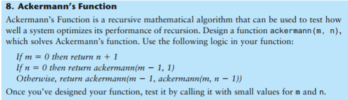 8. Ackermann's Function Ackermann's Function is a recursive mathematical algorithm that can be used to test how well a system optimizes its performance of recursion. Design a function ackermann (m, n), which solves Ackermann's function. Use the following logic in your function: If m 0 then return n + 1 If n = 0 then return ackermann(m – 1, 1) Otherwise, return ackermann(m – 1, ackermann(m, n - 1)) Once you've designed your function, test it by calling it with...
Write a python program (recursive.py) that contains a main() function. The main() should test the following...
Write a python program (recursive.py) that contains a main() function. The main() should test the following functions by calling each one with several different values. Here are the functions: 1) rprint - Recursive Printing: Design a recursive function that accepts an integer argument, n, and prints the numbers 1 up through n. 2) rmult - Recursive Multiplication: Design a recursive function that accepts two arguments into the parameters x and y. The function should return the value of x times...
Give python code for this algorithm in two ways. 1 Method has to be recursive, Method...
Give python code for this algorithm in two ways. 1 Method has to be recursive, Method 2 has to use list comprehensions or list traversal methods. You have to write python function that will be in this form ArithmeticSequence(0,2,10){} where 0 is the first number in the sequence, the next number goes up by 2, and stopping at the last value in sequence before 10, so 10 is the max of this sequence. it has to pass a test like...
2. Consider the function george (int n) computed by the following recursive C++ code. int george ...
 2. Consider the function george (int n) computed by the following recursive C++ code. int george (int n) assert (n >= 0) if (n < 2) return 1; else return 2*george ((n+1)/2)+2*george (n/2)+2 george((n-1)/2)+2*george (n/2-1); (c) Design a memoization algorithm to compute george(n) for any given n. You do not have to write C++ code. This algorithm should be much faster than the dynamic programming algorithm. What is its time complexity?
2. Consider the function george (int n) computed by...
2. Consider the function george (int n) computed by the following recursive C++ code. int george (int n) assert (n >= 0) if (n < 2) return 1; else return 2*george ((n+1)/2)+2*george (n/2)+2 george((n-1)/2)+2*george (n/2-1); (c) Design a memoization algorithm to compute george(n) for any given n. You do not have to write C++ code. This algorithm should be much faster than the dynamic programming algorithm. What is its time complexity?
2. Consider the function george (int n) computed by...
Write a recursive function in Python to find the sum of digits of a number. Name...
 Write a recursive function in Python to find the sum of digits
of a number. Name the function sum_of_digits. The function should
use recursive algorithm (calling itself). The function should print
out the sum of all the digits of a given number. For example,
sum_of_digits(343) should have a output of 10. Marks will be
deducted if you do not follow strictly to the
instructions.
[3]: N 1 def sum_of_digits(n): HNM in sum_of_digits (343) Out[3]: 10
Write a recursive function in Python to find the sum of digits
of a number. Name the function sum_of_digits. The function should
use recursive algorithm (calling itself). The function should print
out the sum of all the digits of a given number. For example,
sum_of_digits(343) should have a output of 10. Marks will be
deducted if you do not follow strictly to the
instructions.
[3]: N 1 def sum_of_digits(n): HNM in sum_of_digits (343) Out[3]: 10
Write a python code function that selects top ten max numbers from a sequence of n...
 Write a python code function that selects top ten max numbers from a sequence of n integers, test it, and determine the Big-Oh of running time for the algorithm (Do not have to prove) -1/i and Write a python recursive function for computing the nth Harmonic number, Hn= test it.
C++ PROGRAM ONLY! For this lab you need to write a program that will read in...
 C++ PROGRAM ONLY!
For this lab you need to write a program that will read in two values from a user and output the greatest common divisor (using a recursive implementation of the Euclidean algorithm) to a file. In Lab #3, you implemented this program using an iterative method. Greatest Common Divisor In mathematics, the greatest common divisor (GCD) of two or more integers (when at least one of of them is zero then the larger value is the GCD....
C++ PROGRAM ONLY!
For this lab you need to write a program that will read in two values from a user and output the greatest common divisor (using a recursive implementation of the Euclidean algorithm) to a file. In Lab #3, you implemented this program using an iterative method. Greatest Common Divisor In mathematics, the greatest common divisor (GCD) of two or more integers (when at least one of of them is zero then the larger value is the GCD....
In python Programming Exercise 1 Write a function that will have a list as an input,...
In python Programming Exercise 1 Write a function that will have a list as an input, the task of the function is to check if all the elements in the list are unique,( i.e. no repetition of any value has occurred in the list), then the function returns true otherwise it returns false. Your program should include a main method that call the method to test it. Algorithm Analysis For the function you implemented in part 1, please calculate T(n),...
Please write down the code in JAVA. Objectives .To gain experience with using recursion by implementing...
 Please write down the code in JAVA.
Objectives .To gain experience with using recursion by implementing the Ackermann's Function. To gain experience with using class variables to record method invocation history Description The Ackermann's function is of interest because it grows rapidly with respect to the size of m and n. It is the simplest example of a well-defined total function which is computable but not primitive recursive. This means it cannot be implemented using only for-loops. Notice that for-...
Please write down the code in JAVA.
Objectives .To gain experience with using recursion by implementing the Ackermann's Function. To gain experience with using class variables to record method invocation history Description The Ackermann's function is of interest because it grows rapidly with respect to the size of m and n. It is the simplest example of a well-defined total function which is computable but not primitive recursive. This means it cannot be implemented using only for-loops. Notice that for-...
For Python debugExercise12.py is a recursive function that accepts an integer argument, n, and prints the...
For Python debugExercise12.py is a recursive function that accepts an integer argument, n, and prints the numbers 1 up through n. By debugging these programs, you can gain expertise in program logic in general and the Python programming language in particular. def main(): # Local variable number = 0 # Get number as input from the user. number = int(input('How many numbers to display? ')) # Display the numbers. print_num(number) # The print_num function is a a recursive function #...
 8. Ackermann's Function Ackermann's Function is a recursive mathematical algorithm that can be used to test how well a system optimizes its performance of recursion. Design a function ackermann (m, n), which solves Ackermann's function. Use the following logic in your function: If m 0 then return n + 1 If n = 0 then return ackermann(m – 1, 1) Otherwise, return ackermann(m – 1, ackermann(m, n - 1)) Once you've designed your function, test it by calling it with...
 2. Consider the function george (int n) computed by the following recursive C++ code. int george (int n) assert (n >= 0) if (n < 2) return 1; else return 2*george ((n+1)/2)+2*george (n/2)+2 george((n-1)/2)+2*george (n/2-1); (c) Design a memoization algorithm to compute george(n) for any given n. You do not have to write C++ code. This algorithm should be much faster than the dynamic programming algorithm. What is its time complexity?
2. Consider the function george (int n) computed by...
2. Consider the function george (int n) computed by the following recursive C++ code. int george (int n) assert (n >= 0) if (n < 2) return 1; else return 2*george ((n+1)/2)+2*george (n/2)+2 george((n-1)/2)+2*george (n/2-1); (c) Design a memoization algorithm to compute george(n) for any given n. You do not have to write C++ code. This algorithm should be much faster than the dynamic programming algorithm. What is its time complexity?
2. Consider the function george (int n) computed by...
 Write a recursive function in Python to find the sum of digits
of a number. Name the function sum_of_digits. The function should
use recursive algorithm (calling itself). The function should print
out the sum of all the digits of a given number. For example,
sum_of_digits(343) should have a output of 10. Marks will be
deducted if you do not follow strictly to the
instructions.
[3]: N 1 def sum_of_digits(n): HNM in sum_of_digits (343) Out[3]: 10
Write a recursive function in Python to find the sum of digits
of a number. Name the function sum_of_digits. The function should
use recursive algorithm (calling itself). The function should print
out the sum of all the digits of a given number. For example,
sum_of_digits(343) should have a output of 10. Marks will be
deducted if you do not follow strictly to the
instructions.
[3]: N 1 def sum_of_digits(n): HNM in sum_of_digits (343) Out[3]: 10
 Write a python code function that selects top ten max numbers from a sequence of n integers, test it, and determine the Big-Oh of running time for the algorithm (Do not have to prove) -1/i and Write a python recursive function for computing the nth Harmonic number, Hn= test it.
 C++ PROGRAM ONLY!
For this lab you need to write a program that will read in two values from a user and output the greatest common divisor (using a recursive implementation of the Euclidean algorithm) to a file. In Lab #3, you implemented this program using an iterative method. Greatest Common Divisor In mathematics, the greatest common divisor (GCD) of two or more integers (when at least one of of them is zero then the larger value is the GCD....
C++ PROGRAM ONLY!
For this lab you need to write a program that will read in two values from a user and output the greatest common divisor (using a recursive implementation of the Euclidean algorithm) to a file. In Lab #3, you implemented this program using an iterative method. Greatest Common Divisor In mathematics, the greatest common divisor (GCD) of two or more integers (when at least one of of them is zero then the larger value is the GCD....
 Please write down the code in JAVA.
Objectives .To gain experience with using recursion by implementing the Ackermann's Function. To gain experience with using class variables to record method invocation history Description The Ackermann's function is of interest because it grows rapidly with respect to the size of m and n. It is the simplest example of a well-defined total function which is computable but not primitive recursive. This means it cannot be implemented using only for-loops. Notice that for-...
Please write down the code in JAVA.
Objectives .To gain experience with using recursion by implementing the Ackermann's Function. To gain experience with using class variables to record method invocation history Description The Ackermann's function is of interest because it grows rapidly with respect to the size of m and n. It is the simplest example of a well-defined total function which is computable but not primitive recursive. This means it cannot be implemented using only for-loops. Notice that for-...
Most questions answered within 3 hours.
-
Where is the error in this code sequence?
String s1 = "Hello";
String s2 = "ello";...
asked 10 months ago -
Financial data for Joel de Paris, Inc., for last year
follow:
Joel de Paris, Inc.
Balance...
asked 10 months ago -
Consider this reaction:
Al2(SO4)3 (aq)+ BaCl3
(aq) Al2Cl6 (aq)- +
3BaSO4(s) . What is the...
asked 10 months ago -
Suppose that Savneet is considering increasing her
recent random sample from 20 car rentals to 40...
asked 10 months ago -
Trucks arrive at an unloading terminal at an average rate of 120
per hour.
Trucks arrive...
asked 10 months ago -
Why are methanol and ethanol completely soluble in water while
octanol is not very little soluble....
asked 10 months ago -
A facilities manager at a university reads in a research report
that the mean amount of...
asked 10 months ago -
When the CuSO4 is rehydrated by adding water to the anhydrous
compound, is this an endothermic...
asked 10 months ago -
A ray of sunlight is passing from diamond into crown glass; the
angle of incidence is...
asked 10 months ago -
A block of mass 0.249 kg is placed on top of a light, vertical
spring of...
asked 10 months ago -
how do the kidneys compensate in the presences of acidosis
a) trigger hyperventilate
b) reserve acid...
asked 10 months ago -
Question 501 pts
The rental rate of capital to the firm increases. Which of the
following...
asked 10 months ago