¹H NMR, ¹³C NMR, and GC-MS of Product between B + G:
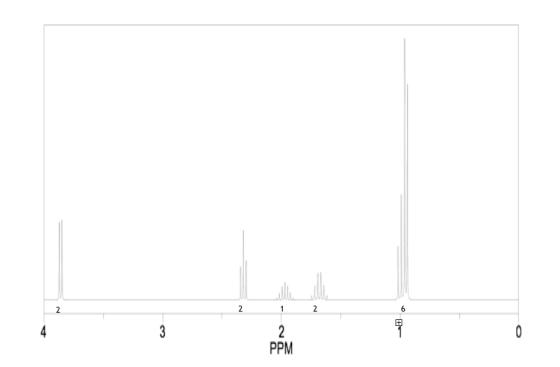
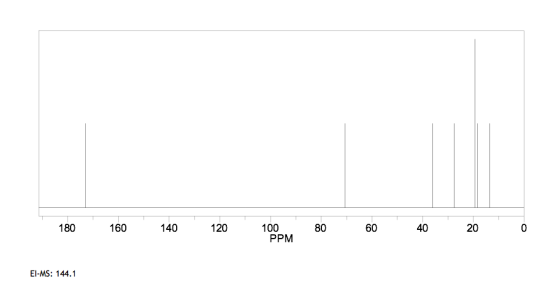
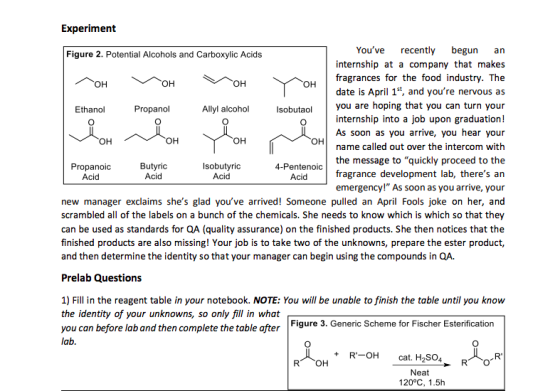
Unknown B is a carboxylic acid, and Unknown G is an alcohol. The product of the two unknowns produced the ¹H NMR, ¹³C NMR, and GC-MS data shown. Of the carboxylic acids and alcohols shown in Figure 2, what are the identities of Unknowns B and G? What is the identity of the product formed by the two unknowns? Please explain how you found the answer.
Thank you!
Homework Answers
Request Answer!
We need at least 10 more requests to produce the answer.
0 / 10 have requested this problem solution
The more requests, the faster the answer.
Add Answer to:
¹H NMR, ¹³C NMR, and GC-MS of Product between B +
G:
Unknown B is a...
I know my product is propyl Isobutyrate and my carboxylic acid is Isobutyric Acid and my...
 I know my product is propyl Isobutyrate and my
carboxylic acid is Isobutyric Acid and my alcohol
is Propanol. Can you please analyze the 1H and
13CNMR spectra to explain how that product is found? Label all
peaks please
an OH OH 0 OH Acid Acid Experiment Figure 2. Potential Alcohols and Carboxylic Acids You've recently begun internship at a company that makes OH fragrances for the food industry. The OH date is April 1", and you're nervous as Ethanol...
I know my product is propyl Isobutyrate and my
carboxylic acid is Isobutyric Acid and my alcohol
is Propanol. Can you please analyze the 1H and
13CNMR spectra to explain how that product is found? Label all
peaks please
an OH OH 0 OH Acid Acid Experiment Figure 2. Potential Alcohols and Carboxylic Acids You've recently begun internship at a company that makes OH fragrances for the food industry. The OH date is April 1", and you're nervous as Ethanol...
I did a lab that underwent Fischer esterification and had one of the possible alcohols and...
 I
did a lab that underwent Fischer esterification and had one of the
possible alcohols and carboxylic acids. please interperet the
spectra results and help identify the new product
Figure 2. Potential Alcohols and Carboxylic Acids 7 ОН Мон Мон ТОН Ethanol Propanol Allyl alcohol Isobutaol о ОН ОН ОН ОН Propanoic Acid Butyric Acid Isobutyric Acid 4-Pentenoic Acid PPM 180 160 140 120 100 PPM 80 60 40 20 0 El-MS: 130.1
I
did a lab that underwent Fischer esterification and had one of the
possible alcohols and carboxylic acids. please interperet the
spectra results and help identify the new product
Figure 2. Potential Alcohols and Carboxylic Acids 7 ОН Мон Мон ТОН Ethanol Propanol Allyl alcohol Isobutaol о ОН ОН ОН ОН Propanoic Acid Butyric Acid Isobutyric Acid 4-Pentenoic Acid PPM 180 160 140 120 100 PPM 80 60 40 20 0 El-MS: 130.1
I need help with this Unknown! Worksheet 4: Identification of Unknown Organic Compounds Reading: For a...
 I need help with this Unknown!
Worksheet 4: Identification of Unknown Organic Compounds Reading: For a quick video about the "Rule of 13" https://www.youtube.com/watch?v=2YNE7w_GQlo Introduction One of the most important tasks that chemists are faced with is the separation and identification of compounds from mixtures. Gratifyingly, chemists have multiple tools in the quest to identify unknown organic compounds. Infrared spectroscopy is useful for determining functional groups that may exist in a molecule. NMR spectroscopy tells information about the connectivity of...
I need help with this Unknown!
Worksheet 4: Identification of Unknown Organic Compounds Reading: For a quick video about the "Rule of 13" https://www.youtube.com/watch?v=2YNE7w_GQlo Introduction One of the most important tasks that chemists are faced with is the separation and identification of compounds from mixtures. Gratifyingly, chemists have multiple tools in the quest to identify unknown organic compounds. Infrared spectroscopy is useful for determining functional groups that may exist in a molecule. NMR spectroscopy tells information about the connectivity of...
After years of study, you have recently finished your graduate degree, and have just accepted a...
 After years of study, you have recently finished your graduate
degree, and have just accepted a position at a small liberal arts
college. You show up the first day and look into your new lab, and
see that there is one unlabeled container. The previous occupant
has retired at the beginning of the summer and is apparently
somewhere in the middle of the Atlantic Ocean now enjoying
retirement (and coincidentally cannot be reached). You’re unsure
whether or not the compound...
After years of study, you have recently finished your graduate
degree, and have just accepted a position at a small liberal arts
college. You show up the first day and look into your new lab, and
see that there is one unlabeled container. The previous occupant
has retired at the beginning of the summer and is apparently
somewhere in the middle of the Atlantic Ocean now enjoying
retirement (and coincidentally cannot be reached). You’re unsure
whether or not the compound...
I need help with this Unknown! Worksheet 4: Identification of Unknown Organic Compounds Reading: For a...
 I need help with this Unknown!
Worksheet 4: Identification of Unknown Organic Compounds Reading: For a quick video about the "Rule of 13" https://www.youtube.com/watch?v=2YNE7w_GQlo Introduction One of the most important tasks that chemists are faced with is the separation and identification of compounds from mixtures. Gratifyingly, chemists have multiple tools in the quest to identify unknown organic compounds. Infrared spectroscopy is useful for determining functional groups that may exist in a molecule. NMR spectroscopy tells information about the connectivity of...
I need help with this Unknown!
Worksheet 4: Identification of Unknown Organic Compounds Reading: For a quick video about the "Rule of 13" https://www.youtube.com/watch?v=2YNE7w_GQlo Introduction One of the most important tasks that chemists are faced with is the separation and identification of compounds from mixtures. Gratifyingly, chemists have multiple tools in the quest to identify unknown organic compounds. Infrared spectroscopy is useful for determining functional groups that may exist in a molecule. NMR spectroscopy tells information about the connectivity of...
IM HAVING DIFFICULTIES TO IDENTIFY NMR, can you please explain in details this answer and whats t...
 IM HAVING DIFFICULTIES TO IDENTIFY NMR, can you please explain
in details this answer and whats the easiest way to read it
The reaction is worked up and compared to the starting material by NMR Staring material (methyl (S 2-methy-4-cxobutanoate) Product зн 러 зн H 24 3H 2H 10 PPM 2 PPM Question #14: Does it appear that the correct product has formed? Examine your reasoning type your text here For example, if you had an alcohol and an aldehyde...
IM HAVING DIFFICULTIES TO IDENTIFY NMR, can you please explain
in details this answer and whats the easiest way to read it
The reaction is worked up and compared to the starting material by NMR Staring material (methyl (S 2-methy-4-cxobutanoate) Product зн 러 зн H 24 3H 2H 10 PPM 2 PPM Question #14: Does it appear that the correct product has formed? Examine your reasoning type your text here For example, if you had an alcohol and an aldehyde...
using the IR, the 13C, and DEPT NMR spectra of your product determine the identity of...
 using the IR, the 13C, and DEPT NMR spectra of your product
determine the identity of your unknown ester from a C-4 or C-5
alcohol. the identity of the C-4 or C-5 alcohol also needs to be
determined.
The following C-4 or C-5 alcohols will be used in this
experiment:
1-butanol (n-butyl alcohol)
2-butanol (sec-butyl alcohol)
2-methyl-1-propanol (isobutyl alcohol)
3-methyl-1-butanol (isopentyl alcohol)
1-pentanol (n-pentyl alcohol)
2-pentanol
3-pentanol
cyclopentanol
Questions:
1. Why is the mixture extracted with aqueous sodium
bicarbonate solution?...
using the IR, the 13C, and DEPT NMR spectra of your product
determine the identity of your unknown ester from a C-4 or C-5
alcohol. the identity of the C-4 or C-5 alcohol also needs to be
determined.
The following C-4 or C-5 alcohols will be used in this
experiment:
1-butanol (n-butyl alcohol)
2-butanol (sec-butyl alcohol)
2-methyl-1-propanol (isobutyl alcohol)
3-methyl-1-butanol (isopentyl alcohol)
1-pentanol (n-pentyl alcohol)
2-pentanol
3-pentanol
cyclopentanol
Questions:
1. Why is the mixture extracted with aqueous sodium
bicarbonate solution?...
งๆ 4 Identification of Unknown Organic Compounds Reading: For a quick video about the "Rule of...
 งๆ 4 Identification of Unknown Organic Compounds Reading: For a quick video about the "Rule of 13" https://www.youtube.com/watch?v=2YNE7w Golo Introduction One of the most important tasks that chemists are faced with is the separation and identification of compounds from mixtures. Gratifyingly, chemists have multiple tools in the quest to identify unknown organic compounds, Infrared spectroscopy is useful for determining functional groups that may exist in a molecule. NMR spectroscopy tells information about the connectivity of C-H bonds, as well as...
Please Help. Identifications of Unknown Compound. I need help figuring this out. Please be detailed on...
 Please Help. Identifications of Unknown Compound. I need help
figuring this out. Please be detailed on why you think its
correct
Introduction One of the most important tasks that chemists are faced with is the separation and identification of compounds from mixtures. Gratifyingly, chemists have multiple tools in the quest to identify unknown organic compounds. Infrared spectroscopy is useful for determining functional groups that may exist in a molecule. NMR spectroscopy tells information about the connectivity of C-H bonds, as...
Please Help. Identifications of Unknown Compound. I need help
figuring this out. Please be detailed on why you think its
correct
Introduction One of the most important tasks that chemists are faced with is the separation and identification of compounds from mixtures. Gratifyingly, chemists have multiple tools in the quest to identify unknown organic compounds. Infrared spectroscopy is useful for determining functional groups that may exist in a molecule. NMR spectroscopy tells information about the connectivity of C-H bonds, as...
(a) From the spectral data ( H, C NMR, IR, MS) you were given, identify the...
 (a) From the spectral data ( H, C NMR, IR, MS) you were given,
identify the structure of your product. Explain why you chose your
particular product based on the spectroscopic data.
(b) Fully assign the 1H NMR spectrum of your product (i.e.
determine which peaks in the 1H NMR correspond to which hydrogens
in the product). You will not receive full marks for determination
of the unknown unless you assign the 1H NMR spectrum
completely.
(c) Now work backwards...
(a) From the spectral data ( H, C NMR, IR, MS) you were given,
identify the structure of your product. Explain why you chose your
particular product based on the spectroscopic data.
(b) Fully assign the 1H NMR spectrum of your product (i.e.
determine which peaks in the 1H NMR correspond to which hydrogens
in the product). You will not receive full marks for determination
of the unknown unless you assign the 1H NMR spectrum
completely.
(c) Now work backwards...
 I know my product is propyl Isobutyrate and my
carboxylic acid is Isobutyric Acid and my alcohol
is Propanol. Can you please analyze the 1H and
13CNMR spectra to explain how that product is found? Label all
peaks please
an OH OH 0 OH Acid Acid Experiment Figure 2. Potential Alcohols and Carboxylic Acids You've recently begun internship at a company that makes OH fragrances for the food industry. The OH date is April 1", and you're nervous as Ethanol...
I know my product is propyl Isobutyrate and my
carboxylic acid is Isobutyric Acid and my alcohol
is Propanol. Can you please analyze the 1H and
13CNMR spectra to explain how that product is found? Label all
peaks please
an OH OH 0 OH Acid Acid Experiment Figure 2. Potential Alcohols and Carboxylic Acids You've recently begun internship at a company that makes OH fragrances for the food industry. The OH date is April 1", and you're nervous as Ethanol...
 I
did a lab that underwent Fischer esterification and had one of the
possible alcohols and carboxylic acids. please interperet the
spectra results and help identify the new product
Figure 2. Potential Alcohols and Carboxylic Acids 7 ОН Мон Мон ТОН Ethanol Propanol Allyl alcohol Isobutaol о ОН ОН ОН ОН Propanoic Acid Butyric Acid Isobutyric Acid 4-Pentenoic Acid PPM 180 160 140 120 100 PPM 80 60 40 20 0 El-MS: 130.1
I
did a lab that underwent Fischer esterification and had one of the
possible alcohols and carboxylic acids. please interperet the
spectra results and help identify the new product
Figure 2. Potential Alcohols and Carboxylic Acids 7 ОН Мон Мон ТОН Ethanol Propanol Allyl alcohol Isobutaol о ОН ОН ОН ОН Propanoic Acid Butyric Acid Isobutyric Acid 4-Pentenoic Acid PPM 180 160 140 120 100 PPM 80 60 40 20 0 El-MS: 130.1
 I need help with this Unknown!
Worksheet 4: Identification of Unknown Organic Compounds Reading: For a quick video about the "Rule of 13" https://www.youtube.com/watch?v=2YNE7w_GQlo Introduction One of the most important tasks that chemists are faced with is the separation and identification of compounds from mixtures. Gratifyingly, chemists have multiple tools in the quest to identify unknown organic compounds. Infrared spectroscopy is useful for determining functional groups that may exist in a molecule. NMR spectroscopy tells information about the connectivity of...
I need help with this Unknown!
Worksheet 4: Identification of Unknown Organic Compounds Reading: For a quick video about the "Rule of 13" https://www.youtube.com/watch?v=2YNE7w_GQlo Introduction One of the most important tasks that chemists are faced with is the separation and identification of compounds from mixtures. Gratifyingly, chemists have multiple tools in the quest to identify unknown organic compounds. Infrared spectroscopy is useful for determining functional groups that may exist in a molecule. NMR spectroscopy tells information about the connectivity of...
 After years of study, you have recently finished your graduate
degree, and have just accepted a position at a small liberal arts
college. You show up the first day and look into your new lab, and
see that there is one unlabeled container. The previous occupant
has retired at the beginning of the summer and is apparently
somewhere in the middle of the Atlantic Ocean now enjoying
retirement (and coincidentally cannot be reached). You’re unsure
whether or not the compound...
After years of study, you have recently finished your graduate
degree, and have just accepted a position at a small liberal arts
college. You show up the first day and look into your new lab, and
see that there is one unlabeled container. The previous occupant
has retired at the beginning of the summer and is apparently
somewhere in the middle of the Atlantic Ocean now enjoying
retirement (and coincidentally cannot be reached). You’re unsure
whether or not the compound...
 I need help with this Unknown!
Worksheet 4: Identification of Unknown Organic Compounds Reading: For a quick video about the "Rule of 13" https://www.youtube.com/watch?v=2YNE7w_GQlo Introduction One of the most important tasks that chemists are faced with is the separation and identification of compounds from mixtures. Gratifyingly, chemists have multiple tools in the quest to identify unknown organic compounds. Infrared spectroscopy is useful for determining functional groups that may exist in a molecule. NMR spectroscopy tells information about the connectivity of...
I need help with this Unknown!
Worksheet 4: Identification of Unknown Organic Compounds Reading: For a quick video about the "Rule of 13" https://www.youtube.com/watch?v=2YNE7w_GQlo Introduction One of the most important tasks that chemists are faced with is the separation and identification of compounds from mixtures. Gratifyingly, chemists have multiple tools in the quest to identify unknown organic compounds. Infrared spectroscopy is useful for determining functional groups that may exist in a molecule. NMR spectroscopy tells information about the connectivity of...
 IM HAVING DIFFICULTIES TO IDENTIFY NMR, can you please explain
in details this answer and whats the easiest way to read it
The reaction is worked up and compared to the starting material by NMR Staring material (methyl (S 2-methy-4-cxobutanoate) Product зн 러 зн H 24 3H 2H 10 PPM 2 PPM Question #14: Does it appear that the correct product has formed? Examine your reasoning type your text here For example, if you had an alcohol and an aldehyde...
IM HAVING DIFFICULTIES TO IDENTIFY NMR, can you please explain
in details this answer and whats the easiest way to read it
The reaction is worked up and compared to the starting material by NMR Staring material (methyl (S 2-methy-4-cxobutanoate) Product зн 러 зн H 24 3H 2H 10 PPM 2 PPM Question #14: Does it appear that the correct product has formed? Examine your reasoning type your text here For example, if you had an alcohol and an aldehyde...
 using the IR, the 13C, and DEPT NMR spectra of your product
determine the identity of your unknown ester from a C-4 or C-5
alcohol. the identity of the C-4 or C-5 alcohol also needs to be
determined.
The following C-4 or C-5 alcohols will be used in this
experiment:
1-butanol (n-butyl alcohol)
2-butanol (sec-butyl alcohol)
2-methyl-1-propanol (isobutyl alcohol)
3-methyl-1-butanol (isopentyl alcohol)
1-pentanol (n-pentyl alcohol)
2-pentanol
3-pentanol
cyclopentanol
Questions:
1. Why is the mixture extracted with aqueous sodium
bicarbonate solution?...
using the IR, the 13C, and DEPT NMR spectra of your product
determine the identity of your unknown ester from a C-4 or C-5
alcohol. the identity of the C-4 or C-5 alcohol also needs to be
determined.
The following C-4 or C-5 alcohols will be used in this
experiment:
1-butanol (n-butyl alcohol)
2-butanol (sec-butyl alcohol)
2-methyl-1-propanol (isobutyl alcohol)
3-methyl-1-butanol (isopentyl alcohol)
1-pentanol (n-pentyl alcohol)
2-pentanol
3-pentanol
cyclopentanol
Questions:
1. Why is the mixture extracted with aqueous sodium
bicarbonate solution?...
 งๆ 4 Identification of Unknown Organic Compounds Reading: For a quick video about the "Rule of 13" https://www.youtube.com/watch?v=2YNE7w Golo Introduction One of the most important tasks that chemists are faced with is the separation and identification of compounds from mixtures. Gratifyingly, chemists have multiple tools in the quest to identify unknown organic compounds, Infrared spectroscopy is useful for determining functional groups that may exist in a molecule. NMR spectroscopy tells information about the connectivity of C-H bonds, as well as...
 Please Help. Identifications of Unknown Compound. I need help
figuring this out. Please be detailed on why you think its
correct
Introduction One of the most important tasks that chemists are faced with is the separation and identification of compounds from mixtures. Gratifyingly, chemists have multiple tools in the quest to identify unknown organic compounds. Infrared spectroscopy is useful for determining functional groups that may exist in a molecule. NMR spectroscopy tells information about the connectivity of C-H bonds, as...
Please Help. Identifications of Unknown Compound. I need help
figuring this out. Please be detailed on why you think its
correct
Introduction One of the most important tasks that chemists are faced with is the separation and identification of compounds from mixtures. Gratifyingly, chemists have multiple tools in the quest to identify unknown organic compounds. Infrared spectroscopy is useful for determining functional groups that may exist in a molecule. NMR spectroscopy tells information about the connectivity of C-H bonds, as...
 (a) From the spectral data ( H, C NMR, IR, MS) you were given,
identify the structure of your product. Explain why you chose your
particular product based on the spectroscopic data.
(b) Fully assign the 1H NMR spectrum of your product (i.e.
determine which peaks in the 1H NMR correspond to which hydrogens
in the product). You will not receive full marks for determination
of the unknown unless you assign the 1H NMR spectrum
completely.
(c) Now work backwards...
(a) From the spectral data ( H, C NMR, IR, MS) you were given,
identify the structure of your product. Explain why you chose your
particular product based on the spectroscopic data.
(b) Fully assign the 1H NMR spectrum of your product (i.e.
determine which peaks in the 1H NMR correspond to which hydrogens
in the product). You will not receive full marks for determination
of the unknown unless you assign the 1H NMR spectrum
completely.
(c) Now work backwards...
Most questions answered within 3 hours.
-
Where is the error in this code sequence?
String s1 = "Hello";
String s2 = "ello";...
asked 11 months ago -
Financial data for Joel de Paris, Inc., for last year
follow:
Joel de Paris, Inc.
Balance...
asked 11 months ago -
Consider this reaction:
Al2(SO4)3 (aq)+ BaCl3
(aq) Al2Cl6 (aq)- +
3BaSO4(s) . What is the...
asked 11 months ago -
Suppose that Savneet is considering increasing her
recent random sample from 20 car rentals to 40...
asked 11 months ago -
Trucks arrive at an unloading terminal at an average rate of 120
per hour.
Trucks arrive...
asked 11 months ago -
Why are methanol and ethanol completely soluble in water while
octanol is not very little soluble....
asked 11 months ago -
A facilities manager at a university reads in a research report
that the mean amount of...
asked 11 months ago -
When the CuSO4 is rehydrated by adding water to the anhydrous
compound, is this an endothermic...
asked 11 months ago -
A ray of sunlight is passing from diamond into crown glass; the
angle of incidence is...
asked 11 months ago -
A block of mass 0.249 kg is placed on top of a light, vertical
spring of...
asked 11 months ago -
how do the kidneys compensate in the presences of acidosis
a) trigger hyperventilate
b) reserve acid...
asked 11 months ago -
Question 501 pts
The rental rate of capital to the firm increases. Which of the
following...
asked 11 months ago