


Homework Answers
Hi there, the unknown identified as n-butylacetate
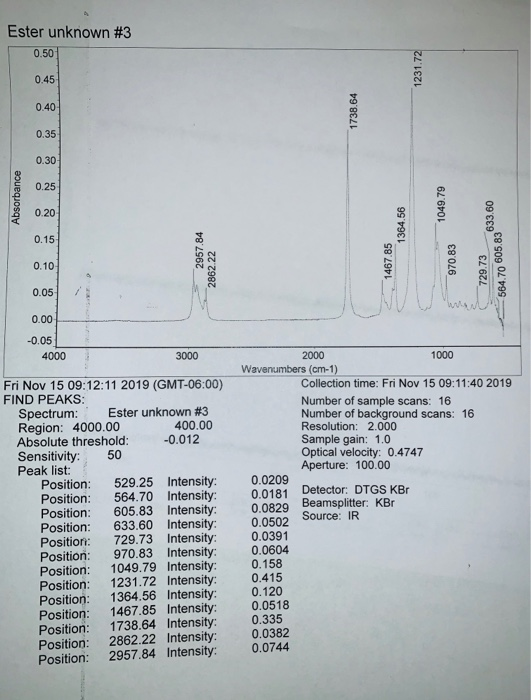
IR:
2957 & 2862 cm-1, strong, sp3 C-H stretch
1738 cm-1, strong, ester C=O stretch
1364 & 1467 cm-1, sp3 C-H bending
1231 cm-1, strong, ester C-O stretch
below 1000 cm-1 out of plane vibrations
DEPT-135:
3 -CH2- groups present as we can clearly seen 3 negative (downward) peaks.
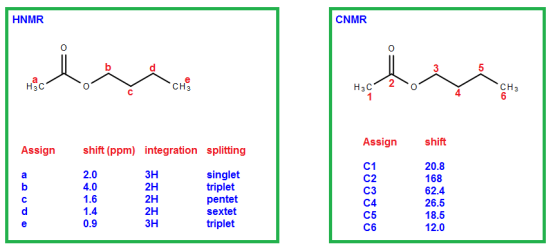
HNMR & CNMR:
Hope this helped you!
Thank You So Much! Please Rate this answer as you wish.("Thumbs Up")
Add Answer to:
using the IR, the 13C, and DEPT NMR spectra of your product
determine the identity of...
report 13 C NMR, DEPT, observed bp. Evidence should be given that shows the reaction yeilded...
 report 13 C NMR, DEPT, observed bp. Evidence should be given
that shows the reaction yeilded an ester product. Specific
evidenceshould be given to support the identification of the
product ester and starting alcohol.
find the starting alcohol and state product ester
Compare the IR spectrum to the IR spectrum of the starting
material. Assign all the major peaks above the fingerprint region
in your IR spectra. Assign the signals in the carbon and Dept NMR
spectra.
what evidence do...
report 13 C NMR, DEPT, observed bp. Evidence should be given
that shows the reaction yeilded an ester product. Specific
evidenceshould be given to support the identification of the
product ester and starting alcohol.
find the starting alcohol and state product ester
Compare the IR spectrum to the IR spectrum of the starting
material. Assign all the major peaks above the fingerprint region
in your IR spectra. Assign the signals in the carbon and Dept NMR
spectra.
what evidence do...
What alcohol IR spectrum is that when reacted with acetic acid UNKNOWN D PPM 112 1-butanol...
 What alcohol IR spectrum is that when reacted with acetic
acid
UNKNOWN D PPM 112 1-butanol (n-butyl alcohol) 2-butanol (sec-butyl alcohol) 2-methyl-1-propanol (isobutyl alcohol) 3-methyl-1-butanol (isopentyl alcohol) 1-pentanol (n-pentyl alcohol) 2-pentanol 3-pentanol cyclopentanol
What alcohol IR spectrum is that when reacted with acetic
acid
UNKNOWN D PPM 112 1-butanol (n-butyl alcohol) 2-butanol (sec-butyl alcohol) 2-methyl-1-propanol (isobutyl alcohol) 3-methyl-1-butanol (isopentyl alcohol) 1-pentanol (n-pentyl alcohol) 2-pentanol 3-pentanol cyclopentanol
Finding the structure of the ester from the following ir peaks. This experiment was performed by...
 Finding the structure of the ester from the following
ir peaks.
This experiment was performed by taking an unknown
alcohol;
1-butanol
2-butanol
3-methyl-1-propanol
cyclopentanol
1-pentanol
2-pentanol
3-pentanol
3-methyl-1-butanol
and acetic acid. to prepare the ester.
Finding the structure of the ester from the following
ir peaks.
This experiment was performed by taking an unknown
alcohol;
1-butanol
2-butanol
3-methyl-1-propanol
cyclopentanol
1-pentanol
2-pentanol
3-pentanol
3-methyl-1-butanol
and acetic acid. to prepare the ester.
What information can we gather from these three spectra (IR, H NMR, 13C NMR) to correctly...
 What information can we gather from these three spectra (IR, H
NMR, 13C NMR) to correctly identify the unknown compound? What is
the identity of my unknown? Please explain how we get there and
from what information we do so. I understand that I must initially
use the rule of 13.
IR Spectrum:
H NMR Spectrum:
13C NMR spectra:
OOT 08 TRANSMITTANCE [%] 09 0+ 4000 3500 3000 2500 2000 WAVENUMBER [cm-1] 15:00 10:00 500 1H NMR 2 3 12.10ģ...
What information can we gather from these three spectra (IR, H
NMR, 13C NMR) to correctly identify the unknown compound? What is
the identity of my unknown? Please explain how we get there and
from what information we do so. I understand that I must initially
use the rule of 13.
IR Spectrum:
H NMR Spectrum:
13C NMR spectra:
OOT 08 TRANSMITTANCE [%] 09 0+ 4000 3500 3000 2500 2000 WAVENUMBER [cm-1] 15:00 10:00 500 1H NMR 2 3 12.10ģ...
I need help determining the product using this NMR and IR spectras. The reaction is happening...
 I need help determining the product using this NMR and IR
spectras. The reaction is happening with glacial acetic acid and an
unknown alcohol.
ppm (t1) 007 - 4.0 - 4.09 4.06 4.03= 3.0 - 00e { 2.049 1.682 1.648 - 1,613 1.576 ετζ لالا مه 15 - είί 1.0 1.473 1.436 1.399 1360 1.325 1.291 0.972 - 0.935 0.899 0.0 TRANSHETTANCE D + 4000 2000 2000 1500 1000 500 HAVENUHBERI-
I need help determining the product using this NMR and IR
spectras. The reaction is happening with glacial acetic acid and an
unknown alcohol.
ppm (t1) 007 - 4.0 - 4.09 4.06 4.03= 3.0 - 00e { 2.049 1.682 1.648 - 1,613 1.576 ετζ لالا مه 15 - είί 1.0 1.473 1.436 1.399 1360 1.325 1.291 0.972 - 0.935 0.899 0.0 TRANSHETTANCE D + 4000 2000 2000 1500 1000 500 HAVENUHBERI-
determine the structure of your unknown from the molecular formula, IR, and 13C NMR spectra. assign all of your 13C NMR...
 determine the structure of your unknown from the molecular
formula, IR, and 13C NMR spectra. assign all of your 13C NMR
absorptions.
IR & 1C NMR Lab Unknown Your group's mission is to determine the structure of your unknown from the molecular forrmula, IR and 13C NMR spectra. Assign all of your C NMR absorptions. You want to know which resonances correspond to which parts of the product's structure. The best way to do this is to draw a picture...
determine the structure of your unknown from the molecular
formula, IR, and 13C NMR spectra. assign all of your 13C NMR
absorptions.
IR & 1C NMR Lab Unknown Your group's mission is to determine the structure of your unknown from the molecular forrmula, IR and 13C NMR spectra. Assign all of your C NMR absorptions. You want to know which resonances correspond to which parts of the product's structure. The best way to do this is to draw a picture...
Explain why the IR corresponds to a particular compound of those that are possible based on BP and why it couldn't be...
 Explain why the
IR corresponds to a particular compound of those that are possible
based on BP and why it couldn't be any of the others -mention at
least 3 IR peaks that are present that correspond to functional
groups in your molecule, and discuss specific peaks that were
either present or absent that allowed you to rule out the other
compounds possible based on the boiling point. Reference your IR
spectra as figures.
the boiling
point for unkown 2:...
Explain why the
IR corresponds to a particular compound of those that are possible
based on BP and why it couldn't be any of the others -mention at
least 3 IR peaks that are present that correspond to functional
groups in your molecule, and discuss specific peaks that were
either present or absent that allowed you to rule out the other
compounds possible based on the boiling point. Reference your IR
spectra as figures.
the boiling
point for unkown 2:...
Given this IR Spectra of an unknown compound, how do I determine the structure of what I have? I think I have some sort of ketone? Possibly a methyl ketone. Attached is also the H-NMR. Please help de...
 Given this IR Spectra of an unknown compound, how do I
determine the structure of what I have?
I think I have some sort of ketone? Possibly a methyl
ketone.
Attached is also the H-NMR. Please help determine structure of
unknown.
the
only other information i have is that it has a low molecular weight
and is neutral
120-pennifers Gr own#1 110 100 80 70 60 50 40 30 20 4000 3500 3000 2500 2000 1500 1000 Wavenumbers (cm-1) ue...
Given this IR Spectra of an unknown compound, how do I
determine the structure of what I have?
I think I have some sort of ketone? Possibly a methyl
ketone.
Attached is also the H-NMR. Please help determine structure of
unknown.
the
only other information i have is that it has a low molecular weight
and is neutral
120-pennifers Gr own#1 110 100 80 70 60 50 40 30 20 4000 3500 3000 2500 2000 1500 1000 Wavenumbers (cm-1) ue...
¹H NMR, ¹³C NMR, and GC-MS of Product between B + G: Unknown B is a...
 ¹H NMR, ¹³C NMR, and GC-MS of Product between B +
G:
Unknown B is a carboxylic acid, and Unknown G is an alcohol. The
product of the two unknowns produced the ¹H NMR, ¹³C NMR, and GC-MS
data shown. Of the carboxylic acids and alcohols shown in Figure 2,
what are the identities of Unknowns B and G? What is the identity
of the product formed by the two unknowns? Please explain how you
found the answer.
Thank you!...
¹H NMR, ¹³C NMR, and GC-MS of Product between B +
G:
Unknown B is a carboxylic acid, and Unknown G is an alcohol. The
product of the two unknowns produced the ¹H NMR, ¹³C NMR, and GC-MS
data shown. Of the carboxylic acids and alcohols shown in Figure 2,
what are the identities of Unknowns B and G? What is the identity
of the product formed by the two unknowns? Please explain how you
found the answer.
Thank you!...
Given the NMR and IR graphs, which unknown compound fits your graph, and fill out the...
 Given the NMR and IR graphs, which unknown compound fits your
graph, and fill out the tables about your unknown.
STANDARD 1N OBSERVE Archive directory! Sample directory: F1101 PROTON A 14 Pulse Sequence! s2pul Solvent: CDC13 Ambient temperature Mercury-300BB Hvarian300 Relax delay 1.000 sec Puis 45.0 degrees Acg. time 1.996 sec Width 4803.1 MZ & repetitions OBSERVE NL, 233.9587289 MHZ DATA PROCESSING FT size 32768 Total tine min. 25 sec 2.8 0 ppm 0.94 1604 1081 1364 3063 534 1384...
Given the NMR and IR graphs, which unknown compound fits your
graph, and fill out the tables about your unknown.
STANDARD 1N OBSERVE Archive directory! Sample directory: F1101 PROTON A 14 Pulse Sequence! s2pul Solvent: CDC13 Ambient temperature Mercury-300BB Hvarian300 Relax delay 1.000 sec Puis 45.0 degrees Acg. time 1.996 sec Width 4803.1 MZ & repetitions OBSERVE NL, 233.9587289 MHZ DATA PROCESSING FT size 32768 Total tine min. 25 sec 2.8 0 ppm 0.94 1604 1081 1364 3063 534 1384...
 report 13 C NMR, DEPT, observed bp. Evidence should be given
that shows the reaction yeilded an ester product. Specific
evidenceshould be given to support the identification of the
product ester and starting alcohol.
find the starting alcohol and state product ester
Compare the IR spectrum to the IR spectrum of the starting
material. Assign all the major peaks above the fingerprint region
in your IR spectra. Assign the signals in the carbon and Dept NMR
spectra.
what evidence do...
report 13 C NMR, DEPT, observed bp. Evidence should be given
that shows the reaction yeilded an ester product. Specific
evidenceshould be given to support the identification of the
product ester and starting alcohol.
find the starting alcohol and state product ester
Compare the IR spectrum to the IR spectrum of the starting
material. Assign all the major peaks above the fingerprint region
in your IR spectra. Assign the signals in the carbon and Dept NMR
spectra.
what evidence do...
 What alcohol IR spectrum is that when reacted with acetic
acid
UNKNOWN D PPM 112 1-butanol (n-butyl alcohol) 2-butanol (sec-butyl alcohol) 2-methyl-1-propanol (isobutyl alcohol) 3-methyl-1-butanol (isopentyl alcohol) 1-pentanol (n-pentyl alcohol) 2-pentanol 3-pentanol cyclopentanol
What alcohol IR spectrum is that when reacted with acetic
acid
UNKNOWN D PPM 112 1-butanol (n-butyl alcohol) 2-butanol (sec-butyl alcohol) 2-methyl-1-propanol (isobutyl alcohol) 3-methyl-1-butanol (isopentyl alcohol) 1-pentanol (n-pentyl alcohol) 2-pentanol 3-pentanol cyclopentanol
 Finding the structure of the ester from the following
ir peaks.
This experiment was performed by taking an unknown
alcohol;
1-butanol
2-butanol
3-methyl-1-propanol
cyclopentanol
1-pentanol
2-pentanol
3-pentanol
3-methyl-1-butanol
and acetic acid. to prepare the ester.
Finding the structure of the ester from the following
ir peaks.
This experiment was performed by taking an unknown
alcohol;
1-butanol
2-butanol
3-methyl-1-propanol
cyclopentanol
1-pentanol
2-pentanol
3-pentanol
3-methyl-1-butanol
and acetic acid. to prepare the ester.
 What information can we gather from these three spectra (IR, H
NMR, 13C NMR) to correctly identify the unknown compound? What is
the identity of my unknown? Please explain how we get there and
from what information we do so. I understand that I must initially
use the rule of 13.
IR Spectrum:
H NMR Spectrum:
13C NMR spectra:
OOT 08 TRANSMITTANCE [%] 09 0+ 4000 3500 3000 2500 2000 WAVENUMBER [cm-1] 15:00 10:00 500 1H NMR 2 3 12.10ģ...
What information can we gather from these three spectra (IR, H
NMR, 13C NMR) to correctly identify the unknown compound? What is
the identity of my unknown? Please explain how we get there and
from what information we do so. I understand that I must initially
use the rule of 13.
IR Spectrum:
H NMR Spectrum:
13C NMR spectra:
OOT 08 TRANSMITTANCE [%] 09 0+ 4000 3500 3000 2500 2000 WAVENUMBER [cm-1] 15:00 10:00 500 1H NMR 2 3 12.10ģ...
 I need help determining the product using this NMR and IR
spectras. The reaction is happening with glacial acetic acid and an
unknown alcohol.
ppm (t1) 007 - 4.0 - 4.09 4.06 4.03= 3.0 - 00e { 2.049 1.682 1.648 - 1,613 1.576 ετζ لالا مه 15 - είί 1.0 1.473 1.436 1.399 1360 1.325 1.291 0.972 - 0.935 0.899 0.0 TRANSHETTANCE D + 4000 2000 2000 1500 1000 500 HAVENUHBERI-
I need help determining the product using this NMR and IR
spectras. The reaction is happening with glacial acetic acid and an
unknown alcohol.
ppm (t1) 007 - 4.0 - 4.09 4.06 4.03= 3.0 - 00e { 2.049 1.682 1.648 - 1,613 1.576 ετζ لالا مه 15 - είί 1.0 1.473 1.436 1.399 1360 1.325 1.291 0.972 - 0.935 0.899 0.0 TRANSHETTANCE D + 4000 2000 2000 1500 1000 500 HAVENUHBERI-
 determine the structure of your unknown from the molecular
formula, IR, and 13C NMR spectra. assign all of your 13C NMR
absorptions.
IR & 1C NMR Lab Unknown Your group's mission is to determine the structure of your unknown from the molecular forrmula, IR and 13C NMR spectra. Assign all of your C NMR absorptions. You want to know which resonances correspond to which parts of the product's structure. The best way to do this is to draw a picture...
determine the structure of your unknown from the molecular
formula, IR, and 13C NMR spectra. assign all of your 13C NMR
absorptions.
IR & 1C NMR Lab Unknown Your group's mission is to determine the structure of your unknown from the molecular forrmula, IR and 13C NMR spectra. Assign all of your C NMR absorptions. You want to know which resonances correspond to which parts of the product's structure. The best way to do this is to draw a picture...
 Explain why the
IR corresponds to a particular compound of those that are possible
based on BP and why it couldn't be any of the others -mention at
least 3 IR peaks that are present that correspond to functional
groups in your molecule, and discuss specific peaks that were
either present or absent that allowed you to rule out the other
compounds possible based on the boiling point. Reference your IR
spectra as figures.
the boiling
point for unkown 2:...
Explain why the
IR corresponds to a particular compound of those that are possible
based on BP and why it couldn't be any of the others -mention at
least 3 IR peaks that are present that correspond to functional
groups in your molecule, and discuss specific peaks that were
either present or absent that allowed you to rule out the other
compounds possible based on the boiling point. Reference your IR
spectra as figures.
the boiling
point for unkown 2:...
 Given this IR Spectra of an unknown compound, how do I
determine the structure of what I have?
I think I have some sort of ketone? Possibly a methyl
ketone.
Attached is also the H-NMR. Please help determine structure of
unknown.
the
only other information i have is that it has a low molecular weight
and is neutral
120-pennifers Gr own#1 110 100 80 70 60 50 40 30 20 4000 3500 3000 2500 2000 1500 1000 Wavenumbers (cm-1) ue...
Given this IR Spectra of an unknown compound, how do I
determine the structure of what I have?
I think I have some sort of ketone? Possibly a methyl
ketone.
Attached is also the H-NMR. Please help determine structure of
unknown.
the
only other information i have is that it has a low molecular weight
and is neutral
120-pennifers Gr own#1 110 100 80 70 60 50 40 30 20 4000 3500 3000 2500 2000 1500 1000 Wavenumbers (cm-1) ue...
 ¹H NMR, ¹³C NMR, and GC-MS of Product between B +
G:
Unknown B is a carboxylic acid, and Unknown G is an alcohol. The
product of the two unknowns produced the ¹H NMR, ¹³C NMR, and GC-MS
data shown. Of the carboxylic acids and alcohols shown in Figure 2,
what are the identities of Unknowns B and G? What is the identity
of the product formed by the two unknowns? Please explain how you
found the answer.
Thank you!...
¹H NMR, ¹³C NMR, and GC-MS of Product between B +
G:
Unknown B is a carboxylic acid, and Unknown G is an alcohol. The
product of the two unknowns produced the ¹H NMR, ¹³C NMR, and GC-MS
data shown. Of the carboxylic acids and alcohols shown in Figure 2,
what are the identities of Unknowns B and G? What is the identity
of the product formed by the two unknowns? Please explain how you
found the answer.
Thank you!...
 Given the NMR and IR graphs, which unknown compound fits your
graph, and fill out the tables about your unknown.
STANDARD 1N OBSERVE Archive directory! Sample directory: F1101 PROTON A 14 Pulse Sequence! s2pul Solvent: CDC13 Ambient temperature Mercury-300BB Hvarian300 Relax delay 1.000 sec Puis 45.0 degrees Acg. time 1.996 sec Width 4803.1 MZ & repetitions OBSERVE NL, 233.9587289 MHZ DATA PROCESSING FT size 32768 Total tine min. 25 sec 2.8 0 ppm 0.94 1604 1081 1364 3063 534 1384...
Given the NMR and IR graphs, which unknown compound fits your
graph, and fill out the tables about your unknown.
STANDARD 1N OBSERVE Archive directory! Sample directory: F1101 PROTON A 14 Pulse Sequence! s2pul Solvent: CDC13 Ambient temperature Mercury-300BB Hvarian300 Relax delay 1.000 sec Puis 45.0 degrees Acg. time 1.996 sec Width 4803.1 MZ & repetitions OBSERVE NL, 233.9587289 MHZ DATA PROCESSING FT size 32768 Total tine min. 25 sec 2.8 0 ppm 0.94 1604 1081 1364 3063 534 1384...
Most questions answered within 3 hours.
-
Where is the error in this code sequence?
String s1 = "Hello";
String s2 = "ello";...
asked 11 months ago -
Financial data for Joel de Paris, Inc., for last year
follow:
Joel de Paris, Inc.
Balance...
asked 11 months ago -
Consider this reaction:
Al2(SO4)3 (aq)+ BaCl3
(aq) Al2Cl6 (aq)- +
3BaSO4(s) . What is the...
asked 11 months ago -
Suppose that Savneet is considering increasing her
recent random sample from 20 car rentals to 40...
asked 11 months ago -
Trucks arrive at an unloading terminal at an average rate of 120
per hour.
Trucks arrive...
asked 11 months ago -
Why are methanol and ethanol completely soluble in water while
octanol is not very little soluble....
asked 11 months ago -
A facilities manager at a university reads in a research report
that the mean amount of...
asked 11 months ago -
When the CuSO4 is rehydrated by adding water to the anhydrous
compound, is this an endothermic...
asked 11 months ago -
A ray of sunlight is passing from diamond into crown glass; the
angle of incidence is...
asked 11 months ago -
A block of mass 0.249 kg is placed on top of a light, vertical
spring of...
asked 11 months ago -
how do the kidneys compensate in the presences of acidosis
a) trigger hyperventilate
b) reserve acid...
asked 11 months ago -
Question 501 pts
The rental rate of capital to the firm increases. Which of the
following...
asked 11 months ago