
Homework Answers
Dear Student answer of your question is given below:
Solution of Q 40: D is the correct answer.
Heterochromatin is a major contributor to varation in gene density in eukaryotes. It is darkly stained, densely packed and scattered throughout the nucleus. It has two types i.e constitutive and facultative. Facultative heterochromatin contains repetitive sequence called as satellite DNA.
Transposons are genetic elements or jumping genes that contribute to cell size and are used in biotechnology to introduce foreign dna into genome. It also creates mutations in the dna.
Restriction sites are recognition sites on a dna molecules containing specific base pairs in length. Restriction enzymes bind to it.
Add Answer to:
40) Which of the following is a major contributor to variation in gene density in eukaryotes?...
Q1)Which of the following is not involved in control of gene expression in eukaryotes? A. Change...
Q1)Which of the following is not involved in control of gene expression in eukaryotes? A. Change to DNA sequence. B. Alternative splicing. C. Export of mRNA from the nucleus. D. Transcriptional repression. E. Destruction of mRNA Q2) Trans-acting regulators of gene expression include? A. promoters. B. histone deacetylases C. introns D. silencers E. the TATA box. Q3) Gene regulation in eukaryotes often involves which of the following, which are not also used by prokaryotes? A.RNA polymerase B.Transcription factors C.Histone modification...
Which of the following is a major difference between prokaryotes and eukaryotes? a. Eukaryotes have linear...
Which of the following is a major difference between prokaryotes and eukaryotes? a. Eukaryotes have linear chromosomal DNA, prokaryotes do not b. Eukaryotes live in extreme environments, prokaryotes do not c. Prokaryotes live in extreme environments, eukaryotes do not d. Only prokaryotes have histones, eukaryotes do no
QUESTION 52 Which of the following has/have repetitive DNA sequences in heterochromatin state? (Select all that...
QUESTION 52 Which of the following has/have repetitive DNA sequences in heterochromatin state? (Select all that apply.) A. mitochondria B. telomere C. centromere D. chloroplast
Which of the following is not true regarding regulation of gene expression in eukaryotes? In eukaryotic...
Which of the following is not true regarding regulation of gene expression in eukaryotes? In eukaryotic cells, transcriptional activators often work by recruiting the transcriptional macinery to gene promoters DNA methylation is an example of an epigenetic mark that can be inherited Acetylation of histones can result in a more open chromatin structure to allow transcription to occur Different genes can be turned off or on between different organs or stages of development Transcription factor DNA sequences are bound by...
Which of the following is different between prokaryotes and eukaryotes? a Prokaryotes are polycistronic and eukaryotes...
Which of the following is different between prokaryotes and eukaryotes? a Prokaryotes are polycistronic and eukaryotes are monocistronic b Prokaryotes have more complex controls over gene expression than eukaryotes c mRNA only exists in eukaryotes. d DNA does exist in prokaryotes. 2. Do humans contain an 80s ribosome? True or False?
Which one of the following conditions described below woudl result in a gene being expressed? A....
Which one of the following conditions described below woudl result in a gene being expressed? A. The gene is located in euchromatin and the promoter is methylated. B. The gene is located in euchromatin and the promoter is not methylated. C. The gene is located in heterochromatin and the promoter is methylated. D. The gene is located in heterochromatin and the promoter is not methylated.
Which of the following is NOT a mechanism for gene regulation? a. Phase variation in DNA....
Which of the following is NOT a mechanism for gene regulation? a. Phase variation in DNA. b. Repressor binding to a promoter. c. Binding of a sRNA to a ribosome-binding site. d. None of the above.
Transcriptional control of gene regulation is common in both prokaryotes and eukaryotes. Which of the following is not true? Both prokaryotes and eukaryotes: A. exhibit both positive and negative cont...
Transcriptional control of gene regulation is common in both prokaryotes and eukaryotes. Which of the following is not true? Both prokaryotes and eukaryotes: A. exhibit both positive and negative control. B. have repressors that impact expression. C. often requires interactions with DNA that is not proximal to structural genes. D. have genes that are closely related in function located proximally on a chromosome
step bt step please The genomic region for the wizarding gene has been identified and characterized...
 step bt step please
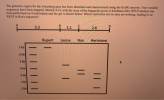
The genomic region for the wizarding gene has been identified and characterized using the EcoRI enzyme. Four variable sequences have been mapped, labeled A-D, with the sizes of the fragments given in kilobases (kb). RFLP analysis has been performed on 4 individuals and the gel is shown below. Which restriction site or sites are missing, leading to an RFLP in Ron's sequence? 3.3 1.1 i 2.6 Rupert Leona Ron Hermione a. site B b.site 6. sites...
step bt step please
The genomic region for the wizarding gene has been identified and characterized using the EcoRI enzyme. Four variable sequences have been mapped, labeled A-D, with the sizes of the fragments given in kilobases (kb). RFLP analysis has been performed on 4 individuals and the gel is shown below. Which restriction site or sites are missing, leading to an RFLP in Ron's sequence? 3.3 1.1 i 2.6 Rupert Leona Ron Hermione a. site B b.site 6. sites...
1) In both eukaryotes and prokaryotes, gene expression can be regulated at the level of ____....
1) In both eukaryotes and prokaryotes, gene expression can be regulated at the level of ____. Group of answer choices a)transcription b)translation c)mRNA splicing d)All of the above e)transcription and translation only 2)Which of the following is the least likely mechanism to convert a proto-oncogene to an oncogene? Group of answer choices a)gene amplification b)point mutation within the gene c)point mutation in the promoter or enhancer regions d)histone acetylation e)chromosome translocation
 step bt step please
The genomic region for the wizarding gene has been identified and characterized using the EcoRI enzyme. Four variable sequences have been mapped, labeled A-D, with the sizes of the fragments given in kilobases (kb). RFLP analysis has been performed on 4 individuals and the gel is shown below. Which restriction site or sites are missing, leading to an RFLP in Ron's sequence? 3.3 1.1 i 2.6 Rupert Leona Ron Hermione a. site B b.site 6. sites...
step bt step please
The genomic region for the wizarding gene has been identified and characterized using the EcoRI enzyme. Four variable sequences have been mapped, labeled A-D, with the sizes of the fragments given in kilobases (kb). RFLP analysis has been performed on 4 individuals and the gel is shown below. Which restriction site or sites are missing, leading to an RFLP in Ron's sequence? 3.3 1.1 i 2.6 Rupert Leona Ron Hermione a. site B b.site 6. sites...
Most questions answered within 3 hours.
-
Where is the error in this code sequence?
String s1 = "Hello";
String s2 = "ello";...
asked 11 months ago -
Financial data for Joel de Paris, Inc., for last year
follow:
Joel de Paris, Inc.
Balance...
asked 11 months ago -
Consider this reaction:
Al2(SO4)3 (aq)+ BaCl3
(aq) Al2Cl6 (aq)- +
3BaSO4(s) . What is the...
asked 11 months ago -
Suppose that Savneet is considering increasing her
recent random sample from 20 car rentals to 40...
asked 11 months ago -
Trucks arrive at an unloading terminal at an average rate of 120
per hour.
Trucks arrive...
asked 11 months ago -
Why are methanol and ethanol completely soluble in water while
octanol is not very little soluble....
asked 11 months ago -
A facilities manager at a university reads in a research report
that the mean amount of...
asked 11 months ago -
When the CuSO4 is rehydrated by adding water to the anhydrous
compound, is this an endothermic...
asked 11 months ago -
A ray of sunlight is passing from diamond into crown glass; the
angle of incidence is...
asked 11 months ago -
A block of mass 0.249 kg is placed on top of a light, vertical
spring of...
asked 11 months ago -
how do the kidneys compensate in the presences of acidosis
a) trigger hyperventilate
b) reserve acid...
asked 11 months ago -
Question 501 pts
The rental rate of capital to the firm increases. Which of the
following...
asked 11 months ago