
Homework Answers
8. a) ATP from myristic acid oxidation:
- Step-1 (activation)
myristic acid to myristoyl CoA = - 2ATP
- Further steps:
7 acetyl CoA
As per acetyl CoA, 12 ATP's are generated = 7 * 12 = 84 ATPs
6 oxidation cycles
6 NADH - as for 1 NADH, 3 ATP's are generated. Therefore, 6 * 3 = 18 ATP
6 FADH2 - as for 1 FADH2, 2 ATP's are generated. Therefore, 6 * 2 = 12 ATP.
So, total ATP's generated = 84 + 18 + 12 = 114 ATP
Subtracting the ATP's spent during activation, net yield is 114 - 2 = 112 ATPs.
b) Normally, c collar of the Fo subunit of F0-F1 ATPase has 10 subunits. Only one out of these c subunits can form a bond with a subunit at a time, due to which the ring rotates one-tenth of a turn of the adjacent a subunit.
As one NADH gave electrons to complex I (at higher energy level), it generated 3 ATP's during the ETC.
and similarly as FADH2 gave electrons to complex II, it generated 2 ATP's through ETC.
F0-F1 ATPase complex is shown as below:
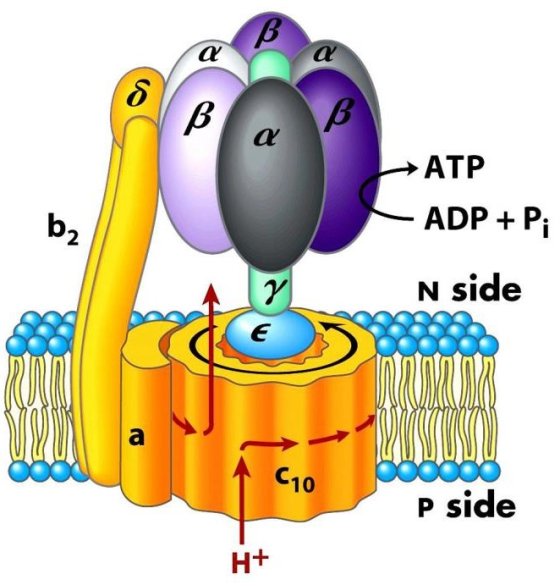
Image adapted from https://www.slideserve.com/vlad/fig19-16
Roughly, 8 protons enter the mitochondria through the F0 subunit for every 3 ATP synthesized.
That means around 2.67 protons for each ATP.
The no. of protons generated by the NADH and FADH2 are independent of the change in the c units of the F0 subunit and hence, there will likely not be any change in the no. of ATP synthesized from NADH or FADH2.
Add Answer to:
8. a) Calculate the ATP yield for myristic acid, 14:0. Don't forget the cost of activation....
please help with B 8. a) Calculate the ATP yield for myristic acid, 14:0. Don't forget...
 please help with B
8. a) Calculate the ATP yield for myristic acid, 14:0. Don't forget the cost of activation. (8 pts) b) What are the ATP yields from NADH and FADHz if the c collar of the Fo section of Fifo-ATPase has 15 subunits? Show work. (6 pts)
please help with B
8. a) Calculate the ATP yield for myristic acid, 14:0. Don't forget the cost of activation. (8 pts) b) What are the ATP yields from NADH and FADHz if the c collar of the Fo section of Fifo-ATPase has 15 subunits? Show work. (6 pts)
 please help with B
8. a) Calculate the ATP yield for myristic acid, 14:0. Don't forget the cost of activation. (8 pts) b) What are the ATP yields from NADH and FADHz if the c collar of the Fo section of Fifo-ATPase has 15 subunits? Show work. (6 pts)
please help with B
8. a) Calculate the ATP yield for myristic acid, 14:0. Don't forget the cost of activation. (8 pts) b) What are the ATP yields from NADH and FADHz if the c collar of the Fo section of Fifo-ATPase has 15 subunits? Show work. (6 pts)
Most questions answered within 3 hours.
-
Where is the error in this code sequence?
String s1 = "Hello";
String s2 = "ello";...
asked 11 months ago -
Financial data for Joel de Paris, Inc., for last year
follow:
Joel de Paris, Inc.
Balance...
asked 11 months ago -
Consider this reaction:
Al2(SO4)3 (aq)+ BaCl3
(aq) Al2Cl6 (aq)- +
3BaSO4(s) . What is the...
asked 11 months ago -
Suppose that Savneet is considering increasing her
recent random sample from 20 car rentals to 40...
asked 11 months ago -
Trucks arrive at an unloading terminal at an average rate of 120
per hour.
Trucks arrive...
asked 11 months ago -
Why are methanol and ethanol completely soluble in water while
octanol is not very little soluble....
asked 11 months ago -
A facilities manager at a university reads in a research report
that the mean amount of...
asked 11 months ago -
When the CuSO4 is rehydrated by adding water to the anhydrous
compound, is this an endothermic...
asked 11 months ago -
A ray of sunlight is passing from diamond into crown glass; the
angle of incidence is...
asked 11 months ago -
A block of mass 0.249 kg is placed on top of a light, vertical
spring of...
asked 11 months ago -
how do the kidneys compensate in the presences of acidosis
a) trigger hyperventilate
b) reserve acid...
asked 11 months ago -
Question 501 pts
The rental rate of capital to the firm increases. Which of the
following...
asked 11 months ago