
Homework Answers
Add Answer to:
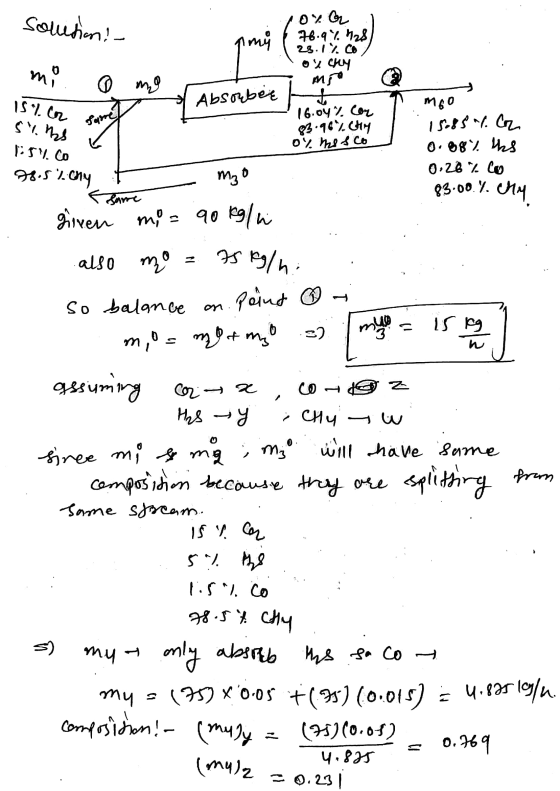
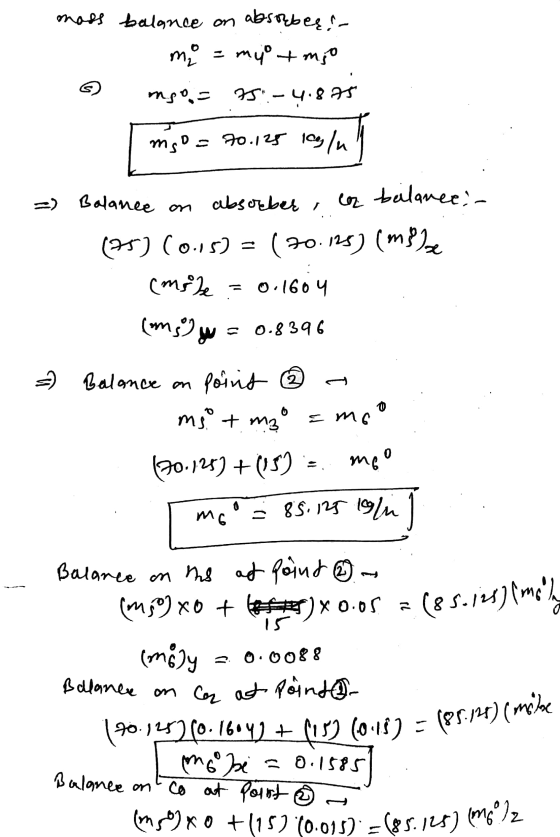
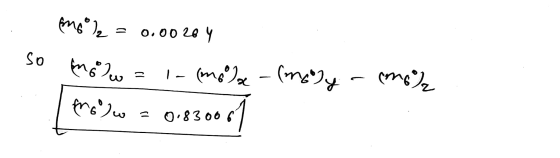
A waste gas stream, containing 15 % CO2,5 % H2S, 1.5 % Co, and the balance...
A waste gas stream, containing 15 % CO2,5 % H2S, 1.5 % Co, and the balance...
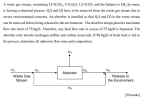 A waste gas stream, containing 15 % CO2,5 % H2S, 1.5 % Co, and the balance is CH4 by mass, is leaving a chemical process. H2S and CO have to be removed from the waste gas stream due to severe environmental concerns. An absorber is installed so that H2S and CO in the waste stream can be removed before being released to the environment. The absorber design placed a maximum flow rate limit of 75 kg/h. Therefore, any feed flow...
Problem 1 An absorber-stripper process is used to remove carbon dioxide (CO2) and hydrogen sulfide (H2S)...
 Problem 1 An absorber-stripper process is used to remove carbon dioxide (CO2) and hydrogen sulfide (H2S) from a feed (stream 1) consisting of 25% CO2 and 15% H2S in nitrogen. In the absorber, a solvent selectively absorbs hydrogen sulfide and carbon dioxide. The absorber overhead (stream 2) contains only 2% CO, and the balance Nitrogen with no Hys. Ny is insoluble in the solvent. The rich solvent stream leaving the absorber (stream 3) is flashed in a flash separator: the...
Sorry about that. #8 (20 pts) SO2 is to be removed from a CIL gas stream...
 Sorry about that.
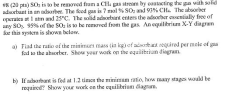
#8 (20 pts) SO2 is to be removed from a CIL gas stream by contacting the gas with solid adsorbant in an adsorber. The feed gas is 7 mol % SO2 and 93% CH4. The absorber operates at 1 atm and 25°C. The solid adsorbant enters the adsorber essentially free of any SO2, 95% of the SO2 is to be removed from. the gas. An equilibrium X-Y diagram for this system is shown below Find the ratio...
Sorry about that.
#8 (20 pts) SO2 is to be removed from a CIL gas stream by contacting the gas with solid adsorbant in an adsorber. The feed gas is 7 mol % SO2 and 93% CH4. The absorber operates at 1 atm and 25°C. The solid adsorbant enters the adsorber essentially free of any SO2, 95% of the SO2 is to be removed from. the gas. An equilibrium X-Y diagram for this system is shown below Find the ratio...
Methanol is synthesized from carbon monoxide and hydrogen (H2) in a catalytic reactor. CO + 2H2...
Methanol is synthesized from carbon monoxide and hydrogen (H2) in a catalytic reactor. CO + 2H2 → CH3OH The fresh feed to the process contains 32.0% mol of CO, 64% of H2 and 4% N2. This stream is mixed with a recirculation stream at a ratio of 5 mol recirculation / 1 mol fresh feed to the process. The mixture of these streams forms the feed stream to the reactor, which contains 13.0 mol% of N2. Low conversion is achieved...
A synthesis gas stream consisting of 65.30% H2, 34.30% CO, and 0.400% CH4 (by mole) is...
A synthesis gas stream consisting of 65.30% H2, 34.30% CO, and 0.400% CH4 (by mole) is fed into the process described below at a rate of 100 mol/hour. The effluent stream from the reactor is fed into a separator where the methanol is completely removed, and the unconverted reactants are recycled to the reactor. To avoid the buildup of methane, a portion of the recycled stream is purged. At present operating conditions, the CO conversion over the entire process is...
i beed help calculating from wt% to moles in the reactor outlet stream. the reactor outket...
 i
beed help calculating from wt% to moles in the reactor outlet
stream. the reactor outket shows a molar flow rate but the
percentages of the reactor outlet are in weight %. see the note in
parenthesis in the question. thanks
3. Methanol is produced by reacting carbon monoxide and hydrogen. A fresh feed stream containing CO and Hjoins a recycle stream and the combined stream is fed to a reactor. The reactor outlet stream flows at a rate of...
i
beed help calculating from wt% to moles in the reactor outlet
stream. the reactor outket shows a molar flow rate but the
percentages of the reactor outlet are in weight %. see the note in
parenthesis in the question. thanks
3. Methanol is produced by reacting carbon monoxide and hydrogen. A fresh feed stream containing CO and Hjoins a recycle stream and the combined stream is fed to a reactor. The reactor outlet stream flows at a rate of...
Problem 4.80 Methanol Synthesis Methanol is synthesized from carbon monoxide and hydrogen in a catalytic reactor....
 Problem 4.80 Methanol Synthesis Methanol is synthesized from carbon monoxide and hydrogen in a catalytic reactor. The fresh feed to the process contains 32.0 mol% CO 64.0 mol% H2 and 4.00 mol% N2: This stream is mixed with a recycle stream in a ratio of 10.00 mol recycle / mol fresh feed to produce th feed to the reactor, which contains 12.0 mol% N2 The reactor effluent goes to a condenser from which two streams emerge: a liquid product stream...
A stream of benzene and another inert gas (containing XB=0.85 kg benzene/kg stream) and air fed...
A stream of benzene and another inert gas (containing XB=0.85 kg benzene/kg stream) and air fed to furnace. all benzene in the feed is converted and the process take out with 35% excess air as part of the furnace design. take basis of 100 kg/hr benzene. a) Draw and label a flow chart for this process b) Calculate the mass and mass composition of the flue gas
A stream of benzene and another inert gas (containing Xb=0.85 kg benzene/kg stream) and air fed...
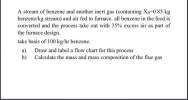 A stream of benzene and another inert gas (containing Xb=0.85 kg benzene/kg stream) and air fed to furnace. all benzene in the feed is converted and the process take out with 35% excess air as part of the furnace design. take basis of 100 kg/hr benzene. a) Draw and label a flow chart for this process b) Calculate the mass and mass composition of the flue gas
A chemical plant produces an ammonia-rich waste gas that cannot be released as-is into the environment....
 A chemical plant produces an ammonia-rich waste gas that cannot be released as-is into the environment. One method to reduce the ammonia concentration in the waste gas is to bubble the waste gas through a liquid solvent. Components of the gas that are highly soluble, like ammonia, will dissolve into the liquid phase. Water is an appropriate liquid solvent for this process. The chemical plant produces 105.0 m^3/hr of waste gas (rho = 0.0407 mol/L) initially having a mole fraction...
 A waste gas stream, containing 15 % CO2,5 % H2S, 1.5 % Co, and the balance is CH4 by mass, is leaving a chemical process. H2S and CO have to be removed from the waste gas stream due to severe environmental concerns. An absorber is installed so that H2S and CO in the waste stream can be removed before being released to the environment. The absorber design placed a maximum flow rate limit of 75 kg/h. Therefore, any feed flow...
 Problem 1 An absorber-stripper process is used to remove carbon dioxide (CO2) and hydrogen sulfide (H2S) from a feed (stream 1) consisting of 25% CO2 and 15% H2S in nitrogen. In the absorber, a solvent selectively absorbs hydrogen sulfide and carbon dioxide. The absorber overhead (stream 2) contains only 2% CO, and the balance Nitrogen with no Hys. Ny is insoluble in the solvent. The rich solvent stream leaving the absorber (stream 3) is flashed in a flash separator: the...
 Sorry about that.
#8 (20 pts) SO2 is to be removed from a CIL gas stream by contacting the gas with solid adsorbant in an adsorber. The feed gas is 7 mol % SO2 and 93% CH4. The absorber operates at 1 atm and 25°C. The solid adsorbant enters the adsorber essentially free of any SO2, 95% of the SO2 is to be removed from. the gas. An equilibrium X-Y diagram for this system is shown below Find the ratio...
Sorry about that.
#8 (20 pts) SO2 is to be removed from a CIL gas stream by contacting the gas with solid adsorbant in an adsorber. The feed gas is 7 mol % SO2 and 93% CH4. The absorber operates at 1 atm and 25°C. The solid adsorbant enters the adsorber essentially free of any SO2, 95% of the SO2 is to be removed from. the gas. An equilibrium X-Y diagram for this system is shown below Find the ratio...
 i
beed help calculating from wt% to moles in the reactor outlet
stream. the reactor outket shows a molar flow rate but the
percentages of the reactor outlet are in weight %. see the note in
parenthesis in the question. thanks
3. Methanol is produced by reacting carbon monoxide and hydrogen. A fresh feed stream containing CO and Hjoins a recycle stream and the combined stream is fed to a reactor. The reactor outlet stream flows at a rate of...
i
beed help calculating from wt% to moles in the reactor outlet
stream. the reactor outket shows a molar flow rate but the
percentages of the reactor outlet are in weight %. see the note in
parenthesis in the question. thanks
3. Methanol is produced by reacting carbon monoxide and hydrogen. A fresh feed stream containing CO and Hjoins a recycle stream and the combined stream is fed to a reactor. The reactor outlet stream flows at a rate of...
 Problem 4.80 Methanol Synthesis Methanol is synthesized from carbon monoxide and hydrogen in a catalytic reactor. The fresh feed to the process contains 32.0 mol% CO 64.0 mol% H2 and 4.00 mol% N2: This stream is mixed with a recycle stream in a ratio of 10.00 mol recycle / mol fresh feed to produce th feed to the reactor, which contains 12.0 mol% N2 The reactor effluent goes to a condenser from which two streams emerge: a liquid product stream...
 A stream of benzene and another inert gas (containing Xb=0.85 kg benzene/kg stream) and air fed to furnace. all benzene in the feed is converted and the process take out with 35% excess air as part of the furnace design. take basis of 100 kg/hr benzene. a) Draw and label a flow chart for this process b) Calculate the mass and mass composition of the flue gas
 A chemical plant produces an ammonia-rich waste gas that cannot be released as-is into the environment. One method to reduce the ammonia concentration in the waste gas is to bubble the waste gas through a liquid solvent. Components of the gas that are highly soluble, like ammonia, will dissolve into the liquid phase. Water is an appropriate liquid solvent for this process. The chemical plant produces 105.0 m^3/hr of waste gas (rho = 0.0407 mol/L) initially having a mole fraction...
Most questions answered within 3 hours.
-
Where is the error in this code sequence?
String s1 = "Hello";
String s2 = "ello";...
asked 11 months ago -
Financial data for Joel de Paris, Inc., for last year
follow:
Joel de Paris, Inc.
Balance...
asked 11 months ago -
Consider this reaction:
Al2(SO4)3 (aq)+ BaCl3
(aq) Al2Cl6 (aq)- +
3BaSO4(s) . What is the...
asked 11 months ago -
Suppose that Savneet is considering increasing her
recent random sample from 20 car rentals to 40...
asked 11 months ago -
Trucks arrive at an unloading terminal at an average rate of 120
per hour.
Trucks arrive...
asked 11 months ago -
Why are methanol and ethanol completely soluble in water while
octanol is not very little soluble....
asked 11 months ago -
A facilities manager at a university reads in a research report
that the mean amount of...
asked 11 months ago -
When the CuSO4 is rehydrated by adding water to the anhydrous
compound, is this an endothermic...
asked 11 months ago -
A ray of sunlight is passing from diamond into crown glass; the
angle of incidence is...
asked 11 months ago -
A block of mass 0.249 kg is placed on top of a light, vertical
spring of...
asked 11 months ago -
how do the kidneys compensate in the presences of acidosis
a) trigger hyperventilate
b) reserve acid...
asked 11 months ago -
Question 501 pts
The rental rate of capital to the firm increases. Which of the
following...
asked 11 months ago