
Homework Answers
Add Answer to:
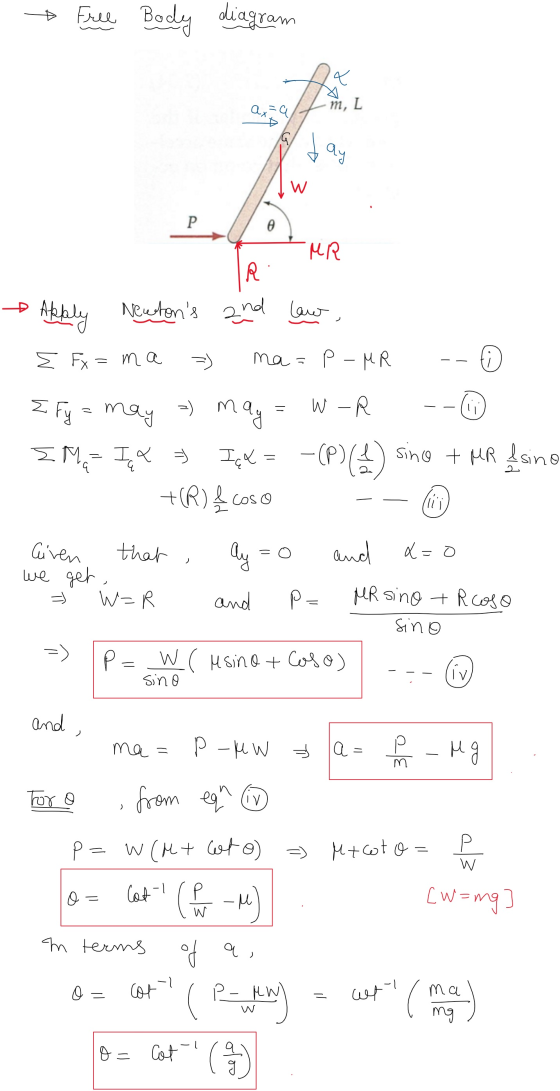
1. Find the angle 0 for which the bar will translate to the right at a...
1. Adjust the angle of inclination of the ramp to be larger than the critical angle...
 1. Adjust the angle of inclination of the ramp to be larger than the critical angle you found in the previous experiment. Place the block at the top of the ramp, carpeted side down, and release it. a Describe the motion of the block. If the block does not remain at rest, does the speed of the block increase, decrease, or remain constant? Block on Inc line b. In the space provided at right, draw a free body diagram of...
The sliders A and B are connected by a light rigid bar of length l =...
 The sliders A and B are connected by a light
rigid bar of length l = 0.37 m and move with negligible
friction in the slots, both of which lie in a horizontal plane. For
the position where xA = 0.29 m, the velocity of
A is vA = 0.84 m/s to the right.
Determine the acceleration of each slider and the force in the bar
at this instant. The acceleration of A is positive if to
the right. The...
The sliders A and B are connected by a light
rigid bar of length l = 0.37 m and move with negligible
friction in the slots, both of which lie in a horizontal plane. For
the position where xA = 0.29 m, the velocity of
A is vA = 0.84 m/s to the right.
Determine the acceleration of each slider and the force in the bar
at this instant. The acceleration of A is positive if to
the right. The...
A block of mass m = 100 kg is placed on an incline of angle 0...
A block of mass m = 100 kg is placed on an incline of angle 0 = 25° , see Fig . What force is required to pull it up at a constant speed if the coefficient of kinetic friction between the block and the incline is 0 . 2 ?
The figure on the right illustrates a ball which is a uniform solid sphere having mass M and radi...
 The figure on the right illustrates a ball which is a uniform solid sphere having mass M and radius R. The ball is initially traveling in the positive direction with pure translational motion along a friction-less region of a horizontal surface (i.e. it slips with angular speed ω0-0). The initial translational speed of the ball is Vo. The friction-less region extends to a region having coefficient of kinetic friction Figure for WAH #10 V. Friction Friction-less No longer slipping '...
A block of mass ? is on a horizontal surface. A force ? = ?? ?...
A block of mass ? is on a horizontal surface. A force ? = ?? ? / ? acts on the bar at an angle ?, where ? is a known constant, ? is the time at the moment, ? is the acceleration of gravity. The coefficient of friction between the bar and the surface is ?. The movement begins from the moment of time ? = 0. a) Find the time ∇? during which the bar will move, touching...
Uniform bar OA rotates around endpoint O and position angle 0= 0 when the bar is...
 Uniform bar OA rotates around endpoint O and position angle 0= 0 when the bar is horizontal and in static equilibrium. The mass of the bar is m = 20 kg, the length of the bar is L=1.2 m , k= 6000 N/m for the spring, and c= 320 N-s/m for the damper. The bar is initially at rest with 0 0 when force F(t) is applied to the end of the bar. Find the response 0(t) if force F(t)...
PHYSICS HOMEWORK # 26 NEWTON'S LAWS FIRST LAW & FRICTION 24. Two masses are sitting on...
 PHYSICS HOMEWORK # 26 NEWTON'S LAWS FIRST LAW & FRICTION 24. Two masses are sitting on a horizontal surface as shown to the right. The coefficient of sliding friction between these two masses and the horizontal surface is m-0.520. A string is attached to the end of mas m,8.00 kg. This string is then looped arounda pulley and is finally attached to the left vertical surface. The pulley is attached to mass m 12.0 kg as shown and then a...
For a certain coefficient of friction u and a certain angle a, the force P required...
 For a certain coefficient of friction u and a certain angle a, the force P required to raise m is 3.08 kN and that required to lower m at a constant slow speed is 1.19 kN. Calculate the mass m. Answer: m =
The right-angle bar with equal legs weighs 6.0 lb and is freely hinged to the vertical...
 The right-angle bar with equal legs weighs 6.0 lb and is freely
hinged to the vertical plate at C. The bar is prevented
from rotating by the two pegs A and B fixed to
the plate. Determine the acceleration a of the plate for
which no force is exerted on the bar by either peg A or
B.
Chapter 6, Problem 6/002 the plate The right angle bar with equal legs weighs 6.0 lb and is freely hinged to the...
The right-angle bar with equal legs weighs 6.0 lb and is freely
hinged to the vertical plate at C. The bar is prevented
from rotating by the two pegs A and B fixed to
the plate. Determine the acceleration a of the plate for
which no force is exerted on the bar by either peg A or
B.
Chapter 6, Problem 6/002 the plate The right angle bar with equal legs weighs 6.0 lb and is freely hinged to the...
A 2.74 kg block is pushed 1.41 m up a vertical wall with a constant speed...
 A 2.74 kg block is pushed 1.41 m up a vertical wall with a
constant speed by a constant force of magnitude F applied at an
angle of 66.3 with the horizontal. The acceleration of gravity is
9.8 m/s2. If the coefficient of kinetic friction between the block
and wall 0.415, find the work done by F.
A 2.74 kg block is pushed 1.41 m up a vertical wall with a constant speed by a constant force of magnitude F...
A 2.74 kg block is pushed 1.41 m up a vertical wall with a
constant speed by a constant force of magnitude F applied at an
angle of 66.3 with the horizontal. The acceleration of gravity is
9.8 m/s2. If the coefficient of kinetic friction between the block
and wall 0.415, find the work done by F.
A 2.74 kg block is pushed 1.41 m up a vertical wall with a constant speed by a constant force of magnitude F...
 1. Adjust the angle of inclination of the ramp to be larger than the critical angle you found in the previous experiment. Place the block at the top of the ramp, carpeted side down, and release it. a Describe the motion of the block. If the block does not remain at rest, does the speed of the block increase, decrease, or remain constant? Block on Inc line b. In the space provided at right, draw a free body diagram of...
 The sliders A and B are connected by a light
rigid bar of length l = 0.37 m and move with negligible
friction in the slots, both of which lie in a horizontal plane. For
the position where xA = 0.29 m, the velocity of
A is vA = 0.84 m/s to the right.
Determine the acceleration of each slider and the force in the bar
at this instant. The acceleration of A is positive if to
the right. The...
The sliders A and B are connected by a light
rigid bar of length l = 0.37 m and move with negligible
friction in the slots, both of which lie in a horizontal plane. For
the position where xA = 0.29 m, the velocity of
A is vA = 0.84 m/s to the right.
Determine the acceleration of each slider and the force in the bar
at this instant. The acceleration of A is positive if to
the right. The...
 The figure on the right illustrates a ball which is a uniform solid sphere having mass M and radius R. The ball is initially traveling in the positive direction with pure translational motion along a friction-less region of a horizontal surface (i.e. it slips with angular speed ω0-0). The initial translational speed of the ball is Vo. The friction-less region extends to a region having coefficient of kinetic friction Figure for WAH #10 V. Friction Friction-less No longer slipping '...
 Uniform bar OA rotates around endpoint O and position angle 0= 0 when the bar is horizontal and in static equilibrium. The mass of the bar is m = 20 kg, the length of the bar is L=1.2 m , k= 6000 N/m for the spring, and c= 320 N-s/m for the damper. The bar is initially at rest with 0 0 when force F(t) is applied to the end of the bar. Find the response 0(t) if force F(t)...
 PHYSICS HOMEWORK # 26 NEWTON'S LAWS FIRST LAW & FRICTION 24. Two masses are sitting on a horizontal surface as shown to the right. The coefficient of sliding friction between these two masses and the horizontal surface is m-0.520. A string is attached to the end of mas m,8.00 kg. This string is then looped arounda pulley and is finally attached to the left vertical surface. The pulley is attached to mass m 12.0 kg as shown and then a...
 For a certain coefficient of friction u and a certain angle a, the force P required to raise m is 3.08 kN and that required to lower m at a constant slow speed is 1.19 kN. Calculate the mass m. Answer: m =
 The right-angle bar with equal legs weighs 6.0 lb and is freely
hinged to the vertical plate at C. The bar is prevented
from rotating by the two pegs A and B fixed to
the plate. Determine the acceleration a of the plate for
which no force is exerted on the bar by either peg A or
B.
Chapter 6, Problem 6/002 the plate The right angle bar with equal legs weighs 6.0 lb and is freely hinged to the...
The right-angle bar with equal legs weighs 6.0 lb and is freely
hinged to the vertical plate at C. The bar is prevented
from rotating by the two pegs A and B fixed to
the plate. Determine the acceleration a of the plate for
which no force is exerted on the bar by either peg A or
B.
Chapter 6, Problem 6/002 the plate The right angle bar with equal legs weighs 6.0 lb and is freely hinged to the...
 A 2.74 kg block is pushed 1.41 m up a vertical wall with a
constant speed by a constant force of magnitude F applied at an
angle of 66.3 with the horizontal. The acceleration of gravity is
9.8 m/s2. If the coefficient of kinetic friction between the block
and wall 0.415, find the work done by F.
A 2.74 kg block is pushed 1.41 m up a vertical wall with a constant speed by a constant force of magnitude F...
A 2.74 kg block is pushed 1.41 m up a vertical wall with a
constant speed by a constant force of magnitude F applied at an
angle of 66.3 with the horizontal. The acceleration of gravity is
9.8 m/s2. If the coefficient of kinetic friction between the block
and wall 0.415, find the work done by F.
A 2.74 kg block is pushed 1.41 m up a vertical wall with a constant speed by a constant force of magnitude F...
Most questions answered within 3 hours.
-
Where is the error in this code sequence?
String s1 = "Hello";
String s2 = "ello";...
asked 10 months ago -
Financial data for Joel de Paris, Inc., for last year
follow:
Joel de Paris, Inc.
Balance...
asked 10 months ago -
Consider this reaction:
Al2(SO4)3 (aq)+ BaCl3
(aq) Al2Cl6 (aq)- +
3BaSO4(s) . What is the...
asked 10 months ago -
Suppose that Savneet is considering increasing her
recent random sample from 20 car rentals to 40...
asked 10 months ago -
Trucks arrive at an unloading terminal at an average rate of 120
per hour.
Trucks arrive...
asked 10 months ago -
Why are methanol and ethanol completely soluble in water while
octanol is not very little soluble....
asked 10 months ago -
A facilities manager at a university reads in a research report
that the mean amount of...
asked 10 months ago -
When the CuSO4 is rehydrated by adding water to the anhydrous
compound, is this an endothermic...
asked 10 months ago -
A ray of sunlight is passing from diamond into crown glass; the
angle of incidence is...
asked 10 months ago -
A block of mass 0.249 kg is placed on top of a light, vertical
spring of...
asked 10 months ago -
how do the kidneys compensate in the presences of acidosis
a) trigger hyperventilate
b) reserve acid...
asked 10 months ago -
Question 501 pts
The rental rate of capital to the firm increases. Which of the
following...
asked 10 months ago