

Homework Answers
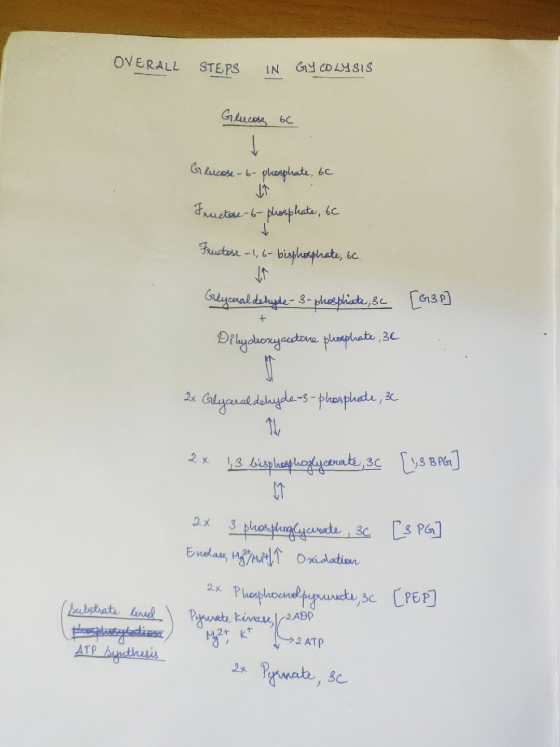
Ans : The process of glycolysis takes place in the cytoplasm.
A six carbon glucose molecule is split into 2 three carbon G3P molecules.
These molecules are phosphorylated into 2 three carbon BPG molecules, which are then dephosphorylated into 2 three carbon 3PG molecules.
These molecules are oxidized into 2 three carbon PEP molecules.
Finally, substrate level ATP synthesis occurs and 2 three carbon pyruvate molecules are released.
Therefore, six carbons enter glycolysis and three carbons three carbons leave glycolysis.
Add Answer to:
These molecules are phosphorylated into 2 carbon molecules, which are then dephosphorylated into 2 carbon molecules....
Rank from the first to the last steps to describe the correct order of events of...
 Rank from the first to the last steps to describe the
correct order of events of glycolysis.
Rank from the first to the last steps to describe the correct order of events of glycolysis. Reset Help Glyceraldehyde- 3-phosphate COOP 3-phosphoglycerate ooo ATP This reaction happens Glucose-6-phosphate OOOOOO Rearrangement P + ADP Glucose GOOOOO NAD* - Fructose-16-bisphosphate POOOOOO twice, once ADP for each glyceraldehyde- 3.phosphate bisphosphoglycerate OOOP + NADH Fructose-6-phosphate ССССССР 2-phosphoglycerate This GOO reaction happens Rearrangement twice, once Phosphoenolpyruvate for...
Rank from the first to the last steps to describe the
correct order of events of glycolysis.
Rank from the first to the last steps to describe the correct order of events of glycolysis. Reset Help Glyceraldehyde- 3-phosphate COOP 3-phosphoglycerate ooo ATP This reaction happens Glucose-6-phosphate OOOOOO Rearrangement P + ADP Glucose GOOOOO NAD* - Fructose-16-bisphosphate POOOOOO twice, once ADP for each glyceraldehyde- 3.phosphate bisphosphoglycerate OOOP + NADH Fructose-6-phosphate ССССССР 2-phosphoglycerate This GOO reaction happens Rearrangement twice, once Phosphoenolpyruvate for...
1) In glycolysis, what three-carbon molecules are left after the ten enzymatic steps? Group of answer...
1) In glycolysis, what three-carbon molecules are left after the ten enzymatic steps? Group of answer choices - pyruvate - acetyl CoA - Glucose - Succinyl CoA Part 2 In glycolysis, what is the net gain of ATP? Group of answer choices - 2 - 4 - 3 - 36
16 Which step consists of a phosphorylation reaction in which ATP is the phosphate source? b...
 16 Which step consists of a phosphorylation reaction in which ATP is the phosphate source? b B с с d D е Е 17 Substrate-level phosphorylation accounts for approximately what percentage of the ATP formed during glycolysis? a 0% b 2% c 10% d 38% @ 100% 18 In addition to ATP, what are the end products of glycolysis? a CO2 and H2O b CO2 and pyruvate NADH and pyruvate d CO, and NADH e H2O, FADH2, and citrate 19...
Which of the following molecules has the highest amount of energy that will be collected during...
 Which of the following molecules has the highest amount of energy that will be collected during its further metabolism in cellular respiration? C6H1206 pyruvate O CO2 02 ATP When glucose and oxygen become carbon dioxide plus water (cell respiration reaction) which of the following is true: The reaction is... positive delta G and glucose is oxidized negative delta G and glucose is oxidized positive delta G and glucose is reduced negative delta G and glucose is reduced The majority of...
art ranking activity the reactions of glycolysis - Part A Rank from the first to the...
 art ranking activity the reactions of glycolysis
- Part A Rank from the first to the last steps to describe the correct order of events of glycolysis. Glyceraldehyde 3 phosphoglycerite QOOP 000 Glukose-6 phosphate GOOOOO-P + ADP rangement Glukose This reaction happens twice, once for each dycaruldalde phosphate NADH Fructose big hosphase BOOO000- OOOOOO 2 phosphegycenate This 000 reacties Rearrangement happens Phosphoenopyre phosphoglyce Fructose phosphate OOOOOO Dihydroacetone biphuphophorte OOO- OOONOP Osation: Gyerde 3 phones phosphorylated and oxided by NAD to...
art ranking activity the reactions of glycolysis
- Part A Rank from the first to the last steps to describe the correct order of events of glycolysis. Glyceraldehyde 3 phosphoglycerite QOOP 000 Glukose-6 phosphate GOOOOO-P + ADP rangement Glukose This reaction happens twice, once for each dycaruldalde phosphate NADH Fructose big hosphase BOOO000- OOOOOO 2 phosphegycenate This 000 reacties Rearrangement happens Phosphoenopyre phosphoglyce Fructose phosphate OOOOOO Dihydroacetone biphuphophorte OOO- OOONOP Osation: Gyerde 3 phones phosphorylated and oxided by NAD to...
QUESTION 13 Which of the following statements is not true about glycolysis? Some reactions in Glycolysis...
 QUESTION 13 Which of the following statements is not true about glycolysis? Some reactions in Glycolysis use NADPH as a source of energy. The first step of glycolysis ensures that glucose is trapped inside the cell The isomerization of DHAP to G3P makes the process of glycolysis efficient The end products of glycolysis are 2 pyruvate molecules, 2 ATPs and 2 NADH ОООО QUESTION 3 ATP is known to be an allosteric inhibitor of an enzyme A. Therefore ATP most...
Catabolism of Glucose. In the following paragraphs, write in the term that fits best. One of...
 Catabolism of Glucose. In the following paragraphs, write in the term that fits best. One of the most thoroughly studied aspects of metabolism is the catabolism of glucose. The process involves many chemical steps and three metabolic The first of these is called . In this pathway, one 6-carbon glucose molecule is converted into two 3-carbon molecules of the early steps of this metabolic pathway, two molecules of must be supplied for energy. Later on, however, a total of ATP...
8. The following molecules form during the stages of glycolysis: 1. pyruvate 2. NADH 3. Fructose-1,6...
 8. The following molecules form during the stages of glycolysis: 1. pyruvate 2. NADH 3. Fructose-1,6 biphosphate glyceraldehyde-3-phosphate (G3P) 5. phosphoenol-pyruvate (PEP) In which order do they form? a. 3,2,5,4,1 b. 1, 2, 3, 4, 5 c. 5,4,3,2,1 d. 3, 4,2,5,1 9. What is true of the organic molecules that can be used in aerobic cellular respiration? Lipids and proteins can be used, but carbohydrates must be in the form of monosaccharides. b. Carbohydrates and lipids can be used, but...
QUESTION 2 When adenosine diphosphate is phosphorylated, what small molecule is lost? H20 CO2 HCI 02...
 QUESTION 2 When adenosine diphosphate is phosphorylated, what small molecule is lost? H20 CO2 HCI 02 QUESTION 4 How many carbon atoms enter the citric acid cycle at a time? 2. 4 3 6 QUESTION 7 How many molecules of ATP (NET) are produced directly from the GLYCOLYSIS of 5 molecules of glucose? 5 12.5 10 QUESTION 8 Which of the following is(are) NOT found in the electron transport chain? O2 CO2 OH ions Fe ions QUESTION 9 Which letter...
biochemistry glycolosis Part 2: Glycolysis and Radiolabeling A common practice in biochemistry is the feeder study, in which radiolabeled substrate is fed to an organism; afterwards, radiolabeled...
 biochemistry glycolosis
Part 2: Glycolysis and Radiolabeling A common practice in biochemistry is the feeder study, in which radiolabeled substrate is fed to an organism; afterwards, radiolabeled metabolites are isolated and used to determine how the substrate was used by the organism. 4. Plants use intermediates from the glycolytic pathway as substrates for other pathways. For example, if we feed plants radiolabeled glucose, the radiolabel eventually ends up in the amino acid valine. If we feed the plants 6-(C)glucose i.e....
biochemistry glycolosis
Part 2: Glycolysis and Radiolabeling A common practice in biochemistry is the feeder study, in which radiolabeled substrate is fed to an organism; afterwards, radiolabeled metabolites are isolated and used to determine how the substrate was used by the organism. 4. Plants use intermediates from the glycolytic pathway as substrates for other pathways. For example, if we feed plants radiolabeled glucose, the radiolabel eventually ends up in the amino acid valine. If we feed the plants 6-(C)glucose i.e....
 Rank from the first to the last steps to describe the
correct order of events of glycolysis.
Rank from the first to the last steps to describe the correct order of events of glycolysis. Reset Help Glyceraldehyde- 3-phosphate COOP 3-phosphoglycerate ooo ATP This reaction happens Glucose-6-phosphate OOOOOO Rearrangement P + ADP Glucose GOOOOO NAD* - Fructose-16-bisphosphate POOOOOO twice, once ADP for each glyceraldehyde- 3.phosphate bisphosphoglycerate OOOP + NADH Fructose-6-phosphate ССССССР 2-phosphoglycerate This GOO reaction happens Rearrangement twice, once Phosphoenolpyruvate for...
Rank from the first to the last steps to describe the
correct order of events of glycolysis.
Rank from the first to the last steps to describe the correct order of events of glycolysis. Reset Help Glyceraldehyde- 3-phosphate COOP 3-phosphoglycerate ooo ATP This reaction happens Glucose-6-phosphate OOOOOO Rearrangement P + ADP Glucose GOOOOO NAD* - Fructose-16-bisphosphate POOOOOO twice, once ADP for each glyceraldehyde- 3.phosphate bisphosphoglycerate OOOP + NADH Fructose-6-phosphate ССССССР 2-phosphoglycerate This GOO reaction happens Rearrangement twice, once Phosphoenolpyruvate for...
 16 Which step consists of a phosphorylation reaction in which ATP is the phosphate source? b B с с d D е Е 17 Substrate-level phosphorylation accounts for approximately what percentage of the ATP formed during glycolysis? a 0% b 2% c 10% d 38% @ 100% 18 In addition to ATP, what are the end products of glycolysis? a CO2 and H2O b CO2 and pyruvate NADH and pyruvate d CO, and NADH e H2O, FADH2, and citrate 19...
 Which of the following molecules has the highest amount of energy that will be collected during its further metabolism in cellular respiration? C6H1206 pyruvate O CO2 02 ATP When glucose and oxygen become carbon dioxide plus water (cell respiration reaction) which of the following is true: The reaction is... positive delta G and glucose is oxidized negative delta G and glucose is oxidized positive delta G and glucose is reduced negative delta G and glucose is reduced The majority of...
 art ranking activity the reactions of glycolysis
- Part A Rank from the first to the last steps to describe the correct order of events of glycolysis. Glyceraldehyde 3 phosphoglycerite QOOP 000 Glukose-6 phosphate GOOOOO-P + ADP rangement Glukose This reaction happens twice, once for each dycaruldalde phosphate NADH Fructose big hosphase BOOO000- OOOOOO 2 phosphegycenate This 000 reacties Rearrangement happens Phosphoenopyre phosphoglyce Fructose phosphate OOOOOO Dihydroacetone biphuphophorte OOO- OOONOP Osation: Gyerde 3 phones phosphorylated and oxided by NAD to...
art ranking activity the reactions of glycolysis
- Part A Rank from the first to the last steps to describe the correct order of events of glycolysis. Glyceraldehyde 3 phosphoglycerite QOOP 000 Glukose-6 phosphate GOOOOO-P + ADP rangement Glukose This reaction happens twice, once for each dycaruldalde phosphate NADH Fructose big hosphase BOOO000- OOOOOO 2 phosphegycenate This 000 reacties Rearrangement happens Phosphoenopyre phosphoglyce Fructose phosphate OOOOOO Dihydroacetone biphuphophorte OOO- OOONOP Osation: Gyerde 3 phones phosphorylated and oxided by NAD to...
 QUESTION 13 Which of the following statements is not true about glycolysis? Some reactions in Glycolysis use NADPH as a source of energy. The first step of glycolysis ensures that glucose is trapped inside the cell The isomerization of DHAP to G3P makes the process of glycolysis efficient The end products of glycolysis are 2 pyruvate molecules, 2 ATPs and 2 NADH ОООО QUESTION 3 ATP is known to be an allosteric inhibitor of an enzyme A. Therefore ATP most...
 Catabolism of Glucose. In the following paragraphs, write in the term that fits best. One of the most thoroughly studied aspects of metabolism is the catabolism of glucose. The process involves many chemical steps and three metabolic The first of these is called . In this pathway, one 6-carbon glucose molecule is converted into two 3-carbon molecules of the early steps of this metabolic pathway, two molecules of must be supplied for energy. Later on, however, a total of ATP...
 8. The following molecules form during the stages of glycolysis: 1. pyruvate 2. NADH 3. Fructose-1,6 biphosphate glyceraldehyde-3-phosphate (G3P) 5. phosphoenol-pyruvate (PEP) In which order do they form? a. 3,2,5,4,1 b. 1, 2, 3, 4, 5 c. 5,4,3,2,1 d. 3, 4,2,5,1 9. What is true of the organic molecules that can be used in aerobic cellular respiration? Lipids and proteins can be used, but carbohydrates must be in the form of monosaccharides. b. Carbohydrates and lipids can be used, but...
 QUESTION 2 When adenosine diphosphate is phosphorylated, what small molecule is lost? H20 CO2 HCI 02 QUESTION 4 How many carbon atoms enter the citric acid cycle at a time? 2. 4 3 6 QUESTION 7 How many molecules of ATP (NET) are produced directly from the GLYCOLYSIS of 5 molecules of glucose? 5 12.5 10 QUESTION 8 Which of the following is(are) NOT found in the electron transport chain? O2 CO2 OH ions Fe ions QUESTION 9 Which letter...
 biochemistry glycolosis
Part 2: Glycolysis and Radiolabeling A common practice in biochemistry is the feeder study, in which radiolabeled substrate is fed to an organism; afterwards, radiolabeled metabolites are isolated and used to determine how the substrate was used by the organism. 4. Plants use intermediates from the glycolytic pathway as substrates for other pathways. For example, if we feed plants radiolabeled glucose, the radiolabel eventually ends up in the amino acid valine. If we feed the plants 6-(C)glucose i.e....
biochemistry glycolosis
Part 2: Glycolysis and Radiolabeling A common practice in biochemistry is the feeder study, in which radiolabeled substrate is fed to an organism; afterwards, radiolabeled metabolites are isolated and used to determine how the substrate was used by the organism. 4. Plants use intermediates from the glycolytic pathway as substrates for other pathways. For example, if we feed plants radiolabeled glucose, the radiolabel eventually ends up in the amino acid valine. If we feed the plants 6-(C)glucose i.e....
Most questions answered within 3 hours.
-
Where is the error in this code sequence?
String s1 = "Hello";
String s2 = "ello";...
asked 10 months ago -
Financial data for Joel de Paris, Inc., for last year
follow:
Joel de Paris, Inc.
Balance...
asked 10 months ago -
Consider this reaction:
Al2(SO4)3 (aq)+ BaCl3
(aq) Al2Cl6 (aq)- +
3BaSO4(s) . What is the...
asked 10 months ago -
Suppose that Savneet is considering increasing her
recent random sample from 20 car rentals to 40...
asked 10 months ago -
Trucks arrive at an unloading terminal at an average rate of 120
per hour.
Trucks arrive...
asked 10 months ago -
Why are methanol and ethanol completely soluble in water while
octanol is not very little soluble....
asked 10 months ago -
A facilities manager at a university reads in a research report
that the mean amount of...
asked 10 months ago -
When the CuSO4 is rehydrated by adding water to the anhydrous
compound, is this an endothermic...
asked 10 months ago -
A ray of sunlight is passing from diamond into crown glass; the
angle of incidence is...
asked 10 months ago -
A block of mass 0.249 kg is placed on top of a light, vertical
spring of...
asked 10 months ago -
how do the kidneys compensate in the presences of acidosis
a) trigger hyperventilate
b) reserve acid...
asked 10 months ago -
Question 501 pts
The rental rate of capital to the firm increases. Which of the
following...
asked 10 months ago