 Using the data in Table 2,
answer Question 2 in the Lab Worksheet by graphing the Cranial
Volume versus the Foramen Magnum Index for each skull. This should
give you a total of five dots on the graph (one dot per skull).
Label these dots to indicate which dot corresponds to each
skull.
Using the data in Table 2,
answer Question 2 in the Lab Worksheet by graphing the Cranial
Volume versus the Foramen Magnum Index for each skull. This should
give you a total of five dots on the graph (one dot per skull).
Label these dots to indicate which dot corresponds to each
skull.
Graph the Cranial Volume versus the FMI for each skull on Chart
1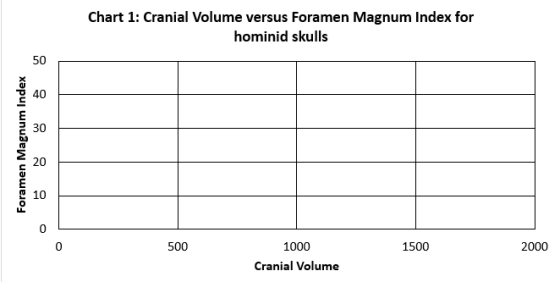
Based on the data you obtained for the hominid skulls (in Tables 1 and 2 and in Chart 1), describe at least three major changes that have occurred in hominids over the last 2 million years.
Homework Answers
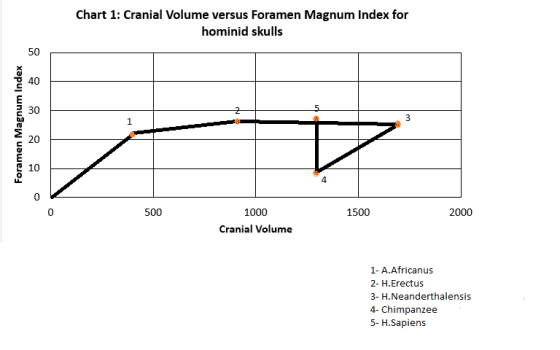
Cranial capacity is a measure of the volume of the interior of the skull of those vertebrates who have a brain. The most commonly used unit of measure is the cubic centimetre (cm3).
Foramen magnum is the hole in the base of the skull through which the spinal cord passes.
Foramen magnum index (FMI) = transverse diameter/ antero-posterior diameter x100
Foramen magnum is an important landmark in the basal region of the cranium because through it significant vital structures transmits i.e. lower end of medulla oblongata along with meninges, vertebral arteries, and the spinal accessory nerve. The foramen magnum functions as a passage of the central nervous system through the skull connecting the brain with the spinal cord. On either side of the foramen magnum is an occipital condyle. These condyles form joints with the first cervical vertebra. This implies more active passage of nueral signals have been possible in modern humans.
Human/ape differences in the position and orientation of the foramen magnum reflect differences in habitual body posture and mode of locomotion. As early humans faced new environmental challenges and evolved bigger bodies, they evolved larger and more complex brains.
A.africanus brains started to show subtle changes in structure and shape as compared with apes. For instance, the neocortex had begun to expand, reorganizing its functions away from visual processing toward other regions of the brain. As our cultural and linguistic complexity, dietary needs and technological prowess took a significant leap forward at this stage, our brains grew to accommodate the changes. The shape changes we see accentuate the regions related to depth of planning, communication, problem solving and other more advanced cognitive functions.
Brain size increases slowly: From 6–2 million years ago
During this time period, early humans began to walk upright and make simple tools. Brain size increased, but only slightly.
Brain and body size increase: From 2 million–800,000 years ago
During this time period early humans spread around the globe, encountering many new environments on different continents. These challenges, along with an increase in body size, led to an increase in brain size.
Brain size increases rapidly: From 800,000–200,000 years ago
Human brain size evolved most rapidly during a time of dramatic climate change. Larger, more complex brains enabled early humans of this time period to interact with each other and with their surroundings in new and different ways. As the environment became more unpredictable, bigger brains helped our ancestors survive.
The modern human brain can:
- store many decades worth of information;
- collect and process information, then deliver output, in split seconds;
- solve problems and create abstract ideas and images.
It can also do much more.
Add Answer to:
Using the data in Table 2,
answer Question 2 in the Lab Worksheet by graphing the...
Most questions answered within 3 hours.
-
Where is the error in this code sequence?
String s1 = "Hello";
String s2 = "ello";...
asked 10 months ago -
Financial data for Joel de Paris, Inc., for last year
follow:
Joel de Paris, Inc.
Balance...
asked 10 months ago -
Consider this reaction:
Al2(SO4)3 (aq)+ BaCl3
(aq) Al2Cl6 (aq)- +
3BaSO4(s) . What is the...
asked 10 months ago -
Suppose that Savneet is considering increasing her
recent random sample from 20 car rentals to 40...
asked 10 months ago -
Trucks arrive at an unloading terminal at an average rate of 120
per hour.
Trucks arrive...
asked 10 months ago -
Why are methanol and ethanol completely soluble in water while
octanol is not very little soluble....
asked 10 months ago -
A facilities manager at a university reads in a research report
that the mean amount of...
asked 10 months ago -
When the CuSO4 is rehydrated by adding water to the anhydrous
compound, is this an endothermic...
asked 10 months ago -
A ray of sunlight is passing from diamond into crown glass; the
angle of incidence is...
asked 10 months ago -
A block of mass 0.249 kg is placed on top of a light, vertical
spring of...
asked 10 months ago -
how do the kidneys compensate in the presences of acidosis
a) trigger hyperventilate
b) reserve acid...
asked 10 months ago -
Question 501 pts
The rental rate of capital to the firm increases. Which of the
following...
asked 10 months ago