
Homework Answers
Add Answer to:
Problem 3: Solve the following initial value / Neumann problem by separation of variables: (8 points)...
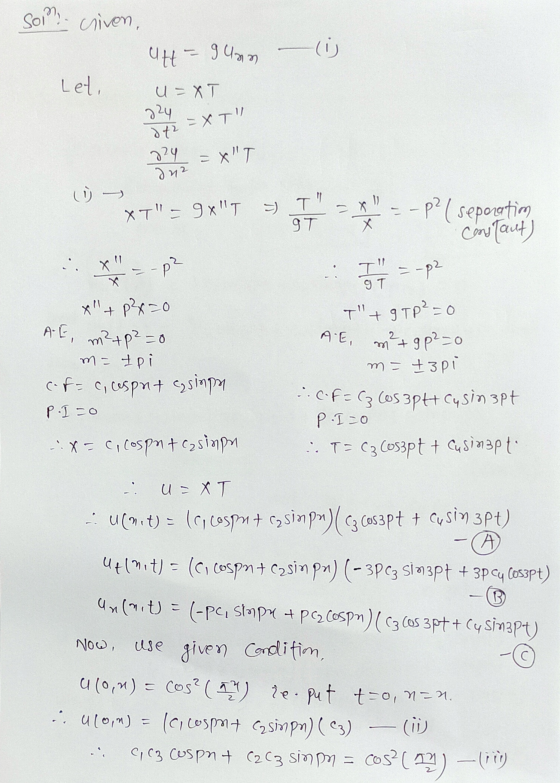
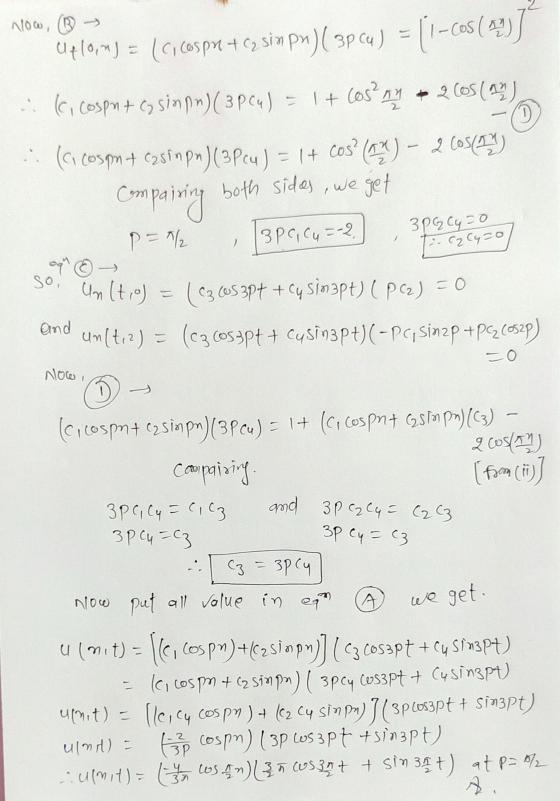
Problem 3: Solve the following initial value / Neumann problem by separation of variables: (8 points)...
 Problem 3: Solve the following initial value / Neumann problem by separation of variables: (8 points) Utt – 9uze = 0, (t, x) ER [0, 2], u(0,2) = cos? (*), u(0, 2) = [1 - COS s()], uz(t,0) = uz(t, 2) = 0.
I need help Problem 3: Solve the following initial value / Neumann problem by separation of...
 I need help
Problem 3: Solve the following initial value / Neumann problem by separation of variables: (8 points) Unt -90.x = 0, (t, x) € Rx (0,2), u(0,x) = cos? ), (0, 3) = [1 – cos (3)], 1,(t,0) = 0,,(t, 2) = 0.
I need help
Problem 3: Solve the following initial value / Neumann problem by separation of variables: (8 points) Unt -90.x = 0, (t, x) € Rx (0,2), u(0,x) = cos? ), (0, 3) = [1 – cos (3)], 1,(t,0) = 0,,(t, 2) = 0.
use the method of separation of variables to solve the following nonhomogeneous initial-Neumann problem: Hint: write...
 use the method of separation of variables to solve the following
nonhomogeneous initial-Neumann problem:
Hint: write the candidate solution as
are the eigenfunctionsof the eigenvalue problem associated with the
homogeneous equation.
use the method of separation of variables to solve the following
nonhomogeneous initial-Neumann problem:
Hint: write the candidate solution as
are the eigenfunctionsof the eigenvalue problem associated with the
homogeneous equation.
pls solve Problem 1: Solve the initial value / Dirichlet problem on the half-line and find...
 pls solve
Problem 1: Solve the initial value / Dirichlet problem on the half-line and find the value u(1, 2): (8 points) uu(t, x) – uzz(t, x) = x +t, (t, x) € Rx [0, +00), u(0, 2) = cos(V), U(0,x) = e, u(t,0) = 1+t.
pls solve
Problem 1: Solve the initial value / Dirichlet problem on the half-line and find the value u(1, 2): (8 points) uu(t, x) – uzz(t, x) = x +t, (t, x) € Rx [0, +00), u(0, 2) = cos(V), U(0,x) = e, u(t,0) = 1+t.
Problem 1: Solve the initial value Dirichlet problem on the half-line and find the value u(1,...
 Problem 1: Solve the initial value Dirichlet problem on the half-line and find the value u(1, 2): (8 points) tut(t, z) - trọt, c) = c+t, (t, x) R x [0, +x), u(0, 2) = cos(V), 4(0,2)=e", u(t,0) = 1+ t.
In each of Problems 1 through 8, solve the initial-boundary value problem using separation of variables....
 In
each of Problems 1 through 8, solve the initial-boundary value
problem using separation of variables. Graph the fiftieth partial
sum of the solution for some values of t. with c = 1 if c is
unspecified in the problem.
a2y = 4- for 0< x <3, t >0 1. at2 ax2 y(0, t)=y(3, t)=0 for t 0 y(x, 0) (x, 0) = x (3- x) for 0x3 0, at a2y yfor 0 <x < 4, t > 0 4....
In
each of Problems 1 through 8, solve the initial-boundary value
problem using separation of variables. Graph the fiftieth partial
sum of the solution for some values of t. with c = 1 if c is
unspecified in the problem.
a2y = 4- for 0< x <3, t >0 1. at2 ax2 y(0, t)=y(3, t)=0 for t 0 y(x, 0) (x, 0) = x (3- x) for 0x3 0, at a2y yfor 0 <x < 4, t > 0 4....
(1 point) Solve the heat problem U4 = Uxx, 0 < x < 1, uz (0,t)...
 (1 point) Solve the heat problem U4 = Uxx, 0 < x < 1, uz (0,t) = 0, uz(t,t) = 0 u(x,0) = cos? (x) (THINK) u(x, t) =
Problem 1: Solve the initial value / Dirichlet problem on the half-line and find the value...
 Problem 1: Solve the initial value / Dirichlet problem on the half-line and find the value u(1, 2): (8 points) Utt(t, 2) – Uzz(t, x) = x+t, (t, x) ER [0, +co), u(0,x) = = cos(2), ut(0, 2) = e", u(t,0) = 1+t.
Problem 1 (Submit): Longitudinal vibrations of an elastic bar with zero strain and stress at both...
 Problem 1 (Submit): Longitudinal vibrations of an elastic bar with zero strain and stress at both ends satisfies the following initial-boundary value problem ras ux(0, t) = uz(r,t) 0 u(z,0) = 5 cos(x), ut(z,0) = 1-cos(2r). (a) Use the method of separation of variables to solve this problem. (b) Find the D'Alembert's solution for this initial-boundary value problem and compare it to the solution you found in (a).
Problem 1 (Submit): Longitudinal vibrations of an elastic bar with zero strain...
Problem 1 (Submit): Longitudinal vibrations of an elastic bar with zero strain and stress at both ends satisfies the following initial-boundary value problem ras ux(0, t) = uz(r,t) 0 u(z,0) = 5 cos(x), ut(z,0) = 1-cos(2r). (a) Use the method of separation of variables to solve this problem. (b) Find the D'Alembert's solution for this initial-boundary value problem and compare it to the solution you found in (a).
Problem 1 (Submit): Longitudinal vibrations of an elastic bar with zero strain...
#01) Use separation of variables to solve the following initial value problem x+ye x dy =...
 #01) Use separation of variables to solve the following initial value problem x+ye x dy = 0; y(1) = 1 Q2) Solue linear equtians dy - {ysetzt cost
 Problem 3: Solve the following initial value / Neumann problem by separation of variables: (8 points) Utt – 9uze = 0, (t, x) ER [0, 2], u(0,2) = cos? (*), u(0, 2) = [1 - COS s()], uz(t,0) = uz(t, 2) = 0.
 I need help
Problem 3: Solve the following initial value / Neumann problem by separation of variables: (8 points) Unt -90.x = 0, (t, x) € Rx (0,2), u(0,x) = cos? ), (0, 3) = [1 – cos (3)], 1,(t,0) = 0,,(t, 2) = 0.
I need help
Problem 3: Solve the following initial value / Neumann problem by separation of variables: (8 points) Unt -90.x = 0, (t, x) € Rx (0,2), u(0,x) = cos? ), (0, 3) = [1 – cos (3)], 1,(t,0) = 0,,(t, 2) = 0.
 use the method of separation of variables to solve the following
nonhomogeneous initial-Neumann problem:
Hint: write the candidate solution as
are the eigenfunctionsof the eigenvalue problem associated with the
homogeneous equation.
use the method of separation of variables to solve the following
nonhomogeneous initial-Neumann problem:
Hint: write the candidate solution as
are the eigenfunctionsof the eigenvalue problem associated with the
homogeneous equation.
 pls solve
Problem 1: Solve the initial value / Dirichlet problem on the half-line and find the value u(1, 2): (8 points) uu(t, x) – uzz(t, x) = x +t, (t, x) € Rx [0, +00), u(0, 2) = cos(V), U(0,x) = e, u(t,0) = 1+t.
pls solve
Problem 1: Solve the initial value / Dirichlet problem on the half-line and find the value u(1, 2): (8 points) uu(t, x) – uzz(t, x) = x +t, (t, x) € Rx [0, +00), u(0, 2) = cos(V), U(0,x) = e, u(t,0) = 1+t.
 Problem 1: Solve the initial value Dirichlet problem on the half-line and find the value u(1, 2): (8 points) tut(t, z) - trọt, c) = c+t, (t, x) R x [0, +x), u(0, 2) = cos(V), 4(0,2)=e", u(t,0) = 1+ t.
 In
each of Problems 1 through 8, solve the initial-boundary value
problem using separation of variables. Graph the fiftieth partial
sum of the solution for some values of t. with c = 1 if c is
unspecified in the problem.
a2y = 4- for 0< x <3, t >0 1. at2 ax2 y(0, t)=y(3, t)=0 for t 0 y(x, 0) (x, 0) = x (3- x) for 0x3 0, at a2y yfor 0 <x < 4, t > 0 4....
In
each of Problems 1 through 8, solve the initial-boundary value
problem using separation of variables. Graph the fiftieth partial
sum of the solution for some values of t. with c = 1 if c is
unspecified in the problem.
a2y = 4- for 0< x <3, t >0 1. at2 ax2 y(0, t)=y(3, t)=0 for t 0 y(x, 0) (x, 0) = x (3- x) for 0x3 0, at a2y yfor 0 <x < 4, t > 0 4....
 (1 point) Solve the heat problem U4 = Uxx, 0 < x < 1, uz (0,t) = 0, uz(t,t) = 0 u(x,0) = cos? (x) (THINK) u(x, t) =
 Problem 1: Solve the initial value / Dirichlet problem on the half-line and find the value u(1, 2): (8 points) Utt(t, 2) – Uzz(t, x) = x+t, (t, x) ER [0, +co), u(0,x) = = cos(2), ut(0, 2) = e", u(t,0) = 1+t.
 Problem 1 (Submit): Longitudinal vibrations of an elastic bar with zero strain and stress at both ends satisfies the following initial-boundary value problem ras ux(0, t) = uz(r,t) 0 u(z,0) = 5 cos(x), ut(z,0) = 1-cos(2r). (a) Use the method of separation of variables to solve this problem. (b) Find the D'Alembert's solution for this initial-boundary value problem and compare it to the solution you found in (a).
Problem 1 (Submit): Longitudinal vibrations of an elastic bar with zero strain...
Problem 1 (Submit): Longitudinal vibrations of an elastic bar with zero strain and stress at both ends satisfies the following initial-boundary value problem ras ux(0, t) = uz(r,t) 0 u(z,0) = 5 cos(x), ut(z,0) = 1-cos(2r). (a) Use the method of separation of variables to solve this problem. (b) Find the D'Alembert's solution for this initial-boundary value problem and compare it to the solution you found in (a).
Problem 1 (Submit): Longitudinal vibrations of an elastic bar with zero strain...
 #01) Use separation of variables to solve the following initial value problem x+ye x dy = 0; y(1) = 1 Q2) Solue linear equtians dy - {ysetzt cost
Most questions answered within 3 hours.
-
Where is the error in this code sequence?
String s1 = "Hello";
String s2 = "ello";...
asked 11 months ago -
Financial data for Joel de Paris, Inc., for last year
follow:
Joel de Paris, Inc.
Balance...
asked 11 months ago -
Consider this reaction:
Al2(SO4)3 (aq)+ BaCl3
(aq) Al2Cl6 (aq)- +
3BaSO4(s) . What is the...
asked 11 months ago -
Suppose that Savneet is considering increasing her
recent random sample from 20 car rentals to 40...
asked 11 months ago -
Trucks arrive at an unloading terminal at an average rate of 120
per hour.
Trucks arrive...
asked 11 months ago -
Why are methanol and ethanol completely soluble in water while
octanol is not very little soluble....
asked 11 months ago -
A facilities manager at a university reads in a research report
that the mean amount of...
asked 11 months ago -
When the CuSO4 is rehydrated by adding water to the anhydrous
compound, is this an endothermic...
asked 11 months ago -
A ray of sunlight is passing from diamond into crown glass; the
angle of incidence is...
asked 11 months ago -
A block of mass 0.249 kg is placed on top of a light, vertical
spring of...
asked 11 months ago -
how do the kidneys compensate in the presences of acidosis
a) trigger hyperventilate
b) reserve acid...
asked 11 months ago -
Question 501 pts
The rental rate of capital to the firm increases. Which of the
following...
asked 11 months ago