
Homework Answers
![Edution: Given Utt gUxoc (toJERX[012] U101_) = cos? () V (0,4)= [- cos()] Uslo) Ux (t, 2) so By wing Sepration of variable:](http://img.homeworklib.com/questions/d518efd0-10d0-11eb-bc89-23279027e99b.png?x-oss-process=image/resize,w_560)
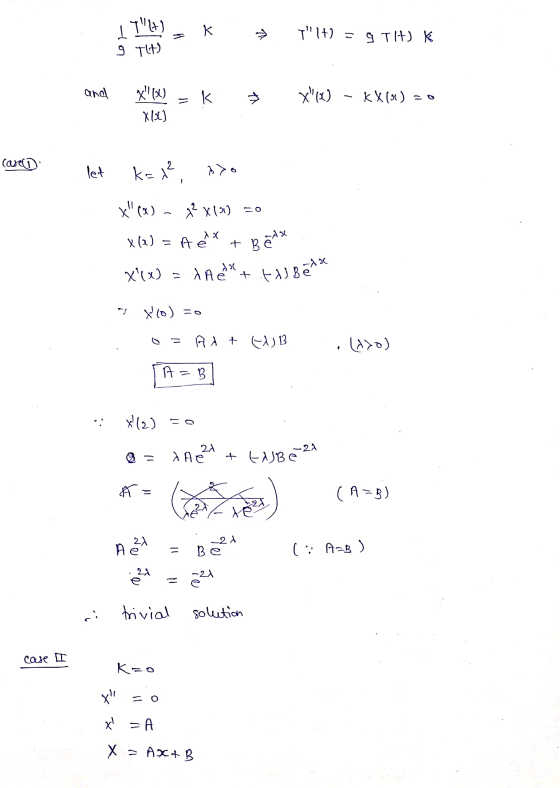
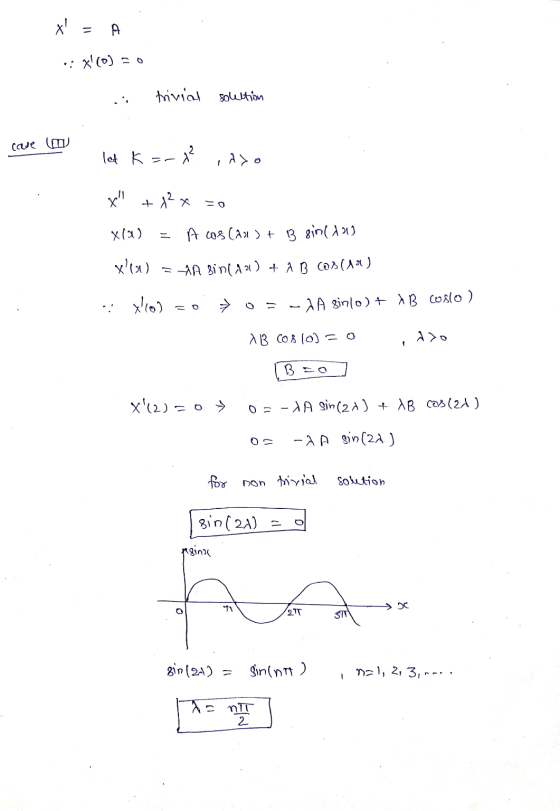
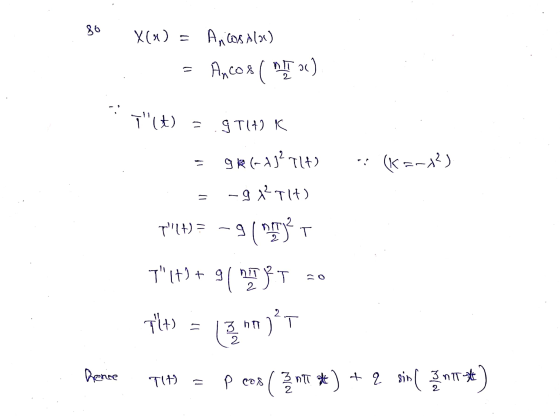
![Ultix) = X () Tit) VH »)= An cos (nt x) [ Pn cox (3 MT) + An sin ( 317 )) (np9 x) cos (21) + Bo Bin (3 m+T+) cos(max)] Ultin)](http://img.homeworklib.com/questions/d7adada0-10d0-11eb-be79-7766b1dc1694.png?x-oss-process=image/resize,w_560)
![(40) 04101%) = 2 E [o + 14 [! - C08 (] en benut) con (x)] [ + cosº (112) – 2 C06 ()] = (131) 8n cou ( ) ] 1 +40* 200*2)) - 2](http://img.homeworklib.com/questions/d875cb20-10d0-11eb-84b7-7d34267ae19b.png?x-oss-process=image/resize,w_560)
Add Answer to:
Problem 3: Solve the following initial value / Neumann problem by separation of variables: (8 points)...
Problem 3: Solve the following initial value / Neumann problem by separation of variables: (8 points)...
 Problem 3: Solve the following initial value / Neumann problem by separation of variables: (8 points) U4 - 9uzz = 0, (t, x) € Rx (0,2), u(0, 2) = cos? (17), 4(0, 1) = [1 $("))", uz(t,0) = un(t, 2) = 0. - COS
I need help Problem 3: Solve the following initial value / Neumann problem by separation of...
 I need help
Problem 3: Solve the following initial value / Neumann problem by separation of variables: (8 points) Unt -90.x = 0, (t, x) € Rx (0,2), u(0,x) = cos? ), (0, 3) = [1 – cos (3)], 1,(t,0) = 0,,(t, 2) = 0.
I need help
Problem 3: Solve the following initial value / Neumann problem by separation of variables: (8 points) Unt -90.x = 0, (t, x) € Rx (0,2), u(0,x) = cos? ), (0, 3) = [1 – cos (3)], 1,(t,0) = 0,,(t, 2) = 0.
use the method of separation of variables to solve the following nonhomogeneous initial-Neumann problem: Hint: write...
 use the method of separation of variables to solve the following
nonhomogeneous initial-Neumann problem:
Hint: write the candidate solution as
are the eigenfunctionsof the eigenvalue problem associated with the
homogeneous equation.
use the method of separation of variables to solve the following
nonhomogeneous initial-Neumann problem:
Hint: write the candidate solution as
are the eigenfunctionsof the eigenvalue problem associated with the
homogeneous equation.
Problem 1: Solve the initial value / Dirichlet problem on the half-line and find the value...
 Problem 1: Solve the initial value / Dirichlet problem on the half-line and find the value u(1, 2): (8 points) Utt(t, 2) – Uzz(t, x) = x+t, (t, x) ER [0, +co), u(0,x) = = cos(2), ut(0, 2) = e", u(t,0) = 1+t.
Problem 1: Solve the initial value Dirichlet problem on the half-line and find the value u(1,...
 Problem 1: Solve the initial value Dirichlet problem on the half-line and find the value u(1, 2): (8 points) tut(t, z) - trọt, c) = c+t, (t, x) R x [0, +x), u(0, 2) = cos(V), 4(0,2)=e", u(t,0) = 1+ t.
In each of Problems 1 through 8, solve the initial-boundary value problem using separation of variables....
 In
each of Problems 1 through 8, solve the initial-boundary value
problem using separation of variables. Graph the fiftieth partial
sum of the solution for some values of t. with c = 1 if c is
unspecified in the problem.
a2y = 4- for 0< x <3, t >0 1. at2 ax2 y(0, t)=y(3, t)=0 for t 0 y(x, 0) (x, 0) = x (3- x) for 0x3 0, at a2y yfor 0 <x < 4, t > 0 4....
In
each of Problems 1 through 8, solve the initial-boundary value
problem using separation of variables. Graph the fiftieth partial
sum of the solution for some values of t. with c = 1 if c is
unspecified in the problem.
a2y = 4- for 0< x <3, t >0 1. at2 ax2 y(0, t)=y(3, t)=0 for t 0 y(x, 0) (x, 0) = x (3- x) for 0x3 0, at a2y yfor 0 <x < 4, t > 0 4....
pls solve Problem 1: Solve the initial value / Dirichlet problem on the half-line and find...
 pls solve
Problem 1: Solve the initial value / Dirichlet problem on the half-line and find the value u(1, 2): (8 points) uu(t, x) – uzz(t, x) = x +t, (t, x) € Rx [0, +00), u(0, 2) = cos(V), U(0,x) = e, u(t,0) = 1+t.
pls solve
Problem 1: Solve the initial value / Dirichlet problem on the half-line and find the value u(1, 2): (8 points) uu(t, x) – uzz(t, x) = x +t, (t, x) € Rx [0, +00), u(0, 2) = cos(V), U(0,x) = e, u(t,0) = 1+t.
Problem 1 (Submit): Longitudinal vibrations of an elastic bar with zero strain and stress at both...
 Problem 1 (Submit): Longitudinal vibrations of an elastic bar with zero strain and stress at both ends satisfies the following initial-boundary value problem ras ux(0, t) = uz(r,t) 0 u(z,0) = 5 cos(x), ut(z,0) = 1-cos(2r). (a) Use the method of separation of variables to solve this problem. (b) Find the D'Alembert's solution for this initial-boundary value problem and compare it to the solution you found in (a).
Problem 1 (Submit): Longitudinal vibrations of an elastic bar with zero strain...
Problem 1 (Submit): Longitudinal vibrations of an elastic bar with zero strain and stress at both ends satisfies the following initial-boundary value problem ras ux(0, t) = uz(r,t) 0 u(z,0) = 5 cos(x), ut(z,0) = 1-cos(2r). (a) Use the method of separation of variables to solve this problem. (b) Find the D'Alembert's solution for this initial-boundary value problem and compare it to the solution you found in (a).
Problem 1 (Submit): Longitudinal vibrations of an elastic bar with zero strain...
5. Consider the following IBVP (initial boundary value problem utt - Curr = 0, 0<x<1, t>0,...
 5. Consider the following IBVP (initial boundary value problem utt - Curr = 0, 0<x<1, t>0, with boundary conditions u(0,t) = u(1, t) = 0, > 0 and initial conditions (7,0) = x(1 – 2), 14(2,0) = 0, 0<x< 1. Use separation of variables method to find an infinite series solution of this problem. Do a complete calculation for this problem.
#01) Use separation of variables to solve the following initial value problem x+ye x dy =...
 #01) Use separation of variables to solve the following initial value problem x+ye x dy = 0; y(1) = 1 Q2) Solue linear equtians dy - {ysetzt cost
 Problem 3: Solve the following initial value / Neumann problem by separation of variables: (8 points) U4 - 9uzz = 0, (t, x) € Rx (0,2), u(0, 2) = cos? (17), 4(0, 1) = [1 $("))", uz(t,0) = un(t, 2) = 0. - COS
 I need help
Problem 3: Solve the following initial value / Neumann problem by separation of variables: (8 points) Unt -90.x = 0, (t, x) € Rx (0,2), u(0,x) = cos? ), (0, 3) = [1 – cos (3)], 1,(t,0) = 0,,(t, 2) = 0.
I need help
Problem 3: Solve the following initial value / Neumann problem by separation of variables: (8 points) Unt -90.x = 0, (t, x) € Rx (0,2), u(0,x) = cos? ), (0, 3) = [1 – cos (3)], 1,(t,0) = 0,,(t, 2) = 0.
 use the method of separation of variables to solve the following
nonhomogeneous initial-Neumann problem:
Hint: write the candidate solution as
are the eigenfunctionsof the eigenvalue problem associated with the
homogeneous equation.
use the method of separation of variables to solve the following
nonhomogeneous initial-Neumann problem:
Hint: write the candidate solution as
are the eigenfunctionsof the eigenvalue problem associated with the
homogeneous equation.
 Problem 1: Solve the initial value / Dirichlet problem on the half-line and find the value u(1, 2): (8 points) Utt(t, 2) – Uzz(t, x) = x+t, (t, x) ER [0, +co), u(0,x) = = cos(2), ut(0, 2) = e", u(t,0) = 1+t.
 Problem 1: Solve the initial value Dirichlet problem on the half-line and find the value u(1, 2): (8 points) tut(t, z) - trọt, c) = c+t, (t, x) R x [0, +x), u(0, 2) = cos(V), 4(0,2)=e", u(t,0) = 1+ t.
 In
each of Problems 1 through 8, solve the initial-boundary value
problem using separation of variables. Graph the fiftieth partial
sum of the solution for some values of t. with c = 1 if c is
unspecified in the problem.
a2y = 4- for 0< x <3, t >0 1. at2 ax2 y(0, t)=y(3, t)=0 for t 0 y(x, 0) (x, 0) = x (3- x) for 0x3 0, at a2y yfor 0 <x < 4, t > 0 4....
In
each of Problems 1 through 8, solve the initial-boundary value
problem using separation of variables. Graph the fiftieth partial
sum of the solution for some values of t. with c = 1 if c is
unspecified in the problem.
a2y = 4- for 0< x <3, t >0 1. at2 ax2 y(0, t)=y(3, t)=0 for t 0 y(x, 0) (x, 0) = x (3- x) for 0x3 0, at a2y yfor 0 <x < 4, t > 0 4....
 pls solve
Problem 1: Solve the initial value / Dirichlet problem on the half-line and find the value u(1, 2): (8 points) uu(t, x) – uzz(t, x) = x +t, (t, x) € Rx [0, +00), u(0, 2) = cos(V), U(0,x) = e, u(t,0) = 1+t.
pls solve
Problem 1: Solve the initial value / Dirichlet problem on the half-line and find the value u(1, 2): (8 points) uu(t, x) – uzz(t, x) = x +t, (t, x) € Rx [0, +00), u(0, 2) = cos(V), U(0,x) = e, u(t,0) = 1+t.
 Problem 1 (Submit): Longitudinal vibrations of an elastic bar with zero strain and stress at both ends satisfies the following initial-boundary value problem ras ux(0, t) = uz(r,t) 0 u(z,0) = 5 cos(x), ut(z,0) = 1-cos(2r). (a) Use the method of separation of variables to solve this problem. (b) Find the D'Alembert's solution for this initial-boundary value problem and compare it to the solution you found in (a).
Problem 1 (Submit): Longitudinal vibrations of an elastic bar with zero strain...
Problem 1 (Submit): Longitudinal vibrations of an elastic bar with zero strain and stress at both ends satisfies the following initial-boundary value problem ras ux(0, t) = uz(r,t) 0 u(z,0) = 5 cos(x), ut(z,0) = 1-cos(2r). (a) Use the method of separation of variables to solve this problem. (b) Find the D'Alembert's solution for this initial-boundary value problem and compare it to the solution you found in (a).
Problem 1 (Submit): Longitudinal vibrations of an elastic bar with zero strain...
 5. Consider the following IBVP (initial boundary value problem utt - Curr = 0, 0<x<1, t>0, with boundary conditions u(0,t) = u(1, t) = 0, > 0 and initial conditions (7,0) = x(1 – 2), 14(2,0) = 0, 0<x< 1. Use separation of variables method to find an infinite series solution of this problem. Do a complete calculation for this problem.
 #01) Use separation of variables to solve the following initial value problem x+ye x dy = 0; y(1) = 1 Q2) Solue linear equtians dy - {ysetzt cost
Most questions answered within 3 hours.
-
Where is the error in this code sequence?
String s1 = "Hello";
String s2 = "ello";...
asked 11 months ago -
Financial data for Joel de Paris, Inc., for last year
follow:
Joel de Paris, Inc.
Balance...
asked 11 months ago -
Consider this reaction:
Al2(SO4)3 (aq)+ BaCl3
(aq) Al2Cl6 (aq)- +
3BaSO4(s) . What is the...
asked 11 months ago -
Suppose that Savneet is considering increasing her
recent random sample from 20 car rentals to 40...
asked 11 months ago -
Trucks arrive at an unloading terminal at an average rate of 120
per hour.
Trucks arrive...
asked 11 months ago -
Why are methanol and ethanol completely soluble in water while
octanol is not very little soluble....
asked 11 months ago -
A facilities manager at a university reads in a research report
that the mean amount of...
asked 11 months ago -
When the CuSO4 is rehydrated by adding water to the anhydrous
compound, is this an endothermic...
asked 11 months ago -
A ray of sunlight is passing from diamond into crown glass; the
angle of incidence is...
asked 11 months ago -
A block of mass 0.249 kg is placed on top of a light, vertical
spring of...
asked 11 months ago -
how do the kidneys compensate in the presences of acidosis
a) trigger hyperventilate
b) reserve acid...
asked 11 months ago -
Question 501 pts
The rental rate of capital to the firm increases. Which of the
following...
asked 11 months ago