
Homework Answers
Solution:
(1)
Screenshot :
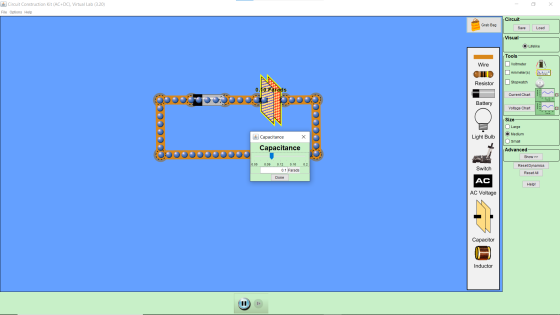
Capacitace: 0.1 Farads.
(2)
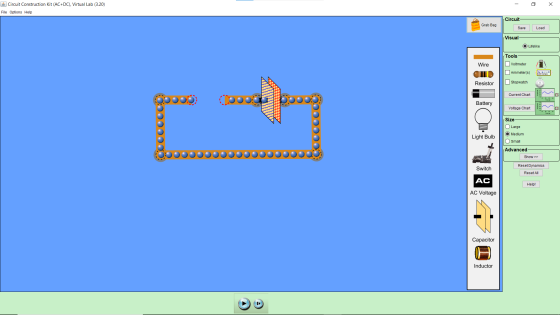
Screenshot:
(3)
Screenshot:
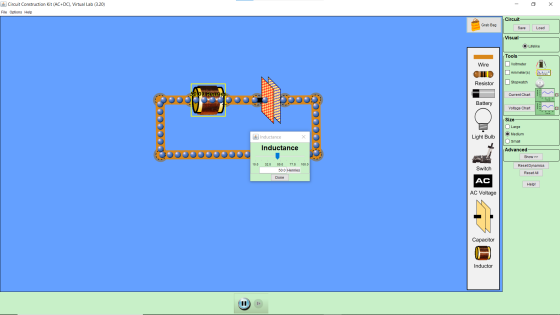
Indutance : 50.0 Henries.
Observations:
As soon as the capacitor is connected to inductor, a current starts flowing in the circuit, and the capacitor starts discharging. The capacitor takes some finite time to discharge completly, as soon as the discharge of the capacitor is complete, the capacitor starts charging again but with opposite polarity. On getting fully charge, the capacitor will again discharge sending current through the inductor in opposite direction(as plates have opposite polarities).
(4)
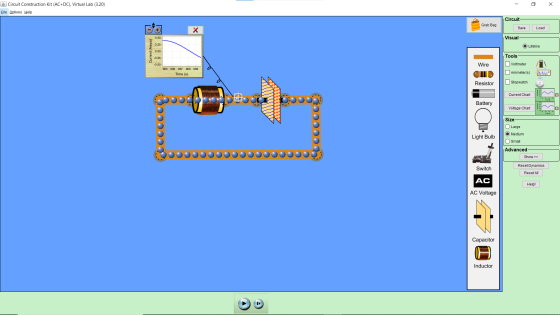
The maximum current is approximatly 0.50 A.
The minimum current is approximatly -0.50 A.
Period between maximum peaks:
Screenshot:
(1) Time at which first maximum peak was measured:
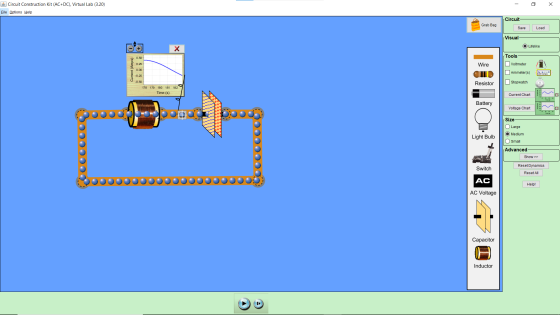
(2) Time at which second maximum peak was measured:
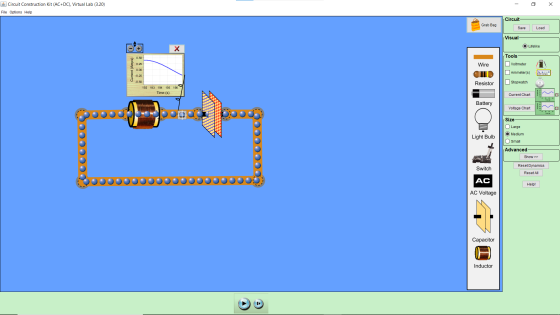
Time of first maximum peak T1 = 178 s.
Time of second maximum peak T2 = 192 s.
Hence,
Time period T = T2 - T1 = 192 - 178 = 14 s.
Add Answer to:
Use the following PhET simulation to complete the experiment. Include this document, figures, and typed summary...
9780750677332.... TS Formula 1 Live Str... PDF JPG PDF a JPG - Conv... Petroleum Ebooks... Sterling...
 9780750677332.... TS Formula 1 Live Str... PDF JPG PDF a JPG - Conv... Petroleum Ebooks... Sterling County, Part 2 - RLC Circuit 1. Create a circuit with an AC Voltage in series with a resistor, inductor, and capacitor. Note also the capacitance, inductance, and resistance as was done in Part 1. 2. Right click the AC Voltage and click Change Voltage and note the current value of the voltage. Click Change Frequency and note the current value of frequency. 3....
I am currently trying to figure out the experiment below. Please complete Table 1 with an...
 I am currently trying to figure out the experiment below. Please
complete Table 1 with an explanation, I appreciate it thank
you! Promise to give thumbs up!
Introduction The phase differences between the output voltage, the voltage across the inductor, the voltage across the capacitor, and the voltage across the resistor will be examined at resonant frequency. The voltage and phase relationship will also be examined for frequencies above and below resonance. Theory An inductor, a capacitor, and a resistor are...
I am currently trying to figure out the experiment below. Please
complete Table 1 with an explanation, I appreciate it thank
you! Promise to give thumbs up!
Introduction The phase differences between the output voltage, the voltage across the inductor, the voltage across the capacitor, and the voltage across the resistor will be examined at resonant frequency. The voltage and phase relationship will also be examined for frequencies above and below resonance. Theory An inductor, a capacitor, and a resistor are...
please use multisim to answer all the parts. EXPERIMENT 3 TESTING SERIES & PARALLEL RESONANCES Objectives:...
 please use multisim to answer all the parts.
EXPERIMENT 3 TESTING SERIES & PARALLEL RESONANCES Objectives: To examine the conditions of resonances To observe the resonant circuit properties Equipment & components: A personal computer with Multisim software Preview questions: 1. How does the resonant frequency relate to the inductance and capacitance in a series LC circuit? 2. When the circuit in Figure 1 is tuned to resonant frequency, how does the voltage cross the resistor relate to the applied voltage?...
please use multisim to answer all the parts.
EXPERIMENT 3 TESTING SERIES & PARALLEL RESONANCES Objectives: To examine the conditions of resonances To observe the resonant circuit properties Equipment & components: A personal computer with Multisim software Preview questions: 1. How does the resonant frequency relate to the inductance and capacitance in a series LC circuit? 2. When the circuit in Figure 1 is tuned to resonant frequency, how does the voltage cross the resistor relate to the applied voltage?...
# No plagiarism #Decide on the type of motherboard to use in the computer system you...
# No plagiarism #Decide on the type of motherboard to use in the computer system you are designing. Explain what it is and why you chose it. This from Lab 5.1 Using the information you recorded previously in Step 5, consult Table 5-1 to find out how to enter your system’s setup utility. (Alternatively, when you first turn on your PC, look for a message on your screen, which might read something like “Press F2 to access setup.” Table 5-1:...
 9780750677332.... TS Formula 1 Live Str... PDF JPG PDF a JPG - Conv... Petroleum Ebooks... Sterling County, Part 2 - RLC Circuit 1. Create a circuit with an AC Voltage in series with a resistor, inductor, and capacitor. Note also the capacitance, inductance, and resistance as was done in Part 1. 2. Right click the AC Voltage and click Change Voltage and note the current value of the voltage. Click Change Frequency and note the current value of frequency. 3....
 I am currently trying to figure out the experiment below. Please
complete Table 1 with an explanation, I appreciate it thank
you! Promise to give thumbs up!
Introduction The phase differences between the output voltage, the voltage across the inductor, the voltage across the capacitor, and the voltage across the resistor will be examined at resonant frequency. The voltage and phase relationship will also be examined for frequencies above and below resonance. Theory An inductor, a capacitor, and a resistor are...
I am currently trying to figure out the experiment below. Please
complete Table 1 with an explanation, I appreciate it thank
you! Promise to give thumbs up!
Introduction The phase differences between the output voltage, the voltage across the inductor, the voltage across the capacitor, and the voltage across the resistor will be examined at resonant frequency. The voltage and phase relationship will also be examined for frequencies above and below resonance. Theory An inductor, a capacitor, and a resistor are...
 please use multisim to answer all the parts.
EXPERIMENT 3 TESTING SERIES & PARALLEL RESONANCES Objectives: To examine the conditions of resonances To observe the resonant circuit properties Equipment & components: A personal computer with Multisim software Preview questions: 1. How does the resonant frequency relate to the inductance and capacitance in a series LC circuit? 2. When the circuit in Figure 1 is tuned to resonant frequency, how does the voltage cross the resistor relate to the applied voltage?...
please use multisim to answer all the parts.
EXPERIMENT 3 TESTING SERIES & PARALLEL RESONANCES Objectives: To examine the conditions of resonances To observe the resonant circuit properties Equipment & components: A personal computer with Multisim software Preview questions: 1. How does the resonant frequency relate to the inductance and capacitance in a series LC circuit? 2. When the circuit in Figure 1 is tuned to resonant frequency, how does the voltage cross the resistor relate to the applied voltage?...
Most questions answered within 3 hours.
-
Where is the error in this code sequence?
String s1 = "Hello";
String s2 = "ello";...
asked 10 months ago -
Financial data for Joel de Paris, Inc., for last year
follow:
Joel de Paris, Inc.
Balance...
asked 10 months ago -
Consider this reaction:
Al2(SO4)3 (aq)+ BaCl3
(aq) Al2Cl6 (aq)- +
3BaSO4(s) . What is the...
asked 10 months ago -
Suppose that Savneet is considering increasing her
recent random sample from 20 car rentals to 40...
asked 10 months ago -
Trucks arrive at an unloading terminal at an average rate of 120
per hour.
Trucks arrive...
asked 10 months ago -
Why are methanol and ethanol completely soluble in water while
octanol is not very little soluble....
asked 10 months ago -
A facilities manager at a university reads in a research report
that the mean amount of...
asked 10 months ago -
When the CuSO4 is rehydrated by adding water to the anhydrous
compound, is this an endothermic...
asked 10 months ago -
A ray of sunlight is passing from diamond into crown glass; the
angle of incidence is...
asked 10 months ago -
A block of mass 0.249 kg is placed on top of a light, vertical
spring of...
asked 10 months ago -
how do the kidneys compensate in the presences of acidosis
a) trigger hyperventilate
b) reserve acid...
asked 10 months ago -
Question 501 pts
The rental rate of capital to the firm increases. Which of the
following...
asked 10 months ago