
Homework Answers
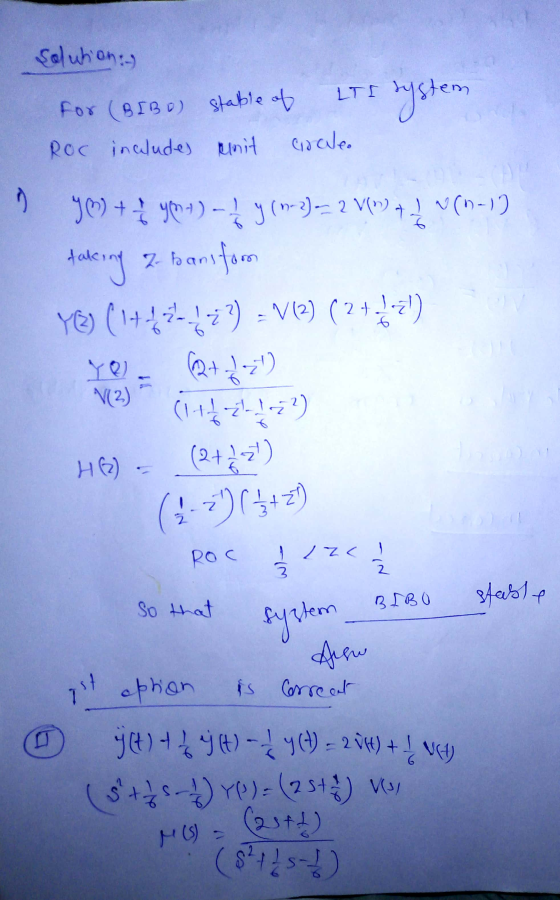
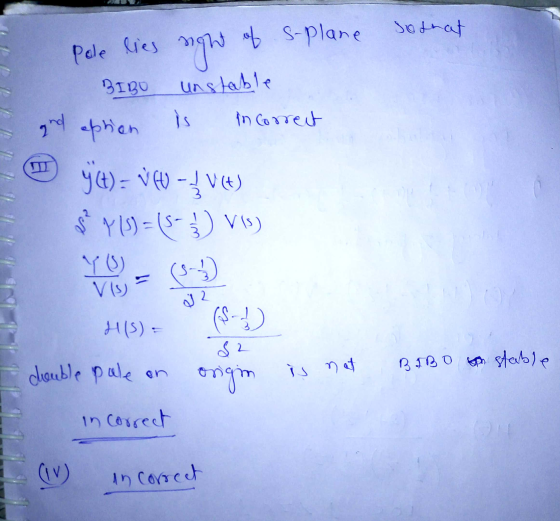
Add Answer to:
In this question you need to tick all correct answers. Which of the following systems are...
In this question you need to tick all correct answers. Which of the following systems are...
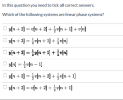 In this question you need to tick all correct answers. Which of the following systems are linear phase systems? y[n + 2] = v[n+ 2] + { v[n + 1] + v[n] y[n + 2] = { v[n + 1] + > v[n] y[n+ 2] = zy[n+ 1] + > v[n] y[n] = {v[n – 1] y[n+2] = { v[n+ 2] + > v[n+ 1] y[n+2] = v[n + 2] + { v[n + 1]
In this question you need to tick all correct answers. Which of the following continuous time...
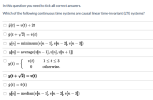 In this question you need to tick all correct answers. Which of the following continuous time systems are causal linear time-invariant (LTI) systems? j(t) = v(t) + 2t (t + v2) = (4) y[n] = minimum(v[n – 1), v[n – 2), v[n – 3]) Oy[n] = average(v[n – 1), v[n], v[n + 1]) v(t) 1<t<3 0 otherwise. s() ={ y(t + 2) = v(t) y(t) = öſt) Oy[n] = median(v[n - 1), vín – 2], v[n – 3])
In this question you need to tick all correct answers. Which of the following discrete time...
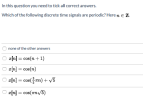 In this question you need to tick all correct answers. Which of the following discrete time signals are periodic? Heren e Z. none of the other answers x[n] = cos(n+1) Ox[n] = cos(n) Ox[n] = cos(fin) + V5 Ox[n] = cos(inV5)
(please explain your answers). for the following transfer function, a) determine if the associated system is...
 (please explain your answers). for the following transfer
function,
a) determine if the associated system is BIBO stable
b) if BIBO stable systems in question a). For these systems,
determine the steady state output Yss(t) given
- an input u(t) = 2step(t) → Yss(t) = lim t→+∞ (y(t)) = constant
value
-an input u(t) = 3 sin(t) → Yss(t) = sin function
c) if non BIBO stable systems in question a). For these systems,
find a bounded input that makes...
(please explain your answers). for the following transfer
function,
a) determine if the associated system is BIBO stable
b) if BIBO stable systems in question a). For these systems,
determine the steady state output Yss(t) given
- an input u(t) = 2step(t) → Yss(t) = lim t→+∞ (y(t)) = constant
value
-an input u(t) = 3 sin(t) → Yss(t) = sin function
c) if non BIBO stable systems in question a). For these systems,
find a bounded input that makes...
2.45,2.48 explain clearly please Signals and Systems: A Primer with MATLAB 104 20 1H y(t) x(t)...
 2.45,2.48 explain clearly please
Signals and Systems: A Primer with MATLAB 104 20 1H y(t) x(t) FIGURE 2.38 For Problem 2.48. 2.45 An accumulator has impulse response h[n] = u[n]. Check if an accumulator is BIBO stable 2.46 The input to the circuit discussed in Example 2.15 is v,) ut - )dt - 2) Use convolution to determine the output 2.47 Determine the output of the circuit discussed in Practice Problem 2.15 if v,) u() 2.48 If the filter in...
2.45,2.48 explain clearly please
Signals and Systems: A Primer with MATLAB 104 20 1H y(t) x(t) FIGURE 2.38 For Problem 2.48. 2.45 An accumulator has impulse response h[n] = u[n]. Check if an accumulator is BIBO stable 2.46 The input to the circuit discussed in Example 2.15 is v,) ut - )dt - 2) Use convolution to determine the output 2.47 Determine the output of the circuit discussed in Practice Problem 2.15 if v,) u() 2.48 If the filter in...
A system is BIBO (bounded-input, bounded-output) stable if every bounded input X(t) yields a bounded output...
 A system is BIBO (bounded-input, bounded-output) stable if every bounded input X(t) yields a bounded output y(t). A system is NOT BIBO stable if there exists any bounded input that results in an unbounded output. By "bounded", we mean that the magnitude of the signal is always less than some finite number. (The signal x(t)=sin(t) would be considered a bounded signal, but X(t)t would not be a bounded signal.) Signals that are infinite in time, but with a magnitude that...
Please answer all of the questions. 6. Consider three systems with the following input-output relationships: {...
 Please
answer all of the questions.
6. Consider three systems with the following input-output relationships: { 0, odd System 1: yn 피[핑], n even System 2: y[nx[n] - 10xr[n + 2] + 3xr[n - 1 System 3: yn x[3n] The interconnection diagram is at follows: y System 3 System System 2 Find the input-output relationship of the interconnected system. State the properties of the system (linear, stable, time invariant, memoryless, and causal)
6. Consider three systems with the following input-output...
Please
answer all of the questions.
6. Consider three systems with the following input-output relationships: { 0, odd System 1: yn 피[핑], n even System 2: y[nx[n] - 10xr[n + 2] + 3xr[n - 1 System 3: yn x[3n] The interconnection diagram is at follows: y System 3 System System 2 Find the input-output relationship of the interconnected system. State the properties of the system (linear, stable, time invariant, memoryless, and causal)
6. Consider three systems with the following input-output...
Linear Systems and Signals ECEN 400 [2096] Two sequences, a(n) and htn) are given by: 1....
 Linear Systems and Signals ECEN 400
[2096] Two sequences, a(n) and htn) are given by: 1. (1) Represent the x(n) and hin) in sequence format and label 1 for n-0 position. (2) Determine the output sequence yín) using the convolution sum, and represent the yín) in sequence (3) Plot (Stem) xn), hin) and y(n) format and label 1for -0 position. s) x(n hln) y ln) 0-3 0-4, 0.4 2. [2096] Given a following system, (1) Find the transfer function H...
Linear Systems and Signals ECEN 400
[2096] Two sequences, a(n) and htn) are given by: 1. (1) Represent the x(n) and hin) in sequence format and label 1 for n-0 position. (2) Determine the output sequence yín) using the convolution sum, and represent the yín) in sequence (3) Plot (Stem) xn), hin) and y(n) format and label 1for -0 position. s) x(n hln) y ln) 0-3 0-4, 0.4 2. [2096] Given a following system, (1) Find the transfer function H...
14. Which of the following define a BIBO (Bounded input bounded output) system? One or more...
 14. Which of the following define a BIBO (Bounded input bounded output) system? One or more answers could be correct. S H(s) (s-5) (s+10) 1 H(s) = (s+5) s(s+10) H(s) (s+5) (s+100)(s+10) H(S) = $2+100 H(s) = s3
Consider three systems with the following input-output relationships 6. Consider three systems with the following input-output...
 Consider three systems with the following input-output
relationships
6. Consider three systems with the following input-output relationships: { 4 0, odd System 1: y[n n even r[n] 10ar(n 2]3r[n - 1 System 2: yn + + System 3: yn x[3n] The interconnection diagram is at follows: System 1 System 2 System 3 Find the input-output relationship of the interconnected system. State the properties of the system (linear, stable, time invariant, memoryless, and causal).
6. Consider three systems with the following...
Consider three systems with the following input-output
relationships
6. Consider three systems with the following input-output relationships: { 4 0, odd System 1: y[n n even r[n] 10ar(n 2]3r[n - 1 System 2: yn + + System 3: yn x[3n] The interconnection diagram is at follows: System 1 System 2 System 3 Find the input-output relationship of the interconnected system. State the properties of the system (linear, stable, time invariant, memoryless, and causal).
6. Consider three systems with the following...
 In this question you need to tick all correct answers. Which of the following systems are linear phase systems? y[n + 2] = v[n+ 2] + { v[n + 1] + v[n] y[n + 2] = { v[n + 1] + > v[n] y[n+ 2] = zy[n+ 1] + > v[n] y[n] = {v[n – 1] y[n+2] = { v[n+ 2] + > v[n+ 1] y[n+2] = v[n + 2] + { v[n + 1]
 In this question you need to tick all correct answers. Which of the following continuous time systems are causal linear time-invariant (LTI) systems? j(t) = v(t) + 2t (t + v2) = (4) y[n] = minimum(v[n – 1), v[n – 2), v[n – 3]) Oy[n] = average(v[n – 1), v[n], v[n + 1]) v(t) 1<t<3 0 otherwise. s() ={ y(t + 2) = v(t) y(t) = öſt) Oy[n] = median(v[n - 1), vín – 2], v[n – 3])
 In this question you need to tick all correct answers. Which of the following discrete time signals are periodic? Heren e Z. none of the other answers x[n] = cos(n+1) Ox[n] = cos(n) Ox[n] = cos(fin) + V5 Ox[n] = cos(inV5)
 (please explain your answers). for the following transfer
function,
a) determine if the associated system is BIBO stable
b) if BIBO stable systems in question a). For these systems,
determine the steady state output Yss(t) given
- an input u(t) = 2step(t) → Yss(t) = lim t→+∞ (y(t)) = constant
value
-an input u(t) = 3 sin(t) → Yss(t) = sin function
c) if non BIBO stable systems in question a). For these systems,
find a bounded input that makes...
(please explain your answers). for the following transfer
function,
a) determine if the associated system is BIBO stable
b) if BIBO stable systems in question a). For these systems,
determine the steady state output Yss(t) given
- an input u(t) = 2step(t) → Yss(t) = lim t→+∞ (y(t)) = constant
value
-an input u(t) = 3 sin(t) → Yss(t) = sin function
c) if non BIBO stable systems in question a). For these systems,
find a bounded input that makes...
 2.45,2.48 explain clearly please
Signals and Systems: A Primer with MATLAB 104 20 1H y(t) x(t) FIGURE 2.38 For Problem 2.48. 2.45 An accumulator has impulse response h[n] = u[n]. Check if an accumulator is BIBO stable 2.46 The input to the circuit discussed in Example 2.15 is v,) ut - )dt - 2) Use convolution to determine the output 2.47 Determine the output of the circuit discussed in Practice Problem 2.15 if v,) u() 2.48 If the filter in...
2.45,2.48 explain clearly please
Signals and Systems: A Primer with MATLAB 104 20 1H y(t) x(t) FIGURE 2.38 For Problem 2.48. 2.45 An accumulator has impulse response h[n] = u[n]. Check if an accumulator is BIBO stable 2.46 The input to the circuit discussed in Example 2.15 is v,) ut - )dt - 2) Use convolution to determine the output 2.47 Determine the output of the circuit discussed in Practice Problem 2.15 if v,) u() 2.48 If the filter in...
 A system is BIBO (bounded-input, bounded-output) stable if every bounded input X(t) yields a bounded output y(t). A system is NOT BIBO stable if there exists any bounded input that results in an unbounded output. By "bounded", we mean that the magnitude of the signal is always less than some finite number. (The signal x(t)=sin(t) would be considered a bounded signal, but X(t)t would not be a bounded signal.) Signals that are infinite in time, but with a magnitude that...
 Please
answer all of the questions.
6. Consider three systems with the following input-output relationships: { 0, odd System 1: yn 피[핑], n even System 2: y[nx[n] - 10xr[n + 2] + 3xr[n - 1 System 3: yn x[3n] The interconnection diagram is at follows: y System 3 System System 2 Find the input-output relationship of the interconnected system. State the properties of the system (linear, stable, time invariant, memoryless, and causal)
6. Consider three systems with the following input-output...
Please
answer all of the questions.
6. Consider three systems with the following input-output relationships: { 0, odd System 1: yn 피[핑], n even System 2: y[nx[n] - 10xr[n + 2] + 3xr[n - 1 System 3: yn x[3n] The interconnection diagram is at follows: y System 3 System System 2 Find the input-output relationship of the interconnected system. State the properties of the system (linear, stable, time invariant, memoryless, and causal)
6. Consider three systems with the following input-output...
 Linear Systems and Signals ECEN 400
[2096] Two sequences, a(n) and htn) are given by: 1. (1) Represent the x(n) and hin) in sequence format and label 1 for n-0 position. (2) Determine the output sequence yín) using the convolution sum, and represent the yín) in sequence (3) Plot (Stem) xn), hin) and y(n) format and label 1for -0 position. s) x(n hln) y ln) 0-3 0-4, 0.4 2. [2096] Given a following system, (1) Find the transfer function H...
Linear Systems and Signals ECEN 400
[2096] Two sequences, a(n) and htn) are given by: 1. (1) Represent the x(n) and hin) in sequence format and label 1 for n-0 position. (2) Determine the output sequence yín) using the convolution sum, and represent the yín) in sequence (3) Plot (Stem) xn), hin) and y(n) format and label 1for -0 position. s) x(n hln) y ln) 0-3 0-4, 0.4 2. [2096] Given a following system, (1) Find the transfer function H...
 14. Which of the following define a BIBO (Bounded input bounded output) system? One or more answers could be correct. S H(s) (s-5) (s+10) 1 H(s) = (s+5) s(s+10) H(s) (s+5) (s+100)(s+10) H(S) = $2+100 H(s) = s3
 Consider three systems with the following input-output
relationships
6. Consider three systems with the following input-output relationships: { 4 0, odd System 1: y[n n even r[n] 10ar(n 2]3r[n - 1 System 2: yn + + System 3: yn x[3n] The interconnection diagram is at follows: System 1 System 2 System 3 Find the input-output relationship of the interconnected system. State the properties of the system (linear, stable, time invariant, memoryless, and causal).
6. Consider three systems with the following...
Consider three systems with the following input-output
relationships
6. Consider three systems with the following input-output relationships: { 4 0, odd System 1: y[n n even r[n] 10ar(n 2]3r[n - 1 System 2: yn + + System 3: yn x[3n] The interconnection diagram is at follows: System 1 System 2 System 3 Find the input-output relationship of the interconnected system. State the properties of the system (linear, stable, time invariant, memoryless, and causal).
6. Consider three systems with the following...
Most questions answered within 3 hours.
-
Where is the error in this code sequence?
String s1 = "Hello";
String s2 = "ello";...
asked 10 months ago -
Financial data for Joel de Paris, Inc., for last year
follow:
Joel de Paris, Inc.
Balance...
asked 10 months ago -
Consider this reaction:
Al2(SO4)3 (aq)+ BaCl3
(aq) Al2Cl6 (aq)- +
3BaSO4(s) . What is the...
asked 10 months ago -
Suppose that Savneet is considering increasing her
recent random sample from 20 car rentals to 40...
asked 10 months ago -
Trucks arrive at an unloading terminal at an average rate of 120
per hour.
Trucks arrive...
asked 10 months ago -
Why are methanol and ethanol completely soluble in water while
octanol is not very little soluble....
asked 10 months ago -
A facilities manager at a university reads in a research report
that the mean amount of...
asked 10 months ago -
When the CuSO4 is rehydrated by adding water to the anhydrous
compound, is this an endothermic...
asked 10 months ago -
A ray of sunlight is passing from diamond into crown glass; the
angle of incidence is...
asked 10 months ago -
A block of mass 0.249 kg is placed on top of a light, vertical
spring of...
asked 10 months ago -
how do the kidneys compensate in the presences of acidosis
a) trigger hyperventilate
b) reserve acid...
asked 10 months ago -
Question 501 pts
The rental rate of capital to the firm increases. Which of the
following...
asked 10 months ago