
Homework Answers
Add Answer to:
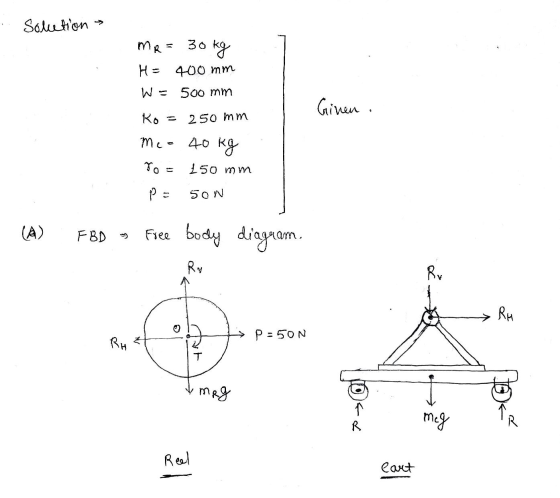
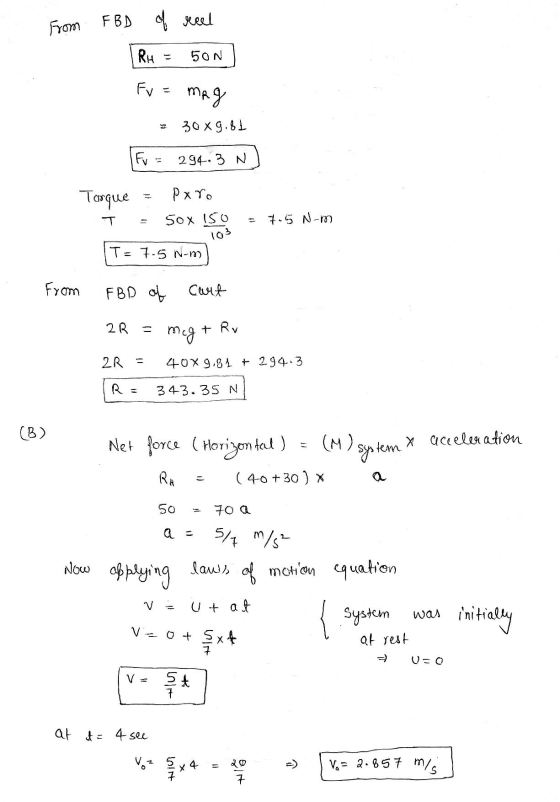
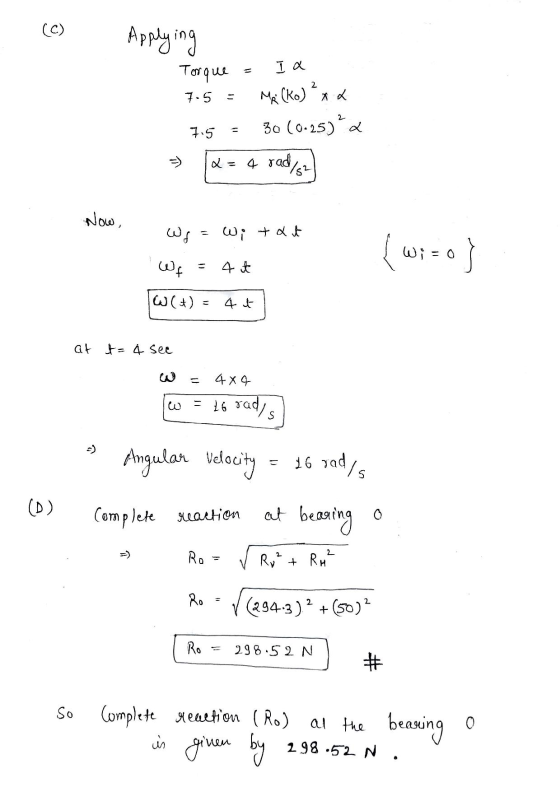
A me=30-kg reel is mounted on top of a cart using a frictionless bearing at its...
The wheel consists of a 2.6-kg rim of 420-mm radius with hub and spokes of negligible mass. The w...
 The wheel consists of a 2.6-kg rim of 420-mm radius with hub and
spokes of negligible mass. The wheel is mounted on the 3.7-kg yoke
OA with mass center at G and with a radius of
gyration about O of 495 mm. If the assembly is released
from rest in the horizontal position shown and if the wheel rolls
on the circular surface without slipping, compute the velocity of
point A when it reaches A'.
Answer: vA =
m/s
420...
The wheel consists of a 2.6-kg rim of 420-mm radius with hub and
spokes of negligible mass. The wheel is mounted on the 3.7-kg yoke
OA with mass center at G and with a radius of
gyration about O of 495 mm. If the assembly is released
from rest in the horizontal position shown and if the wheel rolls
on the circular surface without slipping, compute the velocity of
point A when it reaches A'.
Answer: vA =
m/s
420...
Question 4 Hibbeler 17-57: The 10-kg wheel is suspended above the ground by a frictionless bearing...
 Question 4 Hibbeler 17-57: The 10-kg wheel is suspended above the ground by a frictionless bearing at point A. It has a radius of gyration ka = 200 mm. The wheel is subjected to a moment M = (5) N·m, where t is in seconds. a. Determine its angular velocity when t=3 s starting from rest. b. Compute the force that the fixed pin A exerts on the wheel during the motion. Your answer must include a free body diagram....
The mass of the symmetrical wheel shown below is m = 4 kg and its radius...
 The mass of the symmetrical wheel shown below is m = 4 kg and its radius of gyration about its center is kg = 0.25 m. The outer radius of the wheel is r2 = 0.4 m. The radius of the inner hub, where a cable is wrapped around it, is rı = 0.2 m. The wheel rolls without slipping. The force P, applied to the cable, is increased slowly according to the linear relation P = at, where P...
O/6 points The figure below shows an arrangement with an air track, in which a cart...
 O/6 points The figure below shows an arrangement with an air track, in which a cart is connected by a cord to a hanging block. The cart has mass m10.680 kg and its center is initially at xy coordinates (-0.500 m, 0 m). The block has mass m20.260 kg and its center is initially at xy coordinates (O, -0.100 m). The mass of the cord and pulley are negligible. The cart is released from rest, and both cart and block...
2. A circular shaft is mounted in a bearing as shown. There is a small gap between the stationary inner shaft and the...
 2. A circular shaft is mounted in a bearing as shown. There is a small gap between the stationary inner shaft and the outer rotating bearing filled with a viscous, incompressible Newtonian fluid. The shaft turns with a constant rotation rate o (in rad/sec) due to the downward motion of the attached weight pulling on the cord attached to a the outer bearing (see figure) of radius R Hint: If the gap between the shaft and bearing is small compared...
Section 19.1-19.3 HW Problem 19.15 2 of 4 A6 kg disk Als mounted on arm BC...
 Section 19.1-19.3 HW Problem 19.15 2 of 4 A6 kg disk Als mounted on arm BC which has a negligtale mass Atorgue of M - (5) Nm where t is in seconds is applied to the armat Suppose that 1 = 280 mm (Figure 1) Part A Determine the magnitude of the angular velocity of Bin 2 starting from rest Solve the problem assuming that the disk is set in a smooth bearing at B so that it rotates with...
A 3-kg disk A is mounted on arm BC, which has a negligible mass. A torque...
 A 3-kg disk A is mounted on arm BC, which has a negligible mass. A torque of M = (5e0.5t) N.m, where t is in seconds, is applied to the arm at C. Suppose that I = 220 mm . (Figure 1) Figure < 1 of 1 2 60 mm M = (5ea5) N.m с Part A Determine the magnitude of the angular velocity of BC in 2 s starting from rest. Solve the problem assuming that the it rotates...
In a hurry to digest this . Tks for the help (thumb up) 2. A mass of m kilograms (kg) is mounted on top of a vertical spring. The spring is L metres long when disengaged and the end not attached to t...
 In a hurry to digest this . Tks for the help (thumb up)
2. A mass of m kilograms (kg) is mounted on top of a vertical spring. The spring is L metres long when disengaged and the end not attached to the mass is fixed to the ground. The mass moves vertically up and down, acted on by gravity, the restoring force T of the spring and the damping force R due to friction: see the diagram below The...
In a hurry to digest this . Tks for the help (thumb up)
2. A mass of m kilograms (kg) is mounted on top of a vertical spring. The spring is L metres long when disengaged and the end not attached to the mass is fixed to the ground. The mass moves vertically up and down, acted on by gravity, the restoring force T of the spring and the damping force R due to friction: see the diagram below The...
A mass of m kilograams (kg) is mounted on top of a vertical spring. The spring is L metres long when disengaged and the end not attached to the mass is fixced to the ground. The mass moves vertic...
 A mass of m kilograams (kg) is mounted on top of a vertical spring. The spring is L metres long when disengaged and the end not attached to the mass is fixced to the ground. The mass moves vertically up and down, acted on by gravity, the restoring force T of the spring and the damping force R due to friction: see the diagram below The gravitational force is mg dowswards, where g- 9.8m is acceleration due to gravity, measured...
Anyone please help me solve the last part to find theortetical of V1 and V2 using the first page ...
 anyone please help me solve the last part to find theortetical
of V1 and V2 using the first page type of collision
thank you
4. Cartl has a mass of ml and a velocity of v0. Cart2 has a mass of m2 and is stationary. Cartl then hits cart 2. After the collision, the velocity of cartl is vl and the velocity of cart2 is v2. In any collision, what happens to the m Write an equation for the momentum...
anyone please help me solve the last part to find theortetical
of V1 and V2 using the first page type of collision
thank you
4. Cartl has a mass of ml and a velocity of v0. Cart2 has a mass of m2 and is stationary. Cartl then hits cart 2. After the collision, the velocity of cartl is vl and the velocity of cart2 is v2. In any collision, what happens to the m Write an equation for the momentum...
 The wheel consists of a 2.6-kg rim of 420-mm radius with hub and
spokes of negligible mass. The wheel is mounted on the 3.7-kg yoke
OA with mass center at G and with a radius of
gyration about O of 495 mm. If the assembly is released
from rest in the horizontal position shown and if the wheel rolls
on the circular surface without slipping, compute the velocity of
point A when it reaches A'.
Answer: vA =
m/s
420...
The wheel consists of a 2.6-kg rim of 420-mm radius with hub and
spokes of negligible mass. The wheel is mounted on the 3.7-kg yoke
OA with mass center at G and with a radius of
gyration about O of 495 mm. If the assembly is released
from rest in the horizontal position shown and if the wheel rolls
on the circular surface without slipping, compute the velocity of
point A when it reaches A'.
Answer: vA =
m/s
420...
 Question 4 Hibbeler 17-57: The 10-kg wheel is suspended above the ground by a frictionless bearing at point A. It has a radius of gyration ka = 200 mm. The wheel is subjected to a moment M = (5) N·m, where t is in seconds. a. Determine its angular velocity when t=3 s starting from rest. b. Compute the force that the fixed pin A exerts on the wheel during the motion. Your answer must include a free body diagram....
 The mass of the symmetrical wheel shown below is m = 4 kg and its radius of gyration about its center is kg = 0.25 m. The outer radius of the wheel is r2 = 0.4 m. The radius of the inner hub, where a cable is wrapped around it, is rı = 0.2 m. The wheel rolls without slipping. The force P, applied to the cable, is increased slowly according to the linear relation P = at, where P...
 O/6 points The figure below shows an arrangement with an air track, in which a cart is connected by a cord to a hanging block. The cart has mass m10.680 kg and its center is initially at xy coordinates (-0.500 m, 0 m). The block has mass m20.260 kg and its center is initially at xy coordinates (O, -0.100 m). The mass of the cord and pulley are negligible. The cart is released from rest, and both cart and block...
 2. A circular shaft is mounted in a bearing as shown. There is a small gap between the stationary inner shaft and the outer rotating bearing filled with a viscous, incompressible Newtonian fluid. The shaft turns with a constant rotation rate o (in rad/sec) due to the downward motion of the attached weight pulling on the cord attached to a the outer bearing (see figure) of radius R Hint: If the gap between the shaft and bearing is small compared...
 Section 19.1-19.3 HW Problem 19.15 2 of 4 A6 kg disk Als mounted on arm BC which has a negligtale mass Atorgue of M - (5) Nm where t is in seconds is applied to the armat Suppose that 1 = 280 mm (Figure 1) Part A Determine the magnitude of the angular velocity of Bin 2 starting from rest Solve the problem assuming that the disk is set in a smooth bearing at B so that it rotates with...
 A 3-kg disk A is mounted on arm BC, which has a negligible mass. A torque of M = (5e0.5t) N.m, where t is in seconds, is applied to the arm at C. Suppose that I = 220 mm . (Figure 1) Figure < 1 of 1 2 60 mm M = (5ea5) N.m с Part A Determine the magnitude of the angular velocity of BC in 2 s starting from rest. Solve the problem assuming that the it rotates...
 In a hurry to digest this . Tks for the help (thumb up)
2. A mass of m kilograms (kg) is mounted on top of a vertical spring. The spring is L metres long when disengaged and the end not attached to the mass is fixed to the ground. The mass moves vertically up and down, acted on by gravity, the restoring force T of the spring and the damping force R due to friction: see the diagram below The...
In a hurry to digest this . Tks for the help (thumb up)
2. A mass of m kilograms (kg) is mounted on top of a vertical spring. The spring is L metres long when disengaged and the end not attached to the mass is fixed to the ground. The mass moves vertically up and down, acted on by gravity, the restoring force T of the spring and the damping force R due to friction: see the diagram below The...
 A mass of m kilograams (kg) is mounted on top of a vertical spring. The spring is L metres long when disengaged and the end not attached to the mass is fixced to the ground. The mass moves vertically up and down, acted on by gravity, the restoring force T of the spring and the damping force R due to friction: see the diagram below The gravitational force is mg dowswards, where g- 9.8m is acceleration due to gravity, measured...
 anyone please help me solve the last part to find theortetical
of V1 and V2 using the first page type of collision
thank you
4. Cartl has a mass of ml and a velocity of v0. Cart2 has a mass of m2 and is stationary. Cartl then hits cart 2. After the collision, the velocity of cartl is vl and the velocity of cart2 is v2. In any collision, what happens to the m Write an equation for the momentum...
anyone please help me solve the last part to find theortetical
of V1 and V2 using the first page type of collision
thank you
4. Cartl has a mass of ml and a velocity of v0. Cart2 has a mass of m2 and is stationary. Cartl then hits cart 2. After the collision, the velocity of cartl is vl and the velocity of cart2 is v2. In any collision, what happens to the m Write an equation for the momentum...
Most questions answered within 3 hours.
-
Where is the error in this code sequence?
String s1 = "Hello";
String s2 = "ello";...
asked 11 months ago -
Financial data for Joel de Paris, Inc., for last year
follow:
Joel de Paris, Inc.
Balance...
asked 11 months ago -
Consider this reaction:
Al2(SO4)3 (aq)+ BaCl3
(aq) Al2Cl6 (aq)- +
3BaSO4(s) . What is the...
asked 11 months ago -
Suppose that Savneet is considering increasing her
recent random sample from 20 car rentals to 40...
asked 11 months ago -
Trucks arrive at an unloading terminal at an average rate of 120
per hour.
Trucks arrive...
asked 11 months ago -
Why are methanol and ethanol completely soluble in water while
octanol is not very little soluble....
asked 11 months ago -
A facilities manager at a university reads in a research report
that the mean amount of...
asked 11 months ago -
When the CuSO4 is rehydrated by adding water to the anhydrous
compound, is this an endothermic...
asked 11 months ago -
A ray of sunlight is passing from diamond into crown glass; the
angle of incidence is...
asked 11 months ago -
A block of mass 0.249 kg is placed on top of a light, vertical
spring of...
asked 11 months ago -
how do the kidneys compensate in the presences of acidosis
a) trigger hyperventilate
b) reserve acid...
asked 11 months ago -
Question 501 pts
The rental rate of capital to the firm increases. Which of the
following...
asked 11 months ago