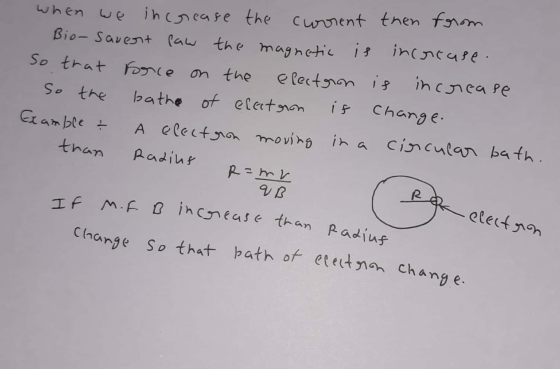
Question 1-2: Why does the path of the electrons change as the coil current is increased?
Question 1-2: Why does the path of the electrons change as the coil current is increased?
Homework Answers
Add Answer to:
Question 1-2: Why does the path of the electrons change as the
coil current is increased?
By what factor does the radius of the electron beam path (r) change if the current...
 By what factor does the radius of the electron beam path (r) change if the current through the Helmholtz coil (I) is doubled? Hint: Use e/m = 2V (5/4)3 a2/(N 4o Ir)2. the radius of the electron beam path increases by a factor of 2 the radius of the electron beam path increases by a factor of 4 the radius of the electron beam path decreases by a factor of the radius of the electron beam path decreases by a...
Does this influx of electrons and protons change the net charge of the Earth? Why?
Does this influx of electrons and protons change the net charge of the Earth? Why?
During a 80-ms interval, a change in the current in a primary coil occurs. This change...
During a 80-ms interval, a change in the current in a primary coil occurs. This change leads to the appearance of a 5.0-mA current in a nearby secondary coil. The secondary coil is part of a circuit in which the resistance is 12 Ω. The mutual inductance between the two coils is 3.2 mH. What is the change in the primary current?
During a 73-ms interval, a change in the current in a primary coil occurs. This change...
During a 73-ms interval, a change in the current in a primary coil occurs. This change leads to the appearance of a 5.6-mA current in a nearby secondary coil. The secondary coil is part of a circuit in which the resistance is 12 Ω. The mutual inductance between the two coils is 3.2 mH. What is the change in the primary current?
During a 58-ms interval, a change in the current in a primary coil occurs. This change...
During a 58-ms interval, a change in the current in a primary coil occurs. This change leads to the appearance of a 4.5-mA current in a nearby secondary coil. The secondary coil is part of a circuit in which the resistance is 12 Ω. The mutual inductance between the two coils is 3.2 mH. What is the change in the primary current?
a)During a 82-ms interval, a change in the current in a primary coil occurs. This change...
a)During a 82-ms interval, a change in the current in a primary coil occurs. This change leads to the appearance of a 4.2-mA current in a nearby secondary coil. The secondary coil is part of a circuit in which the resistance is 12 Ω. The mutual inductance between the two coils is 3.2 mH. What is the change in the primary current? b) The magnetic flux that passes through one turn of a 13-turn coil of wire changes to 3.78...
1. Let’s consider an AC circuit containing a coil. a) How does the impedance for this...
1. Let’s consider an AC circuit containing a coil. a) How does the impedance for this circuit change if the inductance is increased?
During a 59-ms interval, a change in the current in a primary coil occurs. This change...
During a 59-ms interval, a change in the current in a primary coil occurs. This change leads to the appearance of a 7.4-mAcurrent in a nearby secondary coil. The secondary coil is part of a circuit in which the resistance is 12 Ω. The mutual inductance between the two coils is 3.2 mH. What is the change in the primary current? ΔIp = ---Select--- Wb V A T GO Tutorial Additional Materials Section 22.8
1. Why do electrons (blue dots) move? The flow of current (+) is opposite to the...
 1.
Why do electrons (blue dots) move? The flow of
current (+) is opposite to the flow of the electrons. ; note if
toward or away from + terminal of the battery.
2.
What does the Ammeter (on the left)
measure? How is this shown in thesim?
3. What role
do the ?green dots? in the resistor play in the sim? What do you
think they represent? What does this tell you about the effect of
resistors in a circuit?
1.
Why do electrons (blue dots) move? The flow of
current (+) is opposite to the flow of the electrons. ; note if
toward or away from + terminal of the battery.
2.
What does the Ammeter (on the left)
measure? How is this shown in thesim?
3. What role
do the ?green dots? in the resistor play in the sim? What do you
think they represent? What does this tell you about the effect of
resistors in a circuit?
Question 1: Explain why the eye must use accommodation. That is, why does the eye change...
Question 1: Explain why the eye must use accommodation. That is, why does the eye change its lens's focal length to see different objects? Reference the thin lens equation in your response. Question 2: Explain which kind of lens (converging or diverging) fixes farsightedness and why it does so. Include a drawing or description of a ray diagram to support your answer.
 By what factor does the radius of the electron beam path (r) change if the current through the Helmholtz coil (I) is doubled? Hint: Use e/m = 2V (5/4)3 a2/(N 4o Ir)2. the radius of the electron beam path increases by a factor of 2 the radius of the electron beam path increases by a factor of 4 the radius of the electron beam path decreases by a factor of the radius of the electron beam path decreases by a...
 1.
Why do electrons (blue dots) move? The flow of
current (+) is opposite to the flow of the electrons. ; note if
toward or away from + terminal of the battery.
2.
What does the Ammeter (on the left)
measure? How is this shown in thesim?
3. What role
do the ?green dots? in the resistor play in the sim? What do you
think they represent? What does this tell you about the effect of
resistors in a circuit?
1.
Why do electrons (blue dots) move? The flow of
current (+) is opposite to the flow of the electrons. ; note if
toward or away from + terminal of the battery.
2.
What does the Ammeter (on the left)
measure? How is this shown in thesim?
3. What role
do the ?green dots? in the resistor play in the sim? What do you
think they represent? What does this tell you about the effect of
resistors in a circuit?
Most questions answered within 3 hours.
-
Where is the error in this code sequence?
String s1 = "Hello";
String s2 = "ello";...
asked 10 months ago -
Financial data for Joel de Paris, Inc., for last year
follow:
Joel de Paris, Inc.
Balance...
asked 10 months ago -
Consider this reaction:
Al2(SO4)3 (aq)+ BaCl3
(aq) Al2Cl6 (aq)- +
3BaSO4(s) . What is the...
asked 10 months ago -
Suppose that Savneet is considering increasing her
recent random sample from 20 car rentals to 40...
asked 10 months ago -
Trucks arrive at an unloading terminal at an average rate of 120
per hour.
Trucks arrive...
asked 10 months ago -
Why are methanol and ethanol completely soluble in water while
octanol is not very little soluble....
asked 10 months ago -
A facilities manager at a university reads in a research report
that the mean amount of...
asked 10 months ago -
When the CuSO4 is rehydrated by adding water to the anhydrous
compound, is this an endothermic...
asked 10 months ago -
A ray of sunlight is passing from diamond into crown glass; the
angle of incidence is...
asked 10 months ago -
A block of mass 0.249 kg is placed on top of a light, vertical
spring of...
asked 10 months ago -
how do the kidneys compensate in the presences of acidosis
a) trigger hyperventilate
b) reserve acid...
asked 10 months ago -
Question 501 pts
The rental rate of capital to the firm increases. Which of the
following...
asked 10 months ago