in transient response of systems, are static error constants (Kp, Kv, Ka) related to the gain...
in transient response of systems, are static error constants (Kp, Kv, Ka) related to the gain K of a system? For example, if we are asked to design a compensator that yields a Kv of 20 for the ramp response, does the value of K for the compensator have to equal 20?
Homework Answers
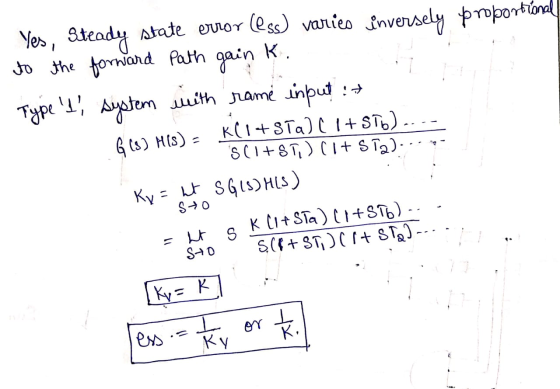
If you have any query comment down below I will surely help you as soon as possible please upvote my answer thanks in advance...!
Add Answer to:
in transient response of systems, are static error constants
(Kp, Kv, Ka) related to the gain...
Question 1 (20 points) As a control system engineer you have been asked to design a...
 Question 1 (20 points) As a control system engineer you have been asked to design a controller that would improve the error and the transient response for the unity feedback system below. The proposed solution must be cost-effective, so consider a passive network-based compensator. The transient response of the closed-loop transfer function to a ramp input has a 30% overshoot (%OS = 30) and a settling time Ts= 2.73 seconds. You need to decrease the peak time by a factor...
QUICK UPVOTE: As a control system engineer you have been asked to design a controller that...
 QUICK UPVOTE:
As a control system engineer you have been asked to design a controller that would improve the error and the transient response for the unity feedback system below. The proposed solution must be cost-effective, so consider a passive network-based compensator. The transient response of the closed-loop transfer function to a ramp input has a 30% overshoot (%OS = 30) and a settling time Ts= 2.73 seconds. You need to decrease the peak time by a factor of 2,...
QUICK UPVOTE:
As a control system engineer you have been asked to design a controller that would improve the error and the transient response for the unity feedback system below. The proposed solution must be cost-effective, so consider a passive network-based compensator. The transient response of the closed-loop transfer function to a ramp input has a 30% overshoot (%OS = 30) and a settling time Ts= 2.73 seconds. You need to decrease the peak time by a factor of 2,...
The parameters are as follows k=10 a=0.50 b=0.3 c=0.6 d=9 w_1=12 w_2=15 Kv=30 A feedback control system (illustrated in Figure 1) needs to be designed such that the closed-loop system is asymptotical...
 The parameters are as follows
k=10 a=0.50 b=0.3 c=0.6 d=9 w_1=12 w_2=15
Kv=30
A feedback control system (illustrated in Figure 1) needs to be
designed such that the closed-loop system is asymptotically stable
and such that the following design criteria are met:
the gain crossover frequency wc should be between
w1 and w2.
the steady-state error should be zero in response to a unit
step reference.
the velocity constant should be greater than Kv (in
other words, the steady-state unit...
The parameters are as follows
k=10 a=0.50 b=0.3 c=0.6 d=9 w_1=12 w_2=15
Kv=30
A feedback control system (illustrated in Figure 1) needs to be
designed such that the closed-loop system is asymptotically stable
and such that the following design criteria are met:
the gain crossover frequency wc should be between
w1 and w2.
the steady-state error should be zero in response to a unit
step reference.
the velocity constant should be greater than Kv (in
other words, the steady-state unit...
i am needing help with a b c o chris question thanks 1000 O(s) Gc(s) s(s2 110s 1250) Figure 2: Disc Drive System Block D...
 i am needing help with a b c o chris question thanks
1000 O(s) Gc(s) s(s2 110s 1250) Figure 2: Disc Drive System Block Diagram We will now try to design a compensator with the requirements that Overshoot 10% ii. Ts S 100ms II. eramp(oo) s 0.001 Do the following (you may use MATLAB at your leisure, but be sure to explain your logic for your design choices) a) Use MATLAB to draw the root locus when Gc K. Augment...
i am needing help with a b c o chris question thanks
1000 O(s) Gc(s) s(s2 110s 1250) Figure 2: Disc Drive System Block Diagram We will now try to design a compensator with the requirements that Overshoot 10% ii. Ts S 100ms II. eramp(oo) s 0.001 Do the following (you may use MATLAB at your leisure, but be sure to explain your logic for your design choices) a) Use MATLAB to draw the root locus when Gc K. Augment...
2. (10 points each) a. Give the system type, then calculate, by hand, the error constants...
 2. (10 points each) a. Give the system type, then calculate, by hand, the error constants (Kp, K, Ka and steady state error amounts for the following transfer functions b. Use MATLAB to give the step response of each transfer function and verify the estep(0) value you calculated in part a. 12 s+15s G(s) 15 (s2 +20s +10)s3
Question 2 a) Consider the control system in Figure 2(a). Determine the transient response characteristics (rise...
 Question 2 a) Consider the control system in Figure 2(a). Determine the transient response characteristics (rise time, peak time, maximum overshoot and settling time) and the steady state error for the system. (2 marks) b) To improve the relative stability, the tachometer feedback are employed as shown in Figure 2b). i Determine the value in so that the damping ratio of the system is 0.5. (1 % marks) From the result obtained in , evaluate the transient response characteristics (rise...
a) Consider the control system in Figure 2(a). Determine the transient response characteristics (rise time, peak...
 a) Consider the control system in Figure 2(a). Determine the transient response characteristics (rise time, peak time, maximum overshoot and settling time) and the steady state error for the system. (2 marks) b) To improve the relative stability, the tachometer feedback are employed as shown in Figure 2(b). i Determine the value K, so that the damping ratio of the system is 0.5. (1 % marks) ii. From the result obtained in (), evaluate the transient response characteristics (rise time,...
Bode Diagram 10 10 Frequency (rad/s) Bode Diagram 100F 140 10 10 Frequency (rad/s) Figure Q4.2 4. The de servo system s...
 Bode Diagram 10 10 Frequency (rad/s) Bode Diagram 100F 140 10 10 Frequency (rad/s) Figure Q4.2 4. The de servo system shown in Figure Q4.1 is required to have a transient step response speci fication with a peak time of 0.58 seconds or better, and a +2% setting time of 1.7 seconds or better 01(s) K (s)G(s) s(s 1 (s 5) Figure Q4.1 The Bode diagram of the open-loop system is shown in Figure Q4.2 on page 8. This Bode...
Problem 4 Suppose we have the system shown below operating at 15% overshoot. G(s)- (G) (s +2)%s +5%s+7) Use time domain techniques to design a compensator (and find K) so the appropriate static e...
 Problem 4 Suppose we have the system shown below operating at 15% overshoot. G(s)- (G) (s +2)%s +5%s+7) Use time domain techniques to design a compensator (and find K) so the appropriate static error constant is 20 without appreciably changing the dominant poles of the uncompensated system. There can be no zero pole cancellations. Do not change the dominant poles of the system.
Problem 4 Suppose we have the system shown below operating at 15% overshoot. G(s)- (G) (s +2)%s...
Problem 4 Suppose we have the system shown below operating at 15% overshoot. G(s)- (G) (s +2)%s +5%s+7) Use time domain techniques to design a compensator (and find K) so the appropriate static error constant is 20 without appreciably changing the dominant poles of the uncompensated system. There can be no zero pole cancellations. Do not change the dominant poles of the system.
Problem 4 Suppose we have the system shown below operating at 15% overshoot. G(s)- (G) (s +2)%s...
Recall the disc drive problem from Tutorials, where we demonstrated that the system can be written as e(s)+ 1000 Ge...
 Recall the disc drive problem from Tutorials, where we demonstrated that the system can be written as e(s)+ 1000 Ge(s) s(s2 110s 1250) Figure 2: Disc Drive System Block Diagram We will now try to design a compensator with the requirements that i. Overshoot 1096 ii. Ts S 100ms ii. eramp() s 0.001 Do the following (you may use MATLAB at your leisure, but be sure to explain your logic for your design choices) a) Use MATLAB to draw the...
 Question 1 (20 points) As a control system engineer you have been asked to design a controller that would improve the error and the transient response for the unity feedback system below. The proposed solution must be cost-effective, so consider a passive network-based compensator. The transient response of the closed-loop transfer function to a ramp input has a 30% overshoot (%OS = 30) and a settling time Ts= 2.73 seconds. You need to decrease the peak time by a factor...
 QUICK UPVOTE:
As a control system engineer you have been asked to design a controller that would improve the error and the transient response for the unity feedback system below. The proposed solution must be cost-effective, so consider a passive network-based compensator. The transient response of the closed-loop transfer function to a ramp input has a 30% overshoot (%OS = 30) and a settling time Ts= 2.73 seconds. You need to decrease the peak time by a factor of 2,...
QUICK UPVOTE:
As a control system engineer you have been asked to design a controller that would improve the error and the transient response for the unity feedback system below. The proposed solution must be cost-effective, so consider a passive network-based compensator. The transient response of the closed-loop transfer function to a ramp input has a 30% overshoot (%OS = 30) and a settling time Ts= 2.73 seconds. You need to decrease the peak time by a factor of 2,...
 The parameters are as follows
k=10 a=0.50 b=0.3 c=0.6 d=9 w_1=12 w_2=15
Kv=30
A feedback control system (illustrated in Figure 1) needs to be
designed such that the closed-loop system is asymptotically stable
and such that the following design criteria are met:
the gain crossover frequency wc should be between
w1 and w2.
the steady-state error should be zero in response to a unit
step reference.
the velocity constant should be greater than Kv (in
other words, the steady-state unit...
The parameters are as follows
k=10 a=0.50 b=0.3 c=0.6 d=9 w_1=12 w_2=15
Kv=30
A feedback control system (illustrated in Figure 1) needs to be
designed such that the closed-loop system is asymptotically stable
and such that the following design criteria are met:
the gain crossover frequency wc should be between
w1 and w2.
the steady-state error should be zero in response to a unit
step reference.
the velocity constant should be greater than Kv (in
other words, the steady-state unit...
 i am needing help with a b c o chris question thanks
1000 O(s) Gc(s) s(s2 110s 1250) Figure 2: Disc Drive System Block Diagram We will now try to design a compensator with the requirements that Overshoot 10% ii. Ts S 100ms II. eramp(oo) s 0.001 Do the following (you may use MATLAB at your leisure, but be sure to explain your logic for your design choices) a) Use MATLAB to draw the root locus when Gc K. Augment...
i am needing help with a b c o chris question thanks
1000 O(s) Gc(s) s(s2 110s 1250) Figure 2: Disc Drive System Block Diagram We will now try to design a compensator with the requirements that Overshoot 10% ii. Ts S 100ms II. eramp(oo) s 0.001 Do the following (you may use MATLAB at your leisure, but be sure to explain your logic for your design choices) a) Use MATLAB to draw the root locus when Gc K. Augment...
 2. (10 points each) a. Give the system type, then calculate, by hand, the error constants (Kp, K, Ka and steady state error amounts for the following transfer functions b. Use MATLAB to give the step response of each transfer function and verify the estep(0) value you calculated in part a. 12 s+15s G(s) 15 (s2 +20s +10)s3
 Question 2 a) Consider the control system in Figure 2(a). Determine the transient response characteristics (rise time, peak time, maximum overshoot and settling time) and the steady state error for the system. (2 marks) b) To improve the relative stability, the tachometer feedback are employed as shown in Figure 2b). i Determine the value in so that the damping ratio of the system is 0.5. (1 % marks) From the result obtained in , evaluate the transient response characteristics (rise...
 a) Consider the control system in Figure 2(a). Determine the transient response characteristics (rise time, peak time, maximum overshoot and settling time) and the steady state error for the system. (2 marks) b) To improve the relative stability, the tachometer feedback are employed as shown in Figure 2(b). i Determine the value K, so that the damping ratio of the system is 0.5. (1 % marks) ii. From the result obtained in (), evaluate the transient response characteristics (rise time,...
 Bode Diagram 10 10 Frequency (rad/s) Bode Diagram 100F 140 10 10 Frequency (rad/s) Figure Q4.2 4. The de servo system shown in Figure Q4.1 is required to have a transient step response speci fication with a peak time of 0.58 seconds or better, and a +2% setting time of 1.7 seconds or better 01(s) K (s)G(s) s(s 1 (s 5) Figure Q4.1 The Bode diagram of the open-loop system is shown in Figure Q4.2 on page 8. This Bode...
 Problem 4 Suppose we have the system shown below operating at 15% overshoot. G(s)- (G) (s +2)%s +5%s+7) Use time domain techniques to design a compensator (and find K) so the appropriate static error constant is 20 without appreciably changing the dominant poles of the uncompensated system. There can be no zero pole cancellations. Do not change the dominant poles of the system.
Problem 4 Suppose we have the system shown below operating at 15% overshoot. G(s)- (G) (s +2)%s...
Problem 4 Suppose we have the system shown below operating at 15% overshoot. G(s)- (G) (s +2)%s +5%s+7) Use time domain techniques to design a compensator (and find K) so the appropriate static error constant is 20 without appreciably changing the dominant poles of the uncompensated system. There can be no zero pole cancellations. Do not change the dominant poles of the system.
Problem 4 Suppose we have the system shown below operating at 15% overshoot. G(s)- (G) (s +2)%s...
 Recall the disc drive problem from Tutorials, where we demonstrated that the system can be written as e(s)+ 1000 Ge(s) s(s2 110s 1250) Figure 2: Disc Drive System Block Diagram We will now try to design a compensator with the requirements that i. Overshoot 1096 ii. Ts S 100ms ii. eramp() s 0.001 Do the following (you may use MATLAB at your leisure, but be sure to explain your logic for your design choices) a) Use MATLAB to draw the...
Most questions answered within 3 hours.
-
Where is the error in this code sequence?
String s1 = "Hello";
String s2 = "ello";...
asked 10 months ago -
Financial data for Joel de Paris, Inc., for last year
follow:
Joel de Paris, Inc.
Balance...
asked 10 months ago -
Consider this reaction:
Al2(SO4)3 (aq)+ BaCl3
(aq) Al2Cl6 (aq)- +
3BaSO4(s) . What is the...
asked 10 months ago -
Suppose that Savneet is considering increasing her
recent random sample from 20 car rentals to 40...
asked 10 months ago -
Trucks arrive at an unloading terminal at an average rate of 120
per hour.
Trucks arrive...
asked 10 months ago -
Why are methanol and ethanol completely soluble in water while
octanol is not very little soluble....
asked 10 months ago -
A facilities manager at a university reads in a research report
that the mean amount of...
asked 10 months ago -
When the CuSO4 is rehydrated by adding water to the anhydrous
compound, is this an endothermic...
asked 10 months ago -
A ray of sunlight is passing from diamond into crown glass; the
angle of incidence is...
asked 10 months ago -
A block of mass 0.249 kg is placed on top of a light, vertical
spring of...
asked 10 months ago -
how do the kidneys compensate in the presences of acidosis
a) trigger hyperventilate
b) reserve acid...
asked 10 months ago -
Question 501 pts
The rental rate of capital to the firm increases. Which of the
following...
asked 10 months ago