
Homework Answers
Request Answer!
We need at least 10 more requests to produce the answer.
0 / 10 have requested this problem solution
The more requests, the faster the answer.
Add Answer to:
Of the following, AHfº is not zero for A) F2 (s) B) O2 (g) C) Cl2...
For which of the following is ΔHo f not zero? ( ) O2(g) ( ) C...
For which of the following is ΔHo f not zero? ( ) O2(g) ( ) C (graphite) ( ) N2(g) ( ) F2(s) ( ) Cl2(g)
B) 1/2 N2(g) + 2H2(g) + 1/2 Cl2(g) → NH4Cl(s) C) N2(g) + H2(g) + Cl2(g)...
 B) 1/2 N2(g) + 2H2(g) + 1/2 Cl2(g) → NH4Cl(s) C) N2(g) + H2(g) + Cl2(g) → 2 NH4Cl(s) D) N2(g) + Cl2(g) + 4 H2(g) → 2 NH4Cl(s) E) 1/2 N2(g) + 1/2 Cl2(g) + 1/2 H2(g) → NH4Cl(s) 12) Which molecule contains the most polar bonds? A) NBr3 B) CH4 C) CF4 D) CO2 The spheres below represent atoms of Li, Be, B, and F (not nece
Question 3 1 pts Given the bond dissociation energies (in kJ/mol) for the following diatomic molecules Cl2 (243), F2 (1...
 Question 3 1 pts Given the bond dissociation energies (in kJ/mol) for the following diatomic molecules Cl2 (243), F2 (158), H2 (436), O2 (498), N2 (945) choose the one(s) that could be broken by using blue light (=465 nm). F2 and Cl2 o F2 F2, C12, H2, O2 and N2 F2, Cl2 and H2 F2, Cl2, H2 and 02
given the following reaction caco3(s)--->cao(s) + co2(g) delta h = 178.1kj C(s,graphite) + O2(g) ---> CO2(g)...
given the following reaction caco3(s)--->cao(s) + co2(g) delta h = 178.1kj C(s,graphite) + O2(g) ---> CO2(g) deltaH=-393.5kj the enthalpy of the reaction CaCO3(s)--->CaO(s) + C(s,graphite) + O2(g) is ________kj.
For the combustion reaction of methane, AHºf is zero for CH4 (g) + O2 (g) →...
 For the combustion reaction of methane, AHºf is zero for CH4 (g) + O2 (g) → 2H2O(g) + CO2 (g) A) 02 (g) B) CH4 (g) CO2 (g) D) H20 (g) E) Both O2 (g) and CH4 (g) 8 Given the following reactions N2 (g) + 202 (g) - 2NO2 (g) AH = 66.4 kJ 2NO (g) + O2 (g) → 2NO2 (g) AH = -114.2 kJ the enthalpy of the reaction of the nitrogen to produce nitric oxide N2...
All the following are oxidation–reduction reactions except: a.) H2(g) + F2(g) → 2HF(g). b.) Ca(s) +...
All the following are oxidation–reduction reactions except: a.) H2(g) + F2(g) → 2HF(g). b.) Ca(s) + H2(g) → CaH2(s). c.) 2K(s) + 2H2O(l) → 2KOH(aq) + H2(g). d.) 6Li(s) + N2(g) → 2Li3N(s). e.) Mg3N2(s) + 6H2O(l) → 3Mg(OH)2(s) + 2NH3(g).
e. -1135 Given the following reactions: CaCO3 (s)-> Cao (s) + CO2 (g) C (s, graphite)...
 e. -1135 Given the following reactions: CaCO3 (s)-> Cao (s) + CO2 (g) C (s, graphite) + O2 (g)-> Co2 (g) AH-393.5 kJ the enthalpy of the reaction CaCO3 (s) -> CaO (s) + C (s, graphite) + O2 (g) ΔH = 178.1 kJ is kJ Select one: 4 a. 7.01 x 10 b. 571.6 ) c. 215.4 d. -215.4 ie. -571.6 Check Given the data in the table below, AH for the reaction
At 25°C, the following heats of reaction are known: 2CIF(g) + O2(g) → Cl20(g) + F2。dH'm...
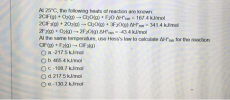 At 25°C, the following heats of reaction are known: 2CIF(g) + O2(g) → Cl20(g) + F2。dH'm = 167.4 kJ/mol 2ClF3(g) + 202(g) → Cl20(g) + 3F20(g) ΔH'm-34 1.4 kJ/mol 2F2(g) + O2(g) → 2F20(g) ΔHoxn--43.4 kJ/mol At the same temperature, use Hess's law to calculate ΔHorn for the reaction: CIF(g) + F2(g) → ClF3(g) 0 a-21 7.5 kJ/mol O b 465.4 kJ/mol O c. -108.7 kJ/mol d 217.5 kJ/mol O e-130.2 kJ/mol
3) Answer all parts of the following question. a. The reaction: Al(s) + Fe2O3(s) → Fe(s)...
3) Answer all parts of the following question. a. The reaction: Al(s) + Fe2O3(s) → Fe(s) + Al2O3(s) has ΔH = -847.6 kJ and ΔS = -41.3 J/K at 25°C. Calculate ΔG and determine if it is spontaneous. b. Above what temperature does the following reaction become nonspontaneous? FeO(s) + CO(g) → CO2(g) + Fe(s) ΔH = -11.0 kJ; ΔS = -17.4 J/K c. Find ΔSsurr and predict whether or not this reaction will be spontaneous at 398 K. NH3(g)...
Identify which of the following equations are balanced. 2KMnO4(s)→K2MnO4(s)+MnO2(s)+O2(g) C(s)+O2(g)→CO(g) 6Li(s)+N2(g)→2Li3N(s) SF4(g)+2F2(g)→SF6(g) Part B Calculate the...
Identify which of the following equations are balanced. 2KMnO4(s)→K2MnO4(s)+MnO2(s)+O2(g) C(s)+O2(g)→CO(g) 6Li(s)+N2(g)→2Li3N(s) SF4(g)+2F2(g)→SF6(g) Part B Calculate the final pressure, in atmospheres, for each of the following, if volume and amount of gas do not change. a)A gas with an initial pressure of 1.22 atm at 67 ∘C is cooled to − 31 ∘C. b)A sample of N2 with an initial pressure of 810. mmHg at − 75 ∘C is heated to 31 ∘C.
 B) 1/2 N2(g) + 2H2(g) + 1/2 Cl2(g) → NH4Cl(s) C) N2(g) + H2(g) + Cl2(g) → 2 NH4Cl(s) D) N2(g) + Cl2(g) + 4 H2(g) → 2 NH4Cl(s) E) 1/2 N2(g) + 1/2 Cl2(g) + 1/2 H2(g) → NH4Cl(s) 12) Which molecule contains the most polar bonds? A) NBr3 B) CH4 C) CF4 D) CO2 The spheres below represent atoms of Li, Be, B, and F (not nece
 Question 3 1 pts Given the bond dissociation energies (in kJ/mol) for the following diatomic molecules Cl2 (243), F2 (158), H2 (436), O2 (498), N2 (945) choose the one(s) that could be broken by using blue light (=465 nm). F2 and Cl2 o F2 F2, C12, H2, O2 and N2 F2, Cl2 and H2 F2, Cl2, H2 and 02
 For the combustion reaction of methane, AHºf is zero for CH4 (g) + O2 (g) → 2H2O(g) + CO2 (g) A) 02 (g) B) CH4 (g) CO2 (g) D) H20 (g) E) Both O2 (g) and CH4 (g) 8 Given the following reactions N2 (g) + 202 (g) - 2NO2 (g) AH = 66.4 kJ 2NO (g) + O2 (g) → 2NO2 (g) AH = -114.2 kJ the enthalpy of the reaction of the nitrogen to produce nitric oxide N2...
 e. -1135 Given the following reactions: CaCO3 (s)-> Cao (s) + CO2 (g) C (s, graphite) + O2 (g)-> Co2 (g) AH-393.5 kJ the enthalpy of the reaction CaCO3 (s) -> CaO (s) + C (s, graphite) + O2 (g) ΔH = 178.1 kJ is kJ Select one: 4 a. 7.01 x 10 b. 571.6 ) c. 215.4 d. -215.4 ie. -571.6 Check Given the data in the table below, AH for the reaction
 At 25°C, the following heats of reaction are known: 2CIF(g) + O2(g) → Cl20(g) + F2。dH'm = 167.4 kJ/mol 2ClF3(g) + 202(g) → Cl20(g) + 3F20(g) ΔH'm-34 1.4 kJ/mol 2F2(g) + O2(g) → 2F20(g) ΔHoxn--43.4 kJ/mol At the same temperature, use Hess's law to calculate ΔHorn for the reaction: CIF(g) + F2(g) → ClF3(g) 0 a-21 7.5 kJ/mol O b 465.4 kJ/mol O c. -108.7 kJ/mol d 217.5 kJ/mol O e-130.2 kJ/mol
Most questions answered within 3 hours.
-
Where is the error in this code sequence?
String s1 = "Hello";
String s2 = "ello";...
asked 11 months ago -
Financial data for Joel de Paris, Inc., for last year
follow:
Joel de Paris, Inc.
Balance...
asked 11 months ago -
Consider this reaction:
Al2(SO4)3 (aq)+ BaCl3
(aq) Al2Cl6 (aq)- +
3BaSO4(s) . What is the...
asked 11 months ago -
Suppose that Savneet is considering increasing her
recent random sample from 20 car rentals to 40...
asked 11 months ago -
Trucks arrive at an unloading terminal at an average rate of 120
per hour.
Trucks arrive...
asked 11 months ago -
Why are methanol and ethanol completely soluble in water while
octanol is not very little soluble....
asked 11 months ago -
A facilities manager at a university reads in a research report
that the mean amount of...
asked 11 months ago -
When the CuSO4 is rehydrated by adding water to the anhydrous
compound, is this an endothermic...
asked 11 months ago -
A ray of sunlight is passing from diamond into crown glass; the
angle of incidence is...
asked 11 months ago -
A block of mass 0.249 kg is placed on top of a light, vertical
spring of...
asked 11 months ago -
how do the kidneys compensate in the presences of acidosis
a) trigger hyperventilate
b) reserve acid...
asked 11 months ago -
Question 501 pts
The rental rate of capital to the firm increases. Which of the
following...
asked 11 months ago