
Homework Answers
Add Answer to:
Q2.) (2) point Water is drawn into the pump, such that the pressure at the inlet...
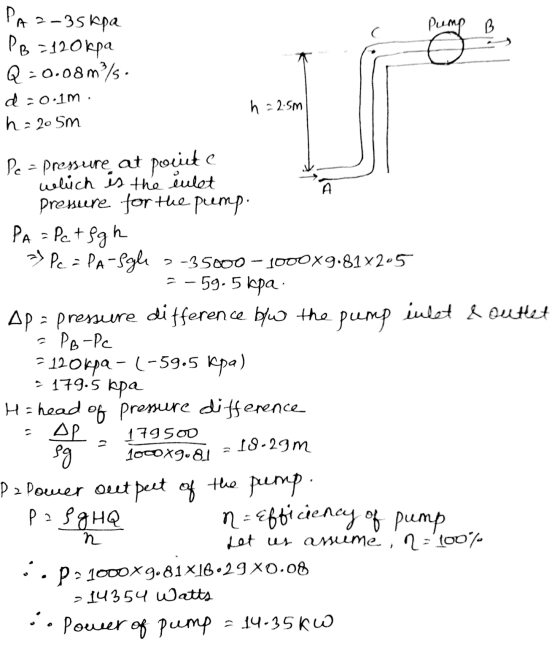
Water is drawn into the pump, such that the pressure at the inlet A is -45...
 Water is drawn into the pump, such that the pressure at the
inlet A is -45 kPa and the pressure at B is 110 kPa . The pipe has
a constant diameter of 100 mm. The discharge at B is 0.08 m3/s.
Take h = 2 m.
Determine the power output of the pump. Neglect friction
losses.
Course Homepage - Fall 2019T X Mastering Engineering Mastering x C Get Homework Help With Chege x + -ox € → C session.masteringengineering.com/myct/itemView?assignmentProblem...
Water is drawn into the pump, such that the pressure at the
inlet A is -45 kPa and the pressure at B is 110 kPa . The pipe has
a constant diameter of 100 mm. The discharge at B is 0.08 m3/s.
Take h = 2 m.
Determine the power output of the pump. Neglect friction
losses.
Course Homepage - Fall 2019T X Mastering Engineering Mastering x C Get Homework Help With Chege x + -ox € → C session.masteringengineering.com/myct/itemView?assignmentProblem...
lunzontal pipe and pump system in the following figure discharges 0.01583 m3/s. The gage pressure iust...
 lunzontal pipe and pump system in the following figure discharges 0.01583 m3/s. The gage pressure iust before the pressure is 400 The m/s2 losses between 20°C water at 57 m3/h 0 kPa and just after the pump the gage a. The pump inlet diameter is 9 cm and the outlet diameter is 3 em. Let g-9.81 pump is 12 o Pwater9 kg/m, Hwate0.001002 kgm-s) and Pat the two pressure points and the pump. But consider frictional losses at the 9-cm...
Q3.) (2) point The pump at C produces a discharge of water at B of 0.035...
 Q3.) (2) point The pump at C produces a discharge of water at B of 0.035 m3/s. If the pipe at B has a diameter of 50 mm and the hose at A has a diameter of 30 mm, determine the power output supplied by the pump. Assume frictional head losses within the pipe system are determined from 3(VB)?/2g. B 30 m te
A pump generates high pressure water as indicated in fig 3. The Inlet pressure and outlet...
 A pump generates high pressure water as indicated in fig 3. The Inlet pressure and outlet pressure are 110 and 300 kPa respectively. The mass flow rate is 3 kg/sec. The inlet pipe is 1 inch diameter and outlet pipe is 0.5 inch. Neglect elevation difference and internal energy changes across inlet and outlet. a) Culculate velocity İf water at inlet and outlet(5) b) Choose a suitable control volume, and write down and expression for conservation of energy applicable to...
7.14 The pump in Fig. 7.20 delivers water from the lower to the upper reservoir at the rate of 0.057 m3/s. The energy loss between the suction pipe inlet and the pump is 1.83 m and that between t...
 7.14 The pump in Fig. 7.20 delivers water from the lower to the upper reservoir at the rate of 0.057 m3/s. The energy loss between the suction pipe inlet and the pump is 1.83 m and that between the pump outlet and the upper reservoir is 3.66 m. Both pipes are 6-in Schedule 40 steel pipe. Calculate (a) the pressure at the pump inlet, (b) the pressure at the pump outlet, (c) the total head on the pump, and (d)...
4. The discharge pressure gauge reading is 5 lb/in2 (psi) for the pumping system shown in the ske...
 4. The discharge pressure gauge reading is 5 lb/in2 (psi) for the pumping system shown in the sketch below, with the outlet nozzle discharging a 2-inch diameter stream of water directly to the atmosphere. The gauge pressure at the pump suction inlet at the point of incipient cavitation is (-2,071.12) lb/ft, i.e., for vapor pressure of water at 68° F of 50.54 lb/ft2 absolute, and standard atmospheric pressure 30 in Hg. Friction losses in the suction piping from the reservoir...
2. Do Problem 5.118 from the textbook. (Statement: A pump moves water horizontally at a rate...
 2. Do Problem 5.118 from the textbook. (Statement: A pump moves water horizontally at a rate of 0.02 m/s. Upstream of the pump where the pipe diameter is 90 mm, the pressure is 120 kPa. Downstream of the pump where the pipe diameter is 30 mm, the pressure is 400 kPa. If the loss in energy across the pump due to fluid friction effects is 170 N.m/kg, determine the hydraulic efficiency of the pump.)
Water at T = 25°C is drawn from an underground detention tank and discharged into a...
 Water at T = 25°C is drawn from an underground detention tank and discharged into a drain using a 6-m-long pipe and pump (Figure 1). The pipe has a diameter of 100 mm and a friction factor of f = 0.02. The atmospheric pressure is 101.3 kPa. The velocity through the pipe is 4 m/s and h = 4 m Neglect minor losses. Part A Determine the available NPSH. Express your answer using three significant figures. IVO ALP O vec...
A pump increases the water pressure from 100 kPa at the inlet to 900 kPa at...
 A pump increases the water pressure from 100 kPa at the inlet to 900 kPa at the outlet. Water enters this pump at 15 degree C through a 1-cm-diameter opening and exits through a 1.5-cm-diameter opening. Determine the velocity of the water at the inlet and outlet when the mass flow rate through the pump is 0.5 kg/s. Will these velocities change significantly if the inlet temperature is raised to 40 degree C?
Liquid water at 120 kPa enters a 7 kW pump where its pressure is raised to...
 Liquid water at 120 kPa enters a 7 kW pump where its pressure is raised to 4.7 MPa. If the elevation difference between the exit and the inlet levels is 10 m, determine the highest mass flow rate of liquid water this pump can handle. Neglect the kinetic energy change of water, and take the specific volume of water to be 0.001 m3/kg The highest mass flow rate of liquid water is kg/s
 Water is drawn into the pump, such that the pressure at the
inlet A is -45 kPa and the pressure at B is 110 kPa . The pipe has
a constant diameter of 100 mm. The discharge at B is 0.08 m3/s.
Take h = 2 m.
Determine the power output of the pump. Neglect friction
losses.
Course Homepage - Fall 2019T X Mastering Engineering Mastering x C Get Homework Help With Chege x + -ox € → C session.masteringengineering.com/myct/itemView?assignmentProblem...
Water is drawn into the pump, such that the pressure at the
inlet A is -45 kPa and the pressure at B is 110 kPa . The pipe has
a constant diameter of 100 mm. The discharge at B is 0.08 m3/s.
Take h = 2 m.
Determine the power output of the pump. Neglect friction
losses.
Course Homepage - Fall 2019T X Mastering Engineering Mastering x C Get Homework Help With Chege x + -ox € → C session.masteringengineering.com/myct/itemView?assignmentProblem...
 lunzontal pipe and pump system in the following figure discharges 0.01583 m3/s. The gage pressure iust before the pressure is 400 The m/s2 losses between 20°C water at 57 m3/h 0 kPa and just after the pump the gage a. The pump inlet diameter is 9 cm and the outlet diameter is 3 em. Let g-9.81 pump is 12 o Pwater9 kg/m, Hwate0.001002 kgm-s) and Pat the two pressure points and the pump. But consider frictional losses at the 9-cm...
 Q3.) (2) point The pump at C produces a discharge of water at B of 0.035 m3/s. If the pipe at B has a diameter of 50 mm and the hose at A has a diameter of 30 mm, determine the power output supplied by the pump. Assume frictional head losses within the pipe system are determined from 3(VB)?/2g. B 30 m te
 A pump generates high pressure water as indicated in fig 3. The Inlet pressure and outlet pressure are 110 and 300 kPa respectively. The mass flow rate is 3 kg/sec. The inlet pipe is 1 inch diameter and outlet pipe is 0.5 inch. Neglect elevation difference and internal energy changes across inlet and outlet. a) Culculate velocity İf water at inlet and outlet(5) b) Choose a suitable control volume, and write down and expression for conservation of energy applicable to...
 7.14 The pump in Fig. 7.20 delivers water from the lower to the upper reservoir at the rate of 0.057 m3/s. The energy loss between the suction pipe inlet and the pump is 1.83 m and that between the pump outlet and the upper reservoir is 3.66 m. Both pipes are 6-in Schedule 40 steel pipe. Calculate (a) the pressure at the pump inlet, (b) the pressure at the pump outlet, (c) the total head on the pump, and (d)...
 4. The discharge pressure gauge reading is 5 lb/in2 (psi) for the pumping system shown in the sketch below, with the outlet nozzle discharging a 2-inch diameter stream of water directly to the atmosphere. The gauge pressure at the pump suction inlet at the point of incipient cavitation is (-2,071.12) lb/ft, i.e., for vapor pressure of water at 68° F of 50.54 lb/ft2 absolute, and standard atmospheric pressure 30 in Hg. Friction losses in the suction piping from the reservoir...
 2. Do Problem 5.118 from the textbook. (Statement: A pump moves water horizontally at a rate of 0.02 m/s. Upstream of the pump where the pipe diameter is 90 mm, the pressure is 120 kPa. Downstream of the pump where the pipe diameter is 30 mm, the pressure is 400 kPa. If the loss in energy across the pump due to fluid friction effects is 170 N.m/kg, determine the hydraulic efficiency of the pump.)
 Water at T = 25°C is drawn from an underground detention tank and discharged into a drain using a 6-m-long pipe and pump (Figure 1). The pipe has a diameter of 100 mm and a friction factor of f = 0.02. The atmospheric pressure is 101.3 kPa. The velocity through the pipe is 4 m/s and h = 4 m Neglect minor losses. Part A Determine the available NPSH. Express your answer using three significant figures. IVO ALP O vec...
 A pump increases the water pressure from 100 kPa at the inlet to 900 kPa at the outlet. Water enters this pump at 15 degree C through a 1-cm-diameter opening and exits through a 1.5-cm-diameter opening. Determine the velocity of the water at the inlet and outlet when the mass flow rate through the pump is 0.5 kg/s. Will these velocities change significantly if the inlet temperature is raised to 40 degree C?
 Liquid water at 120 kPa enters a 7 kW pump where its pressure is raised to 4.7 MPa. If the elevation difference between the exit and the inlet levels is 10 m, determine the highest mass flow rate of liquid water this pump can handle. Neglect the kinetic energy change of water, and take the specific volume of water to be 0.001 m3/kg The highest mass flow rate of liquid water is kg/s
Most questions answered within 3 hours.
-
Where is the error in this code sequence?
String s1 = "Hello";
String s2 = "ello";...
asked 11 months ago -
Financial data for Joel de Paris, Inc., for last year
follow:
Joel de Paris, Inc.
Balance...
asked 11 months ago -
Consider this reaction:
Al2(SO4)3 (aq)+ BaCl3
(aq) Al2Cl6 (aq)- +
3BaSO4(s) . What is the...
asked 11 months ago -
Suppose that Savneet is considering increasing her
recent random sample from 20 car rentals to 40...
asked 11 months ago -
Trucks arrive at an unloading terminal at an average rate of 120
per hour.
Trucks arrive...
asked 11 months ago -
Why are methanol and ethanol completely soluble in water while
octanol is not very little soluble....
asked 11 months ago -
A facilities manager at a university reads in a research report
that the mean amount of...
asked 11 months ago -
When the CuSO4 is rehydrated by adding water to the anhydrous
compound, is this an endothermic...
asked 11 months ago -
A ray of sunlight is passing from diamond into crown glass; the
angle of incidence is...
asked 11 months ago -
A block of mass 0.249 kg is placed on top of a light, vertical
spring of...
asked 11 months ago -
how do the kidneys compensate in the presences of acidosis
a) trigger hyperventilate
b) reserve acid...
asked 11 months ago -
Question 501 pts
The rental rate of capital to the firm increases. Which of the
following...
asked 11 months ago