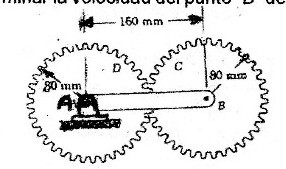
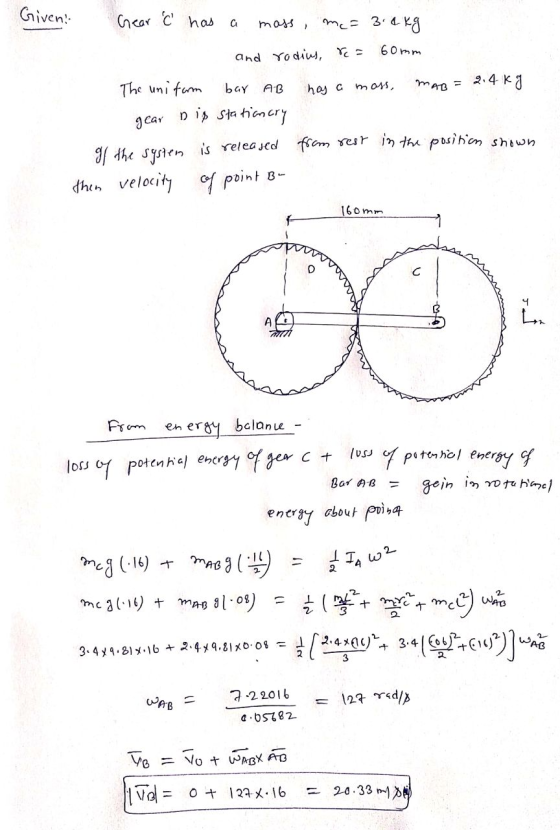
Gear "C" has a mass of 3.4kgs. and a centroidal
turning radius of 60 mm. The uniform bar AB has a mass of 2.4 kgs.
and the "D" gear is stationary. If the system is released from rest
in the position shown, determine the velocity of point "B" after
bar AB has rotated 90 °.
Homework Answers
Add Answer to:
Gear "C" has a mass of 3.4kgs. and a centroidal
turning radius of 60 mm. The...
Gear C has a mass of 5 kg and a centroidal radius of gyration of 75...
 Gear C has a mass of 5 kg and a centroidal radius of gyration of 75 mm. The uniform bar AB has a mass of 3 kg and gear D is stationary. If the system is released from rest in the position shown, determine (a) the angular acceleration of gear C, (b) the acceleration of point B.Fig. P16.108
Gear Chas a mass of 13 kg and a centroidal radius of gyration of 75 mm. The uniform bar AB has a ...
 Gear Chas a mass of 13 kg and a centroidal radius of gyration of 75 mm. The uniform bar AB has a mass of 3 kg and gear D is stationary. The system is released from rest in the position shown 200 mm 100 mm eBook & Resources olue: 0.00 points Determine the angular acceleration of gear C. Round the final answer to one decimal place.) (You must provide an answer before moving to the next part) The angular acceleration...
The velocity and acceleration of the bar AB shown are Wab = 1.8 rad / sec...
 The velocity and acceleration of the bar AB shown are
Wab = 1.8 rad / sec and aAB = 7.6 rad / sec. What is the
acceleration of point D?
160 mm Harry rregr t 90 gr 80mm AL B mm
The velocity and acceleration of the bar AB shown are
Wab = 1.8 rad / sec and aAB = 7.6 rad / sec. What is the
acceleration of point D?
160 mm Harry rregr t 90 gr 80mm AL B mm
The ABC bar has a mass of 20 kg with radius of rotation around its center mass C 150 mm. The bar is secured to the face...
 The ABC bar has a mass of 20 kg with radius of
rotation around its center mass C 150 mm. The bar is secured to the
face of a uniform circular disk, which has a mass of 30 kg. If the
disk and the rod attached there to are released from rest in the
position shown. Calculate the maximum angular velocity of the disk
during movement. The disk rolls without sliding.
A CAFO 480 mm B 120
A CAFO 480...
The ABC bar has a mass of 20 kg with radius of
rotation around its center mass C 150 mm. The bar is secured to the
face of a uniform circular disk, which has a mass of 30 kg. If the
disk and the rod attached there to are released from rest in the
position shown. Calculate the maximum angular velocity of the disk
during movement. The disk rolls without sliding.
A CAFO 480 mm B 120
A CAFO 480...
centroidal radius of gyration 750mm. If point C is pushed 5) The 3kg arm ABC with center of mass G has a down 3mm from its equilibrium position and released from rest (a) Determine the frequency...
 centroidal radius of gyration 750mm. If point C is pushed 5) The 3kg arm ABC with center of mass G has a down 3mm from its equilibrium position and released from rest (a) Determine the frequency of the resulting oscillation k 50 N/m 500 mm k50 N/m 500 mn -900 min-
centroidal radius of gyration 750mm. If point C is pushed 5) The 3kg arm ABC with center of mass G has a down 3mm from its equilibrium position and...
centroidal radius of gyration 750mm. If point C is pushed 5) The 3kg arm ABC with center of mass G has a down 3mm from its equilibrium position and released from rest (a) Determine the frequency of the resulting oscillation k 50 N/m 500 mm k50 N/m 500 mn -900 min-
centroidal radius of gyration 750mm. If point C is pushed 5) The 3kg arm ABC with center of mass G has a down 3mm from its equilibrium position and...
Each of the double pulleys shown has a centroidal mass moment of inertia of 0.25 kg.m?,...
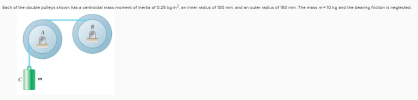 Each of the double pulleys shown has a centroidal mass moment of inertia of 0.25 kg.m?, an inner radius of 100 mm, and an outer radius of 150 mm. The mass m = 10 kg and the bearing friction is neglected. B A с m Determine the velocity of the cylinder 3 s after the system is released from rest. (Round the final answer to two decimal places.) (You must provide an answer before moving to the next part.) The...
plz help answer & continue Each of the double pulleys shown has a centroidal mass moment...
 plz help
answer & continue Each of the double pulleys shown has a centroidal mass moment of inertia of 0.25 kg m?, an inner radius of 100 mm, and an outer radius of 150 mm. The mass m10kg and the bearing friction is neglected B 0 с Required information Determine the velocity of the cylinder 3 s after the system is released from rest (Round the final answer to two decimal places) You must provide an answer before moving to...
plz help
answer & continue Each of the double pulleys shown has a centroidal mass moment of inertia of 0.25 kg m?, an inner radius of 100 mm, and an outer radius of 150 mm. The mass m10kg and the bearing friction is neglected B 0 с Required information Determine the velocity of the cylinder 3 s after the system is released from rest (Round the final answer to two decimal places) You must provide an answer before moving to...
. The 40-kg wheel has a radius of gyration about its center of gravity G of...
 .
The 40-kg wheel has a radius of gyration about its center of gravity G of k_G = 250 mm. If it rolls without slipping, determine its angular velocity when it has rotated clockwise 90 degree from the position shown. The spring AB has a stiffness k = 100 N/m and an unstretched length of 500 mm. The wheel is released from rest.
.
The 40-kg wheel has a radius of gyration about its center of gravity G of k_G = 250 mm. If it rolls without slipping, determine its angular velocity when it has rotated clockwise 90 degree from the position shown. The spring AB has a stiffness k = 100 N/m and an unstretched length of 500 mm. The wheel is released from rest.
Each of the double pulleys shown has a centroidal mass moment of inertia of 0.25 kg-m?,...
 Each of the double pulleys shown has a centroidal mass moment of inertia of 0.25 kg-m?, an inner radius of 100 mm, and an outer radius of 150 mm. The mass m= 10.7 kg and the bearing friction is neglected. W B А с m 8 Required information Determine the velocity of the cylinder 3 s after the system is released from rest. (Round the final answer to two decimal places.) (You must provide an answer before moving to the...
The weight is used to turn the gear system shown below. Gear A has a mass...
 The weight is used to turn the gear system shown below. Gear A has a mass of 15 kg and a radius of gyration of 100 mm about its center of mass. Gear B and Drum C have a combined mass of 25 kg and a radius of gyration about their mass center of 165 mm. If the system starts from rest, determine the speed of the 55-kg weight after it has been lowered 3 m, the angular velocity of...
 Gear C has a mass of 5 kg and a centroidal radius of gyration of 75 mm. The uniform bar AB has a mass of 3 kg and gear D is stationary. If the system is released from rest in the position shown, determine (a) the angular acceleration of gear C, (b) the acceleration of point B.Fig. P16.108
 Gear Chas a mass of 13 kg and a centroidal radius of gyration of 75 mm. The uniform bar AB has a mass of 3 kg and gear D is stationary. The system is released from rest in the position shown 200 mm 100 mm eBook & Resources olue: 0.00 points Determine the angular acceleration of gear C. Round the final answer to one decimal place.) (You must provide an answer before moving to the next part) The angular acceleration...
 The velocity and acceleration of the bar AB shown are
Wab = 1.8 rad / sec and aAB = 7.6 rad / sec. What is the
acceleration of point D?
160 mm Harry rregr t 90 gr 80mm AL B mm
The velocity and acceleration of the bar AB shown are
Wab = 1.8 rad / sec and aAB = 7.6 rad / sec. What is the
acceleration of point D?
160 mm Harry rregr t 90 gr 80mm AL B mm
 The ABC bar has a mass of 20 kg with radius of
rotation around its center mass C 150 mm. The bar is secured to the
face of a uniform circular disk, which has a mass of 30 kg. If the
disk and the rod attached there to are released from rest in the
position shown. Calculate the maximum angular velocity of the disk
during movement. The disk rolls without sliding.
A CAFO 480 mm B 120
A CAFO 480...
The ABC bar has a mass of 20 kg with radius of
rotation around its center mass C 150 mm. The bar is secured to the
face of a uniform circular disk, which has a mass of 30 kg. If the
disk and the rod attached there to are released from rest in the
position shown. Calculate the maximum angular velocity of the disk
during movement. The disk rolls without sliding.
A CAFO 480 mm B 120
A CAFO 480...
 centroidal radius of gyration 750mm. If point C is pushed 5) The 3kg arm ABC with center of mass G has a down 3mm from its equilibrium position and released from rest (a) Determine the frequency of the resulting oscillation k 50 N/m 500 mm k50 N/m 500 mn -900 min-
centroidal radius of gyration 750mm. If point C is pushed 5) The 3kg arm ABC with center of mass G has a down 3mm from its equilibrium position and...
centroidal radius of gyration 750mm. If point C is pushed 5) The 3kg arm ABC with center of mass G has a down 3mm from its equilibrium position and released from rest (a) Determine the frequency of the resulting oscillation k 50 N/m 500 mm k50 N/m 500 mn -900 min-
centroidal radius of gyration 750mm. If point C is pushed 5) The 3kg arm ABC with center of mass G has a down 3mm from its equilibrium position and...
 Each of the double pulleys shown has a centroidal mass moment of inertia of 0.25 kg.m?, an inner radius of 100 mm, and an outer radius of 150 mm. The mass m = 10 kg and the bearing friction is neglected. B A с m Determine the velocity of the cylinder 3 s after the system is released from rest. (Round the final answer to two decimal places.) (You must provide an answer before moving to the next part.) The...
 plz help
answer & continue Each of the double pulleys shown has a centroidal mass moment of inertia of 0.25 kg m?, an inner radius of 100 mm, and an outer radius of 150 mm. The mass m10kg and the bearing friction is neglected B 0 с Required information Determine the velocity of the cylinder 3 s after the system is released from rest (Round the final answer to two decimal places) You must provide an answer before moving to...
plz help
answer & continue Each of the double pulleys shown has a centroidal mass moment of inertia of 0.25 kg m?, an inner radius of 100 mm, and an outer radius of 150 mm. The mass m10kg and the bearing friction is neglected B 0 с Required information Determine the velocity of the cylinder 3 s after the system is released from rest (Round the final answer to two decimal places) You must provide an answer before moving to...
 .
The 40-kg wheel has a radius of gyration about its center of gravity G of k_G = 250 mm. If it rolls without slipping, determine its angular velocity when it has rotated clockwise 90 degree from the position shown. The spring AB has a stiffness k = 100 N/m and an unstretched length of 500 mm. The wheel is released from rest.
.
The 40-kg wheel has a radius of gyration about its center of gravity G of k_G = 250 mm. If it rolls without slipping, determine its angular velocity when it has rotated clockwise 90 degree from the position shown. The spring AB has a stiffness k = 100 N/m and an unstretched length of 500 mm. The wheel is released from rest.
 Each of the double pulleys shown has a centroidal mass moment of inertia of 0.25 kg-m?, an inner radius of 100 mm, and an outer radius of 150 mm. The mass m= 10.7 kg and the bearing friction is neglected. W B А с m 8 Required information Determine the velocity of the cylinder 3 s after the system is released from rest. (Round the final answer to two decimal places.) (You must provide an answer before moving to the...
 The weight is used to turn the gear system shown below. Gear A has a mass of 15 kg and a radius of gyration of 100 mm about its center of mass. Gear B and Drum C have a combined mass of 25 kg and a radius of gyration about their mass center of 165 mm. If the system starts from rest, determine the speed of the 55-kg weight after it has been lowered 3 m, the angular velocity of...
Most questions answered within 3 hours.
-
Where is the error in this code sequence?
String s1 = "Hello";
String s2 = "ello";...
asked 11 months ago -
Financial data for Joel de Paris, Inc., for last year
follow:
Joel de Paris, Inc.
Balance...
asked 11 months ago -
Consider this reaction:
Al2(SO4)3 (aq)+ BaCl3
(aq) Al2Cl6 (aq)- +
3BaSO4(s) . What is the...
asked 11 months ago -
Suppose that Savneet is considering increasing her
recent random sample from 20 car rentals to 40...
asked 11 months ago -
Trucks arrive at an unloading terminal at an average rate of 120
per hour.
Trucks arrive...
asked 11 months ago -
Why are methanol and ethanol completely soluble in water while
octanol is not very little soluble....
asked 11 months ago -
A facilities manager at a university reads in a research report
that the mean amount of...
asked 11 months ago -
When the CuSO4 is rehydrated by adding water to the anhydrous
compound, is this an endothermic...
asked 11 months ago -
A ray of sunlight is passing from diamond into crown glass; the
angle of incidence is...
asked 11 months ago -
A block of mass 0.249 kg is placed on top of a light, vertical
spring of...
asked 11 months ago -
how do the kidneys compensate in the presences of acidosis
a) trigger hyperventilate
b) reserve acid...
asked 11 months ago -
Question 501 pts
The rental rate of capital to the firm increases. Which of the
following...
asked 11 months ago