
Homework Answers
Please give Thumbs Up
Add Answer to:
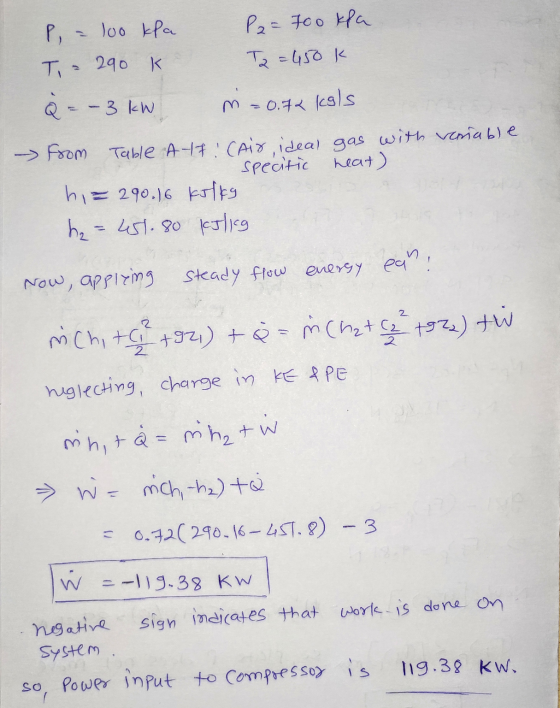
Air enters a compressor operating at steady state at a pressure of 100 kPa, a temperature...
Air enters a compressor at 152 kPa and 290 K and exits at a temperature of...
 Air enters a compressor at 152 kPa and 290 K and exits at a temperature of 507.4 K. Determine the power (kW) for the compressor if the inlet volumetric flow rate is 0.139 m/s and the heat transfer through the shell of the compressor to the surroundings is 1.31 kW. Use the ideal gas tables (variable specific heats).
Problem 2 20) Air enters a compressor operating at steady state at 280 K and exits...
 Problem 2 20) Air enters a compressor operating at steady state at 280 K and exits at a higher pressure and a higher temperature of 1020 K. Specitic heat at constant pressure for air is a constant and equal to 1.003 kJkg K. The mass flow rate is 01 kg's. If the compressor consumes electric power 77 kW Neglect kinetic and potential energy effects and assume air is ideal gas. Find (1) The rate of heat transfer between the compressor...
An air compressor is operating at a steady state with a mass flow rate of 1.3...
 An air compressor is operating at a steady state with a mass flow rate of 1.3 kg/s. The inlet pressure and temperature are P1 171 kPa and T1 319 K, respectively. The exit pressure and temperature are P2 609 kPa and T2 428 K. respectively. Heat lost from the compressor to the surroundings per unit mass flow is 16 kJ/kg. Air can be assumed as an ideal gas. Kinetic and potential energy changes can be neglected. what is the required...
P1) (50 points) - Air is compressed steadily by a 7.5-kW compressor. Air enters a compressor...
 P1) (50 points) - Air is compressed steadily by a 7.5-kW compressor. Air enters a compressor at a pressure of 100 kPa, a temperature of 290 K and a velocity of 6 m/s through an inlet with an area of 0.005 m2. At the exit, the pressure is 700 kPa, the temperature 480 K and the velocity is 2 m/s. Determine: a) heat transfer that takes place between the compressor and the surrounding medium at 290 K, in kW and...
35% Air (udara) is compressed in an axial flow compressor operating at steady state from 27°C,...
 35% Air (udara) is compressed in an axial flow compressor operating at steady state from 27°C, 1 bar to a pressure of 4,41 bar. The work input required is 96,23 kJ/kg of air flowing through the compressor. Heat transfer from the compressor occurs at the rate of 15,65 kJ/kg at the surface of the compressor where the temperature is 40'C. Kinetic and potential energy changes can be ignored. Assuming air as an ideal gas with constant specific heat, cp =...
An adiabatic turbine operates at steady state. Air enters the turbine at a pressure and temperature...
An adiabatic turbine operates at steady state. Air enters the turbine at a pressure and temperature of 800 kPa and 1100 K, respectively, and exits at 100 kPa. A temperature sensor at the turbine exit indicates that the exit air temperature is 700 K. Kinetic and potential energy effects are negligible, and the air can be treated as an ideal gas. Determine if the exit temperature reading can be correct. If yes, determine the turbine isentropic efficiency.
Air modeled as an ideal gas enters a turbine operating at steady state at 1040 K,...
Air modeled as an ideal gas enters a turbine operating at steady state at 1040 K, 278 kPa and exits at 120 kPa. The mass flow rate is 5.5 kg/s, and the power developed is 1200 kW. Stray heat transfer and kinetic and potential energy effects are negligible. Assuming k = 1.4, determine: (a) the temperature of the air at the turbine exit, in K. (b) the percent isentropic turbine efficiency.
A compressor works on a pressure of 105 kPa and temperature 300 K in a Brayton...
A compressor works on a pressure of 105 kPa and temperature 300 K in a Brayton cycle and has an efficiency of 45%. The exhaust temperature is 700 K. Find the pressure ratio and the specific heat addition by the combustion for this cycle. The inlet pressure of an air compressor is 100 kPa, with temperature 290 K, and brings it to 600 kPa, after which the air is cooled in an intercooler to 330K by heat transfer to the...
Air, modeled as an ideal gas, enters a turbine operating at steady state at 450 kPa,...
Air, modeled as an ideal gas, enters a turbine operating at steady state at 450 kPa, 800 K and exits at 100 kPa. The temperature of the exiting air is 420 K. a) If the turbine is well insulated and you can ignore kinetic and potential energy effects, determine if the exit temperature can be correct. b) What if the exit temperature is 550 K? Explain you’re your reasoning. Hint: Find the entropy generation rate first.
Refrigerant 134a enters a horizontal pipe operating at steady state at 50°C, 450 kPa and a...
Refrigerant 134a enters a horizontal pipe operating at steady state at 50°C, 450 kPa and a velocity of 56.9 m/s. At the exit, the temperature is 60 °C and the pressure is 220 kPa. The pipe diameter is 0.03 m. Determine the rate of heat transfer between the pipe and its surroundings, in kW
 Air enters a compressor at 152 kPa and 290 K and exits at a temperature of 507.4 K. Determine the power (kW) for the compressor if the inlet volumetric flow rate is 0.139 m/s and the heat transfer through the shell of the compressor to the surroundings is 1.31 kW. Use the ideal gas tables (variable specific heats).
 Problem 2 20) Air enters a compressor operating at steady state at 280 K and exits at a higher pressure and a higher temperature of 1020 K. Specitic heat at constant pressure for air is a constant and equal to 1.003 kJkg K. The mass flow rate is 01 kg's. If the compressor consumes electric power 77 kW Neglect kinetic and potential energy effects and assume air is ideal gas. Find (1) The rate of heat transfer between the compressor...
 An air compressor is operating at a steady state with a mass flow rate of 1.3 kg/s. The inlet pressure and temperature are P1 171 kPa and T1 319 K, respectively. The exit pressure and temperature are P2 609 kPa and T2 428 K. respectively. Heat lost from the compressor to the surroundings per unit mass flow is 16 kJ/kg. Air can be assumed as an ideal gas. Kinetic and potential energy changes can be neglected. what is the required...
 P1) (50 points) - Air is compressed steadily by a 7.5-kW compressor. Air enters a compressor at a pressure of 100 kPa, a temperature of 290 K and a velocity of 6 m/s through an inlet with an area of 0.005 m2. At the exit, the pressure is 700 kPa, the temperature 480 K and the velocity is 2 m/s. Determine: a) heat transfer that takes place between the compressor and the surrounding medium at 290 K, in kW and...
 35% Air (udara) is compressed in an axial flow compressor operating at steady state from 27°C, 1 bar to a pressure of 4,41 bar. The work input required is 96,23 kJ/kg of air flowing through the compressor. Heat transfer from the compressor occurs at the rate of 15,65 kJ/kg at the surface of the compressor where the temperature is 40'C. Kinetic and potential energy changes can be ignored. Assuming air as an ideal gas with constant specific heat, cp =...
Most questions answered within 3 hours.
-
Where is the error in this code sequence?
String s1 = "Hello";
String s2 = "ello";...
asked 10 months ago -
Financial data for Joel de Paris, Inc., for last year
follow:
Joel de Paris, Inc.
Balance...
asked 10 months ago -
Consider this reaction:
Al2(SO4)3 (aq)+ BaCl3
(aq) Al2Cl6 (aq)- +
3BaSO4(s) . What is the...
asked 10 months ago -
Suppose that Savneet is considering increasing her
recent random sample from 20 car rentals to 40...
asked 10 months ago -
Trucks arrive at an unloading terminal at an average rate of 120
per hour.
Trucks arrive...
asked 10 months ago -
Why are methanol and ethanol completely soluble in water while
octanol is not very little soluble....
asked 10 months ago -
A facilities manager at a university reads in a research report
that the mean amount of...
asked 10 months ago -
When the CuSO4 is rehydrated by adding water to the anhydrous
compound, is this an endothermic...
asked 10 months ago -
A ray of sunlight is passing from diamond into crown glass; the
angle of incidence is...
asked 10 months ago -
A block of mass 0.249 kg is placed on top of a light, vertical
spring of...
asked 10 months ago -
how do the kidneys compensate in the presences of acidosis
a) trigger hyperventilate
b) reserve acid...
asked 10 months ago -
Question 501 pts
The rental rate of capital to the firm increases. Which of the
following...
asked 10 months ago