
Homework Answers

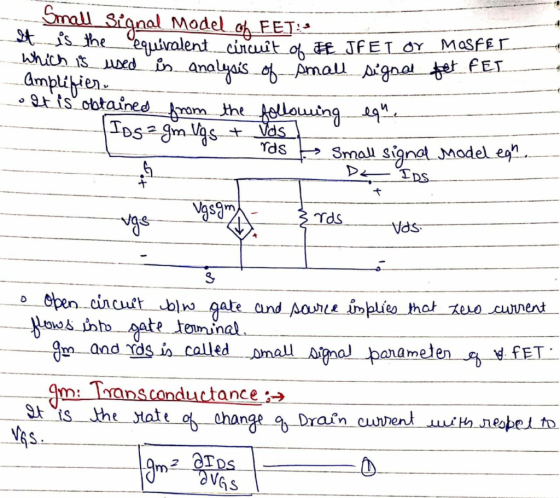
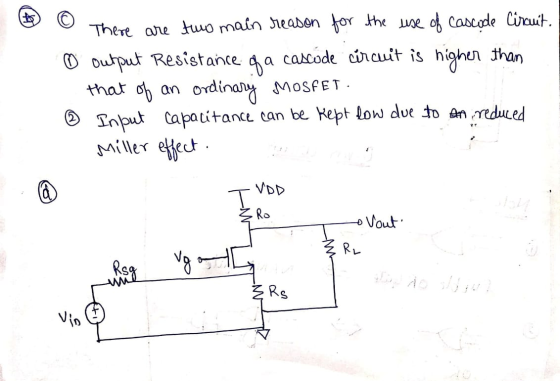
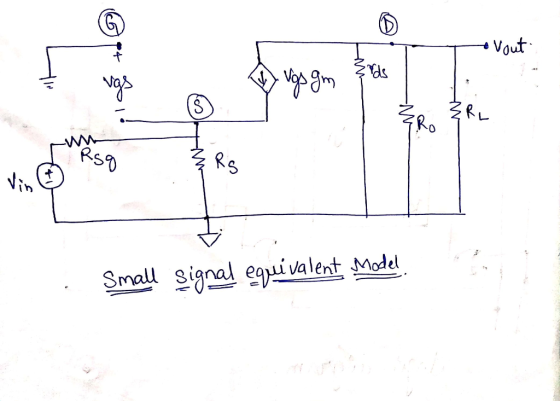
If you have any query comment down below I will surely help you as soon as possible please upvote my answer thanks in advance...!
Add Answer to:
Electronics 2
1. Give two reasons it would be better to use a MOSFET over a...
To induce the resistance expression seen in the X-node. 1) Induce resistance expression in MOSFET circuit...
 To
induce the resistance expression seen in the X-node.
1) Induce resistance expression in MOSFET circuit to complete
expression below.
2) Compare the small-signal circuit to the BJT circuit and the
results in 1) to complete the following expression (do not lead and
obtain the answer through comparative analysis of the two
circuits).
Rx = ro + [ Rx = ro + [ X x VBIAS VBIAS Rs RE wi
To
induce the resistance expression seen in the X-node.
1) Induce resistance expression in MOSFET circuit to complete
expression below.
2) Compare the small-signal circuit to the BJT circuit and the
results in 1) to complete the following expression (do not lead and
obtain the answer through comparative analysis of the two
circuits).
Rx = ro + [ Rx = ro + [ X x VBIAS VBIAS Rs RE wi
VDD RD RG1 out Vin G2 Figure 3 Design your own common source amplifier based on...
 VDD RD RG1 out Vin G2 Figure 3 Design your own common source amplifier based on Figure 3. You need an input resistance Rin 1M2. Make VD 2Voo/3, Vs Voo/3. Use VG 5 [V]. VoD 10 [V] a. Draw the small signal equivalent circuit b. Find RG1, and RG2, and lo c. Choose values of Ro, and Rs d. Find gm, and Av-Vout/Vin
l (33 PTS.) A MOSFET two-stage amplifier is shown below a) Determine gm for both MOSFETS...
 l (33 PTS.) A MOSFET two-stage amplifier is shown below a) Determine gm for both MOSFETS )ndicate the configuration (topology) of each amplifier stage raw the small-signal equivalent circuit of the entire amplifier (with transistors) d) Find Av Vou/vs, R and R Note: lo 1mA, Kn-31 6mAN2 VM-1.73 Lambda0 Mi Config. Mz Config.- RS sk R4 100 C2 OuF Ro R2 50 C1 M1 100uF 50% Ri Vs R3 50k 000uF R10 1.8k
VOD Ro 1. [Design Problem (1)] N-channel MOSFET (NMOS) operating in "Saturation" region. a. Consider a...
 VOD Ro 1. [Design Problem (1)] N-channel MOSFET (NMOS) operating in "Saturation" region. a. Consider a circuit as shown in Fig 1. b. You will need to design the circuit such that Ip = 1 (mA), VG = 0 [V], and Vp = 5 [V]. (determine values for R1, R2, Rp, and Rs) 1 W ID = 5 unCox (Vgs - Vrh)2 = K (Vgs - VTH)2 c. Use Vpp = 15 [V], Vs = -15 [V], and 2N7000 for...
Problem #5 (20 points) n the two stage cascade amplifier circuit shown below, the MOSFET has...
 Problem #5 (20 points) n the two stage cascade amplifier circuit shown below, the MOSFET has V IV and k-0s mA/ and the BIT has p 100 a) Perform the DC analysis of this circuit and based on the appropriate DC current values, calculate the small signal parameters for each transistor. b) Replace each transistor with its appropriate small signal model (neglecting ro) and draw the resulting smali- signal circuit for this amplifier circuit. HINT: You may use the T-model...
Question 4 (25 Marks) (5) 1. Derive the Dynamic Emitter Resistance, re that is used in...
 Question 4 (25 Marks) (5) 1. Derive the Dynamic Emitter Resistance, re that is used in the re-model small-signal analysis of BJT. 2. The circuit in Figure 7 shows the multistage cascade of two single transistors with B=100. Given the value of Vpp=12 V, R1=120 kN, R2=40 kN, R3=100 ks, Ra=30 kn, RE1=3.9 kN, Rez=4.5 kN, Rc1=6.5 kN, Rc2=8 ks, (2) (4) (a) Identify the transistor configuration for all stages. (b) Determine the d.c collector current (Ici and I cz)...
*Note : MOSFET-2N7002 Parameter => Vt : 1.47V, kn = 0.048 A/V^2 1. Obtain [ the...
 *Note : MOSFET-2N7002 Parameter => Vt : 1.47V, kn = 0.048
A/V^2
1. Obtain [ the Voltage and current ] of [ each node and branch
] at DC bias point (operating point) in the common-source +
source-follower figure above.
2. Obtain the small-signal equivalent model of the figure above
at DC bias point , then obtain open-circuit voltage gain Avo, input
resistance Rin, output resistance Rout.
tran 0 100m 99m 0.001m ;op 0 100m 99m 0.001m VDD V1 +...
*Note : MOSFET-2N7002 Parameter => Vt : 1.47V, kn = 0.048
A/V^2
1. Obtain [ the Voltage and current ] of [ each node and branch
] at DC bias point (operating point) in the common-source +
source-follower figure above.
2. Obtain the small-signal equivalent model of the figure above
at DC bias point , then obtain open-circuit voltage gain Avo, input
resistance Rin, output resistance Rout.
tran 0 100m 99m 0.001m ;op 0 100m 99m 0.001m VDD V1 +...
Problem 3: Design Problem On Figure P3a, you have a Common Source (CS) n-channel MOSFET amplifier....
 Problem 3: Design Problem On Figure P3a, you have a Common Source (CS) n-channel MOSFET amplifier. Notice the absence of a source resistor Rsig and load resistor R. If we know how the present amplifier (the one on Figure P3a) behaves without Rsig and RL, we can infer its behaviors if Rsig and R were to be added. design the amplifier circuit on Figure P3a, i.e., you have to find appropriate values for RGj You are to RG,, RD, and...
1. Design the common source amplifier shown in Figure 1 with Ip- 1 mA and Vo 5 V Determine V2 and Ri. The MOSFET characteristics are V-50 V, k-0.093 A/V, gate-to- drain capacitance, Cd 40 pF,...
 1. Design the common source amplifier shown in Figure 1 with Ip- 1 mA and Vo 5 V Determine V2 and Ri. The MOSFET characteristics are V-50 V, k-0.093 A/V, gate-to- drain capacitance, Cd 40 pF, and Vi 1.1 V. (For PSpice simulations, use parameters: VTO. 1.1 LAMBDA-002 KP-0.093 CGDO-4E-7 w=100u L-I00u for the 2N7000 MOSFET.) a. Determine the gain and gm of the circuit b. Determine the low-frequency (high-pass response) poles of the common-source amplifier due to the coupling...
For the IVP below, use Euler's Method with n 2 steps over the interval t [0, 2]. Then solve the same problem analytically and compare the results. Name the two main reasons in case the numerical...
 For the IVP below, use Euler's Method with n 2 steps over the interval t [0, 2]. Then solve the same problem analytically and compare the results. Name the two main reasons in case the numerical result is not close? (After final result assume e ~ 3) [20 p]
For the IVP below, use Euler's Method with n 2 steps over the interval t [0, 2]. Then solve the same problem analytically and compare the results. Name the two main...
For the IVP below, use Euler's Method with n 2 steps over the interval t [0, 2]. Then solve the same problem analytically and compare the results. Name the two main reasons in case the numerical result is not close? (After final result assume e ~ 3) [20 p]
For the IVP below, use Euler's Method with n 2 steps over the interval t [0, 2]. Then solve the same problem analytically and compare the results. Name the two main...
 To
induce the resistance expression seen in the X-node.
1) Induce resistance expression in MOSFET circuit to complete
expression below.
2) Compare the small-signal circuit to the BJT circuit and the
results in 1) to complete the following expression (do not lead and
obtain the answer through comparative analysis of the two
circuits).
Rx = ro + [ Rx = ro + [ X x VBIAS VBIAS Rs RE wi
To
induce the resistance expression seen in the X-node.
1) Induce resistance expression in MOSFET circuit to complete
expression below.
2) Compare the small-signal circuit to the BJT circuit and the
results in 1) to complete the following expression (do not lead and
obtain the answer through comparative analysis of the two
circuits).
Rx = ro + [ Rx = ro + [ X x VBIAS VBIAS Rs RE wi
 VDD RD RG1 out Vin G2 Figure 3 Design your own common source amplifier based on Figure 3. You need an input resistance Rin 1M2. Make VD 2Voo/3, Vs Voo/3. Use VG 5 [V]. VoD 10 [V] a. Draw the small signal equivalent circuit b. Find RG1, and RG2, and lo c. Choose values of Ro, and Rs d. Find gm, and Av-Vout/Vin
 l (33 PTS.) A MOSFET two-stage amplifier is shown below a) Determine gm for both MOSFETS )ndicate the configuration (topology) of each amplifier stage raw the small-signal equivalent circuit of the entire amplifier (with transistors) d) Find Av Vou/vs, R and R Note: lo 1mA, Kn-31 6mAN2 VM-1.73 Lambda0 Mi Config. Mz Config.- RS sk R4 100 C2 OuF Ro R2 50 C1 M1 100uF 50% Ri Vs R3 50k 000uF R10 1.8k
 VOD Ro 1. [Design Problem (1)] N-channel MOSFET (NMOS) operating in "Saturation" region. a. Consider a circuit as shown in Fig 1. b. You will need to design the circuit such that Ip = 1 (mA), VG = 0 [V], and Vp = 5 [V]. (determine values for R1, R2, Rp, and Rs) 1 W ID = 5 unCox (Vgs - Vrh)2 = K (Vgs - VTH)2 c. Use Vpp = 15 [V], Vs = -15 [V], and 2N7000 for...
 Problem #5 (20 points) n the two stage cascade amplifier circuit shown below, the MOSFET has V IV and k-0s mA/ and the BIT has p 100 a) Perform the DC analysis of this circuit and based on the appropriate DC current values, calculate the small signal parameters for each transistor. b) Replace each transistor with its appropriate small signal model (neglecting ro) and draw the resulting smali- signal circuit for this amplifier circuit. HINT: You may use the T-model...
 Question 4 (25 Marks) (5) 1. Derive the Dynamic Emitter Resistance, re that is used in the re-model small-signal analysis of BJT. 2. The circuit in Figure 7 shows the multistage cascade of two single transistors with B=100. Given the value of Vpp=12 V, R1=120 kN, R2=40 kN, R3=100 ks, Ra=30 kn, RE1=3.9 kN, Rez=4.5 kN, Rc1=6.5 kN, Rc2=8 ks, (2) (4) (a) Identify the transistor configuration for all stages. (b) Determine the d.c collector current (Ici and I cz)...
 *Note : MOSFET-2N7002 Parameter => Vt : 1.47V, kn = 0.048
A/V^2
1. Obtain [ the Voltage and current ] of [ each node and branch
] at DC bias point (operating point) in the common-source +
source-follower figure above.
2. Obtain the small-signal equivalent model of the figure above
at DC bias point , then obtain open-circuit voltage gain Avo, input
resistance Rin, output resistance Rout.
tran 0 100m 99m 0.001m ;op 0 100m 99m 0.001m VDD V1 +...
*Note : MOSFET-2N7002 Parameter => Vt : 1.47V, kn = 0.048
A/V^2
1. Obtain [ the Voltage and current ] of [ each node and branch
] at DC bias point (operating point) in the common-source +
source-follower figure above.
2. Obtain the small-signal equivalent model of the figure above
at DC bias point , then obtain open-circuit voltage gain Avo, input
resistance Rin, output resistance Rout.
tran 0 100m 99m 0.001m ;op 0 100m 99m 0.001m VDD V1 +...
 Problem 3: Design Problem On Figure P3a, you have a Common Source (CS) n-channel MOSFET amplifier. Notice the absence of a source resistor Rsig and load resistor R. If we know how the present amplifier (the one on Figure P3a) behaves without Rsig and RL, we can infer its behaviors if Rsig and R were to be added. design the amplifier circuit on Figure P3a, i.e., you have to find appropriate values for RGj You are to RG,, RD, and...
 1. Design the common source amplifier shown in Figure 1 with Ip- 1 mA and Vo 5 V Determine V2 and Ri. The MOSFET characteristics are V-50 V, k-0.093 A/V, gate-to- drain capacitance, Cd 40 pF, and Vi 1.1 V. (For PSpice simulations, use parameters: VTO. 1.1 LAMBDA-002 KP-0.093 CGDO-4E-7 w=100u L-I00u for the 2N7000 MOSFET.) a. Determine the gain and gm of the circuit b. Determine the low-frequency (high-pass response) poles of the common-source amplifier due to the coupling...
 For the IVP below, use Euler's Method with n 2 steps over the interval t [0, 2]. Then solve the same problem analytically and compare the results. Name the two main reasons in case the numerical result is not close? (After final result assume e ~ 3) [20 p]
For the IVP below, use Euler's Method with n 2 steps over the interval t [0, 2]. Then solve the same problem analytically and compare the results. Name the two main...
For the IVP below, use Euler's Method with n 2 steps over the interval t [0, 2]. Then solve the same problem analytically and compare the results. Name the two main reasons in case the numerical result is not close? (After final result assume e ~ 3) [20 p]
For the IVP below, use Euler's Method with n 2 steps over the interval t [0, 2]. Then solve the same problem analytically and compare the results. Name the two main...
Most questions answered within 3 hours.
-
Where is the error in this code sequence?
String s1 = "Hello";
String s2 = "ello";...
asked 10 months ago -
Financial data for Joel de Paris, Inc., for last year
follow:
Joel de Paris, Inc.
Balance...
asked 10 months ago -
Consider this reaction:
Al2(SO4)3 (aq)+ BaCl3
(aq) Al2Cl6 (aq)- +
3BaSO4(s) . What is the...
asked 10 months ago -
Suppose that Savneet is considering increasing her
recent random sample from 20 car rentals to 40...
asked 10 months ago -
Trucks arrive at an unloading terminal at an average rate of 120
per hour.
Trucks arrive...
asked 10 months ago -
Why are methanol and ethanol completely soluble in water while
octanol is not very little soluble....
asked 10 months ago -
A facilities manager at a university reads in a research report
that the mean amount of...
asked 10 months ago -
When the CuSO4 is rehydrated by adding water to the anhydrous
compound, is this an endothermic...
asked 10 months ago -
A ray of sunlight is passing from diamond into crown glass; the
angle of incidence is...
asked 10 months ago -
A block of mass 0.249 kg is placed on top of a light, vertical
spring of...
asked 10 months ago -
how do the kidneys compensate in the presences of acidosis
a) trigger hyperventilate
b) reserve acid...
asked 10 months ago -
Question 501 pts
The rental rate of capital to the firm increases. Which of the
following...
asked 10 months ago