Nitrogen and hydrogen react to form gaseous ammonia. a) Write the balanced chemical equation including states...
Nitrogen and hydrogen react to form gaseous ammonia. a) Write
the balanced chemical equation including states of matter.
b) If 50.0 g of nitrogen is mixed with 20.0 g of hydrogen what is
the limiting reagent, show all work?
c) What is the theoretical yield in grams of NH3?
d) If the percent yield of the reaction is 62.0 % then what is the
actual yield of the reaction?
Homework Answers
Request Answer!
We need at least 10 more requests to produce the answer.
0 / 10 have requested this problem solution
The more requests, the faster the answer.
Add Answer to:
Nitrogen and hydrogen react to form gaseous ammonia. a) Write
the balanced chemical equation including states...
Write a balanced chemical equation based on the following description: gaseous nitrogen and hydrogen react to...
Write a balanced chemical equation based on the following description: gaseous nitrogen and hydrogen react to form gaseous ammonia
Nitrogen and hydrogen gases are present in a rigid steel container which react to form ammonia...
Nitrogen and hydrogen gases are present in a rigid steel container which react to form ammonia gas (NH3). Use the information below to answer the following questions. N2(g) + 3H2(g) --> 2NH3(g) Before this chemical reaction took place, about 98.0 grams of nitrogen gas were present along with some mass of hydrogen gas. After the chemical reaction has occurred, 51.0 g ammonia plus 56.0 grams of excess reactant (either nitrogen or hydrogen) are present in a rigid container....
2. a. Nitrogen dioxide and hydrogen are reacted in the gas phase, in the presence of...
 2. a. Nitrogen dioxide and hydrogen are reacted in the gas phase, in the presence of a catalyst, to produce ammonia and water; write a balanced equation for this reaction. (2 pts) b. If 73.2 g of nitrogen dioxide and 10.6 g of hydrogen are mixed together and react to form ammonia, identify the limiting reactant and calculate the theoretical yield (in grams) of ammonia produced. (6 pts) c. 12.9 g of ammonia is actually produced in this reaction; based...
Nitrogen and oxygen can react to form nitrogen monoxide. Write a balanced chemical equation for this...
Nitrogen and oxygen can react to form nitrogen monoxide. Write a balanced chemical equation for this equilibrium reaction (including states of matter). -Start this reaction by adding 0.012 moles of both nitrogen and oxygen to a 500-mL flask. If Kc = 4.35x10⁻³¹, what are the equilibrium concentrations of my three chemicals?
Nitrogen and hydrogen react to create ammonia. N2 + 3 H2 + 2NH3 Bob Cat reacted...
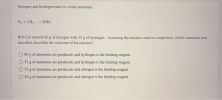 Nitrogen and hydrogen react to create ammonia. N2 + 3 H2 + 2NH3 Bob Cat reacted 42 g of nitrogen with 15 g of hydrogen. Assuming the reaction went to completion, which statement best describes describes the outcome of his reaction? 85 g of ammonia are produced, and hydrogen is the limiting reagent. 51 g of ammonia are produced, and hydrogen is the limiting reagent. 51 g of ammonia are produced, and nitrogen is the limiting reagent. 85 g of...
5.0g of nitrogen is reacted with 5.0 g of hydrogen to produce ammonia according to the...
5.0g of nitrogen is reacted with 5.0 g of hydrogen to produce ammonia according to the chemical equation shown below. Which one of the following statements is false? N2 (g) + 3 H2 (g) > 2 NH3 (g) A) 2.8 grams of hydrogen are left over. B) Nitrogen is the limiting reactant C) The theoretical yield of ammonia is 6.1 g D) Hydrogen is the excess reactant
Ammonia (NH3) is produced by the reaction of nitrogen and hydrogen according to the chemical equation:...
Ammonia (NH3) is produced by the reaction of nitrogen and hydrogen according to the chemical equation: N2+ 3H2 → 2NH3. What mass of nitrogen is necessary to react completely with 100.0 g of hydrogen?
Nitrogen and hydrogen react to form ammonia according to the following balanced equation: N2(g)+3H2(g)=2NH3(g). Calculate the...
Nitrogen and hydrogen react to form ammonia according to the following balanced equation: N2(g)+3H2(g)=2NH3(g). Calculate the number of moles of hydrogen required to react with 0.0723 mole of nitrogen, and the number of moles of ammonia that will form.
Ammonia NH3 may react with water to form oxygen and nitrogen gas . if 2.55g of...
 Ammonia NH3 may react with water to form oxygen and nitrogen gas
.
if 2.55g of NH3 reacts with 3.83g O2 and produces .950L of N2
at 295k and 1.00atm , which reactant is limiting ?
what is the percent yeild of the reaction ?
Ammonia, NH3, may react with oxygen to form nitrogen gas and water. 4NH,(aq) +30,(8) 2N,(s) + 6H,0(1) if 2.55 g of NH3 reacts with 3.83 g Og and produces 0.950 L of N2, at 295...
Ammonia NH3 may react with water to form oxygen and nitrogen gas
.
if 2.55g of NH3 reacts with 3.83g O2 and produces .950L of N2
at 295k and 1.00atm , which reactant is limiting ?
what is the percent yeild of the reaction ?
Ammonia, NH3, may react with oxygen to form nitrogen gas and water. 4NH,(aq) +30,(8) 2N,(s) + 6H,0(1) if 2.55 g of NH3 reacts with 3.83 g Og and produces 0.950 L of N2, at 295...
4. Ammonia reacts with oxygen to produce nitrogen and water. Balanced the chemical equation for the...
 4. Ammonia reacts with oxygen to produce nitrogen and water. Balanced the chemical equation for the reaction. (2 pts) « NH3 + 3_027_N2 + 6 H2O 2.9 126 ö + 36 5. If 38.7 grams of NH3 react with excess oxygen, how many grams of nitrogen are produced (based on the balanced equation in question 4)? (6pts)
 2. a. Nitrogen dioxide and hydrogen are reacted in the gas phase, in the presence of a catalyst, to produce ammonia and water; write a balanced equation for this reaction. (2 pts) b. If 73.2 g of nitrogen dioxide and 10.6 g of hydrogen are mixed together and react to form ammonia, identify the limiting reactant and calculate the theoretical yield (in grams) of ammonia produced. (6 pts) c. 12.9 g of ammonia is actually produced in this reaction; based...
 Nitrogen and hydrogen react to create ammonia. N2 + 3 H2 + 2NH3 Bob Cat reacted 42 g of nitrogen with 15 g of hydrogen. Assuming the reaction went to completion, which statement best describes describes the outcome of his reaction? 85 g of ammonia are produced, and hydrogen is the limiting reagent. 51 g of ammonia are produced, and hydrogen is the limiting reagent. 51 g of ammonia are produced, and nitrogen is the limiting reagent. 85 g of...
 Ammonia NH3 may react with water to form oxygen and nitrogen gas
.
if 2.55g of NH3 reacts with 3.83g O2 and produces .950L of N2
at 295k and 1.00atm , which reactant is limiting ?
what is the percent yeild of the reaction ?
Ammonia, NH3, may react with oxygen to form nitrogen gas and water. 4NH,(aq) +30,(8) 2N,(s) + 6H,0(1) if 2.55 g of NH3 reacts with 3.83 g Og and produces 0.950 L of N2, at 295...
Ammonia NH3 may react with water to form oxygen and nitrogen gas
.
if 2.55g of NH3 reacts with 3.83g O2 and produces .950L of N2
at 295k and 1.00atm , which reactant is limiting ?
what is the percent yeild of the reaction ?
Ammonia, NH3, may react with oxygen to form nitrogen gas and water. 4NH,(aq) +30,(8) 2N,(s) + 6H,0(1) if 2.55 g of NH3 reacts with 3.83 g Og and produces 0.950 L of N2, at 295...
 4. Ammonia reacts with oxygen to produce nitrogen and water. Balanced the chemical equation for the reaction. (2 pts) « NH3 + 3_027_N2 + 6 H2O 2.9 126 ö + 36 5. If 38.7 grams of NH3 react with excess oxygen, how many grams of nitrogen are produced (based on the balanced equation in question 4)? (6pts)
Most questions answered within 3 hours.
-
Where is the error in this code sequence?
String s1 = "Hello";
String s2 = "ello";...
asked 10 months ago -
Financial data for Joel de Paris, Inc., for last year
follow:
Joel de Paris, Inc.
Balance...
asked 10 months ago -
Consider this reaction:
Al2(SO4)3 (aq)+ BaCl3
(aq) Al2Cl6 (aq)- +
3BaSO4(s) . What is the...
asked 10 months ago -
Suppose that Savneet is considering increasing her
recent random sample from 20 car rentals to 40...
asked 10 months ago -
Trucks arrive at an unloading terminal at an average rate of 120
per hour.
Trucks arrive...
asked 10 months ago -
Why are methanol and ethanol completely soluble in water while
octanol is not very little soluble....
asked 10 months ago -
A facilities manager at a university reads in a research report
that the mean amount of...
asked 10 months ago -
When the CuSO4 is rehydrated by adding water to the anhydrous
compound, is this an endothermic...
asked 10 months ago -
A ray of sunlight is passing from diamond into crown glass; the
angle of incidence is...
asked 10 months ago -
A block of mass 0.249 kg is placed on top of a light, vertical
spring of...
asked 10 months ago -
how do the kidneys compensate in the presences of acidosis
a) trigger hyperventilate
b) reserve acid...
asked 10 months ago -
Question 501 pts
The rental rate of capital to the firm increases. Which of the
following...
asked 10 months ago