
Homework Answers
Add Answer to:
The object shown has mass m is placed at the bottom of an inclined plane that...
The object shown has mass m and is pulled by a constant force F directed parallel...
 The object shown has mass m and is pulled by a constant force F directed parallel to the incline. The incline makes an angle 8 with the horizontal. The block moves a distance d up along the inclined plane. The force of friction acts down the incline and has magnitude f. 1. The work done by force F is: a. Fd cos e b.-Fd cos e c. Fd d. -Fd sin e e. Fd sin 8 f. -Fd g. Zero...
A block of mass m is placed in a smooth-bored spring gun at the bottom of an inclined plane
 A block of mass m is placed in a smooth-bored spring gun at the bottom of an inclined plane, such that it compresses the spring by an amount xc, as shown in the figure below. The spring has a spring constant k. The incline makes an angle θ with the horizontal and the coefficient of friction between the block and the inclined plane is μ. The block is released, exits the muzzle of the gun, and slides up the incline...
A block of weight w sits on a plane inclined at an angle θ as shown....
 A block of weight w sits on a plane inclined at an angle θ as
shown. (Figure 1) The coefficient of kinetic friction between the
plane and the block is μ.
A force F⃗ F→F_vec is applied to push the block up the incline
at constant speed.
Part D
What is the change in potential energy of the block, ΔUΔUDeltaU,
as it moves a distance LLL down the incline?
Express your answer in terms of some or all of the...
A block of weight w sits on a plane inclined at an angle θ as
shown. (Figure 1) The coefficient of kinetic friction between the
plane and the block is μ.
A force F⃗ F→F_vec is applied to push the block up the incline
at constant speed.
Part D
What is the change in potential energy of the block, ΔUΔUDeltaU,
as it moves a distance LLL down the incline?
Express your answer in terms of some or all of the...
please show steps :) 21. A block of mass m slides down a rough ramp of...
 please show steps :)
21. A block of mass m slides down a rough ramp of height h. Its initial speed is zero. Its final speed at the bottom of the ramp is v. When it reaches the bottom of the ramp, how much mechanical energy (kinetic + potential) energy was converted into heat? V = 0 A) 0 B) mgh – mv2 C) mgh + mv2 D) mgh E) None of these
please show steps :)
21. A block of mass m slides down a rough ramp of height h. Its initial speed is zero. Its final speed at the bottom of the ramp is v. When it reaches the bottom of the ramp, how much mechanical energy (kinetic + potential) energy was converted into heat? V = 0 A) 0 B) mgh – mv2 C) mgh + mv2 D) mgh E) None of these
A 4.40-kg block is set into motion up an inclined plane with an initial speed of...
 A 4.40-kg block is set into motion up an inclined plane with an initial speed of Vi = 8.20 m/s (see figure below). The block comes to rest after traveling d = 3.00 m along the plane, which is inclined at an angle of 0 = 30.0° to the horizontal. (a) For this motion, determine the change in the block's kinetic energy. (b) For this motion, determine the change in potential energy of the block-Earth system. (c) Determine the friction...
Where's the Energy? Need help with concepts in the problem below! In this problem, we will...
 Where's the Energy?
Need help with concepts in the problem
below!
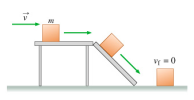
In this problem, we will consider the following situation as
depicted in the diagram (Figure 1) : A block of mass
m slides at a speed v along a horizontal, smooth
table. It next slides down a smooth ramp, descending a height
h, and then slides along a horizontal rough floor,
stopping eventually. Assume that the block slides slowly enough so
that it does not lose contact with the...
Where's the Energy?
Need help with concepts in the problem
below!
In this problem, we will consider the following situation as
depicted in the diagram (Figure 1) : A block of mass
m slides at a speed v along a horizontal, smooth
table. It next slides down a smooth ramp, descending a height
h, and then slides along a horizontal rough floor,
stopping eventually. Assume that the block slides slowly enough so
that it does not lose contact with the...
A 4.40-kg block is set into motion up an inclined plane with an initial speed of...
 A 4.40-kg block is set into motion up an inclined plane with an initial speed of v_i = 8.60 m/s (see figure below). The block comes to rest after traveling d = 3.00 m along the plane, which is inclined at an angle of theta = 30.0degree to the horizontal. (a) For this motion, determine the change in the block's kinetic energy. (b) For this motion, determine the change in potential energy of the block-Earth system. (c) Determine the friction...
True-False (2 points each). Circle the correct answer. 1) D F An isolated system has a...
 True-False (2 points each). Circle the correct answer. 1) D F An isolated system has a net external force of zero. 2)TF Momentum is conserved in an isolated system. 3) TT The definition of work is W = Fdcos(0) 4) T (F) The spring force is proportional to the displacement of the spring end. 5) O T Engines and generators can be 100% efficient. 6) DF The impulse is equal to the change in momentum. 7) DF In an isolated...
A block of mass mis attached to a horizontal spring and rests on a flat, smooth...
 A block of mass mis attached to a horizontal spring and rests on a flat, smooth surface as seen in the figure. The block can be pushed in the negative x- direction to compress the spring or pulled in the positive x-direction to stretch the spring. Where along the x-axis does the block have to be for the spring to have zero potential energy? Marked out of Flag estion ix=0 0 Select one: O a. The spring has zero potential...
3) A 5 kg block is set into motion up an inclined plane with an initial...
 3) A 5 kg block is set into motion up an inclined plane with an initial velocity of 8 m/s as shown below. The block comes to rest after travelling 3 m up the plane which is inclined at an angle of 30° W, = 8.00 m/s 3.00 m 30.0° For this motion, determine: a) The change in the block's kinetic energy b) The change in the block's potential energy c) The frictional force exerted on the object d) The...
 The object shown has mass m and is pulled by a constant force F directed parallel to the incline. The incline makes an angle 8 with the horizontal. The block moves a distance d up along the inclined plane. The force of friction acts down the incline and has magnitude f. 1. The work done by force F is: a. Fd cos e b.-Fd cos e c. Fd d. -Fd sin e e. Fd sin 8 f. -Fd g. Zero...
 A block of weight w sits on a plane inclined at an angle θ as
shown. (Figure 1) The coefficient of kinetic friction between the
plane and the block is μ.
A force F⃗ F→F_vec is applied to push the block up the incline
at constant speed.
Part D
What is the change in potential energy of the block, ΔUΔUDeltaU,
as it moves a distance LLL down the incline?
Express your answer in terms of some or all of the...
A block of weight w sits on a plane inclined at an angle θ as
shown. (Figure 1) The coefficient of kinetic friction between the
plane and the block is μ.
A force F⃗ F→F_vec is applied to push the block up the incline
at constant speed.
Part D
What is the change in potential energy of the block, ΔUΔUDeltaU,
as it moves a distance LLL down the incline?
Express your answer in terms of some or all of the...
 please show steps :)
21. A block of mass m slides down a rough ramp of height h. Its initial speed is zero. Its final speed at the bottom of the ramp is v. When it reaches the bottom of the ramp, how much mechanical energy (kinetic + potential) energy was converted into heat? V = 0 A) 0 B) mgh – mv2 C) mgh + mv2 D) mgh E) None of these
please show steps :)
21. A block of mass m slides down a rough ramp of height h. Its initial speed is zero. Its final speed at the bottom of the ramp is v. When it reaches the bottom of the ramp, how much mechanical energy (kinetic + potential) energy was converted into heat? V = 0 A) 0 B) mgh – mv2 C) mgh + mv2 D) mgh E) None of these
 A 4.40-kg block is set into motion up an inclined plane with an initial speed of Vi = 8.20 m/s (see figure below). The block comes to rest after traveling d = 3.00 m along the plane, which is inclined at an angle of 0 = 30.0° to the horizontal. (a) For this motion, determine the change in the block's kinetic energy. (b) For this motion, determine the change in potential energy of the block-Earth system. (c) Determine the friction...
 Where's the Energy?
Need help with concepts in the problem
below!
In this problem, we will consider the following situation as
depicted in the diagram (Figure 1) : A block of mass
m slides at a speed v along a horizontal, smooth
table. It next slides down a smooth ramp, descending a height
h, and then slides along a horizontal rough floor,
stopping eventually. Assume that the block slides slowly enough so
that it does not lose contact with the...
Where's the Energy?
Need help with concepts in the problem
below!
In this problem, we will consider the following situation as
depicted in the diagram (Figure 1) : A block of mass
m slides at a speed v along a horizontal, smooth
table. It next slides down a smooth ramp, descending a height
h, and then slides along a horizontal rough floor,
stopping eventually. Assume that the block slides slowly enough so
that it does not lose contact with the...
 A 4.40-kg block is set into motion up an inclined plane with an initial speed of v_i = 8.60 m/s (see figure below). The block comes to rest after traveling d = 3.00 m along the plane, which is inclined at an angle of theta = 30.0degree to the horizontal. (a) For this motion, determine the change in the block's kinetic energy. (b) For this motion, determine the change in potential energy of the block-Earth system. (c) Determine the friction...
 True-False (2 points each). Circle the correct answer. 1) D F An isolated system has a net external force of zero. 2)TF Momentum is conserved in an isolated system. 3) TT The definition of work is W = Fdcos(0) 4) T (F) The spring force is proportional to the displacement of the spring end. 5) O T Engines and generators can be 100% efficient. 6) DF The impulse is equal to the change in momentum. 7) DF In an isolated...
 A block of mass mis attached to a horizontal spring and rests on a flat, smooth surface as seen in the figure. The block can be pushed in the negative x- direction to compress the spring or pulled in the positive x-direction to stretch the spring. Where along the x-axis does the block have to be for the spring to have zero potential energy? Marked out of Flag estion ix=0 0 Select one: O a. The spring has zero potential...
 3) A 5 kg block is set into motion up an inclined plane with an initial velocity of 8 m/s as shown below. The block comes to rest after travelling 3 m up the plane which is inclined at an angle of 30° W, = 8.00 m/s 3.00 m 30.0° For this motion, determine: a) The change in the block's kinetic energy b) The change in the block's potential energy c) The frictional force exerted on the object d) The...
Most questions answered within 3 hours.
-
Where is the error in this code sequence?
String s1 = "Hello";
String s2 = "ello";...
asked 10 months ago -
Financial data for Joel de Paris, Inc., for last year
follow:
Joel de Paris, Inc.
Balance...
asked 10 months ago -
Consider this reaction:
Al2(SO4)3 (aq)+ BaCl3
(aq) Al2Cl6 (aq)- +
3BaSO4(s) . What is the...
asked 10 months ago -
Suppose that Savneet is considering increasing her
recent random sample from 20 car rentals to 40...
asked 10 months ago -
Trucks arrive at an unloading terminal at an average rate of 120
per hour.
Trucks arrive...
asked 10 months ago -
Why are methanol and ethanol completely soluble in water while
octanol is not very little soluble....
asked 10 months ago -
A facilities manager at a university reads in a research report
that the mean amount of...
asked 10 months ago -
When the CuSO4 is rehydrated by adding water to the anhydrous
compound, is this an endothermic...
asked 10 months ago -
A ray of sunlight is passing from diamond into crown glass; the
angle of incidence is...
asked 10 months ago -
A block of mass 0.249 kg is placed on top of a light, vertical
spring of...
asked 10 months ago -
how do the kidneys compensate in the presences of acidosis
a) trigger hyperventilate
b) reserve acid...
asked 10 months ago -
Question 501 pts
The rental rate of capital to the firm increases. Which of the
following...
asked 10 months ago