A block of mass m is placed in a smooth-bored spring gun at the bottom of an inclined plane
A block of mass m is placed in a smooth-bored spring gun at the bottom of an inclined plane, such that it compresses the spring by an amount xc, as shown in the figure below. The spring has a spring constant k. The incline makes an angle θ with the horizontal and the coefficient of friction between the block and the inclined plane is μ. The block is released, exits the muzzle of the gun, and slides up the incline a total distance L before coming to rest. Express your answers in terms of known quantities. You can take the acceleration of gravity, g, to be known.
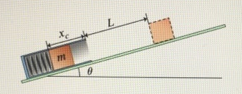
a) Model: How will you model this problem?
b) Visualize: Draw a before-and-after pictorial representation and list the known quantities in each state.
c) Solve: Taking the gravitational potential energy to be zero before the block is released, what is the total initial energy of the block?
d) Solve: What is the work done by friction on the block?
e) Solve: Find the energy the block has the instant after it travels a distance L up the ramp. Hint: do not forget to account for the distance the block travels while inside the spring gun.
f) Use energy conservation to express the distance L as a function of xc,k,m, g,μ, and θ.
g) Assess: Verify that your units from part
f) have the proper dimensions of length.
Homework Answers


Add Answer to:
A block of mass m is placed in a smooth-bored spring gun at the bottom of an inclined plane
6. A 5-kg block is pressed against a spring near the bottom of a 30° inclined...
6. A 5-kg block is pressed against a spring near the bottom of a 30° inclined plane. The spring, (spring constant 450 N/m) is compressed by 0.50 m.When released, the spring projects the block toward the top of the incline. The coefficient of kinetic friction between the block and the inclined plane is 0.3. (a) What is the speed of the block at the instant the block first returns to its equilibrium length? ans [3.9 m/s] (b) Calculate the speed...
A block of mass 3.00 kg is pressed against a spring (k=3,100N/m) near the bottom of a board inclined at θ = 28.0°
 A block of mass 3.00 kg is pressed against a spring (k=3,100N/m)
near the bottom of a board inclined at θ = 28.0°, as shown in
Figure A2.08. When released, the block is projected up the incline
and the spring expands by 14.0 cm to its normal length. Using the law of conservation of energy, determine
the maximum distance (d) traveled by the block up the incline,(a) in the absence of friction.(b)when the coefficient of kinetic friction between the block
and...
A block of mass 3.00 kg is pressed against a spring (k=3,100N/m)
near the bottom of a board inclined at θ = 28.0°, as shown in
Figure A2.08. When released, the block is projected up the incline
and the spring expands by 14.0 cm to its normal length. Using the law of conservation of energy, determine
the maximum distance (d) traveled by the block up the incline,(a) in the absence of friction.(b)when the coefficient of kinetic friction between the block
and...
A block of mass m = 3.5 kg is attached to a spring with spring constant...
A block of mass m = 3.5 kg is attached to a spring with spring constant k = 990 N/m. It is initially at rest on an inclined plane that is at an angle of θ = 22° with respect to the horizontal, and the coefficient of kinetic friction between the block and the plane is μk = 0.12. In the initial position, where the spring is compressed by a distance of d = 0.19 m, the mass is at...
A block of mass m = 3.5 kg is attached to a spring with spring constant...
A block of mass m = 3.5 kg is attached to a spring with spring constant k = 520 N/m. It is initially at rest on an inclined plane that is at an angle of θ = 21° with respect to the horizontal, and the coefficient of kinetic friction between the block and the plane is μk = 0.16. In the initial position, where the spring is compressed by a distance of d = 0.14 m, the mass is at...
Shooting a Block up an Incline
 A block of massis placed in a smooth-bored spring gun at the bottomof the inclineso that it compresses the spring by an amount .The spring has spring constant . The incline makes an angle with the horizontal and the coefficient ofkineticfriction between the block and the incline is . The blockis released, exits the muzzle of the gun, andslides up an incline a total distance .Find ,the distance traveled along the incline by the block afterit exitsthe gun. Ignore friction...
A block of mass m = 3.5 kg is on an inclined plane with a coefficient...
 A block of mass m = 3.5 kg is
on an inclined plane with a coefficient of friction
μ1 = 0.31, at an
initial height h = 0.53 m above
the ground. The plane is inclined at an angle θ =
54°. The block is then compressed against
a spring a distance Δx = 0.11 m
from its equilibrium point (the spring has a spring constant of
k1 = 39 N/m) and
released. At the bottom of the inclined plane...
A block of mass m = 3.5 kg is
on an inclined plane with a coefficient of friction
μ1 = 0.31, at an
initial height h = 0.53 m above
the ground. The plane is inclined at an angle θ =
54°. The block is then compressed against
a spring a distance Δx = 0.11 m
from its equilibrium point (the spring has a spring constant of
k1 = 39 N/m) and
released. At the bottom of the inclined plane...
A block of mass m is pushed against an ideal spring of constant of k, compressing...
A block of mass m is pushed against an ideal spring of constant of k, compressing it over a distance x with respect to its natural length. When the block is released, it moves up a rough ramp of inclination θ and coefficient of friction μk.What is the maximum distance (d) that the block travels up the incline? You MUST use conservation of energy to solve this problem. Epress your answers in term of m, g, k, μk and θ.
A 2-kg block is placed on a plane inclined at an angle of 30 to the...
 A 2-kg block is placed on a plane inclined at an angle of 30 to the horizontal and is connected to a spring fastened at the top of the plane. The spring is parallel to the incline and has a force constant of 100 N/m. The block is released from rest when the spring has its equilibrium length. If the block moves a distance of 10 cm before coming to an instantaneous rest, find the magnitude of the force of...
A block of mass m = 4.5 kg is attached to a spring with spring constant k = 710 N/m.
 A block of mass m = 4.5 kg is attached to a spring with spring constant k = 710 N/m. It is initially at rest on an inclined plane that is at an angle of θ = 25° with respect to the horizontal, and the coefficient of kinetic friction between the block and the plane is μk=0.18. In the initial position, where the spring is compressed by a distance of d = 0.12 m, the mass is at its lowest...
A block of mass m = 3.5 kg is attached to a spring with spring constant k = 780 N/m
 A block of mass m = 3.5 kg is attached to a spring with spring constant k = 780 N/m. It is initially at rest on an inclined plane that is at an angle of θ = 28° with respect to the horizontal, and the coefficient of kinetic friction between the block and the plane is μk = 0.19. In the initial position, where the spring is compressed by a distance of d = 0.19 m, the mass is at...
 A block of mass m = 3.5 kg is
on an inclined plane with a coefficient of friction
μ1 = 0.31, at an
initial height h = 0.53 m above
the ground. The plane is inclined at an angle θ =
54°. The block is then compressed against
a spring a distance Δx = 0.11 m
from its equilibrium point (the spring has a spring constant of
k1 = 39 N/m) and
released. At the bottom of the inclined plane...
A block of mass m = 3.5 kg is
on an inclined plane with a coefficient of friction
μ1 = 0.31, at an
initial height h = 0.53 m above
the ground. The plane is inclined at an angle θ =
54°. The block is then compressed against
a spring a distance Δx = 0.11 m
from its equilibrium point (the spring has a spring constant of
k1 = 39 N/m) and
released. At the bottom of the inclined plane...
 A 2-kg block is placed on a plane inclined at an angle of 30 to the horizontal and is connected to a spring fastened at the top of the plane. The spring is parallel to the incline and has a force constant of 100 N/m. The block is released from rest when the spring has its equilibrium length. If the block moves a distance of 10 cm before coming to an instantaneous rest, find the magnitude of the force of...
Most questions answered within 3 hours.
-
Where is the error in this code sequence?
String s1 = "Hello";
String s2 = "ello";...
asked 11 months ago -
Financial data for Joel de Paris, Inc., for last year
follow:
Joel de Paris, Inc.
Balance...
asked 11 months ago -
Consider this reaction:
Al2(SO4)3 (aq)+ BaCl3
(aq) Al2Cl6 (aq)- +
3BaSO4(s) . What is the...
asked 11 months ago -
Suppose that Savneet is considering increasing her
recent random sample from 20 car rentals to 40...
asked 11 months ago -
Trucks arrive at an unloading terminal at an average rate of 120
per hour.
Trucks arrive...
asked 11 months ago -
Why are methanol and ethanol completely soluble in water while
octanol is not very little soluble....
asked 11 months ago -
A facilities manager at a university reads in a research report
that the mean amount of...
asked 11 months ago -
When the CuSO4 is rehydrated by adding water to the anhydrous
compound, is this an endothermic...
asked 11 months ago -
A ray of sunlight is passing from diamond into crown glass; the
angle of incidence is...
asked 11 months ago -
A block of mass 0.249 kg is placed on top of a light, vertical
spring of...
asked 11 months ago -
how do the kidneys compensate in the presences of acidosis
a) trigger hyperventilate
b) reserve acid...
asked 11 months ago -
Question 501 pts
The rental rate of capital to the firm increases. Which of the
following...
asked 11 months ago