
Homework Answers
Add Answer to:
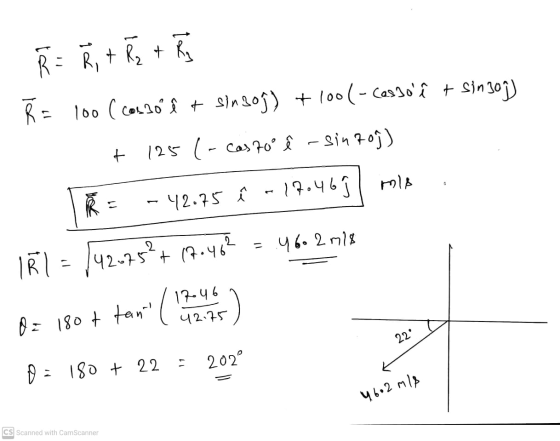
Vector Addition Calculate the resultant vector from the figure: 100.0 m/s 100.0 m/s 30.00 30.00 70.00...
Question 5 (1 point) Determine the resultant of the vectors by vector addition. V2 =180 m/s...
 Question 5 (1 point) Determine the resultant of the vectors by vector addition. V2 =180 m/s @ 75.0° V1 = 200 m/s @35.0° 357m/s @ 54 deg 24 m/s @ 54deg 357 m/s @ 36 deg 380m/s @110 deg
please anwers all of them - N(ALL) VECTOR ADDITION USING COMPONENTS *Sketch the resultant vector to...
 please anwers all of them
- N(ALL) VECTOR ADDITION USING COMPONENTS *Sketch the resultant vector to scale. Write the resultant in unit vector netation Carded#'S), 1. 7 3 - physics.info * calculate magnitude and direction (boxed his
please anwers all of them
- N(ALL) VECTOR ADDITION USING COMPONENTS *Sketch the resultant vector to scale. Write the resultant in unit vector netation Carded#'S), 1. 7 3 - physics.info * calculate magnitude and direction (boxed his
Find the magnitude and direction of the resultant of A+B using Vector Addition by the Rectangular...
Find the magnitude and direction of the resultant of A+B using Vector Addition by the Rectangular Component method. (Angles are in standard position.) A = 5.0 m/s at 45 deg B = 2.0 m/s at 180 deg
2. A 30.00 ml solution of 0.235 M CH2NH2 was titrated with 0.150 M H2S0O.. a) Calculate the pH of the 30.00 ml solution...
 2. A 30.00 ml solution of 0.235 M CH2NH2 was titrated with 0.150 M H2S0O.. a) Calculate the pH of the 30.00 ml solution of 0.235 M CH2NH2 The Kb for CH2NH2 is 4.4x 10⁴ b) Calculate the volume of 0.150 M H2S04 required to completely neutralize the 30.00 mL solution of 0.235 M CH2NH2. c)Calculate the volume of 0.150 M H2SO, required to neutralize half the mole of CH2NHz. present 30.00 mL solution of 0.235 M CH2NH2 d) Calculate...
Part A. Geometric Addition What is the magnitude and direction of the resultant vector, R, when...
 Part A. Geometric Addition
What is the magnitude and direction of the resultant vector, R,
when the parallelogram law is applied to A and B?
Part B. Component addition of vectors
What is the resultant vector, R, obtained by adding vectors C
and D?
Part C. Addition of more than two vectors
For the vector sum R = A + B + C + D, what are the magnitude and
direction of the resultant R?
Learning Goal: To use geometric...
Part A. Geometric Addition
What is the magnitude and direction of the resultant vector, R,
when the parallelogram law is applied to A and B?
Part B. Component addition of vectors
What is the resultant vector, R, obtained by adding vectors C
and D?
Part C. Addition of more than two vectors
For the vector sum R = A + B + C + D, what are the magnitude and
direction of the resultant R?
Learning Goal: To use geometric...
Find the direction of the resultant vector F1 and F2 from the figure 100 N Figure:...
 Find the direction of the resultant vector F1 and F2 from the figure 100 N Figure: Vector 80 N 128.66 degree A. 51.34 degree B. 38.66 degree OC. 141.34 degree OD.
Vector Addition – add the following 3 vectors (find the resultant vector – magnitude and orientation)...
Vector Addition – add the following 3 vectors (find the resultant vector – magnitude and orientation) F1 = 85 N, 60º above the horizontal F2 = 180 N, 35º below the horizontal F3 = 35 N, along the vertical (at 90º)
Vector Addition – add the following 3 vectors (find the resultant vector – magnitude and orientation)...
Vector Addition – add the following 3 vectors (find the resultant vector – magnitude and orientation) F1 = 85 N, 60º above the horizontal F2 = 180 N, 35º below the horizontal F3 = 35 N, along the vertical (at 90º)
Vector Addition – add the following 3 vectors (find the resultant vector – magnitude and orientation)...
Vector Addition – add the following 3 vectors (find the resultant vector – magnitude and orientation) F1 = 85 N, 60º above the horizontal F2 = 180 N, 35º below the horizontal F3 = 35 N, along the vertical (at 90º) Please explain how you got your answer.
Find the value of the resultant vector F1 and F2 from the figure 100 N 80...
 Find the value of the resultant vector F1 and F2 from the figure 100 N 80 N a) 20.06 N A. 180.06 N B. 90.06 N C. 128.06 N D.
 Question 5 (1 point) Determine the resultant of the vectors by vector addition. V2 =180 m/s @ 75.0° V1 = 200 m/s @35.0° 357m/s @ 54 deg 24 m/s @ 54deg 357 m/s @ 36 deg 380m/s @110 deg
 please anwers all of them
- N(ALL) VECTOR ADDITION USING COMPONENTS *Sketch the resultant vector to scale. Write the resultant in unit vector netation Carded#'S), 1. 7 3 - physics.info * calculate magnitude and direction (boxed his
please anwers all of them
- N(ALL) VECTOR ADDITION USING COMPONENTS *Sketch the resultant vector to scale. Write the resultant in unit vector netation Carded#'S), 1. 7 3 - physics.info * calculate magnitude and direction (boxed his
 2. A 30.00 ml solution of 0.235 M CH2NH2 was titrated with 0.150 M H2S0O.. a) Calculate the pH of the 30.00 ml solution of 0.235 M CH2NH2 The Kb for CH2NH2 is 4.4x 10⁴ b) Calculate the volume of 0.150 M H2S04 required to completely neutralize the 30.00 mL solution of 0.235 M CH2NH2. c)Calculate the volume of 0.150 M H2SO, required to neutralize half the mole of CH2NHz. present 30.00 mL solution of 0.235 M CH2NH2 d) Calculate...
 Part A. Geometric Addition
What is the magnitude and direction of the resultant vector, R,
when the parallelogram law is applied to A and B?
Part B. Component addition of vectors
What is the resultant vector, R, obtained by adding vectors C
and D?
Part C. Addition of more than two vectors
For the vector sum R = A + B + C + D, what are the magnitude and
direction of the resultant R?
Learning Goal: To use geometric...
Part A. Geometric Addition
What is the magnitude and direction of the resultant vector, R,
when the parallelogram law is applied to A and B?
Part B. Component addition of vectors
What is the resultant vector, R, obtained by adding vectors C
and D?
Part C. Addition of more than two vectors
For the vector sum R = A + B + C + D, what are the magnitude and
direction of the resultant R?
Learning Goal: To use geometric...
 Find the direction of the resultant vector F1 and F2 from the figure 100 N Figure: Vector 80 N 128.66 degree A. 51.34 degree B. 38.66 degree OC. 141.34 degree OD.
 Find the value of the resultant vector F1 and F2 from the figure 100 N 80 N a) 20.06 N A. 180.06 N B. 90.06 N C. 128.06 N D.
Most questions answered within 3 hours.
-
Where is the error in this code sequence?
String s1 = "Hello";
String s2 = "ello";...
asked 10 months ago -
Financial data for Joel de Paris, Inc., for last year
follow:
Joel de Paris, Inc.
Balance...
asked 10 months ago -
Consider this reaction:
Al2(SO4)3 (aq)+ BaCl3
(aq) Al2Cl6 (aq)- +
3BaSO4(s) . What is the...
asked 10 months ago -
Suppose that Savneet is considering increasing her
recent random sample from 20 car rentals to 40...
asked 10 months ago -
Trucks arrive at an unloading terminal at an average rate of 120
per hour.
Trucks arrive...
asked 10 months ago -
Why are methanol and ethanol completely soluble in water while
octanol is not very little soluble....
asked 10 months ago -
A facilities manager at a university reads in a research report
that the mean amount of...
asked 10 months ago -
When the CuSO4 is rehydrated by adding water to the anhydrous
compound, is this an endothermic...
asked 10 months ago -
A ray of sunlight is passing from diamond into crown glass; the
angle of incidence is...
asked 10 months ago -
A block of mass 0.249 kg is placed on top of a light, vertical
spring of...
asked 10 months ago -
how do the kidneys compensate in the presences of acidosis
a) trigger hyperventilate
b) reserve acid...
asked 10 months ago -
Question 501 pts
The rental rate of capital to the firm increases. Which of the
following...
asked 10 months ago