
Homework Answers
Add Answer to:
0 200287 0.00294 0.00301 0.00308 0.00315 0.00322 0.00329 0. -1 -1.5 -2 -25 -3 y =...
The activation energy for a reaction is 15 kJ mol-1 at 27° C. A catalyst lowers...
 The activation energy for a reaction is 15 kJ mol-1 at 27° C. A catalyst lowers the activation energy to 10 kJ mol at the same temperature. By what factor is the reaction rate increased? Assume that the reactant concentrations and the pre-exponential factor in the Arrhenius equation are unchanged. O A. 1.5 OB. 1.1 OC. 0.67 O D.7.4 O E. 1.7 x 10⁷ Reset Selection
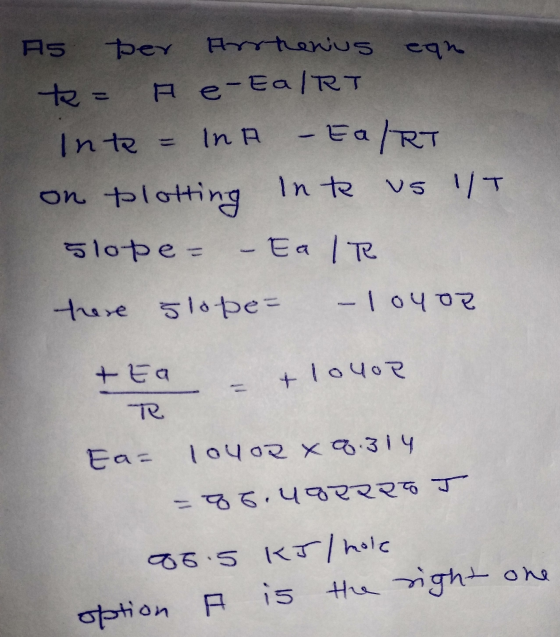
Question 4 2 pts You generate the below Arrhenius plot of your data. Determine the activation...
 Question 4 2 pts You generate the below Arrhenius plot of your data. Determine the activation energy of the reaction in kJ/mol. Note: R = 8.314 J/(mol*K) = 0.008314 kJ/(mol*K) = 0.0821 L*atm/(mol*K) Arrhenius Plot: Sample Data o e đ d c In(k) đ ở s y = -18808x + 56.183 R2 = 0.976 do o o 0.0032 0.00325 0.0033 0.00335 0.0034 0.00345 1/T
The activation energy for the isomerization reaction of CH 3N C: CH 3 NC ⇀ CH...
The activation energy for the isomerization reaction of CH 3N C: CH 3 NC ⇀ CH 3C N is 161 kJ/mol, and the reaction rate constant at 600 K is 0.41 s- 1 . Calculate the Arrhenius factor A for this reaction. Calculate the rate constant for this reaction at 1000 K and assume that the activation energy and A do not change with temperature.
Help with the work please!! Question 3 0/3 pts An Arrhenius plot has a slope of...
 Help with the work please!!
Question 3 0/3 pts An Arrhenius plot has a slope of -13,796 K and an intercept of 6.72. What is the activation energy in kJ/mol? Report your answer to three significant figures. 20 50 er 115 margin of error +/- 2%
Help with the work please!!
Question 3 0/3 pts An Arrhenius plot has a slope of -13,796 K and an intercept of 6.72. What is the activation energy in kJ/mol? Report your answer to three significant figures. 20 50 er 115 margin of error +/- 2%
1) Calculate the activation energy in kJ/mol for the following reaction if the rate constant for...
1) Calculate the activation energy in kJ/mol for the following reaction if the rate constant for the reaction increases from 93.5 M-1s-1 at 497.7 K to 1349.3 M-1s-1 at 636.7 K. do not include units, but make sure your answer is in kJ/mol! 2) A chemist constructs a plot of ln k vs. 1/T for a chemical reaction. The slope of the trendline for the data is -746 K. What is the activation energy for this reaction in kJ/mol? R...
The activation energy of a reaction is 55.5 kJ mol−1 and the frequency factor is 1.5×10¹¹s−1....
The activation energy of a reaction is 55.5 kJ mol−1 and the frequency factor is 1.5×10¹¹s−1. Calculate the rate constant of the reaction at 26 ∘C.
Given the a plot of In k versus 1/T for a reaction yields a straight line...
 Given the a plot of In k versus 1/T for a reaction yields a straight line with the equation, and the value of the least squares fit parameter: y = -2458x + 25.036 R = 0.9998 calculate the value of the activation energy for the reaction in kJ/mol. Select one: O a. 20.44 kJ/mol O b. 2044 kJ/mol O C.2458 kJ/mol O d. 24.58 kJ/mol Which of the following is the conjugate acid of bicarbonate ion, HCO,? Select one: a.co....
Question 24 (1 point) The graph below shows the results of an Arrhenius plot for the...
 Question 24 (1 point) The graph below shows the results of an Arrhenius plot for the reaction 2 N2O(g) --> 4 NO2(g) + O2(g) In(k) vs. 1/1 In(k) (k in units of s.1) slope-1.24x10⁴ K intercept=315 -14 0.0026 0.0028 0.003 0.0032 0.0034 Т (1/к) Which of the following most correctly describes the activation energy and frequency factor for this reaction? Ea-1.03x10² kJ mol 1 A-3.30x1031 - 1 Ea=-1.24x10⁴ kJ mol-1, A=31.5 s -1 O Ea-1.03x10⁸ kJ mol-1 A-4.79x10¹³ 5-1 Ea=1.03x10²...
Please answer questions 1 and 2 on The rate constant for the reaction answered A +...
 Please answer questions 1 and 2
on The rate constant for the reaction answered A + B->C out of 1.0 is 4.1 x10⁴ U(mol s) at 593 K. The activation energy is 101 kj/mol. question Determine the temperature when the rate constant is 1.2 x10⁻³ L/(mol s)- Answer: 2 One (often inaccurate) rule of thumb in biology is that a 10 °C change increases the rate by a factor of ten. If the lower temperature is 3 °C, what activation...
Please answer questions 1 and 2
on The rate constant for the reaction answered A + B->C out of 1.0 is 4.1 x10⁴ U(mol s) at 593 K. The activation energy is 101 kj/mol. question Determine the temperature when the rate constant is 1.2 x10⁻³ L/(mol s)- Answer: 2 One (often inaccurate) rule of thumb in biology is that a 10 °C change increases the rate by a factor of ten. If the lower temperature is 3 °C, what activation...
Part 2 Calculations 1. Using the slope of the line of the Arrhenius plot, calculate the...
 Part 2 Calculations 1. Using the slope of the line of the Arrhenius plot, calculate the activation energy for the iodination of acetone in kJ/mol. Show all work for complete credit. Table 4. Data for the Construction of the Arrhenius Plot. All data obtained under Mixture 2 conditions. Parameter Initial (CH3COCH), M Initial [H], M Initial [13], M Mixture 2 0.5 0.0625 0.00025 Condition Temp. 1 Temp. 2 Temp. 3 Temp. 4 Temp. 5 Temp. 6 Temperature, °C 5.2 13.4...
 The activation energy for a reaction is 15 kJ mol-1 at 27° C. A catalyst lowers the activation energy to 10 kJ mol at the same temperature. By what factor is the reaction rate increased? Assume that the reactant concentrations and the pre-exponential factor in the Arrhenius equation are unchanged. O A. 1.5 OB. 1.1 OC. 0.67 O D.7.4 O E. 1.7 x 10⁷ Reset Selection
 Question 4 2 pts You generate the below Arrhenius plot of your data. Determine the activation energy of the reaction in kJ/mol. Note: R = 8.314 J/(mol*K) = 0.008314 kJ/(mol*K) = 0.0821 L*atm/(mol*K) Arrhenius Plot: Sample Data o e đ d c In(k) đ ở s y = -18808x + 56.183 R2 = 0.976 do o o 0.0032 0.00325 0.0033 0.00335 0.0034 0.00345 1/T
 Help with the work please!!
Question 3 0/3 pts An Arrhenius plot has a slope of -13,796 K and an intercept of 6.72. What is the activation energy in kJ/mol? Report your answer to three significant figures. 20 50 er 115 margin of error +/- 2%
Help with the work please!!
Question 3 0/3 pts An Arrhenius plot has a slope of -13,796 K and an intercept of 6.72. What is the activation energy in kJ/mol? Report your answer to three significant figures. 20 50 er 115 margin of error +/- 2%
 Given the a plot of In k versus 1/T for a reaction yields a straight line with the equation, and the value of the least squares fit parameter: y = -2458x + 25.036 R = 0.9998 calculate the value of the activation energy for the reaction in kJ/mol. Select one: O a. 20.44 kJ/mol O b. 2044 kJ/mol O C.2458 kJ/mol O d. 24.58 kJ/mol Which of the following is the conjugate acid of bicarbonate ion, HCO,? Select one: a.co....
 Question 24 (1 point) The graph below shows the results of an Arrhenius plot for the reaction 2 N2O(g) --> 4 NO2(g) + O2(g) In(k) vs. 1/1 In(k) (k in units of s.1) slope-1.24x10⁴ K intercept=315 -14 0.0026 0.0028 0.003 0.0032 0.0034 Т (1/к) Which of the following most correctly describes the activation energy and frequency factor for this reaction? Ea-1.03x10² kJ mol 1 A-3.30x1031 - 1 Ea=-1.24x10⁴ kJ mol-1, A=31.5 s -1 O Ea-1.03x10⁸ kJ mol-1 A-4.79x10¹³ 5-1 Ea=1.03x10²...
 Please answer questions 1 and 2
on The rate constant for the reaction answered A + B->C out of 1.0 is 4.1 x10⁴ U(mol s) at 593 K. The activation energy is 101 kj/mol. question Determine the temperature when the rate constant is 1.2 x10⁻³ L/(mol s)- Answer: 2 One (often inaccurate) rule of thumb in biology is that a 10 °C change increases the rate by a factor of ten. If the lower temperature is 3 °C, what activation...
Please answer questions 1 and 2
on The rate constant for the reaction answered A + B->C out of 1.0 is 4.1 x10⁴ U(mol s) at 593 K. The activation energy is 101 kj/mol. question Determine the temperature when the rate constant is 1.2 x10⁻³ L/(mol s)- Answer: 2 One (often inaccurate) rule of thumb in biology is that a 10 °C change increases the rate by a factor of ten. If the lower temperature is 3 °C, what activation...
 Part 2 Calculations 1. Using the slope of the line of the Arrhenius plot, calculate the activation energy for the iodination of acetone in kJ/mol. Show all work for complete credit. Table 4. Data for the Construction of the Arrhenius Plot. All data obtained under Mixture 2 conditions. Parameter Initial (CH3COCH), M Initial [H], M Initial [13], M Mixture 2 0.5 0.0625 0.00025 Condition Temp. 1 Temp. 2 Temp. 3 Temp. 4 Temp. 5 Temp. 6 Temperature, °C 5.2 13.4...
Most questions answered within 3 hours.
-
Where is the error in this code sequence?
String s1 = "Hello";
String s2 = "ello";...
asked 11 months ago -
Financial data for Joel de Paris, Inc., for last year
follow:
Joel de Paris, Inc.
Balance...
asked 11 months ago -
Consider this reaction:
Al2(SO4)3 (aq)+ BaCl3
(aq) Al2Cl6 (aq)- +
3BaSO4(s) . What is the...
asked 11 months ago -
Suppose that Savneet is considering increasing her
recent random sample from 20 car rentals to 40...
asked 11 months ago -
Trucks arrive at an unloading terminal at an average rate of 120
per hour.
Trucks arrive...
asked 11 months ago -
Why are methanol and ethanol completely soluble in water while
octanol is not very little soluble....
asked 11 months ago -
A facilities manager at a university reads in a research report
that the mean amount of...
asked 11 months ago -
When the CuSO4 is rehydrated by adding water to the anhydrous
compound, is this an endothermic...
asked 11 months ago -
A ray of sunlight is passing from diamond into crown glass; the
angle of incidence is...
asked 11 months ago -
A block of mass 0.249 kg is placed on top of a light, vertical
spring of...
asked 11 months ago -
how do the kidneys compensate in the presences of acidosis
a) trigger hyperventilate
b) reserve acid...
asked 11 months ago -
Question 501 pts
The rental rate of capital to the firm increases. Which of the
following...
asked 11 months ago