
Homework Answers

Add Answer to:
Question 21 If the p-value of a left sided test is 0.03, what would be the...
A researcher runs a one-sample, one-sided t-test, and finds that t = 1.93, df = 21,...
A researcher runs a one-sample, one-sided t-test, and finds that t = 1.93, df = 21, α = .05, where: H 0: μ = 12 H 1: μ > 12 What decision should be made regarding the hypothesis? -Reject the null hypothesis. -Reject the alternative hypothesis. -Fail to reject the null hypothesis. -Fail to reject the alternative hypothesis.
QUESTION 21 A p value is the probability of obtaining the value of the test statistic...
QUESTION 21 A p value is the probability of obtaining the value of the test statistic or more extreme, if the null hypothesis is true. a. True b. False QUESTION 18 Type I error occurs when a. you reject a false null hypothesis b. you reject a true null hypothesis c. you fail to reject a false null hypothesis d. you fail to reject a true null hypothesis QUESTION 19 Type II error occurs when a. you reject a false...
A hypothesis test is performed at the α = 0.05 level of significance. The p-value is...
A hypothesis test is performed at the α = 0.05 level of significance. The p-value is determined to be 0.03. Therefore, we know that we would _______________. either reject or fail to reject the null hypothesis, depending on the value of the test statistic. reject the null hypothesis know that a 99% confidence interval would contain the value specified in the null hypothesis. fail to reject the null hypothesis
Question 21 (4 points) Use the given information to find the P-value. Also, use a 0.05...
 Question 21 (4 points) Use the given information to find the P-value. Also, use a 0.05 significance level and state the conclusion about the null hypothesis (reject the null hypothesis or fail to reject the null hypothesis). With H1: p. 0.612, the test statistic is z = -3.06. 1) 0.0022; fail to reject the null hypothesis 2) 0.0011; fail to reject the null hypothesis 3) 0.0011; reject the null hypothesis 4) 0.0022; reject the null hypothesis
If the p value for a hypothesis test is 0.0271, which would be a correct decision?...
If the p value for a hypothesis test is 0.0271, which would be a correct decision? Do not reject the null hypothesis when alpha is 0.10. Do not reject the null hypothesis when alpha is 0.05. Reject the null hypothesis when alpha is 0.025. Reject the null hypothesis when alpha is 0.10. none of the above
IPS 19 When testing for independence, what decision/conclusion can we make when the P-value is 0.03...
 IPS 19 When testing for independence, what decision/conclusion can we make when the P-value is 0.03 and the significance level is 0.05? Enough evidence to conclude that the two variables are independent Reject the alternative hypothesis Enough evidence to conclude that the two variables are dependent Reject the null hypothesis
Select the p-value(s) at which you would reject the null hypothesis for a two-sided test at...
Select the p-value(s) at which you would reject the null hypothesis for a two-sided test at the 90% confidence level. SELECT ALL THAT APPLY. 0.9500 0.9000 0.8900 0.1100 0.0900 0.0500 0.0250
Question 3 Not yet answered Marked out of 3.00 P Plas question If your alpha is...
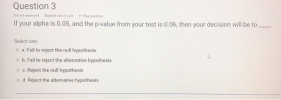 Question 3 Not yet answered Marked out of 3.00 P Plas question If your alpha is 0.05, and the p-value from your test is 0.06, then your decision will be to Select one: a. Fail to reject the null hypothesis b. Fail to reject the alternative hypothesis c. Reject the null hypothesis d. Reject the alternative hypothesis
Score. b. Question 6 B0/3 pts 399 Det Test the claim that the mean GPA of...
 Score. b. Question 6 B0/3 pts 399 Det Test the claim that the mean GPA of night students is larger than 3.5 at the 0.025 significance level. The null and alternative hypothesis would be: H:p = 0.875 H :p > 0.875 HH <3.5 H: > 3.5 H: = 3.5 H :P < 0.875 HP 0.875 H :P < 0.875 H: > 3.5 H: < 3.5 H1: +3.5 H :p > 0.875 The test is: right-tailed two-tailed left-tailed Based on a...
The P-value for a hypothesis test is shown. Use the P-value to decide whether to reject...
 The P-value for a hypothesis test is shown. Use the P-value to decide whether to reject H when the level of significance is (a) a= 0.01, (b) a 0.05, and (c) a0.10. P 0.0749 (a) Do you reject or fail to reject Ho at the 0.01 level of significance? O A. Reject H because the P-value, 0.0749, is greater than a=0.01 O B. Fail to reject Ho because the P-value, 0.0749, is less than a = 0.01 O C. Reject...
 Question 21 (4 points) Use the given information to find the P-value. Also, use a 0.05 significance level and state the conclusion about the null hypothesis (reject the null hypothesis or fail to reject the null hypothesis). With H1: p. 0.612, the test statistic is z = -3.06. 1) 0.0022; fail to reject the null hypothesis 2) 0.0011; fail to reject the null hypothesis 3) 0.0011; reject the null hypothesis 4) 0.0022; reject the null hypothesis
 IPS 19 When testing for independence, what decision/conclusion can we make when the P-value is 0.03 and the significance level is 0.05? Enough evidence to conclude that the two variables are independent Reject the alternative hypothesis Enough evidence to conclude that the two variables are dependent Reject the null hypothesis
 Question 3 Not yet answered Marked out of 3.00 P Plas question If your alpha is 0.05, and the p-value from your test is 0.06, then your decision will be to Select one: a. Fail to reject the null hypothesis b. Fail to reject the alternative hypothesis c. Reject the null hypothesis d. Reject the alternative hypothesis
 Score. b. Question 6 B0/3 pts 399 Det Test the claim that the mean GPA of night students is larger than 3.5 at the 0.025 significance level. The null and alternative hypothesis would be: H:p = 0.875 H :p > 0.875 HH <3.5 H: > 3.5 H: = 3.5 H :P < 0.875 HP 0.875 H :P < 0.875 H: > 3.5 H: < 3.5 H1: +3.5 H :p > 0.875 The test is: right-tailed two-tailed left-tailed Based on a...
 The P-value for a hypothesis test is shown. Use the P-value to decide whether to reject H when the level of significance is (a) a= 0.01, (b) a 0.05, and (c) a0.10. P 0.0749 (a) Do you reject or fail to reject Ho at the 0.01 level of significance? O A. Reject H because the P-value, 0.0749, is greater than a=0.01 O B. Fail to reject Ho because the P-value, 0.0749, is less than a = 0.01 O C. Reject...
Most questions answered within 3 hours.
-
Where is the error in this code sequence?
String s1 = "Hello";
String s2 = "ello";...
asked 10 months ago -
Financial data for Joel de Paris, Inc., for last year
follow:
Joel de Paris, Inc.
Balance...
asked 10 months ago -
Consider this reaction:
Al2(SO4)3 (aq)+ BaCl3
(aq) Al2Cl6 (aq)- +
3BaSO4(s) . What is the...
asked 10 months ago -
Suppose that Savneet is considering increasing her
recent random sample from 20 car rentals to 40...
asked 10 months ago -
Trucks arrive at an unloading terminal at an average rate of 120
per hour.
Trucks arrive...
asked 10 months ago -
Why are methanol and ethanol completely soluble in water while
octanol is not very little soluble....
asked 10 months ago -
A facilities manager at a university reads in a research report
that the mean amount of...
asked 10 months ago -
When the CuSO4 is rehydrated by adding water to the anhydrous
compound, is this an endothermic...
asked 10 months ago -
A ray of sunlight is passing from diamond into crown glass; the
angle of incidence is...
asked 10 months ago -
A block of mass 0.249 kg is placed on top of a light, vertical
spring of...
asked 10 months ago -
how do the kidneys compensate in the presences of acidosis
a) trigger hyperventilate
b) reserve acid...
asked 10 months ago -
Question 501 pts
The rental rate of capital to the firm increases. Which of the
following...
asked 10 months ago