


Homework Answers
Answer (1.7)
T = (T1+ T2+ T3+ T4+ T5)/5
= (0.0054 + 0.0156 + 0.0253 + 0.0454 + 0.0554)/5
= 0.0294 s
(1.8)
Calculate the frequency correponding the abobe problem.
T = 1/f
f = 1/T
= 1/ 0294
= 34 Hz
Add Answer to:
Question 1.7 The period T is the time from one peak of a signal to the...
I circuit with a signal generator and a resistor is shown in Fig. 3. Question 2.1...
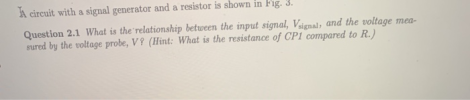 I circuit with a signal generator and a resistor is shown in Fig. 3. Question 2.1 What is the relationship between the input signal, Vsignal, and the voltage mea- sured by the voltage probe, V? (Hint: What is the resistance of CP1 compared to R.) + CP1 + Vsignal(t) R VP2 AC input Figure 3: Resistor circuit with AC input signal
Question 2 (50 points]: Continuous-Time Signals Given the following continuous-time signal (t). (t) 5t (a) [4%]...
 Question 2 (50 points]: Continuous-Time Signals Given the following continuous-time signal (t). (t) 5t (a) [4%] What is the fundamental period (i.e., T) and fundamental frequency (ie, wo) of (+)? (b) [8%] Calculate the time average, average power and total energy of x(t). Is x(t) an energy signal? Explain. (c) [8%] Calculate the Fourier series coefficients of (t), i.e., {x}. [Hint: You can make use of the result in Q1(a).] (d) [8%] What is the percentage of power loss if...
Clear steps, please. Question # 4(a) a. Time period of x(t) Cos(10Tmt) issec b. Time period...
 Clear steps, please.
Question # 4(a) a. Time period of x(t) Cos(10Tmt) issec b. Time period of x(t) Cos(10Tt) +Cos (50Tt) issec c. Frequency of x(t) Cos(10mt) isHz d. Frequency ofx(t) Cos(10mt) + Cos(50πt) is- --Hz e. Phase spectrum is anfunction of frequency. f. Magnitude spectrum is an g To check stability in time domain, a system H(s) is stable if and only if function of frequency. h. To check stability in time domain, a system ht) is stable if...
Clear steps, please.
Question # 4(a) a. Time period of x(t) Cos(10Tmt) issec b. Time period of x(t) Cos(10Tt) +Cos (50Tt) issec c. Frequency of x(t) Cos(10mt) isHz d. Frequency ofx(t) Cos(10mt) + Cos(50πt) is- --Hz e. Phase spectrum is anfunction of frequency. f. Magnitude spectrum is an g To check stability in time domain, a system H(s) is stable if and only if function of frequency. h. To check stability in time domain, a system ht) is stable if...
Question 7 The diagram depicts a digital filter that samples the continuous time input signal x(t)...
 Question 7 The diagram depicts a digital filter that samples the continuous time input signal x(t) at 6 kHz. The digital is filter described by y(n) -x(n) + 0.8y(n -1) Find an expression for the steady state output if x(t) -3sin(2mft) with f 200 Hz? Hint: evaluate the filter's frequency response at the discrete time frequency corresponding to 200 Hz. (12 points) Anti-alias filter Sample A/D Digital Filter
One of the most important classes of time dependent signals are periodic signals. Periodic signals satisfy tho following signal equations, x(t) X(t) x(t+nt) for n 2,3. The periodic signals to b...
 One of the most important classes of time dependent signals are periodic signals. Periodic signals satisfy tho following signal equations, x(t) X(t) x(t+nt) for n 2,3. The periodic signals to be observed in this laboratory assignment are shown below. In all the examples A represents the amplitude of the signal and may be given as the measurement from 0 to the peak value A, Apk or can be given as the measurement between A and -A which defines a peak-to-peak...
Determine the period number of the ufk-4 cos(K+TT/2) discrete time signal! Select one: O A. 34 O ...
 Determine the period number of the ufk-4 cos(K+TT/2) discrete time signal! Select one: O A. 34 O D. Non periodic O E. 34/3 A coil (L 5 mH) is parallel connected to two serially connected resistors (6 kΩ and 4 k2). Calculate the time constant of the above two-pole! Select one: Ο Α.0.5s OC. 5 s Ο D. 0.5 με Ο Ε.0.5 Ms Consider the following sequential network: Z2 Di Ct ㄍ洼 S2 Q2 CLK Choose which function does this...
 I circuit with a signal generator and a resistor is shown in Fig. 3. Question 2.1 What is the relationship between the input signal, Vsignal, and the voltage mea- sured by the voltage probe, V? (Hint: What is the resistance of CP1 compared to R.) + CP1 + Vsignal(t) R VP2 AC input Figure 3: Resistor circuit with AC input signal
 Question 2 (50 points]: Continuous-Time Signals Given the following continuous-time signal (t). (t) 5t (a) [4%] What is the fundamental period (i.e., T) and fundamental frequency (ie, wo) of (+)? (b) [8%] Calculate the time average, average power and total energy of x(t). Is x(t) an energy signal? Explain. (c) [8%] Calculate the Fourier series coefficients of (t), i.e., {x}. [Hint: You can make use of the result in Q1(a).] (d) [8%] What is the percentage of power loss if...
 Clear steps, please.
Question # 4(a) a. Time period of x(t) Cos(10Tmt) issec b. Time period of x(t) Cos(10Tt) +Cos (50Tt) issec c. Frequency of x(t) Cos(10mt) isHz d. Frequency ofx(t) Cos(10mt) + Cos(50πt) is- --Hz e. Phase spectrum is anfunction of frequency. f. Magnitude spectrum is an g To check stability in time domain, a system H(s) is stable if and only if function of frequency. h. To check stability in time domain, a system ht) is stable if...
Clear steps, please.
Question # 4(a) a. Time period of x(t) Cos(10Tmt) issec b. Time period of x(t) Cos(10Tt) +Cos (50Tt) issec c. Frequency of x(t) Cos(10mt) isHz d. Frequency ofx(t) Cos(10mt) + Cos(50πt) is- --Hz e. Phase spectrum is anfunction of frequency. f. Magnitude spectrum is an g To check stability in time domain, a system H(s) is stable if and only if function of frequency. h. To check stability in time domain, a system ht) is stable if...
 Question 7 The diagram depicts a digital filter that samples the continuous time input signal x(t) at 6 kHz. The digital is filter described by y(n) -x(n) + 0.8y(n -1) Find an expression for the steady state output if x(t) -3sin(2mft) with f 200 Hz? Hint: evaluate the filter's frequency response at the discrete time frequency corresponding to 200 Hz. (12 points) Anti-alias filter Sample A/D Digital Filter
 One of the most important classes of time dependent signals are periodic signals. Periodic signals satisfy tho following signal equations, x(t) X(t) x(t+nt) for n 2,3. The periodic signals to be observed in this laboratory assignment are shown below. In all the examples A represents the amplitude of the signal and may be given as the measurement from 0 to the peak value A, Apk or can be given as the measurement between A and -A which defines a peak-to-peak...
 Determine the period number of the ufk-4 cos(K+TT/2) discrete time signal! Select one: O A. 34 O D. Non periodic O E. 34/3 A coil (L 5 mH) is parallel connected to two serially connected resistors (6 kΩ and 4 k2). Calculate the time constant of the above two-pole! Select one: Ο Α.0.5s OC. 5 s Ο D. 0.5 με Ο Ε.0.5 Ms Consider the following sequential network: Z2 Di Ct ㄍ洼 S2 Q2 CLK Choose which function does this...
Most questions answered within 3 hours.
-
Where is the error in this code sequence?
String s1 = "Hello";
String s2 = "ello";...
asked 10 months ago -
Financial data for Joel de Paris, Inc., for last year
follow:
Joel de Paris, Inc.
Balance...
asked 10 months ago -
Consider this reaction:
Al2(SO4)3 (aq)+ BaCl3
(aq) Al2Cl6 (aq)- +
3BaSO4(s) . What is the...
asked 10 months ago -
Suppose that Savneet is considering increasing her
recent random sample from 20 car rentals to 40...
asked 10 months ago -
Trucks arrive at an unloading terminal at an average rate of 120
per hour.
Trucks arrive...
asked 10 months ago -
Why are methanol and ethanol completely soluble in water while
octanol is not very little soluble....
asked 10 months ago -
A facilities manager at a university reads in a research report
that the mean amount of...
asked 10 months ago -
When the CuSO4 is rehydrated by adding water to the anhydrous
compound, is this an endothermic...
asked 10 months ago -
A ray of sunlight is passing from diamond into crown glass; the
angle of incidence is...
asked 10 months ago -
A block of mass 0.249 kg is placed on top of a light, vertical
spring of...
asked 10 months ago -
how do the kidneys compensate in the presences of acidosis
a) trigger hyperventilate
b) reserve acid...
asked 10 months ago -
Question 501 pts
The rental rate of capital to the firm increases. Which of the
following...
asked 10 months ago