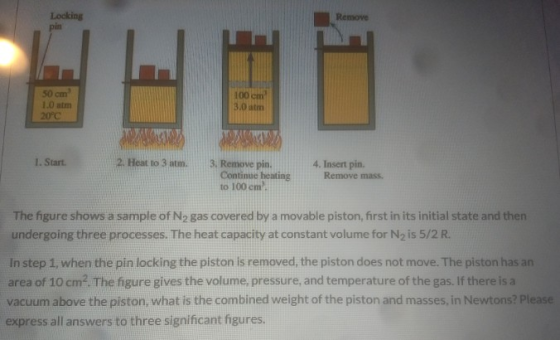
can you help me with this question please
if there's a vacuum above the piston what is the combined weight of pain and masses in Newtons
Homework Answers
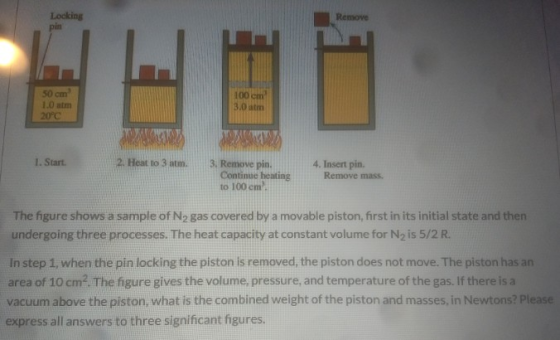
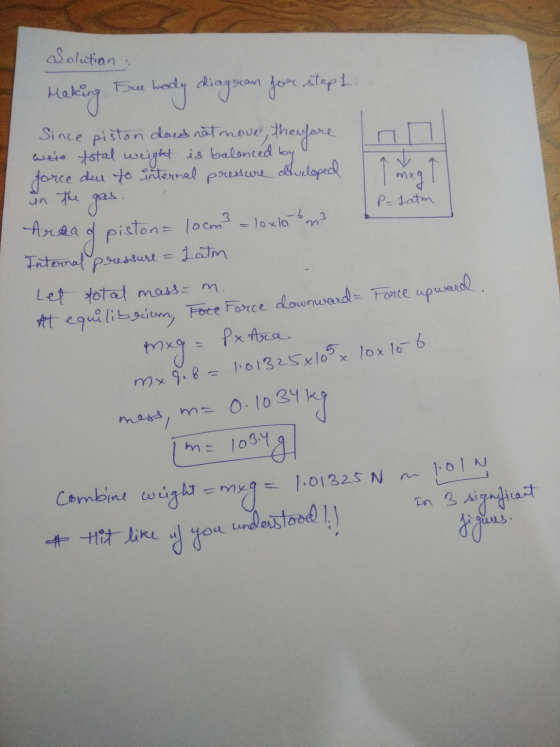
Solution in the uploaded image
Add Answer to:
can you help me with this question please
if there's a vacuum above the piston what...
a) If there is a vacuum above the piston, what is the combined weight of the...
 a) If there is a vacuum above the piston, what is the combined
weight of the piston and masses, in Newtons?
b) How many moles of N2 gas are in the sample?
c) (fill in the blank): In step 2, the pin is reinserted and the
gas is heated until the pressure is 3.0 atmospheres. The new
temperature and volume are __________ K and ________
cm3. The amount of work done on the gas is __________J;
the amount of heat...
a) If there is a vacuum above the piston, what is the combined
weight of the piston and masses, in Newtons?
b) How many moles of N2 gas are in the sample?
c) (fill in the blank): In step 2, the pin is reinserted and the
gas is heated until the pressure is 3.0 atmospheres. The new
temperature and volume are __________ K and ________
cm3. The amount of work done on the gas is __________J;
the amount of heat...
can you help with q8 please Remove Looking pin 50 cm 1.0 atm 20°C 100 cm...
 can you help with q8 please
Remove Looking pin 50 cm 1.0 atm 20°C 100 cm 3.0 am WWW 1. Start 2. Heat to 3 atm. 3. Remove pin. Continue heating to 100 cm 4. Insert pin. Remove mass The figure shows a sample of N2 gas covered by a movable piston, first in its initial state and then undergoing three processes. The heat capacity at constant volume for Nz is 5/2 R. In step 1, when the pin locking...
can you help with q8 please
Remove Looking pin 50 cm 1.0 atm 20°C 100 cm 3.0 am WWW 1. Start 2. Heat to 3 atm. 3. Remove pin. Continue heating to 100 cm 4. Insert pin. Remove mass The figure shows a sample of N2 gas covered by a movable piston, first in its initial state and then undergoing three processes. The heat capacity at constant volume for Nz is 5/2 R. In step 1, when the pin locking...
can you help with Q6&7 please Remove Looking pin 50 cm 1.0 atm 20°C 100 cm...
 can you help with Q6&7 please
Remove Looking pin 50 cm 1.0 atm 20°C 100 cm 3.0 am WWW 1. Start 2. Heat to 3 atm. 3. Remove pin. Continue heating to 100 cm 4. Insert pin. Remove mass The figure shows a sample of N2 gas covered by a movable piston, first in its initial state and then undergoing three processes. The heat capacity at constant volume for Nz is 5/2 R. In step 1, when the pin locking...
can you help with Q6&7 please
Remove Looking pin 50 cm 1.0 atm 20°C 100 cm 3.0 am WWW 1. Start 2. Heat to 3 atm. 3. Remove pin. Continue heating to 100 cm 4. Insert pin. Remove mass The figure shows a sample of N2 gas covered by a movable piston, first in its initial state and then undergoing three processes. The heat capacity at constant volume for Nz is 5/2 R. In step 1, when the pin locking...
can you help with Q4&Q5 please Remove Looking pin 50 cm 1.0 atm 20°C 100 cm...
 can you help with Q4&Q5 please
Remove Looking pin 50 cm 1.0 atm 20°C 100 cm 3.0 am WWW 1. Start 2. Heat to 3 atm. 3. Remove pin. Continue heating to 100 cm 4. Insert pin. Remove mass The figure shows a sample of N2 gas covered by a movable piston, first in its initial state and then undergoing three processes. The heat capacity at constant volume for Nz is 5/2 R. In step 1, when the pin locking...
can you help with Q4&Q5 please
Remove Looking pin 50 cm 1.0 atm 20°C 100 cm 3.0 am WWW 1. Start 2. Heat to 3 atm. 3. Remove pin. Continue heating to 100 cm 4. Insert pin. Remove mass The figure shows a sample of N2 gas covered by a movable piston, first in its initial state and then undergoing three processes. The heat capacity at constant volume for Nz is 5/2 R. In step 1, when the pin locking...
This scenario describes questions 3-8: Remove Locking pin D 50 cm 1.0 atm 20°C 100 cm...
 This scenario describes questions 3-8: Remove Locking pin D 50 cm 1.0 atm 20°C 100 cm 3.0 atm 1. Start. 2. Heat to 3 atm. 3. Remove pin. Continue heating to 100 cm 4. Insert pin. Remove mass. The figure shows a sample of N2 gas covered by a movable piston, first in its initial state and then undergoing three processes. The heat capacity at constant volume for N2 is 5/2 R. In step 1, when the pin locking the...
Can you please help me with these 5 problems!!! please and thank you Question 1 A...
Can you please help me with these 5 problems!!! please and thank you Question 1 A mass of 5 kilograms of carbon dioxide (CO2) in a piston-cylinder assembly undergoes two processes in series from an initial state where p1 = 2.4 MPa, T1 = 260°C: Process 1–2: Constant-temperature expansion until the volume is twice the initial volume. Process 2–3: Constant-volume heating until the pressure is again 2.4 MPa. Assuming ideal gas behavior, determine the overall work, in kJ. ____________________________________________________________ Nitrogen...
CAN YALL PLEASE HELP ME I HAVE 4 HOURS TO DO THESE!! THANK YOU!! Question 1...
CAN YALL PLEASE HELP ME I HAVE 4 HOURS TO DO THESE!! THANK YOU!! Question 1 A mass of 4 kilograms of air in a piston-cylinder assembly undergoes two processes in series from an initial state where p1 = 0.3 MPa, T1 = 211°C: Process 1–2: Constant-temperature expansion until the volume is twice the initial volume. Process 2–3: Constant-volume heating until the pressure is again 0.3 MPa. Assuming ideal gas behavior, determine the temperature at state 3, in kelvin. _________________________________________________...
can you please help me with #3, #4 & #5? 3. A sample of nitrogen gas...
 can you please help me with #3, #4 & #5?
3. A sample of nitrogen gas expands in volume from 2.2 L to 4.6 L at constant temperature. Calculate the work done in joules if the gas expands against: Pext exkemal pressreW-pextlVF-Vi a. a vacuum. b. a constant pressure of 0.65 atm. c. a constant pressure of 2.7 atm. Consider the following data: 4. AI Cu Metal Mass (g) Specific Heat, J/g °C Temperature, °C 10 30 0.900 0.285 60...
can you please help me with #3, #4 & #5?
3. A sample of nitrogen gas expands in volume from 2.2 L to 4.6 L at constant temperature. Calculate the work done in joules if the gas expands against: Pext exkemal pressreW-pextlVF-Vi a. a vacuum. b. a constant pressure of 0.65 atm. c. a constant pressure of 2.7 atm. Consider the following data: 4. AI Cu Metal Mass (g) Specific Heat, J/g °C Temperature, °C 10 30 0.900 0.285 60...
please do both and make sure it's correct. I really need help and i have gotten...
 please do both and make sure it's correct. I really need help
and i have gotten the wrong answer twice.
When gas expands in a cylinder with radius r, the pressure P at any given time is a function of the volume V: P = P(V). The force exerted by the gas on the piston (see the figure) is the product of the pressure and the area: F = ner2p. The work done by the gas when the volume expands...
please do both and make sure it's correct. I really need help
and i have gotten the wrong answer twice.
When gas expands in a cylinder with radius r, the pressure P at any given time is a function of the volume V: P = P(V). The force exerted by the gas on the piston (see the figure) is the product of the pressure and the area: F = ner2p. The work done by the gas when the volume expands...
can you help me figure out the following: part a: Calculate the specific gravity for aluminum...
 can you help me figure out the following:
part a: Calculate the specific gravity for aluminum and for
brass.
part b: Calculate the specific gravity for cork.
part c: Calculate the specific gravity of the isopropyl
alcohol.
Experiment 9 Specific Gravity (Archimedes Principle) Read the Theory section on pages 9-2 & 9-3. Specific gravity is defined as the density (mass per unit volume) of a substance relative to the density of (liquid) water: s p/po, where pe is the density...
can you help me figure out the following:
part a: Calculate the specific gravity for aluminum and for
brass.
part b: Calculate the specific gravity for cork.
part c: Calculate the specific gravity of the isopropyl
alcohol.
Experiment 9 Specific Gravity (Archimedes Principle) Read the Theory section on pages 9-2 & 9-3. Specific gravity is defined as the density (mass per unit volume) of a substance relative to the density of (liquid) water: s p/po, where pe is the density...
 a) If there is a vacuum above the piston, what is the combined
weight of the piston and masses, in Newtons?
b) How many moles of N2 gas are in the sample?
c) (fill in the blank): In step 2, the pin is reinserted and the
gas is heated until the pressure is 3.0 atmospheres. The new
temperature and volume are __________ K and ________
cm3. The amount of work done on the gas is __________J;
the amount of heat...
a) If there is a vacuum above the piston, what is the combined
weight of the piston and masses, in Newtons?
b) How many moles of N2 gas are in the sample?
c) (fill in the blank): In step 2, the pin is reinserted and the
gas is heated until the pressure is 3.0 atmospheres. The new
temperature and volume are __________ K and ________
cm3. The amount of work done on the gas is __________J;
the amount of heat...
 can you help with q8 please
Remove Looking pin 50 cm 1.0 atm 20°C 100 cm 3.0 am WWW 1. Start 2. Heat to 3 atm. 3. Remove pin. Continue heating to 100 cm 4. Insert pin. Remove mass The figure shows a sample of N2 gas covered by a movable piston, first in its initial state and then undergoing three processes. The heat capacity at constant volume for Nz is 5/2 R. In step 1, when the pin locking...
can you help with q8 please
Remove Looking pin 50 cm 1.0 atm 20°C 100 cm 3.0 am WWW 1. Start 2. Heat to 3 atm. 3. Remove pin. Continue heating to 100 cm 4. Insert pin. Remove mass The figure shows a sample of N2 gas covered by a movable piston, first in its initial state and then undergoing three processes. The heat capacity at constant volume for Nz is 5/2 R. In step 1, when the pin locking...
 can you help with Q6&7 please
Remove Looking pin 50 cm 1.0 atm 20°C 100 cm 3.0 am WWW 1. Start 2. Heat to 3 atm. 3. Remove pin. Continue heating to 100 cm 4. Insert pin. Remove mass The figure shows a sample of N2 gas covered by a movable piston, first in its initial state and then undergoing three processes. The heat capacity at constant volume for Nz is 5/2 R. In step 1, when the pin locking...
can you help with Q6&7 please
Remove Looking pin 50 cm 1.0 atm 20°C 100 cm 3.0 am WWW 1. Start 2. Heat to 3 atm. 3. Remove pin. Continue heating to 100 cm 4. Insert pin. Remove mass The figure shows a sample of N2 gas covered by a movable piston, first in its initial state and then undergoing three processes. The heat capacity at constant volume for Nz is 5/2 R. In step 1, when the pin locking...
 can you help with Q4&Q5 please
Remove Looking pin 50 cm 1.0 atm 20°C 100 cm 3.0 am WWW 1. Start 2. Heat to 3 atm. 3. Remove pin. Continue heating to 100 cm 4. Insert pin. Remove mass The figure shows a sample of N2 gas covered by a movable piston, first in its initial state and then undergoing three processes. The heat capacity at constant volume for Nz is 5/2 R. In step 1, when the pin locking...
can you help with Q4&Q5 please
Remove Looking pin 50 cm 1.0 atm 20°C 100 cm 3.0 am WWW 1. Start 2. Heat to 3 atm. 3. Remove pin. Continue heating to 100 cm 4. Insert pin. Remove mass The figure shows a sample of N2 gas covered by a movable piston, first in its initial state and then undergoing three processes. The heat capacity at constant volume for Nz is 5/2 R. In step 1, when the pin locking...
 This scenario describes questions 3-8: Remove Locking pin D 50 cm 1.0 atm 20°C 100 cm 3.0 atm 1. Start. 2. Heat to 3 atm. 3. Remove pin. Continue heating to 100 cm 4. Insert pin. Remove mass. The figure shows a sample of N2 gas covered by a movable piston, first in its initial state and then undergoing three processes. The heat capacity at constant volume for N2 is 5/2 R. In step 1, when the pin locking the...
 can you please help me with #3, #4 & #5?
3. A sample of nitrogen gas expands in volume from 2.2 L to 4.6 L at constant temperature. Calculate the work done in joules if the gas expands against: Pext exkemal pressreW-pextlVF-Vi a. a vacuum. b. a constant pressure of 0.65 atm. c. a constant pressure of 2.7 atm. Consider the following data: 4. AI Cu Metal Mass (g) Specific Heat, J/g °C Temperature, °C 10 30 0.900 0.285 60...
can you please help me with #3, #4 & #5?
3. A sample of nitrogen gas expands in volume from 2.2 L to 4.6 L at constant temperature. Calculate the work done in joules if the gas expands against: Pext exkemal pressreW-pextlVF-Vi a. a vacuum. b. a constant pressure of 0.65 atm. c. a constant pressure of 2.7 atm. Consider the following data: 4. AI Cu Metal Mass (g) Specific Heat, J/g °C Temperature, °C 10 30 0.900 0.285 60...
 please do both and make sure it's correct. I really need help
and i have gotten the wrong answer twice.
When gas expands in a cylinder with radius r, the pressure P at any given time is a function of the volume V: P = P(V). The force exerted by the gas on the piston (see the figure) is the product of the pressure and the area: F = ner2p. The work done by the gas when the volume expands...
please do both and make sure it's correct. I really need help
and i have gotten the wrong answer twice.
When gas expands in a cylinder with radius r, the pressure P at any given time is a function of the volume V: P = P(V). The force exerted by the gas on the piston (see the figure) is the product of the pressure and the area: F = ner2p. The work done by the gas when the volume expands...
 can you help me figure out the following:
part a: Calculate the specific gravity for aluminum and for
brass.
part b: Calculate the specific gravity for cork.
part c: Calculate the specific gravity of the isopropyl
alcohol.
Experiment 9 Specific Gravity (Archimedes Principle) Read the Theory section on pages 9-2 & 9-3. Specific gravity is defined as the density (mass per unit volume) of a substance relative to the density of (liquid) water: s p/po, where pe is the density...
can you help me figure out the following:
part a: Calculate the specific gravity for aluminum and for
brass.
part b: Calculate the specific gravity for cork.
part c: Calculate the specific gravity of the isopropyl
alcohol.
Experiment 9 Specific Gravity (Archimedes Principle) Read the Theory section on pages 9-2 & 9-3. Specific gravity is defined as the density (mass per unit volume) of a substance relative to the density of (liquid) water: s p/po, where pe is the density...
Most questions answered within 3 hours.
-
Where is the error in this code sequence?
String s1 = "Hello";
String s2 = "ello";...
asked 10 months ago -
Financial data for Joel de Paris, Inc., for last year
follow:
Joel de Paris, Inc.
Balance...
asked 10 months ago -
Consider this reaction:
Al2(SO4)3 (aq)+ BaCl3
(aq) Al2Cl6 (aq)- +
3BaSO4(s) . What is the...
asked 10 months ago -
Suppose that Savneet is considering increasing her
recent random sample from 20 car rentals to 40...
asked 10 months ago -
Trucks arrive at an unloading terminal at an average rate of 120
per hour.
Trucks arrive...
asked 10 months ago -
Why are methanol and ethanol completely soluble in water while
octanol is not very little soluble....
asked 10 months ago -
A facilities manager at a university reads in a research report
that the mean amount of...
asked 10 months ago -
When the CuSO4 is rehydrated by adding water to the anhydrous
compound, is this an endothermic...
asked 10 months ago -
A ray of sunlight is passing from diamond into crown glass; the
angle of incidence is...
asked 10 months ago -
A block of mass 0.249 kg is placed on top of a light, vertical
spring of...
asked 10 months ago -
how do the kidneys compensate in the presences of acidosis
a) trigger hyperventilate
b) reserve acid...
asked 10 months ago -
Question 501 pts
The rental rate of capital to the firm increases. Which of the
following...
asked 10 months ago