
Homework Answers
Add Answer to:
Ozone Decomposition: Ozone formation is faster during the day due to the action of sunlight on...
Ozone Decomposition: Ozone formation is faster during the day due to the action of sunlight on...
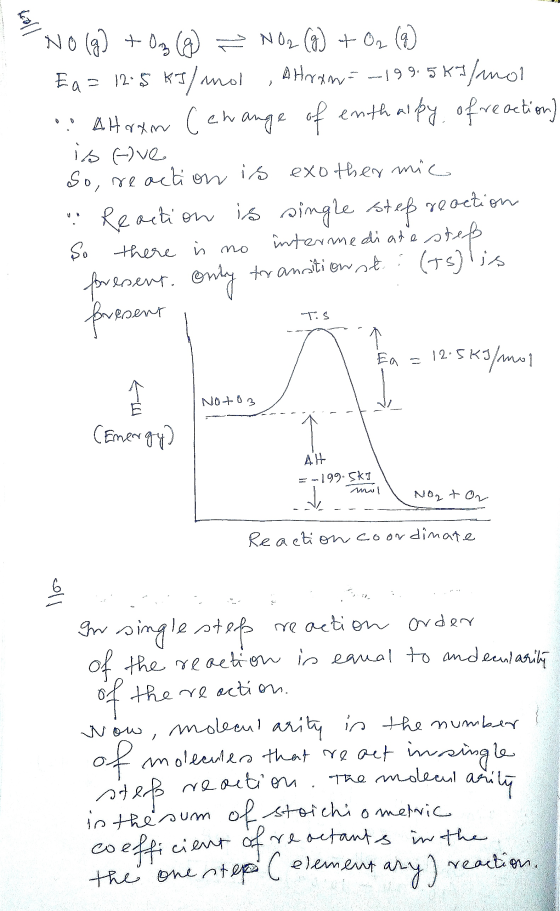
 Ozone Decomposition: Ozone formation is faster during the day due to the action of sunlight on NO, molecules. Thus, Os(g) accumulates in the troposphere and its concentration peaks sometime in the afternoon. During the night, ozone reacts with NO(g) according to the following reaction: NO(g) + O.(B) NO,() + O2(g). This is a single-step process with an activation energy E. = 12.5 kJ/mol and a AH-199.5 kJ/mol. PPB 5. Build potential energy diagram that represents the transformation of reactants to...
Please answer #7 and #8 only, Thank you! Ozone Decomposition: Ozone formation is faster during the...
 Please answer #7 and #8 only,
Thank you!
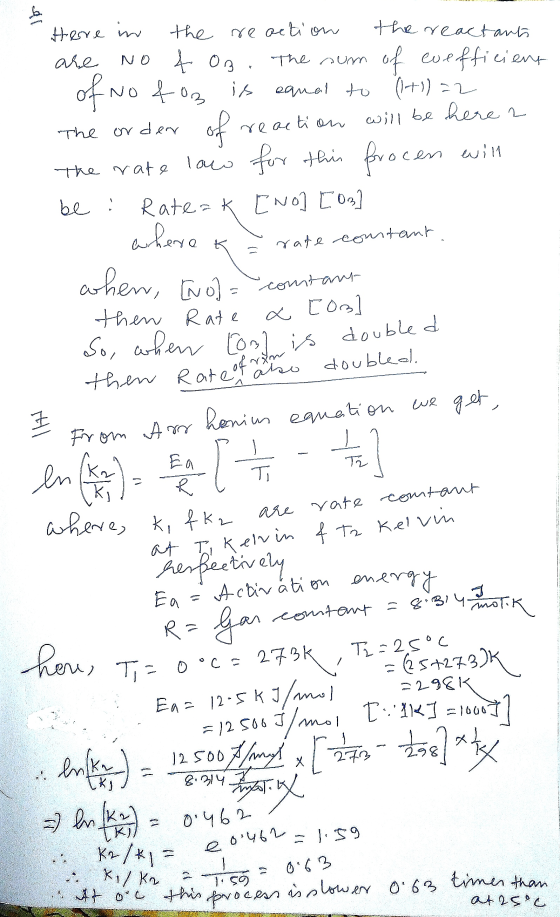
Ozone Decomposition: Ozone formation is faster during the day due to the action of sunlight on NO2 molecules. Thus, Os(g) accumulates in the troposphere and its concentration peaks sometime in the afternoon. During the night, ozone reacts with NO(g) according to the following reaction: NO(g) + Os(g) = NO2(g) + Ox(g). This is a single-step process with an activation energy E. = 12.5 kl/mol and a AH..=-199.5 kJ/mol. 5. Build potential energy...
Please answer #7 and #8 only,
Thank you!
Ozone Decomposition: Ozone formation is faster during the day due to the action of sunlight on NO2 molecules. Thus, Os(g) accumulates in the troposphere and its concentration peaks sometime in the afternoon. During the night, ozone reacts with NO(g) according to the following reaction: NO(g) + Os(g) = NO2(g) + Ox(g). This is a single-step process with an activation energy E. = 12.5 kl/mol and a AH..=-199.5 kJ/mol. 5. Build potential energy...
Please answer #5 and #6 Ozone Decomposition: Ozone formation is faster during the day due to...
 Please answer #5 and #6
Ozone Decomposition: Ozone formation is faster during the day due to the action of sunlight on NO2 molecules. Thus, O.(g) accumulates in the troposphere and its concentration peaks sometime in the afternoon. During the night, ozone reacts with NO(g) according to the following reaction: NO(g) + Ox(g) = NO:(g) + Ox(). This is a single-step process with an activation energy E. = 12.5kl/mol and a AH.n=-199.5 kJ/mol. 5. Build potential energy diagram that represents the...
Please answer #5 and #6
Ozone Decomposition: Ozone formation is faster during the day due to the action of sunlight on NO2 molecules. Thus, O.(g) accumulates in the troposphere and its concentration peaks sometime in the afternoon. During the night, ozone reacts with NO(g) according to the following reaction: NO(g) + Ox(g) = NO:(g) + Ox(). This is a single-step process with an activation energy E. = 12.5kl/mol and a AH.n=-199.5 kJ/mol. 5. Build potential energy diagram that represents the...
II have posted this question yesterday, but no body answered it. Can somebody help me please...
 II have posted this question yesterday, but no body answered it.
Can somebody help me please with these four questions. I apologies
because they are 4 but they all based on each other and cannot post
them separately. So I hope some body help me and really need #8
Ozone Decomposition: Ozone formation is faster during the day due to the action of sunlight on NO, molecules. Thus, Os() accumulates in the troposphere and its concentration peaks sometime in the...
II have posted this question yesterday, but no body answered it.
Can somebody help me please with these four questions. I apologies
because they are 4 but they all based on each other and cannot post
them separately. So I hope some body help me and really need #8
Ozone Decomposition: Ozone formation is faster during the day due to the action of sunlight on NO, molecules. Thus, Os() accumulates in the troposphere and its concentration peaks sometime in the...
NUMBER 3 AND 4 PLEASE! I JUST NEED #3 AND 4 Ozone Formation: NO2(g), is formed...
 NUMBER 3 AND 4 PLEASE! I JUST NEED #3 AND 4
Ozone Formation: NO2(g), is formed by chemical reactions involving N2(g) and O2(g) at the high temperatures Inside internal combustion engines in our cars. In the presence of sunlight, NO2(g) reacts with O2(g) to generate Os(s) as described by the following overall reaction: NO2(g) + O2(g) = NO(g) + O2(g) E = 306.5 l/mol This chemical process occurs in two steps, as illustrated in the potential energy diagram. In the...
NUMBER 3 AND 4 PLEASE! I JUST NEED #3 AND 4
Ozone Formation: NO2(g), is formed by chemical reactions involving N2(g) and O2(g) at the high temperatures Inside internal combustion engines in our cars. In the presence of sunlight, NO2(g) reacts with O2(g) to generate Os(s) as described by the following overall reaction: NO2(g) + O2(g) = NO(g) + O2(g) E = 306.5 l/mol This chemical process occurs in two steps, as illustrated in the potential energy diagram. In the...
Please answer #3 and #4 only Photochemical Smog Photochemical smog is a type of air pollution...
 Please answer #3 and #4
only
Photochemical Smog Photochemical smog is a type of air pollution produced when sunlight acts upon motor vehicle exhaust gases, such as nitrogen oxides (e.g., NO, NO:) to form harmful substances such as ozone (0). These substances participate in a reaction cycle that determines the concentration of pollutants at different times during the day. Ozone Formation: NO:(), is formed by chemical reactions involving N2(g) and O-() at the high temperatures inside internal combustion engines in...
Please answer #3 and #4
only
Photochemical Smog Photochemical smog is a type of air pollution produced when sunlight acts upon motor vehicle exhaust gases, such as nitrogen oxides (e.g., NO, NO:) to form harmful substances such as ozone (0). These substances participate in a reaction cycle that determines the concentration of pollutants at different times during the day. Ozone Formation: NO:(), is formed by chemical reactions involving N2(g) and O-() at the high temperatures inside internal combustion engines in...
I apologies because they are 4 questions, but I cannot split them cause they are related....
 I apologies because they are 4 questions, but I cannot split
them cause they are related. So hope somebody help me with
them.
Ozone Formation: NO2(g), is formed by chemical reactions involving N2(g) and O2(g) at the high temperatures Inside internal combustion engines in our cars. In the presence of sunlight, NO2(g) reacts with O2(g) to generate Os(s) as described by the following overall reaction: NO2(g) + O2(g) = NO(g) + O2(g) E = 306.5 l/mol This chemical process occurs...
I apologies because they are 4 questions, but I cannot split
them cause they are related. So hope somebody help me with
them.
Ozone Formation: NO2(g), is formed by chemical reactions involving N2(g) and O2(g) at the high temperatures Inside internal combustion engines in our cars. In the presence of sunlight, NO2(g) reacts with O2(g) to generate Os(s) as described by the following overall reaction: NO2(g) + O2(g) = NO(g) + O2(g) E = 306.5 l/mol This chemical process occurs...
Can somebody help me please with these 4 questions. They are related and I cannot post...
 Can somebody help me please with these 4 questions. They are
related and I cannot post them separately. I posted them before but
nobody helped. I REALLY NEED NUMBER 3 AND 4
Ozone Formation: NO2(g), is formed by chemical reactions involving N2(g) and O2(g) at the high temperatures Inside internal combustion engines in our cars. In the presence of sunlight, NO2(g) reacts with O2(g) to generate Os(s) as described by the following overall reaction: NO2(g) + O2(g) = NO(g) +...
Can somebody help me please with these 4 questions. They are
related and I cannot post them separately. I posted them before but
nobody helped. I REALLY NEED NUMBER 3 AND 4
Ozone Formation: NO2(g), is formed by chemical reactions involving N2(g) and O2(g) at the high temperatures Inside internal combustion engines in our cars. In the presence of sunlight, NO2(g) reacts with O2(g) to generate Os(s) as described by the following overall reaction: NO2(g) + O2(g) = NO(g) +...
4. Based on the information provided, evaluate whether this process can be expected to occur to...
 4. Based on the information provided, evaluate whether this process can be expected to occur to a large extent at 25 °C (Hint: Express K, for the process and calculate its value). Substance SºlJ/mol K) O2(8) 161.1 0,(8) 238.9 NO(g) 211.2 NO:(8) 240.1 Ozone Formation: NO2(g), is formed by chemical reactions involving N2(g) and O2(g) at the high temperatures Inside internal combustion engines in our cars. In the presence of sunlight, NO2(g) reacts with O2(g) to generate Os(e) as described...
6 The decomposition of ozone in the upper atmosphere is catalyzed by NO. The overall reaction...
 6 The decomposition of ozone in the upper atmosphere is catalyzed by NO. The overall reaction and rate law are: rate k[O][NO] Os(g)+O(g)+20;(g); Write a possible mechanism that is consistent with rate law and identify an intermediate in the reaction. 7. A possible mechanism for the iodide ion catalyzed decomposition of hydrogen peroxide in aqueous solution is: -slow H2O:(aq) +I(aq)H;O(1) + 0I°(aq) -fast H20:(aq) +Or(aq)H:O()) +02(g)+l'(aq) What is: iv) the catalyst? iv) the intermediate ii) the rate law i) the...
 Ozone Decomposition: Ozone formation is faster during the day due to the action of sunlight on NO, molecules. Thus, Os(g) accumulates in the troposphere and its concentration peaks sometime in the afternoon. During the night, ozone reacts with NO(g) according to the following reaction: NO(g) + O.(B) NO,() + O2(g). This is a single-step process with an activation energy E. = 12.5 kJ/mol and a AH-199.5 kJ/mol. PPB 5. Build potential energy diagram that represents the transformation of reactants to...
 Please answer #7 and #8 only,
Thank you!
Ozone Decomposition: Ozone formation is faster during the day due to the action of sunlight on NO2 molecules. Thus, Os(g) accumulates in the troposphere and its concentration peaks sometime in the afternoon. During the night, ozone reacts with NO(g) according to the following reaction: NO(g) + Os(g) = NO2(g) + Ox(g). This is a single-step process with an activation energy E. = 12.5 kl/mol and a AH..=-199.5 kJ/mol. 5. Build potential energy...
Please answer #7 and #8 only,
Thank you!
Ozone Decomposition: Ozone formation is faster during the day due to the action of sunlight on NO2 molecules. Thus, Os(g) accumulates in the troposphere and its concentration peaks sometime in the afternoon. During the night, ozone reacts with NO(g) according to the following reaction: NO(g) + Os(g) = NO2(g) + Ox(g). This is a single-step process with an activation energy E. = 12.5 kl/mol and a AH..=-199.5 kJ/mol. 5. Build potential energy...
 Please answer #5 and #6
Ozone Decomposition: Ozone formation is faster during the day due to the action of sunlight on NO2 molecules. Thus, O.(g) accumulates in the troposphere and its concentration peaks sometime in the afternoon. During the night, ozone reacts with NO(g) according to the following reaction: NO(g) + Ox(g) = NO:(g) + Ox(). This is a single-step process with an activation energy E. = 12.5kl/mol and a AH.n=-199.5 kJ/mol. 5. Build potential energy diagram that represents the...
Please answer #5 and #6
Ozone Decomposition: Ozone formation is faster during the day due to the action of sunlight on NO2 molecules. Thus, O.(g) accumulates in the troposphere and its concentration peaks sometime in the afternoon. During the night, ozone reacts with NO(g) according to the following reaction: NO(g) + Ox(g) = NO:(g) + Ox(). This is a single-step process with an activation energy E. = 12.5kl/mol and a AH.n=-199.5 kJ/mol. 5. Build potential energy diagram that represents the...
 II have posted this question yesterday, but no body answered it.
Can somebody help me please with these four questions. I apologies
because they are 4 but they all based on each other and cannot post
them separately. So I hope some body help me and really need #8
Ozone Decomposition: Ozone formation is faster during the day due to the action of sunlight on NO, molecules. Thus, Os() accumulates in the troposphere and its concentration peaks sometime in the...
II have posted this question yesterday, but no body answered it.
Can somebody help me please with these four questions. I apologies
because they are 4 but they all based on each other and cannot post
them separately. So I hope some body help me and really need #8
Ozone Decomposition: Ozone formation is faster during the day due to the action of sunlight on NO, molecules. Thus, Os() accumulates in the troposphere and its concentration peaks sometime in the...
 NUMBER 3 AND 4 PLEASE! I JUST NEED #3 AND 4
Ozone Formation: NO2(g), is formed by chemical reactions involving N2(g) and O2(g) at the high temperatures Inside internal combustion engines in our cars. In the presence of sunlight, NO2(g) reacts with O2(g) to generate Os(s) as described by the following overall reaction: NO2(g) + O2(g) = NO(g) + O2(g) E = 306.5 l/mol This chemical process occurs in two steps, as illustrated in the potential energy diagram. In the...
NUMBER 3 AND 4 PLEASE! I JUST NEED #3 AND 4
Ozone Formation: NO2(g), is formed by chemical reactions involving N2(g) and O2(g) at the high temperatures Inside internal combustion engines in our cars. In the presence of sunlight, NO2(g) reacts with O2(g) to generate Os(s) as described by the following overall reaction: NO2(g) + O2(g) = NO(g) + O2(g) E = 306.5 l/mol This chemical process occurs in two steps, as illustrated in the potential energy diagram. In the...
 Please answer #3 and #4
only
Photochemical Smog Photochemical smog is a type of air pollution produced when sunlight acts upon motor vehicle exhaust gases, such as nitrogen oxides (e.g., NO, NO:) to form harmful substances such as ozone (0). These substances participate in a reaction cycle that determines the concentration of pollutants at different times during the day. Ozone Formation: NO:(), is formed by chemical reactions involving N2(g) and O-() at the high temperatures inside internal combustion engines in...
Please answer #3 and #4
only
Photochemical Smog Photochemical smog is a type of air pollution produced when sunlight acts upon motor vehicle exhaust gases, such as nitrogen oxides (e.g., NO, NO:) to form harmful substances such as ozone (0). These substances participate in a reaction cycle that determines the concentration of pollutants at different times during the day. Ozone Formation: NO:(), is formed by chemical reactions involving N2(g) and O-() at the high temperatures inside internal combustion engines in...
 I apologies because they are 4 questions, but I cannot split
them cause they are related. So hope somebody help me with
them.
Ozone Formation: NO2(g), is formed by chemical reactions involving N2(g) and O2(g) at the high temperatures Inside internal combustion engines in our cars. In the presence of sunlight, NO2(g) reacts with O2(g) to generate Os(s) as described by the following overall reaction: NO2(g) + O2(g) = NO(g) + O2(g) E = 306.5 l/mol This chemical process occurs...
I apologies because they are 4 questions, but I cannot split
them cause they are related. So hope somebody help me with
them.
Ozone Formation: NO2(g), is formed by chemical reactions involving N2(g) and O2(g) at the high temperatures Inside internal combustion engines in our cars. In the presence of sunlight, NO2(g) reacts with O2(g) to generate Os(s) as described by the following overall reaction: NO2(g) + O2(g) = NO(g) + O2(g) E = 306.5 l/mol This chemical process occurs...
 Can somebody help me please with these 4 questions. They are
related and I cannot post them separately. I posted them before but
nobody helped. I REALLY NEED NUMBER 3 AND 4
Ozone Formation: NO2(g), is formed by chemical reactions involving N2(g) and O2(g) at the high temperatures Inside internal combustion engines in our cars. In the presence of sunlight, NO2(g) reacts with O2(g) to generate Os(s) as described by the following overall reaction: NO2(g) + O2(g) = NO(g) +...
Can somebody help me please with these 4 questions. They are
related and I cannot post them separately. I posted them before but
nobody helped. I REALLY NEED NUMBER 3 AND 4
Ozone Formation: NO2(g), is formed by chemical reactions involving N2(g) and O2(g) at the high temperatures Inside internal combustion engines in our cars. In the presence of sunlight, NO2(g) reacts with O2(g) to generate Os(s) as described by the following overall reaction: NO2(g) + O2(g) = NO(g) +...
 4. Based on the information provided, evaluate whether this process can be expected to occur to a large extent at 25 °C (Hint: Express K, for the process and calculate its value). Substance SºlJ/mol K) O2(8) 161.1 0,(8) 238.9 NO(g) 211.2 NO:(8) 240.1 Ozone Formation: NO2(g), is formed by chemical reactions involving N2(g) and O2(g) at the high temperatures Inside internal combustion engines in our cars. In the presence of sunlight, NO2(g) reacts with O2(g) to generate Os(e) as described...
 6 The decomposition of ozone in the upper atmosphere is catalyzed by NO. The overall reaction and rate law are: rate k[O][NO] Os(g)+O(g)+20;(g); Write a possible mechanism that is consistent with rate law and identify an intermediate in the reaction. 7. A possible mechanism for the iodide ion catalyzed decomposition of hydrogen peroxide in aqueous solution is: -slow H2O:(aq) +I(aq)H;O(1) + 0I°(aq) -fast H20:(aq) +Or(aq)H:O()) +02(g)+l'(aq) What is: iv) the catalyst? iv) the intermediate ii) the rate law i) the...
Most questions answered within 3 hours.
-
Where is the error in this code sequence?
String s1 = "Hello";
String s2 = "ello";...
asked 10 months ago -
Financial data for Joel de Paris, Inc., for last year
follow:
Joel de Paris, Inc.
Balance...
asked 10 months ago -
Consider this reaction:
Al2(SO4)3 (aq)+ BaCl3
(aq) Al2Cl6 (aq)- +
3BaSO4(s) . What is the...
asked 10 months ago -
Suppose that Savneet is considering increasing her
recent random sample from 20 car rentals to 40...
asked 10 months ago -
Trucks arrive at an unloading terminal at an average rate of 120
per hour.
Trucks arrive...
asked 10 months ago -
Why are methanol and ethanol completely soluble in water while
octanol is not very little soluble....
asked 10 months ago -
A facilities manager at a university reads in a research report
that the mean amount of...
asked 10 months ago -
When the CuSO4 is rehydrated by adding water to the anhydrous
compound, is this an endothermic...
asked 10 months ago -
A ray of sunlight is passing from diamond into crown glass; the
angle of incidence is...
asked 10 months ago -
A block of mass 0.249 kg is placed on top of a light, vertical
spring of...
asked 10 months ago -
how do the kidneys compensate in the presences of acidosis
a) trigger hyperventilate
b) reserve acid...
asked 10 months ago -
Question 501 pts
The rental rate of capital to the firm increases. Which of the
following...
asked 10 months ago