
Homework Answers
Answer:

Hope I answered the questions.
If you have any doubts/queries, feel free to ask by commenting down below. I will respond within 24 hours
And if you like my answer, then please do upvote for it, your feedback really matters alot to me.
STAY HOME STAY SAFE
Add Answer to:
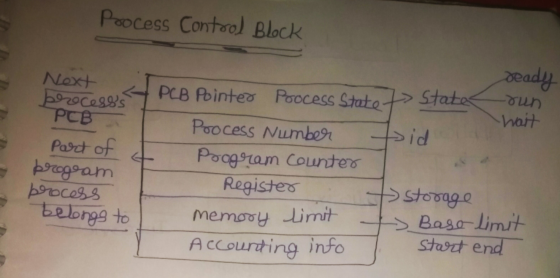
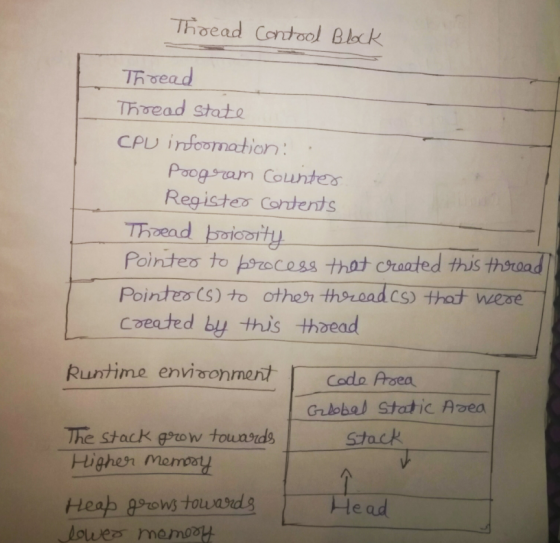
9.- ( 11 points) Draw a diagram showing the ELF(object code), Process Control Block, Thread Control...
2.- [11 points) When the object code is loaded into memory, a segment called the run...
 2.- [11 points) When the object code is loaded into memory, a segment called the run time environment is created. Name the sections of the object code file generated by the assembler and describe each entry in the header file. Name the sections of the run time environment and draw a picture of the object code file and the run time environment indicating how they are related. Use arrows to indicate relationships.
6- [11 points) Draw a diagram showing the states a process can be in and also...
 6- [11 points) Draw a diagram showing the states a process can be in and also indicate what is the event (interrupt) that moves the process from one state to another.
1. Analyze the following code: public class Test implements Runnable { public static void main(String[] args) { Thread t = new Thread(this); t.start(); } public void run() { System....
1. Analyze the following code: public class Test implements Runnable { public static void main(String[] args) { Thread t = new Thread(this); t.start(); } public void run() { System.out.println("test"); } } 1. The code compiles but will not print anything since t does not invoke the run method. 2. The code will not compile since you cannot invoke "this" in a static method. 3. The program compiles, runs, and prints tests on the console. 2. What will the following example...
a) Draw the block diagram of a generic closed-loop digital control system. Show clearly all blocks...
 a) Draw the block diagram of a generic closed-loop digital control system. Show clearly all blocks and all signals (continuous and discrete, including disturbances added to the forward path). b) Explain the advantages of digital control over analogue control. c) Explain why the Zero-Order-Hold (ZOH) operation may destabilize the system. (4) 14) Table of Laplace and z-transform Time function Laplace transform E() 2-Transform E(z) er) TED 20- lime-of-16- ri(n) 410) p=!11) ( 101) 10-10) re-10) त 21-26
11. Draw the process state transition diagram that involves new, ready, running, block/wait, suspend ready, and...
11. Draw the process state transition diagram that involves new, ready, running, block/wait, suspend ready, and suspend block/wait states. You may copy from the Powerpoint slides posted on Blackboard. However, you need to explain the following information in your own words. Only reproducing the diagram will not give you any points. (4 points) a) Explain each state where it is located (disk or memory) b) What are the roles of short term (ST), long term (LT), and Medium term (MT)...
State transition diagram used for operating system management of the Process Control Block has the following...
State transition diagram used for operating system management of the Process Control Block has the following states A New (Create)– In this step, process is about to be created but not yet created, it is the program which is present in secondary memory that will be picked up by OS to create the process. Ready -> Ready to run. After creation of a process, the process enters the ready state i.e. the process is loaded into the main memory. The...
The ACME Manufacturing Company has hired you to help automate their production assembly line. Cameras have...
 The ACME Manufacturing Company has hired you to help automate
their production assembly line. Cameras have been placed above a
conveyer belt to enables parts on the belt to be photographed and
analyzed. You are to augment the system that has been put in place
by writing C code to detect the number of parts on the belt, and
the positions of each object. The process by which you will do this
is called Connected Component Labeling (CCL). These positions...
The ACME Manufacturing Company has hired you to help automate
their production assembly line. Cameras have been placed above a
conveyer belt to enables parts on the belt to be photographed and
analyzed. You are to augment the system that has been put in place
by writing C code to detect the number of parts on the belt, and
the positions of each object. The process by which you will do this
is called Connected Component Labeling (CCL). These positions...
Additional code needed: PartA: BurgerOrder class (1 point) Objective: Create a new class that represents an...
 Additional code needed:
PartA: BurgerOrder class (1 point) Objective: Create a new class that represents an order at a fast-food burger joint. This class will be used in Part B, when we work with a list of orders. As vou work through this part and Part B, draw a UML diagram of each class in using the UML drawing tool 1) Create a new Lab5TestProject project in Netbeans, right-click on the lab5testproject package and select New>Java Class 2) Call your...
Additional code needed:
PartA: BurgerOrder class (1 point) Objective: Create a new class that represents an order at a fast-food burger joint. This class will be used in Part B, when we work with a list of orders. As vou work through this part and Part B, draw a UML diagram of each class in using the UML drawing tool 1) Create a new Lab5TestProject project in Netbeans, right-click on the lab5testproject package and select New>Java Class 2) Call your...
Project 7: Vehicles 1 Objective In the last couple projects, you’ve created and used objects in...
Project 7: Vehicles 1 Objective In the last couple projects, you’ve created and used objects in interesting ways. Now you’ll get a chance to use more of what objects offer, implementing inheritance and polymorphism and seeing them in action. You’ll also get a chance to create and use abstract classes (and, perhaps, methods). After this project, you will have gotten a good survey of object-oriented programming and its potential. This project won’t have a complete UI but will have a...
 2.- [11 points) When the object code is loaded into memory, a segment called the run time environment is created. Name the sections of the object code file generated by the assembler and describe each entry in the header file. Name the sections of the run time environment and draw a picture of the object code file and the run time environment indicating how they are related. Use arrows to indicate relationships.
 6- [11 points) Draw a diagram showing the states a process can be in and also indicate what is the event (interrupt) that moves the process from one state to another.
 a) Draw the block diagram of a generic closed-loop digital control system. Show clearly all blocks and all signals (continuous and discrete, including disturbances added to the forward path). b) Explain the advantages of digital control over analogue control. c) Explain why the Zero-Order-Hold (ZOH) operation may destabilize the system. (4) 14) Table of Laplace and z-transform Time function Laplace transform E() 2-Transform E(z) er) TED 20- lime-of-16- ri(n) 410) p=!11) ( 101) 10-10) re-10) त 21-26
 The ACME Manufacturing Company has hired you to help automate
their production assembly line. Cameras have been placed above a
conveyer belt to enables parts on the belt to be photographed and
analyzed. You are to augment the system that has been put in place
by writing C code to detect the number of parts on the belt, and
the positions of each object. The process by which you will do this
is called Connected Component Labeling (CCL). These positions...
The ACME Manufacturing Company has hired you to help automate
their production assembly line. Cameras have been placed above a
conveyer belt to enables parts on the belt to be photographed and
analyzed. You are to augment the system that has been put in place
by writing C code to detect the number of parts on the belt, and
the positions of each object. The process by which you will do this
is called Connected Component Labeling (CCL). These positions...
 Additional code needed:
PartA: BurgerOrder class (1 point) Objective: Create a new class that represents an order at a fast-food burger joint. This class will be used in Part B, when we work with a list of orders. As vou work through this part and Part B, draw a UML diagram of each class in using the UML drawing tool 1) Create a new Lab5TestProject project in Netbeans, right-click on the lab5testproject package and select New>Java Class 2) Call your...
Additional code needed:
PartA: BurgerOrder class (1 point) Objective: Create a new class that represents an order at a fast-food burger joint. This class will be used in Part B, when we work with a list of orders. As vou work through this part and Part B, draw a UML diagram of each class in using the UML drawing tool 1) Create a new Lab5TestProject project in Netbeans, right-click on the lab5testproject package and select New>Java Class 2) Call your...
Most questions answered within 3 hours.
-
Where is the error in this code sequence?
String s1 = "Hello";
String s2 = "ello";...
asked 10 months ago -
Financial data for Joel de Paris, Inc., for last year
follow:
Joel de Paris, Inc.
Balance...
asked 10 months ago -
Consider this reaction:
Al2(SO4)3 (aq)+ BaCl3
(aq) Al2Cl6 (aq)- +
3BaSO4(s) . What is the...
asked 10 months ago -
Suppose that Savneet is considering increasing her
recent random sample from 20 car rentals to 40...
asked 10 months ago -
Trucks arrive at an unloading terminal at an average rate of 120
per hour.
Trucks arrive...
asked 10 months ago -
Why are methanol and ethanol completely soluble in water while
octanol is not very little soluble....
asked 10 months ago -
A facilities manager at a university reads in a research report
that the mean amount of...
asked 10 months ago -
When the CuSO4 is rehydrated by adding water to the anhydrous
compound, is this an endothermic...
asked 10 months ago -
A ray of sunlight is passing from diamond into crown glass; the
angle of incidence is...
asked 10 months ago -
A block of mass 0.249 kg is placed on top of a light, vertical
spring of...
asked 10 months ago -
how do the kidneys compensate in the presences of acidosis
a) trigger hyperventilate
b) reserve acid...
asked 10 months ago -
Question 501 pts
The rental rate of capital to the firm increases. Which of the
following...
asked 10 months ago