
Homework Answers
Request Answer!
We need at least 10 more requests to produce the answer.
0 / 10 have requested this problem solution
The more requests, the faster the answer.
Add Answer to:
Question #8: Using any reactions we have learned this semester design a synthesis for the following...
this was the question 8 Bonus: Describe the NMR for the product from Question 8 including...
 this was the question 8
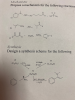
Bonus: Describe the NMR for the product from Question 8 including chemical shifts, multiplicity, and integration. (8 pts possible) Question #8: Using any reactions we have learned this semester design a synthesis for the following transformation, pay attention to stereochemistry. (10 pts) (Multi-step required) CH3CH2 H HC=CH H CH; (E)-2-pentene
this was the question 8
Bonus: Describe the NMR for the product from Question 8 including chemical shifts, multiplicity, and integration. (8 pts possible) Question #8: Using any reactions we have learned this semester design a synthesis for the following transformation, pay attention to stereochemistry. (10 pts) (Multi-step required) CH3CH2 H HC=CH H CH; (E)-2-pentene
For each of the reactions, show the reafents that would best accomplish the given synthesis, according...
 For
each of the reactions, show the reafents that would best accomplish
the given synthesis, according to reactions we have atudied in
class. be sure to number your steps.
(a) CH3 ? CH3 "ОН (b) ? CH3CH2-CEC-CH2CH3 H CH2CH3 C=C H3CH2C H ? (CH3)2CHCH2C=CH o (CH3)2CHCH2CCH3 Br ? + enantiomer ( e) -CEC-H CEC (1) Hint: this is a multistep synthesis. Propose a series of reactions that would achieve the following transformation. Make sure to number the steps. . ?
For
each of the reactions, show the reafents that would best accomplish
the given synthesis, according to reactions we have atudied in
class. be sure to number your steps.
(a) CH3 ? CH3 "ОН (b) ? CH3CH2-CEC-CH2CH3 H CH2CH3 C=C H3CH2C H ? (CH3)2CHCH2C=CH o (CH3)2CHCH2CCH3 Br ? + enantiomer ( e) -CEC-H CEC (1) Hint: this is a multistep synthesis. Propose a series of reactions that would achieve the following transformation. Make sure to number the steps. . ?
9. P ropose a multi-step synthesis to accomplish the overall transformation shown below (make the molecule...
 9. P ropose a multi-step synthesis to accomplish the overall transformation shown below (make the molecule on the right starting with the molecule on the left). Show all necessary reagents and products for each forward step. [It is not necessary to show any mechanisms.] OH 10. Propose a multi-step synthesis to accomplish the overall transformation shown below (make the molecule on the right starting with the molecule on the left). Show all necessary reagents and products for each forward step....
Propose a synthesis of the following derivative of diethyl malonate using reagents from the choices provided...
 Propose a synthesis of the following derivative of diethyl malonate using reagents from the choices provided below. (From the choices provided, list the reagent(s) in order that will accomplish this transformation. No more than 4 steps are required. List your answer as a single letter (single-step transformation) or a series of letters (multi-step transformation) with no commas separating them.) Reagents available a. Eto Na g. CH2=CHCH=CHCH,Br b. CH3 CH2Br c. CH3 CH, CH, CH(CH3)Br d. (CH3)2 CHCH, CH,Br e. CH3...
Provide an efficient synthesis for each product using reactions we have discussed this semester. It will...
 Provide an efficient synthesis for each product using reactions we have discussed this semester. It will be easier to award partial credit if you show the intermediates (i.e. product(s) after each synthetic step). You may use the reactant indicated and any reagents that contain seven (7) or fewer carbon atoms (this of course includes reagents with no carbon atoms) to complete your synthesis. If the reaction conditions (i.e. amount of reagent, temperature, etc.) are important, please be sure to specify....
Mechanisms Propose a mechanism for the following reactions Synthesis Design a synthesis scheme for the following...
 Mechanisms Propose a mechanism for the following reactions Synthesis Design a synthesis scheme for the following (CH) 110 2) DMS 1) EMBI 2) H0 C, H,0) (C,H,0) AIC, | | |Hºà CH3)2NH (-H,0)
Devise a synthesis of (Z)-4-methyl-2-pentene using one of the starting materials and any of the reagents...
 Devise a synthesis of (Z)-4-methyl-2-pentene using one of the starting materials and any of the reagents below using the fewest steps possible. If you need fewer than the 3 steps allowed, enter "none" for reagents in the remaining unused steps. Starting materials HC=CH HC=C-CH, HC=C-CH,CH, сн. HC=C-CH2CH2CH2CH2HC=C-C-CH, von CH, HC=C-¢-CH, . CHO Reagents a NaNH, NH(l) diodoethane g 1-bromo-3-methylbutane į Hy / Lindlar catalyst - Na0H: H0 e 1-bromopropane ht-butyl bromide k H / NH (1) ciodomethane f 2-bromopropane i...
Question : Predict the major and minor products for the following reactions: NASH -CH3 + 1...
 Question : Predict the major and minor products for the following reactions: NASH -CH3 + 1 H30 HC b) NaOEt Question 6: Predict the major and minor products for the following reactions: NaOEt OTS - Tosylate (OTS) With on CHM 2210 CH3 NaOH H₂C O=O=O Question 7: Draw the plausible mechanism for each of the following transformations: CHE BECH HO HBr CH CH CH3 H₂C- conc. H,SO heat HC Insuu H Question 8 Which is the better retrosynthesis for the...
Devise a synthesis of (Z)-4,4-dimethyl-2-pentene using one of the starting materials and any of the reagents...
 Devise a synthesis of (Z)-4,4-dimethyl-2-pentene using one of the starting materials and any of the reagents below using the fewest steps possible. If you need fewer than the 3 steps allowed, enter "none" for reagents in the remaining unused steps. Starting materials HCBCH HC=C–CH, HC=C=CH-CH, HC=C=CH-CH-CH-CH, остаток сн. HC=C–C–CH, Η. сн. HC=C–C–CH, CH, . Reagents a NaNH, NHI) diodoethane g 1-bromo-3-methylbutane į Hy / Lindlar catalyst b NaOH ІН,0 e 1-bromopropane ht-butyl bromide k H, NH (1) c iodomethane f...
4. Synthesis Reactions. Draw the feature product of the following reactions. (8 x 3 pts) 1....
 4. Synthesis Reactions. Draw the feature product of the following reactions. (8 x 3 pts) 1. Mg Ph Br 2. CO2 3. H a "NH2 Ph 1. NaOH, CI 2. LAIH b. CHỊCH NHA NaBHgCN, H+ Ph C. Br (excess) NH d NaOH H HO OH H CH e. 1. NaOH H2O NH 2. H+ o= 1. NaOH H2O 2. SOCI N(CH3)2 3 HO
 this was the question 8
Bonus: Describe the NMR for the product from Question 8 including chemical shifts, multiplicity, and integration. (8 pts possible) Question #8: Using any reactions we have learned this semester design a synthesis for the following transformation, pay attention to stereochemistry. (10 pts) (Multi-step required) CH3CH2 H HC=CH H CH; (E)-2-pentene
this was the question 8
Bonus: Describe the NMR for the product from Question 8 including chemical shifts, multiplicity, and integration. (8 pts possible) Question #8: Using any reactions we have learned this semester design a synthesis for the following transformation, pay attention to stereochemistry. (10 pts) (Multi-step required) CH3CH2 H HC=CH H CH; (E)-2-pentene
 For
each of the reactions, show the reafents that would best accomplish
the given synthesis, according to reactions we have atudied in
class. be sure to number your steps.
(a) CH3 ? CH3 "ОН (b) ? CH3CH2-CEC-CH2CH3 H CH2CH3 C=C H3CH2C H ? (CH3)2CHCH2C=CH o (CH3)2CHCH2CCH3 Br ? + enantiomer ( e) -CEC-H CEC (1) Hint: this is a multistep synthesis. Propose a series of reactions that would achieve the following transformation. Make sure to number the steps. . ?
For
each of the reactions, show the reafents that would best accomplish
the given synthesis, according to reactions we have atudied in
class. be sure to number your steps.
(a) CH3 ? CH3 "ОН (b) ? CH3CH2-CEC-CH2CH3 H CH2CH3 C=C H3CH2C H ? (CH3)2CHCH2C=CH o (CH3)2CHCH2CCH3 Br ? + enantiomer ( e) -CEC-H CEC (1) Hint: this is a multistep synthesis. Propose a series of reactions that would achieve the following transformation. Make sure to number the steps. . ?
 9. P ropose a multi-step synthesis to accomplish the overall transformation shown below (make the molecule on the right starting with the molecule on the left). Show all necessary reagents and products for each forward step. [It is not necessary to show any mechanisms.] OH 10. Propose a multi-step synthesis to accomplish the overall transformation shown below (make the molecule on the right starting with the molecule on the left). Show all necessary reagents and products for each forward step....
 Propose a synthesis of the following derivative of diethyl malonate using reagents from the choices provided below. (From the choices provided, list the reagent(s) in order that will accomplish this transformation. No more than 4 steps are required. List your answer as a single letter (single-step transformation) or a series of letters (multi-step transformation) with no commas separating them.) Reagents available a. Eto Na g. CH2=CHCH=CHCH,Br b. CH3 CH2Br c. CH3 CH, CH, CH(CH3)Br d. (CH3)2 CHCH, CH,Br e. CH3...
 Provide an efficient synthesis for each product using reactions we have discussed this semester. It will be easier to award partial credit if you show the intermediates (i.e. product(s) after each synthetic step). You may use the reactant indicated and any reagents that contain seven (7) or fewer carbon atoms (this of course includes reagents with no carbon atoms) to complete your synthesis. If the reaction conditions (i.e. amount of reagent, temperature, etc.) are important, please be sure to specify....
 Mechanisms Propose a mechanism for the following reactions Synthesis Design a synthesis scheme for the following (CH) 110 2) DMS 1) EMBI 2) H0 C, H,0) (C,H,0) AIC, | | |Hºà CH3)2NH (-H,0)
 Devise a synthesis of (Z)-4-methyl-2-pentene using one of the starting materials and any of the reagents below using the fewest steps possible. If you need fewer than the 3 steps allowed, enter "none" for reagents in the remaining unused steps. Starting materials HC=CH HC=C-CH, HC=C-CH,CH, сн. HC=C-CH2CH2CH2CH2HC=C-C-CH, von CH, HC=C-¢-CH, . CHO Reagents a NaNH, NH(l) diodoethane g 1-bromo-3-methylbutane į Hy / Lindlar catalyst - Na0H: H0 e 1-bromopropane ht-butyl bromide k H / NH (1) ciodomethane f 2-bromopropane i...
 Question : Predict the major and minor products for the following reactions: NASH -CH3 + 1 H30 HC b) NaOEt Question 6: Predict the major and minor products for the following reactions: NaOEt OTS - Tosylate (OTS) With on CHM 2210 CH3 NaOH H₂C O=O=O Question 7: Draw the plausible mechanism for each of the following transformations: CHE BECH HO HBr CH CH CH3 H₂C- conc. H,SO heat HC Insuu H Question 8 Which is the better retrosynthesis for the...
 Devise a synthesis of (Z)-4,4-dimethyl-2-pentene using one of the starting materials and any of the reagents below using the fewest steps possible. If you need fewer than the 3 steps allowed, enter "none" for reagents in the remaining unused steps. Starting materials HCBCH HC=C–CH, HC=C=CH-CH, HC=C=CH-CH-CH-CH, остаток сн. HC=C–C–CH, Η. сн. HC=C–C–CH, CH, . Reagents a NaNH, NHI) diodoethane g 1-bromo-3-methylbutane į Hy / Lindlar catalyst b NaOH ІН,0 e 1-bromopropane ht-butyl bromide k H, NH (1) c iodomethane f...
 4. Synthesis Reactions. Draw the feature product of the following reactions. (8 x 3 pts) 1. Mg Ph Br 2. CO2 3. H a "NH2 Ph 1. NaOH, CI 2. LAIH b. CHỊCH NHA NaBHgCN, H+ Ph C. Br (excess) NH d NaOH H HO OH H CH e. 1. NaOH H2O NH 2. H+ o= 1. NaOH H2O 2. SOCI N(CH3)2 3 HO
Most questions answered within 3 hours.
-
Where is the error in this code sequence?
String s1 = "Hello";
String s2 = "ello";...
asked 10 months ago -
Financial data for Joel de Paris, Inc., for last year
follow:
Joel de Paris, Inc.
Balance...
asked 10 months ago -
Consider this reaction:
Al2(SO4)3 (aq)+ BaCl3
(aq) Al2Cl6 (aq)- +
3BaSO4(s) . What is the...
asked 10 months ago -
Suppose that Savneet is considering increasing her
recent random sample from 20 car rentals to 40...
asked 10 months ago -
Trucks arrive at an unloading terminal at an average rate of 120
per hour.
Trucks arrive...
asked 10 months ago -
Why are methanol and ethanol completely soluble in water while
octanol is not very little soluble....
asked 10 months ago -
A facilities manager at a university reads in a research report
that the mean amount of...
asked 10 months ago -
When the CuSO4 is rehydrated by adding water to the anhydrous
compound, is this an endothermic...
asked 10 months ago -
A ray of sunlight is passing from diamond into crown glass; the
angle of incidence is...
asked 10 months ago -
A block of mass 0.249 kg is placed on top of a light, vertical
spring of...
asked 10 months ago -
how do the kidneys compensate in the presences of acidosis
a) trigger hyperventilate
b) reserve acid...
asked 10 months ago -
Question 501 pts
The rental rate of capital to the firm increases. Which of the
following...
asked 10 months ago