Starting materials used; - 1mL sebacoyl chloride - 50 mL hexane - 2.5 mL 1,6-diaminohexane -...
Starting materials used;
- 1mL sebacoyl chloride
- 50 mL hexane
- 2.5 mL 1,6-diaminohexane
- 25 mL 3% sodium hydroxide
Final products;
- 0.94 g adipic acid
- 1,6-hexamethylenediamine
Calculate the theoretical yield adipic acid if the actual yield is 0.94g?
Homework Answers
Request Answer!
We need at least 10 more requests to produce the answer.
0 / 10 have requested this problem solution
The more requests, the faster the answer.
Add Answer to:
Starting materials used;
- 1mL sebacoyl chloride
- 50 mL hexane
- 2.5 mL 1,6-diaminohexane
-...
* Densities of the two reactants are: Sebacoyl chloride 1.121 g/mL and, 1,6-diaminohexane 0.83 g/mL yion Co1o o-diaminohexane Se ba coyl chloride If I start with 2 mL of the sebacoyl chloride and 1.3...
 * Densities of the two reactants are: Sebacoyl chloride 1.121
g/mL and, 1,6-diaminohexane 0.83 g/mL
yion Co1o o-diaminohexane Se ba coyl chloride If I start with 2 mL of the sebacoyl chloride and 1.3 mL 1,6- diaminohexane and end up with 3.30g of my product nylon 6,10 what is my percent yield?
yion Co1o o-diaminohexane Se ba coyl chloride If I start with 2 mL of the sebacoyl chloride and 1.3 mL 1,6- diaminohexane and end up with 3.30g of...
* Densities of the two reactants are: Sebacoyl chloride 1.121
g/mL and, 1,6-diaminohexane 0.83 g/mL
yion Co1o o-diaminohexane Se ba coyl chloride If I start with 2 mL of the sebacoyl chloride and 1.3 mL 1,6- diaminohexane and end up with 3.30g of my product nylon 6,10 what is my percent yield?
yion Co1o o-diaminohexane Se ba coyl chloride If I start with 2 mL of the sebacoyl chloride and 1.3 mL 1,6- diaminohexane and end up with 3.30g of...
10 mL of 0.59M 1,6-diaminohexane and 10 mL of 0.29M Sebacoyl chloride are used to make nylon 6.10. The final product weight was 1.36g. Calculate the percent yield? Use the MW of one repeating monomer...
10 mL of 0.59M 1,6-diaminohexane and 10 mL of 0.29M Sebacoyl chloride are used to make nylon 6.10. The final product weight was 1.36g. Calculate the percent yield? Use the MW of one repeating monomer for the weight of the product? Please show all work.
What are the products of the reaction between Hexamethylenediamine and Adipic acid? Is this an addition...
What are the products of the reaction between Hexamethylenediamine and Adipic acid? Is this an addition or a condensation polymerization reaction? What is the molecular weight of the repeating unit (formula unit) of Nylon 6,10? Write Rx 1 (p.2) for n = 1 and consider the amounts of reagents used in the lab to determine LR and theoretical yield of Nylon 6,10 for this reaction. (a) What is the by-product of the condensation reaction to produce Nylon 6,10 (using Hexamethylenediamine...
How to calculate theoretical yield & actual yield for this problem. A student used 3 mL...
 How to calculate theoretical yield & actual yield for this
problem.
A student used 3 mL propanal and an equimolar amount of acetophenone as starting materials for the aldol condensation experiment. Sodium hydroxide was used for the base and ethanol was used for the solvent. After refluxing and purification, He/She obtained 3.9 g of the product.
How to calculate theoretical yield & actual yield for this
problem.
A student used 3 mL propanal and an equimolar amount of acetophenone as starting materials for the aldol condensation experiment. Sodium hydroxide was used for the base and ethanol was used for the solvent. After refluxing and purification, He/She obtained 3.9 g of the product.
Starting Materials: 0.25 4-Aminobenzoic Acid mL; _moles Ethyl Alcohol 2.5 mL; moles BA 0.3 Conc. H2SO4...
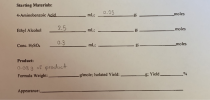 Starting Materials: 0.25 4-Aminobenzoic Acid mL; _moles Ethyl Alcohol 2.5 mL; moles BA 0.3 Conc. H2SO4 mL; moles Product: 0.08 g of product Formula Weight: g/mole; Isolated Yield: -8; Yield Appearance:
Calculate the theoretical yield and percent yield for experiments 7, 8, and 9. For experiment 9,...
 Calculate the theoretical yield and percent yield for
experiments 7, 8, and 9. For experiment 9, determine the
theoretical yield based on starting with 0.50g of 3-nitrobenzoic
acid. Show work
Acid I (experiment 7): Weight of methyl 3-nitrobenzoate = 1.9
g
Acid II (experiment 8): Weight of 3-nitrobenzoic acid = 1.75
g
Acid III (experiment 9): Weight of 3-nitrobenzamide = 0.30 g
Experiment 7:
-2.5 mL concentrated H2SO4
-1.75 mL concentrated HNO3 (16M)
-2.1 mL concentrated Methyl Benzoate
Experiment 8:...
Calculate the theoretical yield and percent yield for
experiments 7, 8, and 9. For experiment 9, determine the
theoretical yield based on starting with 0.50g of 3-nitrobenzoic
acid. Show work
Acid I (experiment 7): Weight of methyl 3-nitrobenzoate = 1.9
g
Acid II (experiment 8): Weight of 3-nitrobenzoic acid = 1.75
g
Acid III (experiment 9): Weight of 3-nitrobenzamide = 0.30 g
Experiment 7:
-2.5 mL concentrated H2SO4
-1.75 mL concentrated HNO3 (16M)
-2.1 mL concentrated Methyl Benzoate
Experiment 8:...
Suppose 1.00 g of NaOH is used to prepare 250 mL of an NaOH solution. Compare...
Suppose 1.00 g of NaOH is used to prepare 250 mL of an NaOH solution. Compare the expected molarity of this solution to the actual average molarity you measured in the standardization. What do you notice? Do you think the results would have been more accurate if a different type of acid or base were used in the standardization? Why, or why not? There are many different primary standards that could be used in a standardization titration. What are the...
Calculate the theoretical yield for Orange II (mw= 422g/mol; experimental weight of orange II azo-dye=0.4g). EXPERIMENTAL...
 Calculate the theoretical yield for Orange II (mw= 422g/mol;
experimental weight of orange II azo-dye=0.4g).
EXPERIMENTAL Calculate the theoretical yield before the lab. Caution: Orange II dyes clothing and other organic materials a permanent unique orange. As a measure of your technique, points may be subtracted for orange hands, etc. 1 DIAZOTIZATION OF SULFANILIC ACID Dissolve 0.4 g of anhydrous sodium carbonate in 7.5 mL of H.O. Use a 25 mL Erlenmever flask. 2. Add 0.45 g of sulfanilic acid...
Calculate the theoretical yield for Orange II (mw= 422g/mol;
experimental weight of orange II azo-dye=0.4g).
EXPERIMENTAL Calculate the theoretical yield before the lab. Caution: Orange II dyes clothing and other organic materials a permanent unique orange. As a measure of your technique, points may be subtracted for orange hands, etc. 1 DIAZOTIZATION OF SULFANILIC ACID Dissolve 0.4 g of anhydrous sodium carbonate in 7.5 mL of H.O. Use a 25 mL Erlenmever flask. 2. Add 0.45 g of sulfanilic acid...
CHROMIC ACID OXIDATION Pre Lab Questions the amounts of materials that will be used from the...
 CHROMIC ACID OXIDATION Pre Lab Questions the amounts of materials that will be used from the experimental section above) H2SO4 + Na2Cr207 2H20- H2O, A Molecular Weight Theoretical yield amount moles on (if applicable) Equivalents 2. Look up the melting point for p-nitrobenzoic acid and record the reference. 3. What color change is expected to be observed in the reaction? Explain why. CHROMIC ACID OXIDATION Experimental Procedure: Part I: Synthesis of p-nitrobenzoic Acid 1. Under the hood, add 0.400 g...
what is the theoretical yield for this experiment? ORGANIC POLYMERS: THE SYNTHESIS OF NYLON Nylon's outstanding...
 what is the theoretical yield for this experiment?
ORGANIC POLYMERS: THE SYNTHESIS OF NYLON Nylon's outstanding characteristic in the textile industry is its versatility. It can be made strong enough to stand up under the punishment tire cords must endure, fine enough for sheer, high fashion hosiery, and light enough for parachute cloth and backpacker's tents. Nylon is used both alone and in blends with other fibers, where its chief contributions are strength and abrasion resistance. Nylon washes easily, dries...
what is the theoretical yield for this experiment?
ORGANIC POLYMERS: THE SYNTHESIS OF NYLON Nylon's outstanding characteristic in the textile industry is its versatility. It can be made strong enough to stand up under the punishment tire cords must endure, fine enough for sheer, high fashion hosiery, and light enough for parachute cloth and backpacker's tents. Nylon is used both alone and in blends with other fibers, where its chief contributions are strength and abrasion resistance. Nylon washes easily, dries...
 * Densities of the two reactants are: Sebacoyl chloride 1.121
g/mL and, 1,6-diaminohexane 0.83 g/mL
yion Co1o o-diaminohexane Se ba coyl chloride If I start with 2 mL of the sebacoyl chloride and 1.3 mL 1,6- diaminohexane and end up with 3.30g of my product nylon 6,10 what is my percent yield?
yion Co1o o-diaminohexane Se ba coyl chloride If I start with 2 mL of the sebacoyl chloride and 1.3 mL 1,6- diaminohexane and end up with 3.30g of...
* Densities of the two reactants are: Sebacoyl chloride 1.121
g/mL and, 1,6-diaminohexane 0.83 g/mL
yion Co1o o-diaminohexane Se ba coyl chloride If I start with 2 mL of the sebacoyl chloride and 1.3 mL 1,6- diaminohexane and end up with 3.30g of my product nylon 6,10 what is my percent yield?
yion Co1o o-diaminohexane Se ba coyl chloride If I start with 2 mL of the sebacoyl chloride and 1.3 mL 1,6- diaminohexane and end up with 3.30g of...
 How to calculate theoretical yield & actual yield for this
problem.
A student used 3 mL propanal and an equimolar amount of acetophenone as starting materials for the aldol condensation experiment. Sodium hydroxide was used for the base and ethanol was used for the solvent. After refluxing and purification, He/She obtained 3.9 g of the product.
How to calculate theoretical yield & actual yield for this
problem.
A student used 3 mL propanal and an equimolar amount of acetophenone as starting materials for the aldol condensation experiment. Sodium hydroxide was used for the base and ethanol was used for the solvent. After refluxing and purification, He/She obtained 3.9 g of the product.
 Starting Materials: 0.25 4-Aminobenzoic Acid mL; _moles Ethyl Alcohol 2.5 mL; moles BA 0.3 Conc. H2SO4 mL; moles Product: 0.08 g of product Formula Weight: g/mole; Isolated Yield: -8; Yield Appearance:
 Calculate the theoretical yield and percent yield for
experiments 7, 8, and 9. For experiment 9, determine the
theoretical yield based on starting with 0.50g of 3-nitrobenzoic
acid. Show work
Acid I (experiment 7): Weight of methyl 3-nitrobenzoate = 1.9
g
Acid II (experiment 8): Weight of 3-nitrobenzoic acid = 1.75
g
Acid III (experiment 9): Weight of 3-nitrobenzamide = 0.30 g
Experiment 7:
-2.5 mL concentrated H2SO4
-1.75 mL concentrated HNO3 (16M)
-2.1 mL concentrated Methyl Benzoate
Experiment 8:...
Calculate the theoretical yield and percent yield for
experiments 7, 8, and 9. For experiment 9, determine the
theoretical yield based on starting with 0.50g of 3-nitrobenzoic
acid. Show work
Acid I (experiment 7): Weight of methyl 3-nitrobenzoate = 1.9
g
Acid II (experiment 8): Weight of 3-nitrobenzoic acid = 1.75
g
Acid III (experiment 9): Weight of 3-nitrobenzamide = 0.30 g
Experiment 7:
-2.5 mL concentrated H2SO4
-1.75 mL concentrated HNO3 (16M)
-2.1 mL concentrated Methyl Benzoate
Experiment 8:...
 Calculate the theoretical yield for Orange II (mw= 422g/mol;
experimental weight of orange II azo-dye=0.4g).
EXPERIMENTAL Calculate the theoretical yield before the lab. Caution: Orange II dyes clothing and other organic materials a permanent unique orange. As a measure of your technique, points may be subtracted for orange hands, etc. 1 DIAZOTIZATION OF SULFANILIC ACID Dissolve 0.4 g of anhydrous sodium carbonate in 7.5 mL of H.O. Use a 25 mL Erlenmever flask. 2. Add 0.45 g of sulfanilic acid...
Calculate the theoretical yield for Orange II (mw= 422g/mol;
experimental weight of orange II azo-dye=0.4g).
EXPERIMENTAL Calculate the theoretical yield before the lab. Caution: Orange II dyes clothing and other organic materials a permanent unique orange. As a measure of your technique, points may be subtracted for orange hands, etc. 1 DIAZOTIZATION OF SULFANILIC ACID Dissolve 0.4 g of anhydrous sodium carbonate in 7.5 mL of H.O. Use a 25 mL Erlenmever flask. 2. Add 0.45 g of sulfanilic acid...
 CHROMIC ACID OXIDATION Pre Lab Questions the amounts of materials that will be used from the experimental section above) H2SO4 + Na2Cr207 2H20- H2O, A Molecular Weight Theoretical yield amount moles on (if applicable) Equivalents 2. Look up the melting point for p-nitrobenzoic acid and record the reference. 3. What color change is expected to be observed in the reaction? Explain why. CHROMIC ACID OXIDATION Experimental Procedure: Part I: Synthesis of p-nitrobenzoic Acid 1. Under the hood, add 0.400 g...
 what is the theoretical yield for this experiment?
ORGANIC POLYMERS: THE SYNTHESIS OF NYLON Nylon's outstanding characteristic in the textile industry is its versatility. It can be made strong enough to stand up under the punishment tire cords must endure, fine enough for sheer, high fashion hosiery, and light enough for parachute cloth and backpacker's tents. Nylon is used both alone and in blends with other fibers, where its chief contributions are strength and abrasion resistance. Nylon washes easily, dries...
what is the theoretical yield for this experiment?
ORGANIC POLYMERS: THE SYNTHESIS OF NYLON Nylon's outstanding characteristic in the textile industry is its versatility. It can be made strong enough to stand up under the punishment tire cords must endure, fine enough for sheer, high fashion hosiery, and light enough for parachute cloth and backpacker's tents. Nylon is used both alone and in blends with other fibers, where its chief contributions are strength and abrasion resistance. Nylon washes easily, dries...
Most questions answered within 3 hours.
-
Where is the error in this code sequence?
String s1 = "Hello";
String s2 = "ello";...
asked 10 months ago -
Financial data for Joel de Paris, Inc., for last year
follow:
Joel de Paris, Inc.
Balance...
asked 10 months ago -
Consider this reaction:
Al2(SO4)3 (aq)+ BaCl3
(aq) Al2Cl6 (aq)- +
3BaSO4(s) . What is the...
asked 10 months ago -
Suppose that Savneet is considering increasing her
recent random sample from 20 car rentals to 40...
asked 10 months ago -
Trucks arrive at an unloading terminal at an average rate of 120
per hour.
Trucks arrive...
asked 10 months ago -
Why are methanol and ethanol completely soluble in water while
octanol is not very little soluble....
asked 10 months ago -
A facilities manager at a university reads in a research report
that the mean amount of...
asked 10 months ago -
When the CuSO4 is rehydrated by adding water to the anhydrous
compound, is this an endothermic...
asked 10 months ago -
A ray of sunlight is passing from diamond into crown glass; the
angle of incidence is...
asked 10 months ago -
A block of mass 0.249 kg is placed on top of a light, vertical
spring of...
asked 10 months ago -
how do the kidneys compensate in the presences of acidosis
a) trigger hyperventilate
b) reserve acid...
asked 10 months ago -
Question 501 pts
The rental rate of capital to the firm increases. Which of the
following...
asked 10 months ago