What are the products of the reaction between Hexamethylenediamine and Adipic acid? Is this an addition...
-
What are the products of the reaction between Hexamethylenediamine and Adipic acid? Is this an addition or a condensation polymerization reaction?
-
What is the molecular weight of the repeating unit (formula unit) of Nylon 6,10?
-
Write Rx 1 (p.2) for n = 1 and consider the amounts of reagents used in the lab to determine
LR and theoretical yield of Nylon 6,10 for this reaction.
-
(a) What is the by-product of the condensation reaction to produce Nylon 6,10 (using
Hexamethylenediamine and Sebacoyl chloride)? (b) How much of this product (g) was
produced in our experiment?
-
Why did we use sodium hydroxide in our lab? Write the chemical reaction NaOH
participates in.
-
Besides small amounts of polymer, what chemical compounds were left in the beaker at the
end of condensation reaction?
Homework Answers
The products of the reaction between two monomers hexamethylene diamine and adipic acid results in the formation of a polymer Nylon 6,6 shown below:
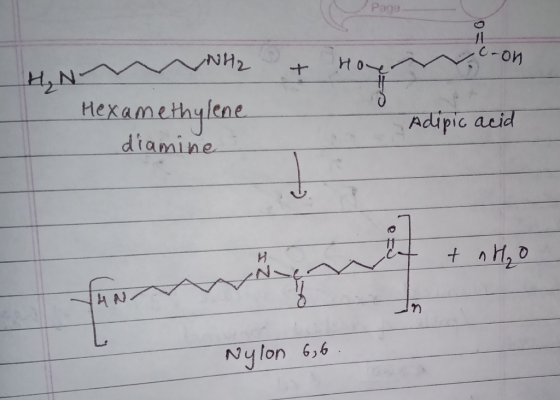
It is a condensation polymerization reaction because of the production of by-products along with the polymer. As the two monomers hexamethylene diamine and adipic acid condenses (to form nylon 6,6) and water is removed.
The molecular weight of the repeating unit of nylon 6,10 is 282.43 g/mol and its structure is shown below:
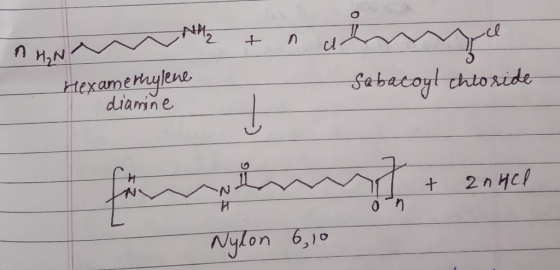
The by-product of the condensation reaction of hexamethylene diamine and sebacoyl chloride is HCl, therefore to neutralise the acidic environment of the polymer nylon 6,10 NaOH should be added. As a result it reacts with HCl to form H2O.

The limiting reagent(LR) is sebacoyl chloride and the theoritical yield calculations for nylon 6,10 are shown below:
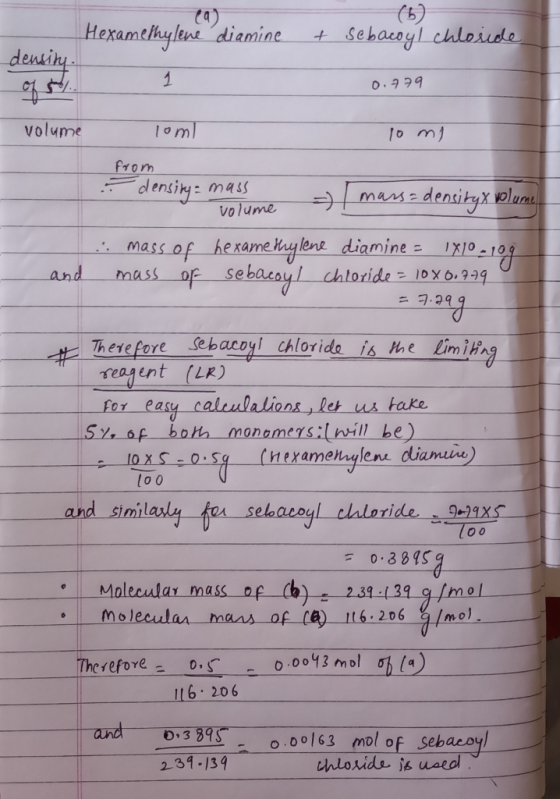
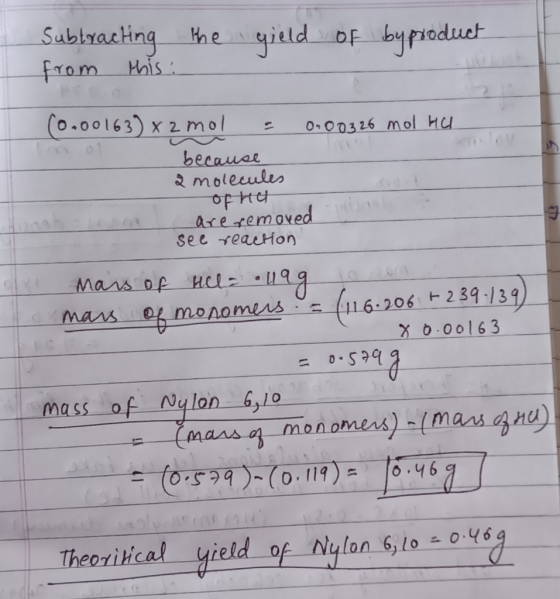
At the end of the polymerization reaction the chemical compounds left in the beaker includes all the by-products formed during the course of the reaction.
Add Answer to:
What are the products of the reaction between
Hexamethylenediamine and Adipic acid? Is this an addition...
i) Which of the following is not true about step-growth polymers? Formation of step-growth polymers usually...
i) Which of the following is not true about step-growth polymers? Formation of step-growth polymers usually results in the loss of a small molecule. Step-growth polymers are formed by the reaction of bifunctional molecules. Step-growth polymers can be formed by a free radical mechanism. Step-growth polymers are also known as condensation polymers. Step-growth polymers do not reach high molecular weight until the reaction has gone nearly to completion. ii) Which of the following are not termination methods in radical polymerization?...
A. This addition polymer features aromatic rings and is commonly found in moisture-barrier wraps used in...
 A. This addition polymer features aromatic rings and is commonly found in moisture-barrier wraps used in home construction B. This condensation polymer is the product of a difunctional acid with aromatic character and the type of glycol one would find in antifreeze solutions and is used to make countless beverage containers annually. C. This addition polymer is completely halogenated and is associated with non-stick working surfaces in the kitchen and in industry. D. This condensation polymer is the product of...
Need as much help i can get on this!!!! 1. Write a reaction equation for the...
 Need as much help i can get on this!!!!
1. Write a reaction equation for the synthesis of nylon 4,6. (Hint: the reaction equation for making nylon 6,10 is shown at the top of page 2. Make appropriate changes to the reactants to make nylon 4,6.) Но - + H₂N. wit 2. Which side product is formed when sebacyl chloride and hexamethylenediamine react to form nylon? (Hint: In the reaction equation at the top of page 1, which atoms are...
Need as much help i can get on this!!!!
1. Write a reaction equation for the synthesis of nylon 4,6. (Hint: the reaction equation for making nylon 6,10 is shown at the top of page 2. Make appropriate changes to the reactants to make nylon 4,6.) Но - + H₂N. wit 2. Which side product is formed when sebacyl chloride and hexamethylenediamine react to form nylon? (Hint: In the reaction equation at the top of page 1, which atoms are...
what is the theoretical yield for this experiment? ORGANIC POLYMERS: THE SYNTHESIS OF NYLON Nylon's outstanding...
 what is the theoretical yield for this experiment?
ORGANIC POLYMERS: THE SYNTHESIS OF NYLON Nylon's outstanding characteristic in the textile industry is its versatility. It can be made strong enough to stand up under the punishment tire cords must endure, fine enough for sheer, high fashion hosiery, and light enough for parachute cloth and backpacker's tents. Nylon is used both alone and in blends with other fibers, where its chief contributions are strength and abrasion resistance. Nylon washes easily, dries...
what is the theoretical yield for this experiment?
ORGANIC POLYMERS: THE SYNTHESIS OF NYLON Nylon's outstanding characteristic in the textile industry is its versatility. It can be made strong enough to stand up under the punishment tire cords must endure, fine enough for sheer, high fashion hosiery, and light enough for parachute cloth and backpacker's tents. Nylon is used both alone and in blends with other fibers, where its chief contributions are strength and abrasion resistance. Nylon washes easily, dries...
for this experiment, what is the balanced chemical equation and mechanism? Experimental Procedure a) Reagent Prep...
 for this experiment, what is the balanced chemical equation and
mechanism?
Experimental Procedure a) Reagent Preparation (mix in hood): 1. In a 125mL Erlenmeyer dissolve 1 mL of the sebacyl chloride in 50 mL of hexane. Label the Solution as SC 2. In a 50mL Erlenmeyer dissolve 2.5 mL of 1,6-hexanediamine in 25 mL of 3% sodium hydroxid Label the solution as diamine. (The 3% NaOH solution will be provided) b) Nylon Synthesis 1. Using a 10mL graduate cylinder take...
for this experiment, what is the balanced chemical equation and
mechanism?
Experimental Procedure a) Reagent Preparation (mix in hood): 1. In a 125mL Erlenmeyer dissolve 1 mL of the sebacyl chloride in 50 mL of hexane. Label the Solution as SC 2. In a 50mL Erlenmeyer dissolve 2.5 mL of 1,6-hexanediamine in 25 mL of 3% sodium hydroxid Label the solution as diamine. (The 3% NaOH solution will be provided) b) Nylon Synthesis 1. Using a 10mL graduate cylinder take...
The mechanism for number 2 please Polymers11 2. Write the reaction mechanism (showing arrows) of the...
 The mechanism for number 2 please
Polymers11 2. Write the reaction mechanism (showing arrows) of the synthesis of polystyrene. 4pts Include and show arrows in 2 initiation steps with benzoyl peroxide forming the phenyl radical. (this is shown in Figure 9 of the lab- just add all arrows) • A propagation step of the styrene (the monomer) and phenyl radical. • A second propagation step showing polymer growth by reacting styrene and the radical product of first propagation step. A...
The mechanism for number 2 please
Polymers11 2. Write the reaction mechanism (showing arrows) of the synthesis of polystyrene. 4pts Include and show arrows in 2 initiation steps with benzoyl peroxide forming the phenyl radical. (this is shown in Figure 9 of the lab- just add all arrows) • A propagation step of the styrene (the monomer) and phenyl radical. • A second propagation step showing polymer growth by reacting styrene and the radical product of first propagation step. A...
Q6. 2/2 points (a)What are the chemical formulas for the compounds below ? Are the compounds...
 Q6. 2/2 points
(a)What are the chemical formulas for the compounds below ?
Are the compounds shown
below isomers?
(b) Consider the two alkene compounds below? Which one is cis,
which one is trans?
Q7. 3/3/3 points
(a) What are addition polymerization steps?
(b) What type of polymerization does the below reaction
present?
(c) Calculate the degree of polymerization if 6,6-nylon has a
molecular weight of 120,000 g/mol, two repeating unit of Nylon6,6
shown in (b).
Q8. 4 points...
Q6. 2/2 points
(a)What are the chemical formulas for the compounds below ?
Are the compounds shown
below isomers?
(b) Consider the two alkene compounds below? Which one is cis,
which one is trans?
Q7. 3/3/3 points
(a) What are addition polymerization steps?
(b) What type of polymerization does the below reaction
present?
(c) Calculate the degree of polymerization if 6,6-nylon has a
molecular weight of 120,000 g/mol, two repeating unit of Nylon6,6
shown in (b).
Q8. 4 points...
33. The following scheme depicts what type of chemical reaction? Page 5 H Η Ο Iran...
 33. The following scheme depicts what type of chemical reaction? Page 5 H Η Ο Iran no ranom.don -- [ H-NCH27, N-H + 1 HOCCH27; COH Diamine Adipic acid tN(CH)N-C(CH2),C7,+ 2n H,O Nylon 6,6 A) Addition polymerization C) Condensation polymerization E) Elastomeric polymerization B) Acid-base reaction D) Ionic polymerization 34. The phase changes BC and D E are not associated with temperature increases because the heat energy (q) is consumed to A) increase distances between molecules B) break intramolecular bonds...
reaction mech: initiation , propagation, and termination of the synthesis of polystyrene Polymersti 2. Write the...
 reaction mech: initiation , propagation, and termination of
the synthesis of polystyrene
Polymersti 2. Write the reaction mechanism (showing arrows) of the synthesis of polystyrene. 4pts • Include and show arrows in 2 initiation steps with benzoyl peroxide forming the phenyl radical. (this is shown in Figure 9 of the lab- just add all arrows) A propagation step of the styrene (the monomer) and phenyl radical. A second propagation step showing polymer growth by reacting styrene and the radical product...
reaction mech: initiation , propagation, and termination of
the synthesis of polystyrene
Polymersti 2. Write the reaction mechanism (showing arrows) of the synthesis of polystyrene. 4pts • Include and show arrows in 2 initiation steps with benzoyl peroxide forming the phenyl radical. (this is shown in Figure 9 of the lab- just add all arrows) A propagation step of the styrene (the monomer) and phenyl radical. A second propagation step showing polymer growth by reacting styrene and the radical product...
in LINE ANGLE format please Polymersti 2. Write the reaction mechanism (showing arrows) of the synthesis of polyst...
 in
LINE ANGLE format please
Polymersti 2. Write the reaction mechanism (showing arrows) of the synthesis of polystyrene. 4pts • Include and show arrows in 2 initiation steps with benzoyl peroxide forming the phenyl radical. (this is shown in Figure 9 of the lab- just add all arrows) A propagation step of the styrene (the monomer) and phenyl radical. A second propagation step showing polymer growth by reacting styrene and the radical product of first propagation step. A termination step...
in
LINE ANGLE format please
Polymersti 2. Write the reaction mechanism (showing arrows) of the synthesis of polystyrene. 4pts • Include and show arrows in 2 initiation steps with benzoyl peroxide forming the phenyl radical. (this is shown in Figure 9 of the lab- just add all arrows) A propagation step of the styrene (the monomer) and phenyl radical. A second propagation step showing polymer growth by reacting styrene and the radical product of first propagation step. A termination step...
 A. This addition polymer features aromatic rings and is commonly found in moisture-barrier wraps used in home construction B. This condensation polymer is the product of a difunctional acid with aromatic character and the type of glycol one would find in antifreeze solutions and is used to make countless beverage containers annually. C. This addition polymer is completely halogenated and is associated with non-stick working surfaces in the kitchen and in industry. D. This condensation polymer is the product of...
 Need as much help i can get on this!!!!
1. Write a reaction equation for the synthesis of nylon 4,6. (Hint: the reaction equation for making nylon 6,10 is shown at the top of page 2. Make appropriate changes to the reactants to make nylon 4,6.) Но - + H₂N. wit 2. Which side product is formed when sebacyl chloride and hexamethylenediamine react to form nylon? (Hint: In the reaction equation at the top of page 1, which atoms are...
Need as much help i can get on this!!!!
1. Write a reaction equation for the synthesis of nylon 4,6. (Hint: the reaction equation for making nylon 6,10 is shown at the top of page 2. Make appropriate changes to the reactants to make nylon 4,6.) Но - + H₂N. wit 2. Which side product is formed when sebacyl chloride and hexamethylenediamine react to form nylon? (Hint: In the reaction equation at the top of page 1, which atoms are...
 what is the theoretical yield for this experiment?
ORGANIC POLYMERS: THE SYNTHESIS OF NYLON Nylon's outstanding characteristic in the textile industry is its versatility. It can be made strong enough to stand up under the punishment tire cords must endure, fine enough for sheer, high fashion hosiery, and light enough for parachute cloth and backpacker's tents. Nylon is used both alone and in blends with other fibers, where its chief contributions are strength and abrasion resistance. Nylon washes easily, dries...
what is the theoretical yield for this experiment?
ORGANIC POLYMERS: THE SYNTHESIS OF NYLON Nylon's outstanding characteristic in the textile industry is its versatility. It can be made strong enough to stand up under the punishment tire cords must endure, fine enough for sheer, high fashion hosiery, and light enough for parachute cloth and backpacker's tents. Nylon is used both alone and in blends with other fibers, where its chief contributions are strength and abrasion resistance. Nylon washes easily, dries...
 for this experiment, what is the balanced chemical equation and
mechanism?
Experimental Procedure a) Reagent Preparation (mix in hood): 1. In a 125mL Erlenmeyer dissolve 1 mL of the sebacyl chloride in 50 mL of hexane. Label the Solution as SC 2. In a 50mL Erlenmeyer dissolve 2.5 mL of 1,6-hexanediamine in 25 mL of 3% sodium hydroxid Label the solution as diamine. (The 3% NaOH solution will be provided) b) Nylon Synthesis 1. Using a 10mL graduate cylinder take...
for this experiment, what is the balanced chemical equation and
mechanism?
Experimental Procedure a) Reagent Preparation (mix in hood): 1. In a 125mL Erlenmeyer dissolve 1 mL of the sebacyl chloride in 50 mL of hexane. Label the Solution as SC 2. In a 50mL Erlenmeyer dissolve 2.5 mL of 1,6-hexanediamine in 25 mL of 3% sodium hydroxid Label the solution as diamine. (The 3% NaOH solution will be provided) b) Nylon Synthesis 1. Using a 10mL graduate cylinder take...
 The mechanism for number 2 please
Polymers11 2. Write the reaction mechanism (showing arrows) of the synthesis of polystyrene. 4pts Include and show arrows in 2 initiation steps with benzoyl peroxide forming the phenyl radical. (this is shown in Figure 9 of the lab- just add all arrows) • A propagation step of the styrene (the monomer) and phenyl radical. • A second propagation step showing polymer growth by reacting styrene and the radical product of first propagation step. A...
The mechanism for number 2 please
Polymers11 2. Write the reaction mechanism (showing arrows) of the synthesis of polystyrene. 4pts Include and show arrows in 2 initiation steps with benzoyl peroxide forming the phenyl radical. (this is shown in Figure 9 of the lab- just add all arrows) • A propagation step of the styrene (the monomer) and phenyl radical. • A second propagation step showing polymer growth by reacting styrene and the radical product of first propagation step. A...
 Q6. 2/2 points
(a)What are the chemical formulas for the compounds below ?
Are the compounds shown
below isomers?
(b) Consider the two alkene compounds below? Which one is cis,
which one is trans?
Q7. 3/3/3 points
(a) What are addition polymerization steps?
(b) What type of polymerization does the below reaction
present?
(c) Calculate the degree of polymerization if 6,6-nylon has a
molecular weight of 120,000 g/mol, two repeating unit of Nylon6,6
shown in (b).
Q8. 4 points...
Q6. 2/2 points
(a)What are the chemical formulas for the compounds below ?
Are the compounds shown
below isomers?
(b) Consider the two alkene compounds below? Which one is cis,
which one is trans?
Q7. 3/3/3 points
(a) What are addition polymerization steps?
(b) What type of polymerization does the below reaction
present?
(c) Calculate the degree of polymerization if 6,6-nylon has a
molecular weight of 120,000 g/mol, two repeating unit of Nylon6,6
shown in (b).
Q8. 4 points...
 33. The following scheme depicts what type of chemical reaction? Page 5 H Η Ο Iran no ranom.don -- [ H-NCH27, N-H + 1 HOCCH27; COH Diamine Adipic acid tN(CH)N-C(CH2),C7,+ 2n H,O Nylon 6,6 A) Addition polymerization C) Condensation polymerization E) Elastomeric polymerization B) Acid-base reaction D) Ionic polymerization 34. The phase changes BC and D E are not associated with temperature increases because the heat energy (q) is consumed to A) increase distances between molecules B) break intramolecular bonds...
 reaction mech: initiation , propagation, and termination of
the synthesis of polystyrene
Polymersti 2. Write the reaction mechanism (showing arrows) of the synthesis of polystyrene. 4pts • Include and show arrows in 2 initiation steps with benzoyl peroxide forming the phenyl radical. (this is shown in Figure 9 of the lab- just add all arrows) A propagation step of the styrene (the monomer) and phenyl radical. A second propagation step showing polymer growth by reacting styrene and the radical product...
reaction mech: initiation , propagation, and termination of
the synthesis of polystyrene
Polymersti 2. Write the reaction mechanism (showing arrows) of the synthesis of polystyrene. 4pts • Include and show arrows in 2 initiation steps with benzoyl peroxide forming the phenyl radical. (this is shown in Figure 9 of the lab- just add all arrows) A propagation step of the styrene (the monomer) and phenyl radical. A second propagation step showing polymer growth by reacting styrene and the radical product...
 in
LINE ANGLE format please
Polymersti 2. Write the reaction mechanism (showing arrows) of the synthesis of polystyrene. 4pts • Include and show arrows in 2 initiation steps with benzoyl peroxide forming the phenyl radical. (this is shown in Figure 9 of the lab- just add all arrows) A propagation step of the styrene (the monomer) and phenyl radical. A second propagation step showing polymer growth by reacting styrene and the radical product of first propagation step. A termination step...
in
LINE ANGLE format please
Polymersti 2. Write the reaction mechanism (showing arrows) of the synthesis of polystyrene. 4pts • Include and show arrows in 2 initiation steps with benzoyl peroxide forming the phenyl radical. (this is shown in Figure 9 of the lab- just add all arrows) A propagation step of the styrene (the monomer) and phenyl radical. A second propagation step showing polymer growth by reacting styrene and the radical product of first propagation step. A termination step...
Most questions answered within 3 hours.
-
Where is the error in this code sequence?
String s1 = "Hello";
String s2 = "ello";...
asked 11 months ago -
Financial data for Joel de Paris, Inc., for last year
follow:
Joel de Paris, Inc.
Balance...
asked 11 months ago -
Consider this reaction:
Al2(SO4)3 (aq)+ BaCl3
(aq) Al2Cl6 (aq)- +
3BaSO4(s) . What is the...
asked 11 months ago -
Suppose that Savneet is considering increasing her
recent random sample from 20 car rentals to 40...
asked 11 months ago -
Trucks arrive at an unloading terminal at an average rate of 120
per hour.
Trucks arrive...
asked 11 months ago -
Why are methanol and ethanol completely soluble in water while
octanol is not very little soluble....
asked 11 months ago -
A facilities manager at a university reads in a research report
that the mean amount of...
asked 11 months ago -
When the CuSO4 is rehydrated by adding water to the anhydrous
compound, is this an endothermic...
asked 11 months ago -
A ray of sunlight is passing from diamond into crown glass; the
angle of incidence is...
asked 11 months ago -
A block of mass 0.249 kg is placed on top of a light, vertical
spring of...
asked 11 months ago -
how do the kidneys compensate in the presences of acidosis
a) trigger hyperventilate
b) reserve acid...
asked 11 months ago -
Question 501 pts
The rental rate of capital to the firm increases. Which of the
following...
asked 11 months ago