
Homework Answers
Add Answer to:
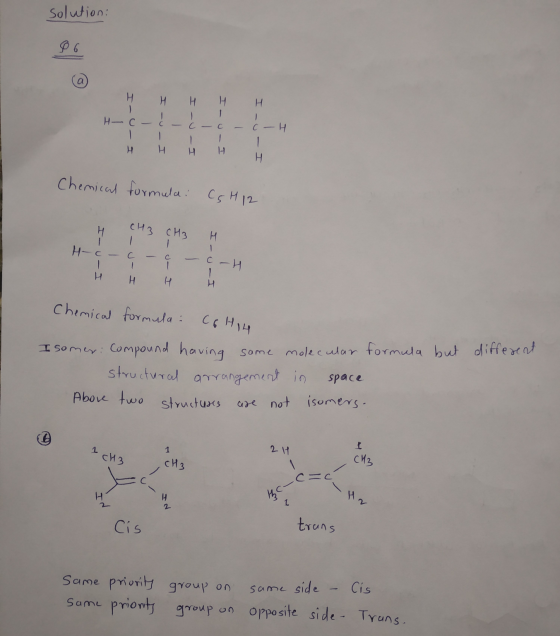
Q6. 2/2 points
(a)What are the chemical formulas for the compounds below ?
Are the compounds...
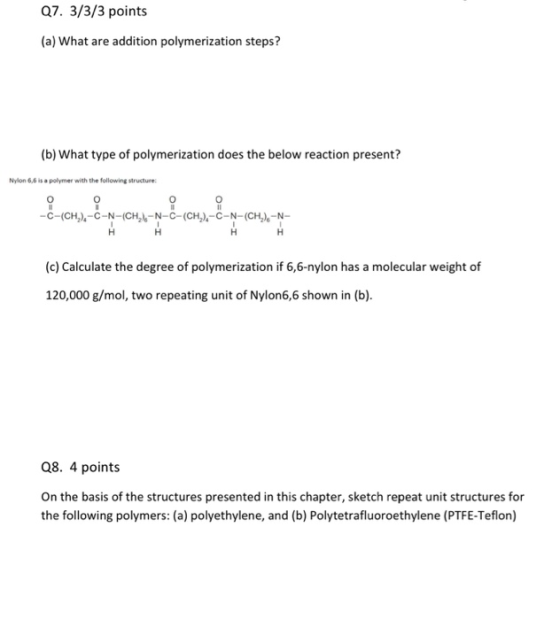
Example: The linear polymer 6,6-nylon is to be produced by combining of hexamethylene diamine [NH2-(CH2)6 NH2l...
 Example: The linear polymer 6,6-nylon is to be produced by combining of hexamethylene diamine [NH2-(CH2)6 NH2l with adipic acid. Calculate the degree of polymerization if the product has a molecular weight of 120,000 g/mol. O HH H H O но-с-с-с-с-с-с-он adipic acid
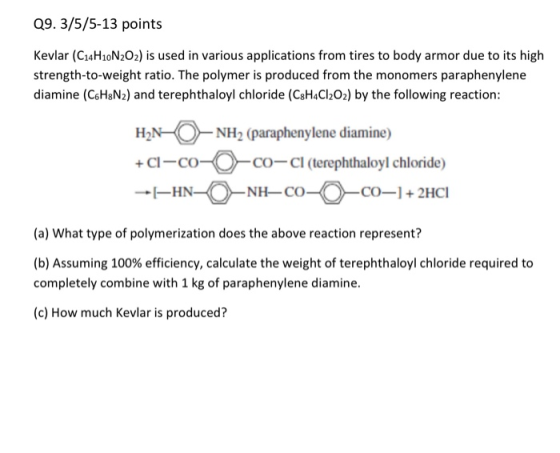
What is the theoretical yield of the below reaction: Theoretical Yield: Hydroquinone Terephthaloyl Polymer Product Chlo...
 What is the theoretical yield of the below reaction:
Theoretical Yield: Hydroquinone Terephthaloyl Polymer Product Chloride C14H9O Molecular C$HO2 CsH4O2Cl2 Formula 203.02 g/mol 110.11 g/mol 327.39 g/mol Molecular Weight Quantity 1.01 g 1.59g
What is the theoretical yield of the below reaction:
Theoretical Yield: Hydroquinone Terephthaloyl Polymer Product Chloride C14H9O Molecular C$HO2 CsH4O2Cl2 Formula 203.02 g/mol 110.11 g/mol 327.39 g/mol Molecular Weight Quantity 1.01 g 1.59g
What are the products of the reaction between Hexamethylenediamine and Adipic acid? Is this an addition...
What are the products of the reaction between Hexamethylenediamine and Adipic acid? Is this an addition or a condensation polymerization reaction? What is the molecular weight of the repeating unit (formula unit) of Nylon 6,10? Write Rx 1 (p.2) for n = 1 and consider the amounts of reagents used in the lab to determine LR and theoretical yield of Nylon 6,10 for this reaction. (a) What is the by-product of the condensation reaction to produce Nylon 6,10 (using Hexamethylenediamine...
Question 3 (5 points): A student is performing a 1:1 stoichiometric polymerization of 1,4-diamonobutane with sebacoyl...
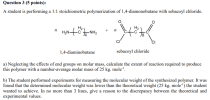 Question 3 (5 points): A student is performing a 1:1 stoichiometric polymerization of 1,4-diamonobutane with sebacoyl chloride. H2 H2 C -NH2 4 sebacoyl chloride 1,4-diaminobutane a) Neglecting the effects of end groups on molar mass, calculate the extent of reaction required to produce this polymer with a number-average molar mass of 25 kg. molel b) The student performed experiments for measuring the molecular weight of the synthesized polymer. It was found that the determined molecular weight was lower than the...
Polystyrene can be polymerized from the starting monomer (styrene) pictured below. a. Anionic polymerization is one...
 Polystyrene can be polymerized from the starting monomer
(styrene) pictured below.
a. Anionic polymerization is one method of polymerization that
can be used to generate polystyrene from styrene. Explain what type
of initiator should be used for this reaction
and draw an example of a styrene monomer that has reacted with
initiator.
b. Using this anionic polymerization method and a starting
concentration of 1M styrene and 1mM initiator, what degree of
polymerization (Xn) would you expect if you use up...
Polystyrene can be polymerized from the starting monomer
(styrene) pictured below.
a. Anionic polymerization is one method of polymerization that
can be used to generate polystyrene from styrene. Explain what type
of initiator should be used for this reaction
and draw an example of a styrene monomer that has reacted with
initiator.
b. Using this anionic polymerization method and a starting
concentration of 1M styrene and 1mM initiator, what degree of
polymerization (Xn) would you expect if you use up...
for the perovskite structure (shown below) 14. Coordination numbers of Ti". Ba?' and are, respectively: a....
 for the perovskite structure (shown below) 14. Coordination numbers of Ti". Ba?' and are, respectively: a. 6, 6, and 6 b. 12,6, and 6 c. 6, 16, and 8 d. 6, 12, and 6 15. In the cesium chloride (CCI) structure, cations are located at a cach of the corners of cubes b. the centre of cubes c. interior tetrahedral sites d. interior octahedral sites 16. Low density polyethylene (LDPE) is a. a linear polymer b. a branched polymer c....
Question 30 (2 points) What are the expected major products of the reaction sequence shown below?...
 Question 30 (2 points) What are the expected major products of the reaction sequence shown below? 1. 03 2. H20 e OH O=C=0 OH II III IV V O a) I and IV Ob) II, III and IV Oc) I and II O d) 1, III and IV Question 31 (2 points) A compound with a molecular formula of C10H1202 has the following 'H NMR spectrum. Which of the following structures is consistent with this spectrum? 2 o OCH2CH2CH3 0...
2. (3 points) Consider molecules shown below: CH3 CHs CH CHs CHs CI CCI CH CI...
 2. (3 points) Consider molecules shown below: CH3 CHs CH CHs CHs CI CCI CH CI CH CI- H-CCI H-CCI Н-с—н HCH H-CH H--CH H-CH H-CH HCCI CI H H Н-С—СI CI Cн, CHs CH CHs CH3 E D. C. A (a) Identify all pairs of diastereomers. CAACBE (b) Identify all meso compounds. (c) Identify all pairs of enantiomers. (A (810le AOLBO
Question 5 (2 points) For which of the following compounds will the M+2 peak intensity be...
 Question 5 (2 points) For which of the following compounds will the M+2 peak intensity be equal to the intensity of the molecular ion peak M? a) CH3CH2CH OH 0 b) CHỊCH CHANH, Oc) CH3CH2CH_Br d) CH,CH2CH2C1 Question 6 (2 points) What is the product of the reaction below? "OH PCC o OH O OH TV a) Obiy c)
PART 2. Written Short Answers. (58 points) 22. (10 points) Write the full chemical name for...
 PART 2. Written Short Answers. (58 points) 22. (10 points) Write the full chemical name for each of the compounds listed below: a) MgF2 b Feo, diom trioxidlX c) HiPOs (ag) d) H,N (ag) 23. (10 points) Write the correct chemical formula for each of the compounds listed below N(n) a) nitrous acid b) ithium bicarbonateLiCn x CaBr X c) caleium bromide d)gold(I) oxide- e) tetraphosphorus trisulfideTy (BONUS) sodium bromite 24. (12 points) Write the complete and balanced chemical equation...
 Example: The linear polymer 6,6-nylon is to be produced by combining of hexamethylene diamine [NH2-(CH2)6 NH2l with adipic acid. Calculate the degree of polymerization if the product has a molecular weight of 120,000 g/mol. O HH H H O но-с-с-с-с-с-с-он adipic acid
 What is the theoretical yield of the below reaction:
Theoretical Yield: Hydroquinone Terephthaloyl Polymer Product Chloride C14H9O Molecular C$HO2 CsH4O2Cl2 Formula 203.02 g/mol 110.11 g/mol 327.39 g/mol Molecular Weight Quantity 1.01 g 1.59g
What is the theoretical yield of the below reaction:
Theoretical Yield: Hydroquinone Terephthaloyl Polymer Product Chloride C14H9O Molecular C$HO2 CsH4O2Cl2 Formula 203.02 g/mol 110.11 g/mol 327.39 g/mol Molecular Weight Quantity 1.01 g 1.59g
 Question 3 (5 points): A student is performing a 1:1 stoichiometric polymerization of 1,4-diamonobutane with sebacoyl chloride. H2 H2 C -NH2 4 sebacoyl chloride 1,4-diaminobutane a) Neglecting the effects of end groups on molar mass, calculate the extent of reaction required to produce this polymer with a number-average molar mass of 25 kg. molel b) The student performed experiments for measuring the molecular weight of the synthesized polymer. It was found that the determined molecular weight was lower than the...
 Polystyrene can be polymerized from the starting monomer
(styrene) pictured below.
a. Anionic polymerization is one method of polymerization that
can be used to generate polystyrene from styrene. Explain what type
of initiator should be used for this reaction
and draw an example of a styrene monomer that has reacted with
initiator.
b. Using this anionic polymerization method and a starting
concentration of 1M styrene and 1mM initiator, what degree of
polymerization (Xn) would you expect if you use up...
Polystyrene can be polymerized from the starting monomer
(styrene) pictured below.
a. Anionic polymerization is one method of polymerization that
can be used to generate polystyrene from styrene. Explain what type
of initiator should be used for this reaction
and draw an example of a styrene monomer that has reacted with
initiator.
b. Using this anionic polymerization method and a starting
concentration of 1M styrene and 1mM initiator, what degree of
polymerization (Xn) would you expect if you use up...
 for the perovskite structure (shown below) 14. Coordination numbers of Ti". Ba?' and are, respectively: a. 6, 6, and 6 b. 12,6, and 6 c. 6, 16, and 8 d. 6, 12, and 6 15. In the cesium chloride (CCI) structure, cations are located at a cach of the corners of cubes b. the centre of cubes c. interior tetrahedral sites d. interior octahedral sites 16. Low density polyethylene (LDPE) is a. a linear polymer b. a branched polymer c....
 Question 30 (2 points) What are the expected major products of the reaction sequence shown below? 1. 03 2. H20 e OH O=C=0 OH II III IV V O a) I and IV Ob) II, III and IV Oc) I and II O d) 1, III and IV Question 31 (2 points) A compound with a molecular formula of C10H1202 has the following 'H NMR spectrum. Which of the following structures is consistent with this spectrum? 2 o OCH2CH2CH3 0...
 2. (3 points) Consider molecules shown below: CH3 CHs CH CHs CHs CI CCI CH CI CH CI- H-CCI H-CCI Н-с—н HCH H-CH H--CH H-CH H-CH HCCI CI H H Н-С—СI CI Cн, CHs CH CHs CH3 E D. C. A (a) Identify all pairs of diastereomers. CAACBE (b) Identify all meso compounds. (c) Identify all pairs of enantiomers. (A (810le AOLBO
 Question 5 (2 points) For which of the following compounds will the M+2 peak intensity be equal to the intensity of the molecular ion peak M? a) CH3CH2CH OH 0 b) CHỊCH CHANH, Oc) CH3CH2CH_Br d) CH,CH2CH2C1 Question 6 (2 points) What is the product of the reaction below? "OH PCC o OH O OH TV a) Obiy c)
 PART 2. Written Short Answers. (58 points) 22. (10 points) Write the full chemical name for each of the compounds listed below: a) MgF2 b Feo, diom trioxidlX c) HiPOs (ag) d) H,N (ag) 23. (10 points) Write the correct chemical formula for each of the compounds listed below N(n) a) nitrous acid b) ithium bicarbonateLiCn x CaBr X c) caleium bromide d)gold(I) oxide- e) tetraphosphorus trisulfideTy (BONUS) sodium bromite 24. (12 points) Write the complete and balanced chemical equation...
Most questions answered within 3 hours.
-
Where is the error in this code sequence?
String s1 = "Hello";
String s2 = "ello";...
asked 10 months ago -
Financial data for Joel de Paris, Inc., for last year
follow:
Joel de Paris, Inc.
Balance...
asked 10 months ago -
Consider this reaction:
Al2(SO4)3 (aq)+ BaCl3
(aq) Al2Cl6 (aq)- +
3BaSO4(s) . What is the...
asked 10 months ago -
Suppose that Savneet is considering increasing her
recent random sample from 20 car rentals to 40...
asked 10 months ago -
Trucks arrive at an unloading terminal at an average rate of 120
per hour.
Trucks arrive...
asked 10 months ago -
Why are methanol and ethanol completely soluble in water while
octanol is not very little soluble....
asked 10 months ago -
A facilities manager at a university reads in a research report
that the mean amount of...
asked 10 months ago -
When the CuSO4 is rehydrated by adding water to the anhydrous
compound, is this an endothermic...
asked 10 months ago -
A ray of sunlight is passing from diamond into crown glass; the
angle of incidence is...
asked 10 months ago -
A block of mass 0.249 kg is placed on top of a light, vertical
spring of...
asked 10 months ago -
how do the kidneys compensate in the presences of acidosis
a) trigger hyperventilate
b) reserve acid...
asked 10 months ago -
Question 501 pts
The rental rate of capital to the firm increases. Which of the
following...
asked 10 months ago