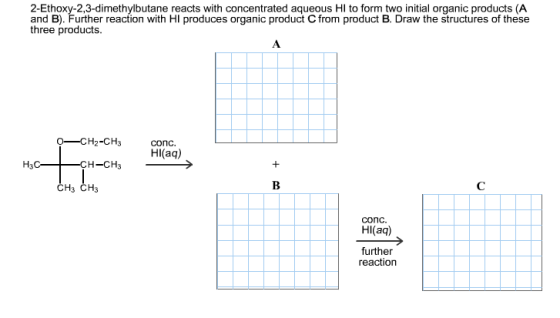
2-Ethoxy-2,3-dimethylbutane reacts with concentrated aqueous HI to form two initial organic products (A and B). Further...
Homework Answers

The concept used to solve this question is cleavage of ether takes place with strong acid, HI and forms an alcohol, alkyl iodide, which is further reacted with HI to form second alkyl iodide.
The mechanism of ether cleavage takes place via or .
With the methyl or primary alkyl groups that are bonded to ether oxygen, the cleavage of C-O bond takes place via mechanism. Similarly, with the secondary or tertiary alkyl groups that are bonded to ether oxygen, the cleavage of C-O bond takes place via mechanism.
The reaction is as follows:

The reaction is as follows:

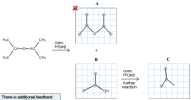
The structures of three products are as follows:

Add Answer to:
2-Ethoxy-2,3-dimethylbutane reacts with concentrated aqueous HI to form two initial organic products (A and B). Further...
2-Ethoxy-2,3-dimethylbutane reacts with concentrated aqueous HI to form two initial organic products (A and B). Further...
2-Ethoxy-2,3-dimethylbutane reacts with concentrated aqueous HI to form two initial organic products (A and B). Further reaction with HI produces organic product C from product B. Draw the structures of these three products.
Diisopropyl ether reacts with concentrated aqueous HI to form two initial organic products (A and B). Further reaction...
 Diisopropyl ether reacts with concentrated aqueous HI to form two initial organic products (A and B). Further reaction with HI produces organic product C from product B. Draw the structures of these three products.
Diisopropyl ether reacts with concentrated aqueous HI to form two initial organic products (A and B). Further reactio...
 Diisopropyl ether reacts with concentrated aqueous HI to form two
initial organic products (A and B). Further reaction with HI
produces organic product C from product B. Draw the structures of
these three products.
Diisopropyl ether reacts with concentrated aqueous HI to form two
initial organic products (A and B). Further reaction with HI
produces organic product C from product B. Draw the structures of
these three products.
Benzyl ethyl ether reacts with concentrated aqueous HI to form two initial organic products (A and B). Further reaction...
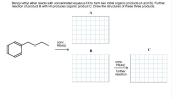
Benzyl ethyl ether reacts with concentrated aqueous HI to form two initial organic products (A and B). Further reaction of product B with HI produces organic product C. Draw the structures of these three products.
Benzyl ethyl ether reacts with concentrated aqueous HI to form two initial organic products (A and B). Further reacti...
 Benzyl ethyl ether reacts with concentrated aqueous HI to form
two initial organic products (A and B). Further reaction of product
B with HI produces organic product C. Draw the structures of these
three products.
Benzyl ethyl ether reacts with concentrated aqueous HI to form
two initial organic products (A and B). Further reaction of product
B with HI produces organic product C. Draw the structures of these
three products.
Ethers react with HI to form two cleavage products. One of the products might react further with HI. In the first box...
 Ethers react with HI to form two cleavage products. One of the
products might react further with HI. In the first box below draw
the two major products that could be recovered after treatment with
one equivalent of HI. In the second box draw the two major products
that could be recovered after treatment with excess HI. (If a
product of the first step does not undergo additional reaction with
excess HI, repeat its structure in the second box.)
Ethers...
Ethers react with HI to form two cleavage products. One of the
products might react further with HI. In the first box below draw
the two major products that could be recovered after treatment with
one equivalent of HI. In the second box draw the two major products
that could be recovered after treatment with excess HI. (If a
product of the first step does not undergo additional reaction with
excess HI, repeat its structure in the second box.)
Ethers...
When 2-bromo-3-methylbutane reacts with ethanol,two products are formed, 2-ethoxy-3-methylbutane and 2-ethoxy-2-methylbutane. 1.Give an explanation for the...
When 2-bromo-3-methylbutane reacts with ethanol,two products are formed, 2-ethoxy-3-methylbutane and 2-ethoxy-2-methylbutane. 1.Give an explanation for the two products. 2. Draw the full mechanism for the formation of the second product. (mechanism should have fours steps in total, including a deprotonation step.) Please show all work!
2-Ethoxy-2,3-dimethylbutane reacts with concentrated aqueous HI to form two initial organic products (A and B). Further reaction with HI produces organic product C from product B. Draw the structures of these three products. (Picture attached)
 Screen Shot 2019-12-03 at 8.01.04 AM.png
2,3-Dimethylbutan-2-ol is converted to 2,3-dichloro-2,3-dimethylbutane in two steps. Which reagents would you use to achieve this...
2,3-Dimethylbutan-2-ol is converted to 2,3-dichloro-2,3-dimethylbutane in two steps. Which reagents would you use to achieve this conversion? Select one: a. Reagent A is NaOH(aq) with heat and reagent B is Cl2 b. Reagent A is hot KMnO4 and reagent B is H2O/H+ c. Reagent A is concentrated H2SO4 and reagent B is Cl2 d. Reagent A is NaOH in ethanol and reagent B is HCl e. Reagent A is B2H6 followed by H2O2/OH- and reagent B is NaOH<(aq)
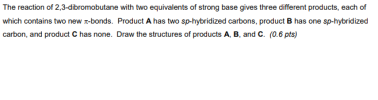
The reaction of 2,3-dibromobutane with two equivalents of strong base gives three different products, each of...
 The reaction of 2,3-dibromobutane with two equivalents of strong base gives three different products, each of which contains two new T-bonds. Product A has two sp-hybridized carbons, product B has one sp-hybridized carbon, and product C has none. Draw the structures of products A, B, and C. (0.6 pts)
 Diisopropyl ether reacts with concentrated aqueous HI to form two initial organic products (A and B). Further reaction with HI produces organic product C from product B. Draw the structures of these three products.
 Benzyl ethyl ether reacts with concentrated aqueous HI to form
two initial organic products (A and B). Further reaction of product
B with HI produces organic product C. Draw the structures of these
three products.
Benzyl ethyl ether reacts with concentrated aqueous HI to form
two initial organic products (A and B). Further reaction of product
B with HI produces organic product C. Draw the structures of these
three products.
 Ethers react with HI to form two cleavage products. One of the
products might react further with HI. In the first box below draw
the two major products that could be recovered after treatment with
one equivalent of HI. In the second box draw the two major products
that could be recovered after treatment with excess HI. (If a
product of the first step does not undergo additional reaction with
excess HI, repeat its structure in the second box.)
Ethers...
Ethers react with HI to form two cleavage products. One of the
products might react further with HI. In the first box below draw
the two major products that could be recovered after treatment with
one equivalent of HI. In the second box draw the two major products
that could be recovered after treatment with excess HI. (If a
product of the first step does not undergo additional reaction with
excess HI, repeat its structure in the second box.)
Ethers...
 The reaction of 2,3-dibromobutane with two equivalents of strong base gives three different products, each of which contains two new T-bonds. Product A has two sp-hybridized carbons, product B has one sp-hybridized carbon, and product C has none. Draw the structures of products A, B, and C. (0.6 pts)
Most questions answered within 3 hours.
-
Where is the error in this code sequence?
String s1 = "Hello";
String s2 = "ello";...
asked 10 months ago -
Financial data for Joel de Paris, Inc., for last year
follow:
Joel de Paris, Inc.
Balance...
asked 10 months ago -
Consider this reaction:
Al2(SO4)3 (aq)+ BaCl3
(aq) Al2Cl6 (aq)- +
3BaSO4(s) . What is the...
asked 10 months ago -
Suppose that Savneet is considering increasing her
recent random sample from 20 car rentals to 40...
asked 10 months ago -
Trucks arrive at an unloading terminal at an average rate of 120
per hour.
Trucks arrive...
asked 10 months ago -
Why are methanol and ethanol completely soluble in water while
octanol is not very little soluble....
asked 10 months ago -
A facilities manager at a university reads in a research report
that the mean amount of...
asked 10 months ago -
When the CuSO4 is rehydrated by adding water to the anhydrous
compound, is this an endothermic...
asked 10 months ago -
A ray of sunlight is passing from diamond into crown glass; the
angle of incidence is...
asked 10 months ago -
A block of mass 0.249 kg is placed on top of a light, vertical
spring of...
asked 10 months ago -
how do the kidneys compensate in the presences of acidosis
a) trigger hyperventilate
b) reserve acid...
asked 10 months ago -
Question 501 pts
The rental rate of capital to the firm increases. Which of the
following...
asked 10 months ago