
Homework Answers
Vertical force on ball F=10N
Weight of ball W= 0.7N
Now net force on the ball in upward direction



Now impulse = change in linear momentum




Thanks for asking.
Add Answer to:
12. What is the velocity of a tennis ball just after release from a toss straight...
12. What is the velocity of a tennis ball right at the release (vf) from a...
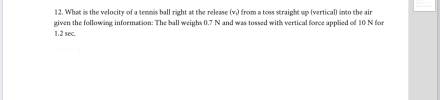 12. What is the velocity of a tennis ball right at the release (vf) from a toss straight up (vertical) into the air given the following information: The ball weighs 0.7 N and was tossed with vertical force applied of 10 N for 1.2 sec.
6. A tennis player strikes a tennis ball with her racket when the ball is at the uppermost point of its trajectory as shown. Just after impact, the velocity of the ball is directed at an angle of 15°...
 6. A tennis player strikes a tennis ball with her racket when the ball is at the uppermost point of its trajectory as shown. Just after impact, the velocity of the ball is directed at an angle of 15° above the horizontal. If the 125 gram ball is in contact with the racket for 0.02 sec, and the average impulsive force exerted by the racket on the ball is of magnitude of 200 N and directed at an angle 9°...
A tennis player tosses a tennis ball straight up and then catches it after 2.00 s...
A tennis player tosses a tennis ball straight up and then catches it after 2.00 s at the same height as the point of release. (a) What is the acceleration of the ball while it is in flight? (b) What is the velocity of the ball when it reaches its maximum height? Find (c) the initial velocity of the ball and (d) the maximum height it reaches.
A tennis player tosses a tennis ball straight up and then catches it after 1.63 s...
 A tennis player tosses a tennis ball straight up and then catches it after 1.63 s at the same height as the point of release. (a) What is the acceleration of the ball while it is in flight? magnitude direction Select m/s² (b) What is the velocity of the ball when it reaches its maximum height? magnitude m/s direction --Select- (c) Find the initial velocity of the ball. m/s upward (d) Find the maximum height it reaches.
A tennis ball is shot straight up from the ground. After traveling 4.00 m, the ball...
A tennis ball is shot straight up from the ground. After traveling 4.00 m, the ball passes a 4.00 m high window and then continues straight up until it loses all its upward velocity and falls to the ground. During the last second of its flight before it hits the ground, the ball drops 20.0 m. a) What is the maximum height above the ground reached by the ball? b) What is the total time for the ball’s flight? c)...
Just before it is struck by a racket, a tennis ball weighing 0.560 N has a velocity of (20.0m/s)i^−(4.0m/s)j^. During...
Just before it is struck by a racket, a tennis ball weighing 0.560 N has a velocity of (20.0m/s)i^−(4.0m/s)j^. During the 3.00 msthat the racket and ball are in contact, the net force on the ball is constant and equal to −(380N)i^+(110N)j^. A. What is the x -component of the impulse of the net force applied to the ball? B. What is the y-component of the impulse of the net force applied to the ball? C. What is the x-component...
ㄐ-X. 19X A tennis ball with mass 0.06 kg moves toward a wall with a velocity...
 ㄐ-X. 19X A tennis ball with mass 0.06 kg moves toward a wall with a velocity of 20 m/s. The tennis ball bounces off a wall and then has a velocity of -20 m/s. If a force of 10 N is applied to the ball from the wall to change the balls direction, how long was the ball in contact with the wall?
Part A Just before it is struck by a racket, a tennis ball weighing 0.560 N...
 Part A Just before it is struck by a racket, a tennis ball weighing 0.560 N has a velocity of (20.0 m/s)i - (4.0 m/s)j. During the 3.00 ms that the racket and ball are in contact, the net force on the ball is constant and equal to -(380 N)i (110 N)j What is the -component of the impulse of the net force applied to the ball? Submit uest Answer ▼ Part B What is the y-component of the impulse...
a tennis ball was hit with a tennis racquet. The ball was hit in the same...
 a tennis ball was hit with a tennis racquet. The ball was hit in
the same direction from which it approached the raquet ( the
opposite of the direction it was going), so it was s essentially a
one- dimensional collision. The 60.0 gram tennis ball approached
the racquet with a speed of 34.3 m/s. The tennis racquet gave the
ball an impulse of 4.5 newton-seconds. a) Find the velocity of the
ball after the collision.
Ferce as a Function...
a tennis ball was hit with a tennis racquet. The ball was hit in
the same direction from which it approached the raquet ( the
opposite of the direction it was going), so it was s essentially a
one- dimensional collision. The 60.0 gram tennis ball approached
the racquet with a speed of 34.3 m/s. The tennis racquet gave the
ball an impulse of 4.5 newton-seconds. a) Find the velocity of the
ball after the collision.
Ferce as a Function...
A ball is tossed straight upwards with an initial velocity of .30.00 metres per second from...
 A ball is tossed straight upwards with an initial velocity of .30.00 metres per second from a height of 20,000 meters. Assume that the only force acting on the object is acceleration due to Earth's gravity. Write out the position and velocity functions. With what velocity does the object hit the ground? When the object hits the ground, it bounces back up with one-fourth the speed that it had when it hit the ground. Determine the height of the ball...
 12. What is the velocity of a tennis ball right at the release (vf) from a toss straight up (vertical) into the air given the following information: The ball weighs 0.7 N and was tossed with vertical force applied of 10 N for 1.2 sec.
 6. A tennis player strikes a tennis ball with her racket when the ball is at the uppermost point of its trajectory as shown. Just after impact, the velocity of the ball is directed at an angle of 15° above the horizontal. If the 125 gram ball is in contact with the racket for 0.02 sec, and the average impulsive force exerted by the racket on the ball is of magnitude of 200 N and directed at an angle 9°...
 A tennis player tosses a tennis ball straight up and then catches it after 1.63 s at the same height as the point of release. (a) What is the acceleration of the ball while it is in flight? magnitude direction Select m/s² (b) What is the velocity of the ball when it reaches its maximum height? magnitude m/s direction --Select- (c) Find the initial velocity of the ball. m/s upward (d) Find the maximum height it reaches.
 ㄐ-X. 19X A tennis ball with mass 0.06 kg moves toward a wall with a velocity of 20 m/s. The tennis ball bounces off a wall and then has a velocity of -20 m/s. If a force of 10 N is applied to the ball from the wall to change the balls direction, how long was the ball in contact with the wall?
 Part A Just before it is struck by a racket, a tennis ball weighing 0.560 N has a velocity of (20.0 m/s)i - (4.0 m/s)j. During the 3.00 ms that the racket and ball are in contact, the net force on the ball is constant and equal to -(380 N)i (110 N)j What is the -component of the impulse of the net force applied to the ball? Submit uest Answer ▼ Part B What is the y-component of the impulse...
 a tennis ball was hit with a tennis racquet. The ball was hit in
the same direction from which it approached the raquet ( the
opposite of the direction it was going), so it was s essentially a
one- dimensional collision. The 60.0 gram tennis ball approached
the racquet with a speed of 34.3 m/s. The tennis racquet gave the
ball an impulse of 4.5 newton-seconds. a) Find the velocity of the
ball after the collision.
Ferce as a Function...
a tennis ball was hit with a tennis racquet. The ball was hit in
the same direction from which it approached the raquet ( the
opposite of the direction it was going), so it was s essentially a
one- dimensional collision. The 60.0 gram tennis ball approached
the racquet with a speed of 34.3 m/s. The tennis racquet gave the
ball an impulse of 4.5 newton-seconds. a) Find the velocity of the
ball after the collision.
Ferce as a Function...
 A ball is tossed straight upwards with an initial velocity of .30.00 metres per second from a height of 20,000 meters. Assume that the only force acting on the object is acceleration due to Earth's gravity. Write out the position and velocity functions. With what velocity does the object hit the ground? When the object hits the ground, it bounces back up with one-fourth the speed that it had when it hit the ground. Determine the height of the ball...
Most questions answered within 3 hours.
-
Where is the error in this code sequence?
String s1 = "Hello";
String s2 = "ello";...
asked 11 months ago -
Financial data for Joel de Paris, Inc., for last year
follow:
Joel de Paris, Inc.
Balance...
asked 11 months ago -
Consider this reaction:
Al2(SO4)3 (aq)+ BaCl3
(aq) Al2Cl6 (aq)- +
3BaSO4(s) . What is the...
asked 11 months ago -
Suppose that Savneet is considering increasing her
recent random sample from 20 car rentals to 40...
asked 11 months ago -
Trucks arrive at an unloading terminal at an average rate of 120
per hour.
Trucks arrive...
asked 11 months ago -
Why are methanol and ethanol completely soluble in water while
octanol is not very little soluble....
asked 11 months ago -
A facilities manager at a university reads in a research report
that the mean amount of...
asked 11 months ago -
When the CuSO4 is rehydrated by adding water to the anhydrous
compound, is this an endothermic...
asked 11 months ago -
A ray of sunlight is passing from diamond into crown glass; the
angle of incidence is...
asked 11 months ago -
A block of mass 0.249 kg is placed on top of a light, vertical
spring of...
asked 11 months ago -
how do the kidneys compensate in the presences of acidosis
a) trigger hyperventilate
b) reserve acid...
asked 11 months ago -
Question 501 pts
The rental rate of capital to the firm increases. Which of the
following...
asked 11 months ago