
Homework Answers
Add Answer to:
PROBLEM A1 - MATH A resistor and a capacitor are connected to the source with a...
Please Show all steps in getting to the Solution (Please, thank you) 2. Charging a capacitor usually has a circuit with...
 Please Show all steps in getting to the Solution (Please, thank
you)
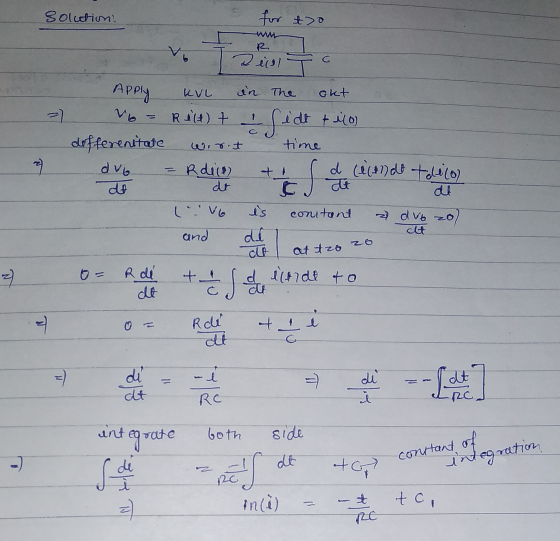
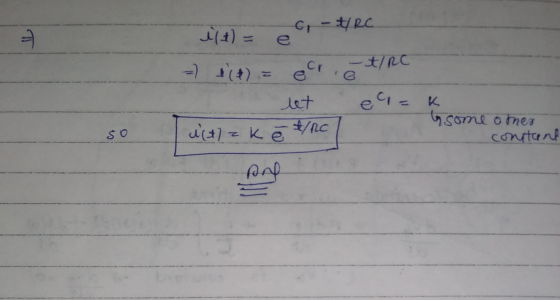
2. Charging a capacitor usually has a circuit with a battery, a resistor and a capacitor all in series The voltage of the resistor is given by Ohm's law VRIR and the voltage across the capacitor is given by Vc. According to Kirchoff's voltage law we have the equation Vb - Va + Vc Vb ㅡ R-+ Integrate the equation to find the charge on the capacitor as...
Please Show all steps in getting to the Solution (Please, thank
you)
2. Charging a capacitor usually has a circuit with a battery, a resistor and a capacitor all in series The voltage of the resistor is given by Ohm's law VRIR and the voltage across the capacitor is given by Vc. According to Kirchoff's voltage law we have the equation Vb - Va + Vc Vb ㅡ R-+ Integrate the equation to find the charge on the capacitor as...
1. A resistor R and capacitor care connected in series with an AC voltage source with...
 1. A resistor R and capacitor care connected in series with an AC voltage source with frequency f and maximum voltage Vo. a. Find the complex impedance (in the form Z = R + jX). If the impedance is written in polar form (Z = Zejº), find expressions for Z and Ⓡ. Write your answers in terms of the variables R, C, and o(= 21f). b. If the voltage source is described by the phasor V = V, ejwt, and...
Problem 2 HE In the given RC circuit, a capacitor is connected to a resistor in...
 Problem 2 HE In the given RC circuit, a capacitor is connected to a resistor in series and is getting charged after closing the Switch. The time constant of the circuit is 10 (s). R = 10° (0) C=? (F) A- Calculate the capacitance of the capacitor. B- How much time does it take for the capacitor to become fully (about 99%) charged? C- If we close the Switch and the capacitor starts getting charged, what is the charge at...
Problem 2 HE In the given RC circuit, a capacitor is connected to a resistor in...
 Problem 2 HE In the given RC circuit, a capacitor is connected to a resistor in series and is getting charged after closing the Switch. The time constant of the circuit is 10 (S). R = 109 (0) C =? (F) A- Calculate the capacitance of the capacitor. B- How much time does it take for the capacitor to become fully (about 99%) charged? C- If we close the Switch and the capacitor starts getting charged, what is the charge...
Problem 2 mA In the given RC circuit, a capacitor is connected to a resistor in...
 Problem 2 mA In the given RC circuit, a capacitor is connected to a resistor in series and is getting charged after closing the Switch. The time constant of the circuit is 10 (S). R = 109 (0) C =? (F) A- Calculate the capacitance of the capacitor. B- How much time does it take for the capacitor to become fully (about 99%) charged? C- If we close the Switch and the capacitor starts getting charged, what is the charge...
What are the Equilibrium voltages of the capacitor and the resistor when the function generator v...
 What are the Equilibrium voltages of the capacitor and the
resistor when the function generator voltage is +v0? Is this what
you observe on your oscilloscope sketches?
what are the equilibrium voltages of the capacitor and the resistor when the function generator voltage is ± you observe on your oscilloscope sketches? ? Is this what An RC circuit consists of a resistor connected to a capacitor. There may also be a fixed power supply, depending on whether the capacitor is...
What are the Equilibrium voltages of the capacitor and the
resistor when the function generator voltage is +v0? Is this what
you observe on your oscilloscope sketches?
what are the equilibrium voltages of the capacitor and the resistor when the function generator voltage is ± you observe on your oscilloscope sketches? ? Is this what An RC circuit consists of a resistor connected to a capacitor. There may also be a fixed power supply, depending on whether the capacitor is...
Answer a, b, c, d A circuit consists of a resistor R connected in series with a capacitor C, as shown in Fig.1 EL Eo Fig 1. The capacitor C is connected in series with the resistor R The equation...
 Answer a, b, c, d
A circuit consists of a resistor R connected in series with a capacitor C, as shown in Fig.1 EL Eo Fig 1. The capacitor C is connected in series with the resistor R The equation which describes this circuit when subject to a step function is given below di 0.3.21-9 dt a) What is the time constant r of this system? b) Assume zero initial condition (0 when r0), find the solution i() of the...
Answer a, b, c, d
A circuit consists of a resistor R connected in series with a capacitor C, as shown in Fig.1 EL Eo Fig 1. The capacitor C is connected in series with the resistor R The equation which describes this circuit when subject to a step function is given below di 0.3.21-9 dt a) What is the time constant r of this system? b) Assume zero initial condition (0 when r0), find the solution i() of the...
A 127 pF capacitor in parallel of a 100k resistor is connected to a voltage source...
A 127 pF capacitor in parallel of a 100k resistor is connected to a voltage source such that vc(t)=12V, t<0. The voltage source is removed when t =0. Calculate the energy stored in the capacitor at t equal to (a) 0 (b) 200 ms
1. A capacitor C has been charged up to potential Vo. At timet0, it is connected...
 1. A capacitor C has been charged up to potential Vo. At timet0, it is connected to a resistor R, and begins to discharge [see figure (a) below] +0 (a) i Determine the charge Q(t) on the capacitor as a function of time. ii. What is the current I(t) through the resistor? iii. Sketch Q(t) and I(t) as a function oft iv. Wha v. By integrating P VI, where P is the power delivered to the circuit and V the...
2) Consider an ac source Vincos(wt + p), a capacitor and a resistor, all connected in...
 2) Consider an ac source Vincos(wt + p), a capacitor and a resistor, all connected in series. IV.nl is the amplitude of the input voltage. Let outc and outur denote the amplitude of voltage across the capacitor and resistor respectively. In this problem we are looking only the steady state response (you! can ignore transients). (a) Derive an expression for the amplitude of voltage across the capacitor divided by the amplitude of the input voltage (b) Assuming that C =...
 Please Show all steps in getting to the Solution (Please, thank
you)
2. Charging a capacitor usually has a circuit with a battery, a resistor and a capacitor all in series The voltage of the resistor is given by Ohm's law VRIR and the voltage across the capacitor is given by Vc. According to Kirchoff's voltage law we have the equation Vb - Va + Vc Vb ㅡ R-+ Integrate the equation to find the charge on the capacitor as...
Please Show all steps in getting to the Solution (Please, thank
you)
2. Charging a capacitor usually has a circuit with a battery, a resistor and a capacitor all in series The voltage of the resistor is given by Ohm's law VRIR and the voltage across the capacitor is given by Vc. According to Kirchoff's voltage law we have the equation Vb - Va + Vc Vb ㅡ R-+ Integrate the equation to find the charge on the capacitor as...
 1. A resistor R and capacitor care connected in series with an AC voltage source with frequency f and maximum voltage Vo. a. Find the complex impedance (in the form Z = R + jX). If the impedance is written in polar form (Z = Zejº), find expressions for Z and Ⓡ. Write your answers in terms of the variables R, C, and o(= 21f). b. If the voltage source is described by the phasor V = V, ejwt, and...
 Problem 2 HE In the given RC circuit, a capacitor is connected to a resistor in series and is getting charged after closing the Switch. The time constant of the circuit is 10 (s). R = 10° (0) C=? (F) A- Calculate the capacitance of the capacitor. B- How much time does it take for the capacitor to become fully (about 99%) charged? C- If we close the Switch and the capacitor starts getting charged, what is the charge at...
 Problem 2 HE In the given RC circuit, a capacitor is connected to a resistor in series and is getting charged after closing the Switch. The time constant of the circuit is 10 (S). R = 109 (0) C =? (F) A- Calculate the capacitance of the capacitor. B- How much time does it take for the capacitor to become fully (about 99%) charged? C- If we close the Switch and the capacitor starts getting charged, what is the charge...
 Problem 2 mA In the given RC circuit, a capacitor is connected to a resistor in series and is getting charged after closing the Switch. The time constant of the circuit is 10 (S). R = 109 (0) C =? (F) A- Calculate the capacitance of the capacitor. B- How much time does it take for the capacitor to become fully (about 99%) charged? C- If we close the Switch and the capacitor starts getting charged, what is the charge...
 What are the Equilibrium voltages of the capacitor and the
resistor when the function generator voltage is +v0? Is this what
you observe on your oscilloscope sketches?
what are the equilibrium voltages of the capacitor and the resistor when the function generator voltage is ± you observe on your oscilloscope sketches? ? Is this what An RC circuit consists of a resistor connected to a capacitor. There may also be a fixed power supply, depending on whether the capacitor is...
What are the Equilibrium voltages of the capacitor and the
resistor when the function generator voltage is +v0? Is this what
you observe on your oscilloscope sketches?
what are the equilibrium voltages of the capacitor and the resistor when the function generator voltage is ± you observe on your oscilloscope sketches? ? Is this what An RC circuit consists of a resistor connected to a capacitor. There may also be a fixed power supply, depending on whether the capacitor is...
 Answer a, b, c, d
A circuit consists of a resistor R connected in series with a capacitor C, as shown in Fig.1 EL Eo Fig 1. The capacitor C is connected in series with the resistor R The equation which describes this circuit when subject to a step function is given below di 0.3.21-9 dt a) What is the time constant r of this system? b) Assume zero initial condition (0 when r0), find the solution i() of the...
Answer a, b, c, d
A circuit consists of a resistor R connected in series with a capacitor C, as shown in Fig.1 EL Eo Fig 1. The capacitor C is connected in series with the resistor R The equation which describes this circuit when subject to a step function is given below di 0.3.21-9 dt a) What is the time constant r of this system? b) Assume zero initial condition (0 when r0), find the solution i() of the...
 1. A capacitor C has been charged up to potential Vo. At timet0, it is connected to a resistor R, and begins to discharge [see figure (a) below] +0 (a) i Determine the charge Q(t) on the capacitor as a function of time. ii. What is the current I(t) through the resistor? iii. Sketch Q(t) and I(t) as a function oft iv. Wha v. By integrating P VI, where P is the power delivered to the circuit and V the...
 2) Consider an ac source Vincos(wt + p), a capacitor and a resistor, all connected in series. IV.nl is the amplitude of the input voltage. Let outc and outur denote the amplitude of voltage across the capacitor and resistor respectively. In this problem we are looking only the steady state response (you! can ignore transients). (a) Derive an expression for the amplitude of voltage across the capacitor divided by the amplitude of the input voltage (b) Assuming that C =...
Most questions answered within 3 hours.
-
Where is the error in this code sequence?
String s1 = "Hello";
String s2 = "ello";...
asked 10 months ago -
Financial data for Joel de Paris, Inc., for last year
follow:
Joel de Paris, Inc.
Balance...
asked 10 months ago -
Consider this reaction:
Al2(SO4)3 (aq)+ BaCl3
(aq) Al2Cl6 (aq)- +
3BaSO4(s) . What is the...
asked 10 months ago -
Suppose that Savneet is considering increasing her
recent random sample from 20 car rentals to 40...
asked 10 months ago -
Trucks arrive at an unloading terminal at an average rate of 120
per hour.
Trucks arrive...
asked 10 months ago -
Why are methanol and ethanol completely soluble in water while
octanol is not very little soluble....
asked 10 months ago -
A facilities manager at a university reads in a research report
that the mean amount of...
asked 10 months ago -
When the CuSO4 is rehydrated by adding water to the anhydrous
compound, is this an endothermic...
asked 10 months ago -
A ray of sunlight is passing from diamond into crown glass; the
angle of incidence is...
asked 10 months ago -
A block of mass 0.249 kg is placed on top of a light, vertical
spring of...
asked 10 months ago -
how do the kidneys compensate in the presences of acidosis
a) trigger hyperventilate
b) reserve acid...
asked 10 months ago -
Question 501 pts
The rental rate of capital to the firm increases. Which of the
following...
asked 10 months ago