
Homework Answers
In case of any query please comment. If you have liked the solution then please THUMBS UP.
Add Answer to:
Question 20 2 pts You are hiking in a forest and come upon a mysterious plant,...
Question 21 2 pts In which of the following taxa does the mature sporophyte depend completely...
 Question 21 2 pts In which of the following taxa does the mature sporophyte depend completely on the gametophyte for nutrition? O Anthophyta O Bryophyta Pterophyta (Psilotopsida) O Gingophyta Lycophyta If a fern gametophyte is a hermaphrodite (that is, has both male and female gametangia on the same plant), then it has antheridia and archegonia combined into a single sex organ. O must be diploid. belongs to a species that is homosporous. has lost the need for a sporophyte generation....
Question 25 3 pts A botanist discovers a new species of plant in a tropical rain...
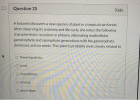 Question 25 3 pts A botanist discovers a new species of plant in a tropical rain forest. After observing its anatomy and life cycle, she notes the following characteristics: no xylem or phloem, alternating multicellular gametophyte and sporophyte generations with the gametophyte dominant, and no seeds. This plant is probably most closely related to O flowering plants. Oferns. O charophytes. O mosses. green algae.
Question 29 2 pts Suppose a new species of plant is discovered in a tropical rainforest....
 Question 29 2 pts Suppose a new species of plant is discovered in a tropical rainforest. Careful observations show the following characteristics: flagellated sperm, xylem with tracheids, separate gametophyte and sporophyte generations with the sporophyte dominant, and no seeds. This plant is probably most closely related to O gymnosperms. O flowering plants. O ferns. O mosses. O charophytes.
Question 2 2 pts While on a walk through a forest, you notice birds in trees,...
 Question 2 2 pts While on a walk through a forest, you notice birds in trees, earthworms in the soil, and fungi on plant litter on the forest floor. Based on your observations, you conclude that each of these organisms occupies a different Biome Ecosystem Biosphere O Habitat
1. When you look at a pine or maple tree, the plant you see is a...
1. When you look at a pine or maple tree, the plant you see is a _____. 2. The Brazil nut tree, Bertholletia excels (n = 17), is native to tropical rain forests of South America. It is a hardwood tree that can grow to over 50 meters tall, is a source of high-quality lumber, and is a favorite nesting site for harpy eagles. As the rainy season ends, tough-walled fruits, each containing 8-25 seeds (Brazil nuts), fall to the...
Question 32 2 pts Which of the following is true of seedless vascular plants? They produce...
 Question 32 2 pts Which of the following is true of seedless vascular plants? They produce many spores, which are really the same as seeds. Sphagnum is an economically and ecologically important example, The gametophyte is the dominant generation Whole forests were dominated by large, seedless vascular plants during the Carboniferous period. O Extant seedless vascular plants are larger than the extinct varieties. If humans had been present to build log structures during the Carboniferous period (they weren't), which plant...
1. Label the microphylls and strobili in the Figure 1 below. Figure 1. Lycopodium sp. Examine...
 1. Label the microphylls and strobili in the Figure 1 below. Figure 1. Lycopodium sp. Examine the prepared slide of a mature Lycopodium strobilus. (See text Figure 17-16, pages 406 and 407.) Note that Lycopodium, like most species in the Lycopodiaceae, is homosperous and only produces one type of spore 2. Label the spores in Figure 2 below. Figure 2. Lycopodium strobilus 1.s. 3. Given that Lycopodium is homosporaus, would you expect its gametophytes to be unisexual or bisexual? Explain...
Question 9 2 pts You are given an organism to identify. It has a fruiting body...
 Question 9 2 pts You are given an organism to identify. It has a fruiting body that contains many structures with eight haploid spores lined up in a row. What kind of a fungus is this? O zygomycete chytrid O ascomycete basidiomycete O deuteromycete Which of the following terms refers to symbiotic relationships that involve fungi living between the cells in plant leaves? O endosymbioses O mycorrhizae O pathogens O lichens O endophytes
2. Hostas are a decorative leafy shade-loving plant. You take pollen from a true-breeding variety called...
 2. Hostas are a decorative leafy shade-loving plant. You take pollen from a true-breeding variety called "Fire and Ice" with leaves that start white then develop green sectors, and purple flowers. The second strain (the female parent) is a true breeding variety called Earth Angel, which has green leaves with golden/yellow leaf centers, and white flowers. "Fire and Ice" "Earth Angel" The F1s all have the golden centered green leaves and pink flowers. Flower colors The F2s come out as...
please answer all 4 questions Question 23 3 pts A plant that is homozygous recessive for...
 please answer all 4 questions
Question 23 3 pts A plant that is homozygous recessive for mangled leaf and prickly fruit (mmpp) is crossed with the double heterozygote (MmPp), resulting in 1047 offspring: 472 with mangled leaves (mP), 453 with prickly fruit (Mp), 63 wild type (MP), and 59 with mangled leaves and prickly fruit (mp). From these data, you can conclude that o The M and P genes are located 11.7 CM apart o The M and P genes...
please answer all 4 questions
Question 23 3 pts A plant that is homozygous recessive for mangled leaf and prickly fruit (mmpp) is crossed with the double heterozygote (MmPp), resulting in 1047 offspring: 472 with mangled leaves (mP), 453 with prickly fruit (Mp), 63 wild type (MP), and 59 with mangled leaves and prickly fruit (mp). From these data, you can conclude that o The M and P genes are located 11.7 CM apart o The M and P genes...
 Question 21 2 pts In which of the following taxa does the mature sporophyte depend completely on the gametophyte for nutrition? O Anthophyta O Bryophyta Pterophyta (Psilotopsida) O Gingophyta Lycophyta If a fern gametophyte is a hermaphrodite (that is, has both male and female gametangia on the same plant), then it has antheridia and archegonia combined into a single sex organ. O must be diploid. belongs to a species that is homosporous. has lost the need for a sporophyte generation....
 Question 25 3 pts A botanist discovers a new species of plant in a tropical rain forest. After observing its anatomy and life cycle, she notes the following characteristics: no xylem or phloem, alternating multicellular gametophyte and sporophyte generations with the gametophyte dominant, and no seeds. This plant is probably most closely related to O flowering plants. Oferns. O charophytes. O mosses. green algae.
 Question 29 2 pts Suppose a new species of plant is discovered in a tropical rainforest. Careful observations show the following characteristics: flagellated sperm, xylem with tracheids, separate gametophyte and sporophyte generations with the sporophyte dominant, and no seeds. This plant is probably most closely related to O gymnosperms. O flowering plants. O ferns. O mosses. O charophytes.
 Question 2 2 pts While on a walk through a forest, you notice birds in trees, earthworms in the soil, and fungi on plant litter on the forest floor. Based on your observations, you conclude that each of these organisms occupies a different Biome Ecosystem Biosphere O Habitat
 Question 32 2 pts Which of the following is true of seedless vascular plants? They produce many spores, which are really the same as seeds. Sphagnum is an economically and ecologically important example, The gametophyte is the dominant generation Whole forests were dominated by large, seedless vascular plants during the Carboniferous period. O Extant seedless vascular plants are larger than the extinct varieties. If humans had been present to build log structures during the Carboniferous period (they weren't), which plant...
 1. Label the microphylls and strobili in the Figure 1 below. Figure 1. Lycopodium sp. Examine the prepared slide of a mature Lycopodium strobilus. (See text Figure 17-16, pages 406 and 407.) Note that Lycopodium, like most species in the Lycopodiaceae, is homosperous and only produces one type of spore 2. Label the spores in Figure 2 below. Figure 2. Lycopodium strobilus 1.s. 3. Given that Lycopodium is homosporaus, would you expect its gametophytes to be unisexual or bisexual? Explain...
 Question 9 2 pts You are given an organism to identify. It has a fruiting body that contains many structures with eight haploid spores lined up in a row. What kind of a fungus is this? O zygomycete chytrid O ascomycete basidiomycete O deuteromycete Which of the following terms refers to symbiotic relationships that involve fungi living between the cells in plant leaves? O endosymbioses O mycorrhizae O pathogens O lichens O endophytes
 2. Hostas are a decorative leafy shade-loving plant. You take pollen from a true-breeding variety called "Fire and Ice" with leaves that start white then develop green sectors, and purple flowers. The second strain (the female parent) is a true breeding variety called Earth Angel, which has green leaves with golden/yellow leaf centers, and white flowers. "Fire and Ice" "Earth Angel" The F1s all have the golden centered green leaves and pink flowers. Flower colors The F2s come out as...
 please answer all 4 questions
Question 23 3 pts A plant that is homozygous recessive for mangled leaf and prickly fruit (mmpp) is crossed with the double heterozygote (MmPp), resulting in 1047 offspring: 472 with mangled leaves (mP), 453 with prickly fruit (Mp), 63 wild type (MP), and 59 with mangled leaves and prickly fruit (mp). From these data, you can conclude that o The M and P genes are located 11.7 CM apart o The M and P genes...
please answer all 4 questions
Question 23 3 pts A plant that is homozygous recessive for mangled leaf and prickly fruit (mmpp) is crossed with the double heterozygote (MmPp), resulting in 1047 offspring: 472 with mangled leaves (mP), 453 with prickly fruit (Mp), 63 wild type (MP), and 59 with mangled leaves and prickly fruit (mp). From these data, you can conclude that o The M and P genes are located 11.7 CM apart o The M and P genes...
Most questions answered within 3 hours.
-
Where is the error in this code sequence?
String s1 = "Hello";
String s2 = "ello";...
asked 11 months ago -
Financial data for Joel de Paris, Inc., for last year
follow:
Joel de Paris, Inc.
Balance...
asked 11 months ago -
Consider this reaction:
Al2(SO4)3 (aq)+ BaCl3
(aq) Al2Cl6 (aq)- +
3BaSO4(s) . What is the...
asked 11 months ago -
Suppose that Savneet is considering increasing her
recent random sample from 20 car rentals to 40...
asked 11 months ago -
Trucks arrive at an unloading terminal at an average rate of 120
per hour.
Trucks arrive...
asked 11 months ago -
Why are methanol and ethanol completely soluble in water while
octanol is not very little soluble....
asked 11 months ago -
A facilities manager at a university reads in a research report
that the mean amount of...
asked 11 months ago -
When the CuSO4 is rehydrated by adding water to the anhydrous
compound, is this an endothermic...
asked 11 months ago -
A ray of sunlight is passing from diamond into crown glass; the
angle of incidence is...
asked 11 months ago -
A block of mass 0.249 kg is placed on top of a light, vertical
spring of...
asked 11 months ago -
how do the kidneys compensate in the presences of acidosis
a) trigger hyperventilate
b) reserve acid...
asked 11 months ago -
Question 501 pts
The rental rate of capital to the firm increases. Which of the
following...
asked 11 months ago