
Homework Answers
Solution: Given differential equation is
 .......(1)
and

assume that a second solution will have the form


putting these values in (1), we get




consider,

we get


By integrating, we get



taking antilog

Substituting back  , we get

integrate both sides
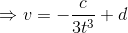
By choosing  , we have

Thus,


Hence the general solution is given by

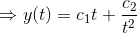
Which is the required solution.
This complete the solution.
The function Y(t) = t is a solution of the differential equation (t2+4)y" - 2ty' + 2y = 0. Find a...
The function Y(t) = t is a solution of the differential equation (t2+4)y" - 2ty' + 2y = 0. Find a real general solution of this equation.
3. Given that yı(t) = t, y(t) = t, and yz(t) = are solutions to the...
 3. Given that yı(t) = t, y(t) = t, and yz(t) = are solutions to the homogeneous differential equation corresponding to ty" + t'y" – 2ty' + 2y = 2*, t > 0, use variation of parameters to find its general solution.
how to use reduction of order to solve nonlinear differential equation? Use reduction of order to...
 how to use reduction of order to solve nonlinear differential
equation?
Use reduction of order to solve nonlinear differential equation (a) y'"+xy"=0) or (b) yy"=(y')? or (c) x’yy"-(y- xy')? =
how to use reduction of order to solve nonlinear differential
equation?
Use reduction of order to solve nonlinear differential equation (a) y'"+xy"=0) or (b) yy"=(y')? or (c) x’yy"-(y- xy')? =
1- Use the Reduction of Order method to find a second solution of the equation 4x2y"...
 1- Use the Reduction of Order method to find a second solution of the equation 4x2y" + y = 0 Given that yı = xì Inx 2- Solve the differential equation y" + 4y + 4y = 0 3- Solve the differential equation y" + 2y + 10y = 0 y” + 5y + 4y = cosx + 2e*
(1 point) Solve y" + 2y' + 2y = 4te* cos(t). 1) Solve the homogeneous part:...
 (1 point) Solve y" + 2y' + 2y = 4te* cos(t). 1) Solve the homogeneous part: y" + 2y' + 2y = 0 for Yh, using a real basis. Note the coded answer is ordered. If your basis is correct and your answer is not accepted, try again with the other ordering. Yn = C1 te^(-+)*cost +C2 te^(-t)*cost 2) Compute the particular solution y, via complexifying the differential equation: Note that the forcing et cos(t) = Re(el-1+i)t). You will solve...
(1 point) Solve y" + 2y + 2y = 4te-t cos(t). 1) Solve the homogeneous part:...
 (1 point) Solve y" + 2y + 2y = 4te-t cos(t). 1) Solve the homogeneous part: y' + 2y + 2y = 0 for Yh, using a real basis. Note the coded answer is ordered. If your basis is correct and your answer is not accepted, try again with the other ordering. Yn = C1 e^(-t)sin(t) +C2 e^(-t)cos(t) . 2) Compute the particular solution yp via complexifying the differential equation: Note that the forcing e * cos(t) = Re(el 1+i)t)....
Find the solution y of the initial value problem 3"(t) = 2 (3(t). y(1) = 0,...
 Find the solution y of the initial value problem 3"(t) = 2 (3(t). y(1) = 0, y' (1) = 1. +3 g(t) = M Solve the initial value problem g(t) g” (t) + 50g (+)? = 0, y(0) = 1, y'(0) = 7. g(t) = Σ Use the reduction order method to find a second solution ya to the differential equation ty" + 12ty' +28 y = 0. knowing that the function yı(t) = + 4 is solution to that...
3. Consider the differential equation ty" - (t+1)y + y = t?e?', t>0. (a) Find a...
 3. Consider the differential equation ty" - (t+1)y + y = t?e?', t>0. (a) Find a value ofr for which y = et is a solution to the corresponding homogeneous differential equation. (b) Use Reduction of Order to find a second, linearly independent, solution to the correspond- ing homogeneous differential equation. (c) Use Variation of Parameters to find a particular solution to the nonhomogeneous differ- ential equation and then give the general solution to the differential equation.
3. Consider the differential equation ty" - (t+1)yy = te2, t> 0. ert is a solution...
 3. Consider the differential equation ty" - (t+1)yy = te2, t> 0. ert is a solution to the corresponding homogeneous (a) Find a value of r for which y = differential equation (b) Use Reduction of Order to find a second, linearly independent, solution to the correspond- ing homogeneous differential equation
please states whaere the answer is . (1 point) Solve y" + 2y + 2y =...
 please states whaere the answer is .
(1 point) Solve y" + 2y + 2y = 4te-cos(t). 1) Solve the homogeneous part: y" + 2y + 2y = 0 for yo, using a real basis. Note the coded answer is ordered. If your basis is correct and your answer is not accepted, try again with the other ordering. Yn = 0^-t)cos( + e^(-t)sin((3 - 2) Compute the particular solution y, via complexifying the differential equation: Note that the forcing e...
please states whaere the answer is .
(1 point) Solve y" + 2y + 2y = 4te-cos(t). 1) Solve the homogeneous part: y" + 2y + 2y = 0 for yo, using a real basis. Note the coded answer is ordered. If your basis is correct and your answer is not accepted, try again with the other ordering. Yn = 0^-t)cos( + e^(-t)sin((3 - 2) Compute the particular solution y, via complexifying the differential equation: Note that the forcing e...
 3. Given that yı(t) = t, y(t) = t, and yz(t) = are solutions to the homogeneous differential equation corresponding to ty" + t'y" – 2ty' + 2y = 2*, t > 0, use variation of parameters to find its general solution.
 how to use reduction of order to solve nonlinear differential
equation?
Use reduction of order to solve nonlinear differential equation (a) y'"+xy"=0) or (b) yy"=(y')? or (c) x’yy"-(y- xy')? =
how to use reduction of order to solve nonlinear differential
equation?
Use reduction of order to solve nonlinear differential equation (a) y'"+xy"=0) or (b) yy"=(y')? or (c) x’yy"-(y- xy')? =
 1- Use the Reduction of Order method to find a second solution of the equation 4x2y" + y = 0 Given that yı = xì Inx 2- Solve the differential equation y" + 4y + 4y = 0 3- Solve the differential equation y" + 2y + 10y = 0 y” + 5y + 4y = cosx + 2e*
 (1 point) Solve y" + 2y' + 2y = 4te* cos(t). 1) Solve the homogeneous part: y" + 2y' + 2y = 0 for Yh, using a real basis. Note the coded answer is ordered. If your basis is correct and your answer is not accepted, try again with the other ordering. Yn = C1 te^(-+)*cost +C2 te^(-t)*cost 2) Compute the particular solution y, via complexifying the differential equation: Note that the forcing et cos(t) = Re(el-1+i)t). You will solve...
 (1 point) Solve y" + 2y + 2y = 4te-t cos(t). 1) Solve the homogeneous part: y' + 2y + 2y = 0 for Yh, using a real basis. Note the coded answer is ordered. If your basis is correct and your answer is not accepted, try again with the other ordering. Yn = C1 e^(-t)sin(t) +C2 e^(-t)cos(t) . 2) Compute the particular solution yp via complexifying the differential equation: Note that the forcing e * cos(t) = Re(el 1+i)t)....
 Find the solution y of the initial value problem 3"(t) = 2 (3(t). y(1) = 0, y' (1) = 1. +3 g(t) = M Solve the initial value problem g(t) g” (t) + 50g (+)? = 0, y(0) = 1, y'(0) = 7. g(t) = Σ Use the reduction order method to find a second solution ya to the differential equation ty" + 12ty' +28 y = 0. knowing that the function yı(t) = + 4 is solution to that...
 3. Consider the differential equation ty" - (t+1)y + y = t?e?', t>0. (a) Find a value ofr for which y = et is a solution to the corresponding homogeneous differential equation. (b) Use Reduction of Order to find a second, linearly independent, solution to the correspond- ing homogeneous differential equation. (c) Use Variation of Parameters to find a particular solution to the nonhomogeneous differ- ential equation and then give the general solution to the differential equation.
 3. Consider the differential equation ty" - (t+1)yy = te2, t> 0. ert is a solution to the corresponding homogeneous (a) Find a value of r for which y = differential equation (b) Use Reduction of Order to find a second, linearly independent, solution to the correspond- ing homogeneous differential equation
 please states whaere the answer is .
(1 point) Solve y" + 2y + 2y = 4te-cos(t). 1) Solve the homogeneous part: y" + 2y + 2y = 0 for yo, using a real basis. Note the coded answer is ordered. If your basis is correct and your answer is not accepted, try again with the other ordering. Yn = 0^-t)cos( + e^(-t)sin((3 - 2) Compute the particular solution y, via complexifying the differential equation: Note that the forcing e...
please states whaere the answer is .
(1 point) Solve y" + 2y + 2y = 4te-cos(t). 1) Solve the homogeneous part: y" + 2y + 2y = 0 for yo, using a real basis. Note the coded answer is ordered. If your basis is correct and your answer is not accepted, try again with the other ordering. Yn = 0^-t)cos( + e^(-t)sin((3 - 2) Compute the particular solution y, via complexifying the differential equation: Note that the forcing e...
Most questions answered within 3 hours.
-
Where is the error in this code sequence?
String s1 = "Hello";
String s2 = "ello";...
asked 11 months ago -
Financial data for Joel de Paris, Inc., for last year
follow:
Joel de Paris, Inc.
Balance...
asked 11 months ago -
Consider this reaction:
Al2(SO4)3 (aq)+ BaCl3
(aq) Al2Cl6 (aq)- +
3BaSO4(s) . What is the...
asked 11 months ago -
Suppose that Savneet is considering increasing her
recent random sample from 20 car rentals to 40...
asked 11 months ago -
Trucks arrive at an unloading terminal at an average rate of 120
per hour.
Trucks arrive...
asked 11 months ago -
Why are methanol and ethanol completely soluble in water while
octanol is not very little soluble....
asked 11 months ago -
A facilities manager at a university reads in a research report
that the mean amount of...
asked 11 months ago -
When the CuSO4 is rehydrated by adding water to the anhydrous
compound, is this an endothermic...
asked 11 months ago -
A ray of sunlight is passing from diamond into crown glass; the
angle of incidence is...
asked 11 months ago -
A block of mass 0.249 kg is placed on top of a light, vertical
spring of...
asked 11 months ago -
how do the kidneys compensate in the presences of acidosis
a) trigger hyperventilate
b) reserve acid...
asked 11 months ago -
Question 501 pts
The rental rate of capital to the firm increases. Which of the
following...
asked 11 months ago