Please print please
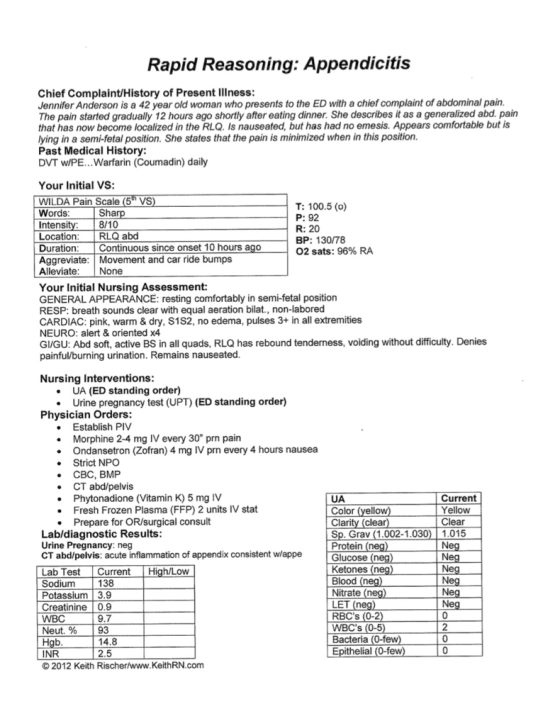
1. What intervention will you initiate based on this priority?
- Pain management
- Fever management
- Preparation for surgery to avoid complications
|
Nursing Interventions |
Rationale |
Expected Outcome |
|
1. |
1. |
1. |
|
2. |
2. |
2. |
|
3. |
3. |
3. |
|
4. |
4. |
4. |
2. What can you do to engage yourself with this patient’s experience, and show that they matter to you as a person?
Homework Answers
| Diagnosis | Nursing interventions (Pain management) | Rationale | expected ooutcome |
| pain related to appendicitis as evidenced by the patient reactions | assess the level of pain experienced by the patient | this will help us to identify and prioritise the care | pain is reduced to some extent as evidenced by the patients facial expressions. |
| provide a comfortable semi fowlers position itself | this will help them to alleviate the pain | ||
| provide a calm environment to the patient | this will help the patient to have a good sleep and can reduce the level of pain | ||
| provide medications like pain killers / | this will help the patient to alleviate the pain | ||
| take the patient to surgery | this will help to come out of the pain |
| diagnosis | fever management | rationale | expected outcome |
| Hyperthermia related to disease condition as evidenced by the patient temperature is 100degree | assess the temeprture level of the patient | this will help us to get an idea about the care that is to be given for the patient. | Patient'sd temperature will be decreased to normal |
| encourage the patient to take lot of oral fluid | this will help him to prevent dehydration. | ||
| provide a comfortable position to the patient | help the patient to take rest | ||
| do not cover the patient with balnket | covering with blanket will increase the body temperature. | ||
| provide medications to the patient like antipyretic medications | this will help to reduce the temperture |
preparation for surgery to avoid complications
- get a detailed history about the patient to have an underline knowledge about the patient
- do a complete physical assessment of the patient to know the exact location of pain a
- check with the partientregarding the severity of pain
- ask about the patients allergic history
- if anything is there, it should be noted immediately
- explain about the surgical procedure to be carried out
- ask the patient to be nil per oral before night itself to prevent complications during the surgery.
- provide premedications needed for the surgery
- on the day of the surgery make the patient to wear the OT gown and clean the area with betadine
- get an informed consent from the patient regarding the procedure
- take all the necessary documents like x-ray, USG while the patient is shifted to operation theatre.
2. To make them feel that we consider them as persons, first of all, we should develop a good interpersonal relationship with the patient and make them feel that they are important to them.
always listen to them about their doubts and anxieties.
provide clear proper explanation to the patient
before doing any procedure on the patient always give a proper information about each and every procedure.
enquire about their culture, customs and beliefs etc to the patient, so that they feel that we are giving comprehensive care to the patient.
always try to respect and fulfill their needs
These are the things that can be done to make them feel that we consider them as person rather than patient
Add Answer to:
Please print please
1. What intervention will you initiate based on this
priority?
Pain management
Fever...
develop a care plan for a patient that has a Clostridium difficile Colitis. Please use the provided format for building...
develop a care plan for a patient that has a Clostridium difficile Colitis. Please use the provided format for building your care plan. You will need to use your nursing reference materials as you build this care plan. Mindy Perkins is a 48 year old woman who presents to the ED with 10-15 loose, liquid stools daily for the past 2 days. She completed a course of oral Amoxacillin seven days ago for a dental infection. In addition to loose...
Care Plan Map Mr. TM is a 71year old admitted to room H-523 with a GI Bleed. VS= B/P 100/60 TPR= 37°C 100- 20. Pulse Ox=...
Care Plan Map Mr. TM is a 71year old admitted to room H-523 with a GI Bleed. VS= B/P 100/60 TPR= 37°C 100- 20. Pulse Ox= 96% RA. Pain 7/10 c/o abdominal discomfort. Color pale, skin warm & dry. Braden = 21. A & O x 4, PERRLA, MAE x 4. Hand grip = & weak. Unsteady gait when ambulating. Needs assistance of 1. Denies numbness or tingling to extremities. Lungs clear vesicular sounds. No cough. PPP x 4 @...
Concept Map Twenty-five year old Mr. B is admitted to room 12A recurrent Tonsillitis. B/P= 111/78....
Concept Map Twenty-five year old Mr. B is admitted to room 12A recurrent Tonsillitis. B/P= 111/78. TPR= 38.4 ° C-108-22. Allergies=Penicillin (rash). Pt. c/o throat and ear pain 9/10 and swollen glands in jaw area. Pulse Ox 97% on room air. Respirations easy and unlabored. A & O x 4. States ↑ throat discomfort when speaking and inability to eat/swallow food or fluids for the past 48 hours. Tonsils moderately enlarged and reddened bilaterally, not obstructing airway. Halitosis noted. Color...
II. Nurse Collected Clinical Data: Current VS: T: 100.5 (oral) P: 110 (regular WILDA Pain Assessment...
 II. Nurse Collected Clinical Data: Current VS: T: 100.5 (oral) P: 110 (regular WILDA Pain Assessment (s" vs) Words: Intensity: 610 Location: RUQepigastric Duration: Continuous Ache BP: 12888 0 2 sat: 95% RA | Aggravate: Nothing Alleviate: Nothing Orthostatic BP's: Position: HR: BP: Standing What VS data is RELEVANT that must be recognized as clinically significant? 110 128/88 132 124/80 RELEVANT VS Data: Clinical Significance: Current Assessment: GENERAL Appears uncomfortable APPEARANCE: Breath sounds clear with equal acration bilaterally, nonlabored respiratory...
#1. Case Study Millie Larson is an 80 year old widow being seen in the Emergency...
#1. Case Study Millie Larson is an 80 year old widow being seen in the Emergency Room. She complains that she hasn’t been feeling well the past few days. Your RN assessment is as follows: Chief complaint—“decreased appetite, not sleeping well, fatigue, abdominal pain off and on, constipation.” Past medical History: Hypertension, Atrial Fibrillation (A-fib), osteoporosis, anemia, Past Surgical History: Appendectomy, C-section x 2 Home Medications: Aspirin 81 mg daily, Metoprolol 100 mg daily, Oxycodone 5 mg q 4 hrs...
Chapter 8—Intrapartum assessment and interventions As the nurse, you admit Margarite Sanchez to the labor and...
Chapter 8—Intrapartum assessment and interventions As the nurse, you admit Margarite Sanchez to the labor and delivery unit. She arrived in the triage unit at midnight in early labor. She presented with uterine contractions that were 5 minutes apart for 3 hours. The patient is a 28-year-old G3 P1011 Hispanic woman. She is at 39 weeks’ gestation. José, her husband, has accompanied her to the unit. Two years ago, she had a normal spontaneous vaginal delivery after an 18-hour labor...
Divya Shetty Scenario Details: Patient data: Female – Age 26 years (Feb. 11, 1994). Weight 58...
Divya Shetty Scenario Details: Patient data: Female – Age 26 years (Feb. 11, 1994). Weight 58 kg (128 lbs). Height: 167.64 cm (5’5) Allergies: Seasonal allergies Prior Medical History: Two previous pregnancies. The first pregnancy was a spontaneous abortion at 8 weeks, and the second pregnancy was three years ago with spontaneous vaginal delivery of a healthy baby girl. During that pregnancy, she was hospitalized several times for IV and antiemetic therapy until week 20. Divya was taking prenatal vitamins,...
The nurse is counseling a client with a poor appetite and weight loss. Which priority intervention...
The nurse is counseling a client with a poor appetite and weight loss. Which priority intervention should the nurse recommend? Eat your favorite foods to get additional calories, no matter what they are. Consume high protein, high-calorie replacement drinks between meals. Take a daily vitamin. Eat 6 small meals each day. A client is prescribed a diet that can be advanced as tolerated. How does the nurse recognize that the client is ready to be started on regular food? Select...
This is a very important assignment, I need help with it is either failing or passing...
This is a very important assignment, I need help with it is either failing or passing assignment please if you are not sure about your answer do not respond, I need answers typed, please. Learning Outcomes By the end of this assignment, the student will: Document focused body system assessments correctly and accurately. (35% of grade) Document interventions correctly and accurately. (35% of grade) Demonstrate integration of clinical reasoning within documentation. (15% of grade) Demonstrate accurate implementation of the nursing...
Post-op Pain Management: Day of Surgery (1/2) History of Present Problem: Sheila Dalton is a 52-ver-old...
 Post-op Pain Management: Day of Surgery (1/2) History of Present Problem: Sheila Dalton is a 52-ver-old woman who has a history of chronic low back pain and COPD. She had a posterior spinal fusion of L4S1 today. She had an estimated blood loss (EBL) 675 ml during surgery and received 2500 mL of Lactated Ringers (LR) Paimis currently controlled at 2 10 and increases with movement. She was started on a hydromorphone patient-controlled analgesia (PCA) with IV bolus dose of...
 II. Nurse Collected Clinical Data: Current VS: T: 100.5 (oral) P: 110 (regular WILDA Pain Assessment (s" vs) Words: Intensity: 610 Location: RUQepigastric Duration: Continuous Ache BP: 12888 0 2 sat: 95% RA | Aggravate: Nothing Alleviate: Nothing Orthostatic BP's: Position: HR: BP: Standing What VS data is RELEVANT that must be recognized as clinically significant? 110 128/88 132 124/80 RELEVANT VS Data: Clinical Significance: Current Assessment: GENERAL Appears uncomfortable APPEARANCE: Breath sounds clear with equal acration bilaterally, nonlabored respiratory...
 Post-op Pain Management: Day of Surgery (1/2) History of Present Problem: Sheila Dalton is a 52-ver-old woman who has a history of chronic low back pain and COPD. She had a posterior spinal fusion of L4S1 today. She had an estimated blood loss (EBL) 675 ml during surgery and received 2500 mL of Lactated Ringers (LR) Paimis currently controlled at 2 10 and increases with movement. She was started on a hydromorphone patient-controlled analgesia (PCA) with IV bolus dose of...
Most questions answered within 3 hours.
-
Where is the error in this code sequence?
String s1 = "Hello";
String s2 = "ello";...
asked 10 months ago -
Financial data for Joel de Paris, Inc., for last year
follow:
Joel de Paris, Inc.
Balance...
asked 10 months ago -
Consider this reaction:
Al2(SO4)3 (aq)+ BaCl3
(aq) Al2Cl6 (aq)- +
3BaSO4(s) . What is the...
asked 10 months ago -
Suppose that Savneet is considering increasing her
recent random sample from 20 car rentals to 40...
asked 10 months ago -
Trucks arrive at an unloading terminal at an average rate of 120
per hour.
Trucks arrive...
asked 10 months ago -
Why are methanol and ethanol completely soluble in water while
octanol is not very little soluble....
asked 10 months ago -
A facilities manager at a university reads in a research report
that the mean amount of...
asked 10 months ago -
When the CuSO4 is rehydrated by adding water to the anhydrous
compound, is this an endothermic...
asked 10 months ago -
A ray of sunlight is passing from diamond into crown glass; the
angle of incidence is...
asked 10 months ago -
A block of mass 0.249 kg is placed on top of a light, vertical
spring of...
asked 10 months ago -
how do the kidneys compensate in the presences of acidosis
a) trigger hyperventilate
b) reserve acid...
asked 10 months ago -
Question 501 pts
The rental rate of capital to the firm increases. Which of the
following...
asked 10 months ago