Equilibrium and Le Chatelier Principle
Homework Answers
Request Answer!
We need at least 10 more requests to produce the answer.
0 / 10 have requested this problem solution
The more requests, the faster the answer.
Add Answer to:
Equilibrium and Le Chatelier Principle
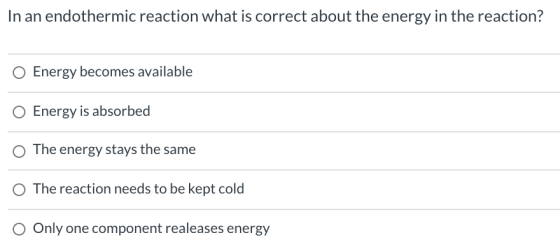
In an endothermic reaction what is correct about the energy in...
8. According to Le Chatelier, adding heat to an endothermic equilibrium reaction will cause: (A) No...
 8. According to Le Chatelier, adding heat to an endothermic equilibrium reaction will cause: (A) No change (B) Products to form (C) Reactants to form 9. At a given temperature, Kc = 3.0 for the hypothetical reaction, A(g) +B(g) = C(g) If [A] = 2.0 M, [B] = 1.5 M, and [C]=9.0 M, is the reaction at equilibrium? If not, which way will it go? (A) No, to the left (B) No, to the right (C) It is at equilibrium...
Equilibrium and Le Chatelier Principle According to Le Chatelier's principle: What is going to happen to...
 Equilibrium and Le Chatelier Principle
According to Le Chatelier's principle: What is going to happen to the color if you add more CuCl42- and why? The Kc is the equilibrium constant, the large the number the more product is favored. System 1: Cu²+(aq) + 4C1 (aq) = CuC142-(aq) Blue/Green Green/Yellow Kc or lc [CuCl2-] [Cu2+][C1-]4 O It will turn more Blue/Green and since you are adding extra chlorine ion O It will turn more Green/Yellow and since you are adding...
Equilibrium and Le Chatelier Principle
According to Le Chatelier's principle: What is going to happen to the color if you add more CuCl42- and why? The Kc is the equilibrium constant, the large the number the more product is favored. System 1: Cu²+(aq) + 4C1 (aq) = CuC142-(aq) Blue/Green Green/Yellow Kc or lc [CuCl2-] [Cu2+][C1-]4 O It will turn more Blue/Green and since you are adding extra chlorine ion O It will turn more Green/Yellow and since you are adding...
Given the equilibrium reaction for a general reaction, A+B <->C, explain what happens to the reactants...
 Given the equilibrium reaction for a general reaction, A+B <->C, explain what happens to the reactants and products from time until the time at which the A reaction reaches equilibrium. (Choose any that are correct) Concentration (mol.dm-3) B С Time (s) Once products are formed in a reversible reaction, reactans can not be formed At equilibrium both the reactant and product concentration are the same At time 0, there are no products. At equilibrium all concentrations become constant As the...
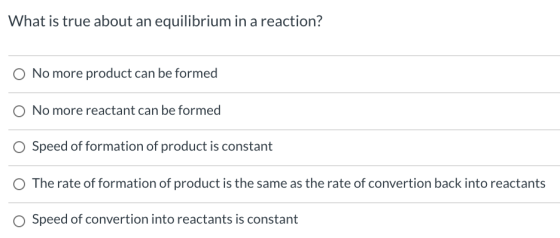
iun ntu teactants 13 constant O The rate of format ion of product is the same...
 iun ntu teactants 13 constant O The rate of format ion of product is the same as the rate of convertion back into reac QUESTION 2 In an endothermic reaction what is correct about the energy in the reaction? O The reaction needs to be kept cold O only one component realeases energy O Energy becomes available O Energy is absorbed O The energy stays the same QUESTION 3 Click Save and Submit to save and submit. Click Save All...
2. If the reaction between iron(III) ion and thiocyanate ion yielded an equilibrium concentration of 0.30...
 2. If the reaction between iron(III) ion and thiocyanate ion yielded an equilibrium concentration of 0.30 M for each of these ions, what is the equilibrium concentration of the red iron(III)-thiocyanate complex? (Hint: The equilibrium constant for the reaction is in the Background section.) Show your work 3. In the reaction below, NH3(g) + H2O(1) - NH; +H30+ the equilibrium constant is 10-34. Is this reaction likely to take place? Explain your answer. iron(III) and thiocyanate ions, the equilibrium expression...
Question 1 a) According to Le Châtelier’s Principle, for an endothermic reaction at equilibrium, what will...
Question 1 a) According to Le Châtelier’s Principle, for an endothermic reaction at equilibrium, what will happen if a reaction product is removed?
Model 1 - Potential Energy Diagrams 1) The energy (enthalpy) change of a reaction can be...
 Model 1 - Potential Energy Diagrams 1) The energy (enthalpy) change of a reaction can be determined by the following expression: Activated Complex Transition State AH = Energy products - Energy reactants Activation Energy, E Reactants Consider the energy change for the reaction in Model 1 (the graph to the left). Potential Energy (kJ/mol) Energy change (AH) Products a) The energy change shown is (positive/negative). b) This reaction is (endothermic / exothermic). c) These (reactants / transition state) has more...
If the reaction A + B → C has an equilibrium constant of 10-6. Which of...
If the reaction A + B → C has an equilibrium constant of 10-6. Which of the following statements are necessarily true? Make sure to select all of the correct responses At equilibrium there will be more products than reactants At equilibrium there will be more reactants than products the reaction is spontaneous the reaction is not spontaneous The reaction is fast The reaction is slow The chemical potential energy of the products is greater than that of the reactants...
In general, what can one say about the total potential energy in the products versus reactants for an endothermic reacti...
In general, what can one say about the total potential energy in the products versus reactants for an endothermic reaction? Exothermic reaction?
At a given temperature, the equilibrium constant for a certain reaction is 1 X 10¹⁴. Does...
 At a given temperature, the equilibrium constant for a certain reaction is 1 X 10¹⁴. Does this equilibrium favor products or reactants? Why? Select the single best answer. A very high value for the equilbrium constant favors product formation. O O Significant concentrations of both products and reactants are present at equilibrium. A very high value for the equilbrium constant favors reactant formation. A very low value for the equilibrium constant favors reactant formation. A very low value for the...
 8. According to Le Chatelier, adding heat to an endothermic equilibrium reaction will cause: (A) No change (B) Products to form (C) Reactants to form 9. At a given temperature, Kc = 3.0 for the hypothetical reaction, A(g) +B(g) = C(g) If [A] = 2.0 M, [B] = 1.5 M, and [C]=9.0 M, is the reaction at equilibrium? If not, which way will it go? (A) No, to the left (B) No, to the right (C) It is at equilibrium...
 Equilibrium and Le Chatelier Principle
According to Le Chatelier's principle: What is going to happen to the color if you add more CuCl42- and why? The Kc is the equilibrium constant, the large the number the more product is favored. System 1: Cu²+(aq) + 4C1 (aq) = CuC142-(aq) Blue/Green Green/Yellow Kc or lc [CuCl2-] [Cu2+][C1-]4 O It will turn more Blue/Green and since you are adding extra chlorine ion O It will turn more Green/Yellow and since you are adding...
Equilibrium and Le Chatelier Principle
According to Le Chatelier's principle: What is going to happen to the color if you add more CuCl42- and why? The Kc is the equilibrium constant, the large the number the more product is favored. System 1: Cu²+(aq) + 4C1 (aq) = CuC142-(aq) Blue/Green Green/Yellow Kc or lc [CuCl2-] [Cu2+][C1-]4 O It will turn more Blue/Green and since you are adding extra chlorine ion O It will turn more Green/Yellow and since you are adding...
 Given the equilibrium reaction for a general reaction, A+B <->C, explain what happens to the reactants and products from time until the time at which the A reaction reaches equilibrium. (Choose any that are correct) Concentration (mol.dm-3) B С Time (s) Once products are formed in a reversible reaction, reactans can not be formed At equilibrium both the reactant and product concentration are the same At time 0, there are no products. At equilibrium all concentrations become constant As the...
 iun ntu teactants 13 constant O The rate of format ion of product is the same as the rate of convertion back into reac QUESTION 2 In an endothermic reaction what is correct about the energy in the reaction? O The reaction needs to be kept cold O only one component realeases energy O Energy becomes available O Energy is absorbed O The energy stays the same QUESTION 3 Click Save and Submit to save and submit. Click Save All...
 2. If the reaction between iron(III) ion and thiocyanate ion yielded an equilibrium concentration of 0.30 M for each of these ions, what is the equilibrium concentration of the red iron(III)-thiocyanate complex? (Hint: The equilibrium constant for the reaction is in the Background section.) Show your work 3. In the reaction below, NH3(g) + H2O(1) - NH; +H30+ the equilibrium constant is 10-34. Is this reaction likely to take place? Explain your answer. iron(III) and thiocyanate ions, the equilibrium expression...
 Model 1 - Potential Energy Diagrams 1) The energy (enthalpy) change of a reaction can be determined by the following expression: Activated Complex Transition State AH = Energy products - Energy reactants Activation Energy, E Reactants Consider the energy change for the reaction in Model 1 (the graph to the left). Potential Energy (kJ/mol) Energy change (AH) Products a) The energy change shown is (positive/negative). b) This reaction is (endothermic / exothermic). c) These (reactants / transition state) has more...
 At a given temperature, the equilibrium constant for a certain reaction is 1 X 10¹⁴. Does this equilibrium favor products or reactants? Why? Select the single best answer. A very high value for the equilbrium constant favors product formation. O O Significant concentrations of both products and reactants are present at equilibrium. A very high value for the equilbrium constant favors reactant formation. A very low value for the equilibrium constant favors reactant formation. A very low value for the...
Most questions answered within 3 hours.
-
Where is the error in this code sequence?
String s1 = "Hello";
String s2 = "ello";...
asked 10 months ago -
Financial data for Joel de Paris, Inc., for last year
follow:
Joel de Paris, Inc.
Balance...
asked 10 months ago -
Consider this reaction:
Al2(SO4)3 (aq)+ BaCl3
(aq) Al2Cl6 (aq)- +
3BaSO4(s) . What is the...
asked 10 months ago -
Suppose that Savneet is considering increasing her
recent random sample from 20 car rentals to 40...
asked 10 months ago -
Trucks arrive at an unloading terminal at an average rate of 120
per hour.
Trucks arrive...
asked 10 months ago -
Why are methanol and ethanol completely soluble in water while
octanol is not very little soluble....
asked 10 months ago -
A facilities manager at a university reads in a research report
that the mean amount of...
asked 10 months ago -
When the CuSO4 is rehydrated by adding water to the anhydrous
compound, is this an endothermic...
asked 10 months ago -
A ray of sunlight is passing from diamond into crown glass; the
angle of incidence is...
asked 10 months ago -
A block of mass 0.249 kg is placed on top of a light, vertical
spring of...
asked 10 months ago -
how do the kidneys compensate in the presences of acidosis
a) trigger hyperventilate
b) reserve acid...
asked 10 months ago -
Question 501 pts
The rental rate of capital to the firm increases. Which of the
following...
asked 10 months ago