
Homework Answers
Add Answer to:
Identify the transfer function 10/; of the RL circuit shown below. Express the transfer function using...
Identify the transfer function 10/; of the RL circuit shown below. Express the transfer function using...
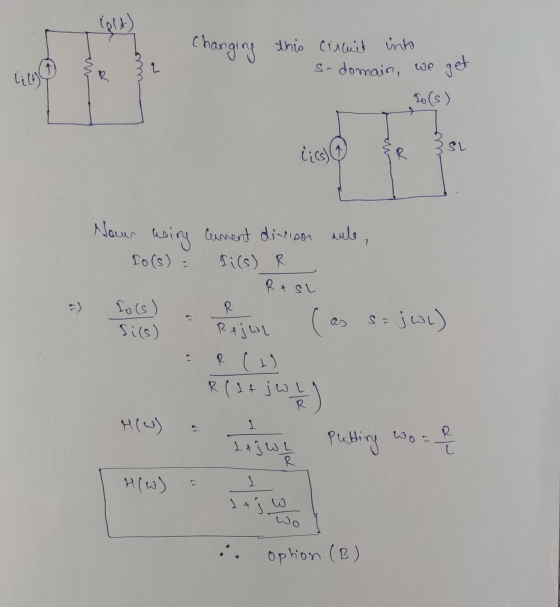
 Identify the transfer function 10/; of the RL circuit shown below. Express the transfer function using Wo= RIL. i(t) R ele L O H (@) II = WO j + 1 O H(@) = 1+ Wo O H (0) jo 1+ W0 1 O H(0) = 00 1+.
Identify the transfer function / of the RL circuit shown below. Express the transfer function using...
 Identify the transfer function / of the RL circuit shown below. Express the transfer function using w.= RIL. i.lt i(t) R ell L OH(W) ith 1+ 1 O HW) it O HW) الناز 1+ WO OH(W) 1+1
Find the transfer function H(jω) for the circuit above as a function of jω. (Leave R...
 Find the transfer function H(jω) for the
circuit above as a function of jω. (Leave R and L as variables).
Assume V R to be the output and V S to be the input.
С L RVR(t) vs (t) A. Find the transfer function H(jo) for the circuit above as a function of jaw. (Leave R and L as variables). Assume V to be the output and V to be the input. S R B. Find the Magnitude and Phase...
Find the transfer function H(jω) for the
circuit above as a function of jω. (Leave R and L as variables).
Assume V R to be the output and V S to be the input.
С L RVR(t) vs (t) A. Find the transfer function H(jo) for the circuit above as a function of jaw. (Leave R and L as variables). Assume V to be the output and V to be the input. S R B. Find the Magnitude and Phase...
Pre-Laboratory Task 4: Derive an expression for the magnitude of the transfer function, H(Go)Vout(jo)/Wn(j, and the phase of the transfer function LH (ja) for the LCR circuit in Figure 4. Plot H(ja)l...
 Pre-Laboratory Task 4: Derive an expression for the magnitude of the transfer function, H(Go)Vout(jo)/Wn(j, and the phase of the transfer function LH (ja) for the LCR circuit in Figure 4. Plot H(ja)l and H(jo) vs. frequency (o) in the form of a Bode plot indicating the damping frequency and the value of |H(jo)| at the damping frequency. Also determine the 3dB frequency and the roll off rate for Ir(ja)1 when ω > ω3dB. Vounlius R 470Ω C 100 nF Figure...
Consider a causal LTI system implemented as the RL circuit shown below. In this circuit, v(t)...
 Consider a causal LTI system implemented as the RL circuit shown below. In this circuit, v(t) is the input voltage. The current i(t) is considered the system output. i(t) R L wwwm v(t) (a) Find the differential equation relating v(t) and i(t). (b) Determine the frequency response of this system (H(jw)). (c) Determine the output it) if v(t) = sin(t), R=10 and L=1. (d) Sketch Bode plot of H (jw) for R=10 and L=1. (e) Determine if the system is...
Problem 2: /25 For the circuit shown below, use frequency-domain circuit analysis techniques to determine (a)...
 Problem 2: /25 For the circuit shown below, use frequency-domain circuit analysis techniques to determine (a) the voltage transfer function H(o) of the circuit; (b) the magnitude response H(o) of the circuit; and (c) the phase response (0) of the circuit. (d) Based on the results of parts (a) - (c), identify the type of filter circuit shown. L 10000 + + R Vout(t)
Question 1 For the circuit shown in figure 1; i. Find the transfer impedance function, H(s)...
 Question 1 For the circuit shown in figure 1; i. Find the transfer impedance function, H(s) = Vds(s) Find the poles and zeros for this transfer function and plot them on the s - Find the magnitude of the transfer function in decibels. [10] s-plane [8] ii [3] 2H 20 20 2 H Figure Question 2 The hybrid parameters (h-parameters) for the two -port network circuit in figure 2 are; 5 h=2 0.05 Find the equivalent impedance parameters (z-parameters) Find...
Problem 1: /25 For the circuit shown below, use frequency-domain circuit analysis techniques to determine (a)...
 Problem 1: /25 For the circuit shown below, use frequency-domain circuit analysis techniques to determine (a) the voltage transfer function Ho) of the circuit; (b) the magnitude response H(o) of the circuit; and (c) the phase response (0) of the circuit. (d) Based on the results of parts (a) - (c), identify the type of filter circuit shown. R + Vin(t) llll L Vout(t)
Problem 4: /25 For the circuit shown below, use frequency-domain circuit analysis techniques to determine (a)...
 Problem 4: /25 For the circuit shown below, use frequency-domain circuit analysis techniques to determine (a) the voltage transfer function Hw) of the circuit; (b) the magnitude response H(o) of the circuit; and (c) the phase response (0) of the circuit. (d) Based on the results of parts (a) - (c), identify the type of filter circuit shown. R L 10000 + + Vout(t)
As shown in the figure, a simple RL circuit (L = 1H) is powered by a...
 As shown in the figure, a simple RL circuit (L = 1H) is powered by a 10 V batterey. The initial current in the circuit is zero. (el-0.367 -0.135, -0.049, e---0.018, e'-0.006) R t-0)0 time (sec) Vc (Volt) MW 6.33 8.65 9.51 9.82 9.94 3 4 5 6 7 8 sec.) a) Calculate the time constant of the RL circuit using the graph given above. O b) Calculate VR(t) the voltage across the resistor R. as a function of time....
 Identify the transfer function 10/; of the RL circuit shown below. Express the transfer function using Wo= RIL. i(t) R ele L O H (@) II = WO j + 1 O H(@) = 1+ Wo O H (0) jo 1+ W0 1 O H(0) = 00 1+.
 Identify the transfer function / of the RL circuit shown below. Express the transfer function using w.= RIL. i.lt i(t) R ell L OH(W) ith 1+ 1 O HW) it O HW) الناز 1+ WO OH(W) 1+1
 Find the transfer function H(jω) for the
circuit above as a function of jω. (Leave R and L as variables).
Assume V R to be the output and V S to be the input.
С L RVR(t) vs (t) A. Find the transfer function H(jo) for the circuit above as a function of jaw. (Leave R and L as variables). Assume V to be the output and V to be the input. S R B. Find the Magnitude and Phase...
Find the transfer function H(jω) for the
circuit above as a function of jω. (Leave R and L as variables).
Assume V R to be the output and V S to be the input.
С L RVR(t) vs (t) A. Find the transfer function H(jo) for the circuit above as a function of jaw. (Leave R and L as variables). Assume V to be the output and V to be the input. S R B. Find the Magnitude and Phase...
 Pre-Laboratory Task 4: Derive an expression for the magnitude of the transfer function, H(Go)Vout(jo)/Wn(j, and the phase of the transfer function LH (ja) for the LCR circuit in Figure 4. Plot H(ja)l and H(jo) vs. frequency (o) in the form of a Bode plot indicating the damping frequency and the value of |H(jo)| at the damping frequency. Also determine the 3dB frequency and the roll off rate for Ir(ja)1 when ω > ω3dB. Vounlius R 470Ω C 100 nF Figure...
 Consider a causal LTI system implemented as the RL circuit shown below. In this circuit, v(t) is the input voltage. The current i(t) is considered the system output. i(t) R L wwwm v(t) (a) Find the differential equation relating v(t) and i(t). (b) Determine the frequency response of this system (H(jw)). (c) Determine the output it) if v(t) = sin(t), R=10 and L=1. (d) Sketch Bode plot of H (jw) for R=10 and L=1. (e) Determine if the system is...
 Problem 2: /25 For the circuit shown below, use frequency-domain circuit analysis techniques to determine (a) the voltage transfer function H(o) of the circuit; (b) the magnitude response H(o) of the circuit; and (c) the phase response (0) of the circuit. (d) Based on the results of parts (a) - (c), identify the type of filter circuit shown. L 10000 + + R Vout(t)
 Question 1 For the circuit shown in figure 1; i. Find the transfer impedance function, H(s) = Vds(s) Find the poles and zeros for this transfer function and plot them on the s - Find the magnitude of the transfer function in decibels. [10] s-plane [8] ii [3] 2H 20 20 2 H Figure Question 2 The hybrid parameters (h-parameters) for the two -port network circuit in figure 2 are; 5 h=2 0.05 Find the equivalent impedance parameters (z-parameters) Find...
 Problem 1: /25 For the circuit shown below, use frequency-domain circuit analysis techniques to determine (a) the voltage transfer function Ho) of the circuit; (b) the magnitude response H(o) of the circuit; and (c) the phase response (0) of the circuit. (d) Based on the results of parts (a) - (c), identify the type of filter circuit shown. R + Vin(t) llll L Vout(t)
 Problem 4: /25 For the circuit shown below, use frequency-domain circuit analysis techniques to determine (a) the voltage transfer function Hw) of the circuit; (b) the magnitude response H(o) of the circuit; and (c) the phase response (0) of the circuit. (d) Based on the results of parts (a) - (c), identify the type of filter circuit shown. R L 10000 + + Vout(t)
 As shown in the figure, a simple RL circuit (L = 1H) is powered by a 10 V batterey. The initial current in the circuit is zero. (el-0.367 -0.135, -0.049, e---0.018, e'-0.006) R t-0)0 time (sec) Vc (Volt) MW 6.33 8.65 9.51 9.82 9.94 3 4 5 6 7 8 sec.) a) Calculate the time constant of the RL circuit using the graph given above. O b) Calculate VR(t) the voltage across the resistor R. as a function of time....
Most questions answered within 3 hours.
-
Where is the error in this code sequence?
String s1 = "Hello";
String s2 = "ello";...
asked 10 months ago -
Financial data for Joel de Paris, Inc., for last year
follow:
Joel de Paris, Inc.
Balance...
asked 10 months ago -
Consider this reaction:
Al2(SO4)3 (aq)+ BaCl3
(aq) Al2Cl6 (aq)- +
3BaSO4(s) . What is the...
asked 10 months ago -
Suppose that Savneet is considering increasing her
recent random sample from 20 car rentals to 40...
asked 10 months ago -
Trucks arrive at an unloading terminal at an average rate of 120
per hour.
Trucks arrive...
asked 10 months ago -
Why are methanol and ethanol completely soluble in water while
octanol is not very little soluble....
asked 10 months ago -
A facilities manager at a university reads in a research report
that the mean amount of...
asked 10 months ago -
When the CuSO4 is rehydrated by adding water to the anhydrous
compound, is this an endothermic...
asked 10 months ago -
A ray of sunlight is passing from diamond into crown glass; the
angle of incidence is...
asked 10 months ago -
A block of mass 0.249 kg is placed on top of a light, vertical
spring of...
asked 10 months ago -
how do the kidneys compensate in the presences of acidosis
a) trigger hyperventilate
b) reserve acid...
asked 10 months ago -
Question 501 pts
The rental rate of capital to the firm increases. Which of the
following...
asked 10 months ago