Calculate Vo(t) for the following figure. Please explain with
steps! Thanks
Homework Answers

Add Answer to:
Calculate Vo(t) for the following figure. Please explain with
steps! Thanks
1. Calculate vo(t) for the...
Please explain /show steps thank you ! Problem 9.34 Part A Find the steady-state expression for...
 Please explain /show steps thank you !
Problem 9.34 Part A Find the steady-state expression for v, in the circuit of (Figure 1) if ig = 50 cos 10000t mA. Suppose that vo(t) = Vo cos(wt+), where -180º < < 180º. Determine the values V, W, 0. Express your answers using three significant figures separated by commas. V AED 1 vec o 2 ? Vo, w, $ = 3.72, 10000,26.5 V, rad/s, º Submit Previous Answers Request Answer Figure <...
Please explain /show steps thank you !
Problem 9.34 Part A Find the steady-state expression for v, in the circuit of (Figure 1) if ig = 50 cos 10000t mA. Suppose that vo(t) = Vo cos(wt+), where -180º < < 180º. Determine the values V, W, 0. Express your answers using three significant figures separated by commas. V AED 1 vec o 2 ? Vo, w, $ = 3.72, 10000,26.5 V, rad/s, º Submit Previous Answers Request Answer Figure <...
100 k22 RE R1 vo-w 20 ΚΩ ER vo + İPUCU: -Avi The Op-Amp used in...
 100 k22 RE R1 vo-w 20 ΚΩ ER vo + İPUCU: -Avi The Op-Amp used in the circuit in the figure is not ideal (i.e. for an internal resistance (Ri)): = V/V) resistors (R1, RF and Ri). Take a) First, regain the gain expression of the circuit in (Av the open loop gain A of the Op-Amp. b) Values given in the figure and R = 1 ks2, 10 ks, 100 ke ve 1 Calculate the gain separately for the...
The switch in the given figure opens at t = 0. Find Vo for t >...
 The switch in the given figure opens at t = 0. Find Vo for t > 0, Assume C-10 mF. 2 kQ t=0 15V(± The voltage is given by Vo (t)-Vo (0) e-t/r V, where Vo(0)「 V and τ = S.
Show all the steps in clear way please and thanks in advance! 4. Solve for V,...
 Show all the steps in clear way please and thanks in
advance!
4. Solve for V, and I, in the circuit below. Answer in polar. 20 ΚΩ -j4 ΚΩ 10 ΚΩ Ο + > 2/30° V -j2 ΚΩ Το.
Show all the steps in clear way please and thanks in
advance!
4. Solve for V, and I, in the circuit below. Answer in polar. 20 ΚΩ -j4 ΚΩ 10 ΚΩ Ο + > 2/30° V -j2 ΚΩ Το.
Hello Please write clearly and visible large print is good. Please explain all steps chosen, and...
 Hello Please write clearly and visible large
print is good. Please explain all steps chosen, and use best
practices, or common methods to solve. Please, and thank you
I will rate up.
10. + -/2 points My Notes + Ask Your Teacher In this circuit, the sources have values Vsi(t) = 24 · cos(1900 · t) V and Vs2(t) = 12 · cos(1900 · t + 35°) V, while the components have values R = 3.2 k22, L1 = 4.2...
Hello Please write clearly and visible large
print is good. Please explain all steps chosen, and use best
practices, or common methods to solve. Please, and thank you
I will rate up.
10. + -/2 points My Notes + Ask Your Teacher In this circuit, the sources have values Vsi(t) = 24 · cos(1900 · t) V and Vs2(t) = 12 · cos(1900 · t + 35°) V, while the components have values R = 3.2 k22, L1 = 4.2...
Please answer clearly Question 2 The amplifier shown in Figure 2 has the following parameters: Kn(W/L)-1 mA/V2, V-1 V Determine a) Voltage gain (Vo/vi) b) Input resistance (R) c) Output resistance (R...
 Please answer clearly
Question 2 The amplifier shown in Figure 2 has the following parameters: Kn(W/L)-1 mA/V2, V-1 V Determine a) Voltage gain (Vo/vi) b) Input resistance (R) c) Output resistance (Ro) d) Maximum output voltage swing so as the amplifier stays in saturation mode. Assume VDD-20 V, R1-2.5 ΚΩ, R2-1KQ, R3-0.5 ΚΩ, R4-5 MQ, R5_1ΜΩ. R4 R1 R5 R2 Ro R3
Question 2 The amplifier shown in Figure 2 has the following parameters: Kn(W/L)-1 mA/V2, V-1 V Determine a)...
Please answer clearly
Question 2 The amplifier shown in Figure 2 has the following parameters: Kn(W/L)-1 mA/V2, V-1 V Determine a) Voltage gain (Vo/vi) b) Input resistance (R) c) Output resistance (Ro) d) Maximum output voltage swing so as the amplifier stays in saturation mode. Assume VDD-20 V, R1-2.5 ΚΩ, R2-1KQ, R3-0.5 ΚΩ, R4-5 MQ, R5_1ΜΩ. R4 R1 R5 R2 Ro R3
Question 2 The amplifier shown in Figure 2 has the following parameters: Kn(W/L)-1 mA/V2, V-1 V Determine a)...
Chapter 16, Problem 16.025 Calculate vo(t) in the circuit shown in the figure below ifh(t) is...
 Chapter 16, Problem 16.025 Calculate vo(t) in the circuit shown in the figure below ifh(t) is 200 cos(105t + 60°) mA, i2(t) is 100 sin( 105t + 90°) mA, and vs(t) = 10 sin(105t) V vcl!) 250 nF 36 Ohnvo() (a) Find the amplitude of vo(t) (b) Find the phase of vo(t) in degrees degrees Chapter 16, Problem 16.011 (Circuit Solution) Find Z in the network in the figure below 2? 1? 2? 2?
v(t) is the output voltage. please explain the steps in words as well. thanks. 2) In...
 v(t) is the output voltage. please explain the steps in words as
well. thanks.
2) In ha figine below the switch is closed at to. Find e resulthng output voltage vCt. write devon stepsyou sed 1o Solve he answen た。lon 1F OSL 1H ! 几
v(t) is the output voltage. please explain the steps in words as
well. thanks.
2) In ha figine below the switch is closed at to. Find e resulthng output voltage vCt. write devon stepsyou sed 1o Solve he answen た。lon 1F OSL 1H ! 几
Please explain all steps and reasoning! 6) For the circuit shown below, plot VO and V1...
 Please explain all steps and reasoning!
6) For the circuit shown below, plot VO and V1 as a function of time in the plot shown below. The input voltage on the left is a sawtooth wave show below. The turn on voltage of the diodes are 1 V and 0.7 V as shown below. Use the CVD model Clearly mark the voltages. VNIV OD 0.7V Tapat Villay V San 210 mF Draw your final answer for Vo and V1 in...
Please explain all steps and reasoning!
6) For the circuit shown below, plot VO and V1 as a function of time in the plot shown below. The input voltage on the left is a sawtooth wave show below. The turn on voltage of the diodes are 1 V and 0.7 V as shown below. Use the CVD model Clearly mark the voltages. VNIV OD 0.7V Tapat Villay V San 210 mF Draw your final answer for Vo and V1 in...
The answer to the problem is given. Please show how to build the circuit in PSpice...
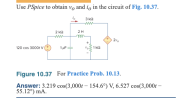 The answer to the problem is given. Please show how to build the
circuit in PSpice and how to solve it please. Thank you.
Use PSpice to obtain V, and i, in the circuit of Fig. 10.37. 3 k22 2H 2 ΚΩ w TO 2v. 120 cos 3000+ VC 19F 1 ΚΩ Figure 10.37 For Practice Prob. 10.13. Answer: 3.219 cos(3,000t – 154.6°) V, 6.527 cos(3,000t - 55.12) mA.
The answer to the problem is given. Please show how to build the
circuit in PSpice and how to solve it please. Thank you.
Use PSpice to obtain V, and i, in the circuit of Fig. 10.37. 3 k22 2H 2 ΚΩ w TO 2v. 120 cos 3000+ VC 19F 1 ΚΩ Figure 10.37 For Practice Prob. 10.13. Answer: 3.219 cos(3,000t – 154.6°) V, 6.527 cos(3,000t - 55.12) mA.
 Please explain /show steps thank you !
Problem 9.34 Part A Find the steady-state expression for v, in the circuit of (Figure 1) if ig = 50 cos 10000t mA. Suppose that vo(t) = Vo cos(wt+), where -180º < < 180º. Determine the values V, W, 0. Express your answers using three significant figures separated by commas. V AED 1 vec o 2 ? Vo, w, $ = 3.72, 10000,26.5 V, rad/s, º Submit Previous Answers Request Answer Figure <...
Please explain /show steps thank you !
Problem 9.34 Part A Find the steady-state expression for v, in the circuit of (Figure 1) if ig = 50 cos 10000t mA. Suppose that vo(t) = Vo cos(wt+), where -180º < < 180º. Determine the values V, W, 0. Express your answers using three significant figures separated by commas. V AED 1 vec o 2 ? Vo, w, $ = 3.72, 10000,26.5 V, rad/s, º Submit Previous Answers Request Answer Figure <...
 100 k22 RE R1 vo-w 20 ΚΩ ER vo + İPUCU: -Avi The Op-Amp used in the circuit in the figure is not ideal (i.e. for an internal resistance (Ri)): = V/V) resistors (R1, RF and Ri). Take a) First, regain the gain expression of the circuit in (Av the open loop gain A of the Op-Amp. b) Values given in the figure and R = 1 ks2, 10 ks, 100 ke ve 1 Calculate the gain separately for the...
 The switch in the given figure opens at t = 0. Find Vo for t > 0, Assume C-10 mF. 2 kQ t=0 15V(± The voltage is given by Vo (t)-Vo (0) e-t/r V, where Vo(0)「 V and τ = S.
 Show all the steps in clear way please and thanks in
advance!
4. Solve for V, and I, in the circuit below. Answer in polar. 20 ΚΩ -j4 ΚΩ 10 ΚΩ Ο + > 2/30° V -j2 ΚΩ Το.
Show all the steps in clear way please and thanks in
advance!
4. Solve for V, and I, in the circuit below. Answer in polar. 20 ΚΩ -j4 ΚΩ 10 ΚΩ Ο + > 2/30° V -j2 ΚΩ Το.
 Hello Please write clearly and visible large
print is good. Please explain all steps chosen, and use best
practices, or common methods to solve. Please, and thank you
I will rate up.
10. + -/2 points My Notes + Ask Your Teacher In this circuit, the sources have values Vsi(t) = 24 · cos(1900 · t) V and Vs2(t) = 12 · cos(1900 · t + 35°) V, while the components have values R = 3.2 k22, L1 = 4.2...
Hello Please write clearly and visible large
print is good. Please explain all steps chosen, and use best
practices, or common methods to solve. Please, and thank you
I will rate up.
10. + -/2 points My Notes + Ask Your Teacher In this circuit, the sources have values Vsi(t) = 24 · cos(1900 · t) V and Vs2(t) = 12 · cos(1900 · t + 35°) V, while the components have values R = 3.2 k22, L1 = 4.2...
 Please answer clearly
Question 2 The amplifier shown in Figure 2 has the following parameters: Kn(W/L)-1 mA/V2, V-1 V Determine a) Voltage gain (Vo/vi) b) Input resistance (R) c) Output resistance (Ro) d) Maximum output voltage swing so as the amplifier stays in saturation mode. Assume VDD-20 V, R1-2.5 ΚΩ, R2-1KQ, R3-0.5 ΚΩ, R4-5 MQ, R5_1ΜΩ. R4 R1 R5 R2 Ro R3
Question 2 The amplifier shown in Figure 2 has the following parameters: Kn(W/L)-1 mA/V2, V-1 V Determine a)...
Please answer clearly
Question 2 The amplifier shown in Figure 2 has the following parameters: Kn(W/L)-1 mA/V2, V-1 V Determine a) Voltage gain (Vo/vi) b) Input resistance (R) c) Output resistance (Ro) d) Maximum output voltage swing so as the amplifier stays in saturation mode. Assume VDD-20 V, R1-2.5 ΚΩ, R2-1KQ, R3-0.5 ΚΩ, R4-5 MQ, R5_1ΜΩ. R4 R1 R5 R2 Ro R3
Question 2 The amplifier shown in Figure 2 has the following parameters: Kn(W/L)-1 mA/V2, V-1 V Determine a)...
 Chapter 16, Problem 16.025 Calculate vo(t) in the circuit shown in the figure below ifh(t) is 200 cos(105t + 60°) mA, i2(t) is 100 sin( 105t + 90°) mA, and vs(t) = 10 sin(105t) V vcl!) 250 nF 36 Ohnvo() (a) Find the amplitude of vo(t) (b) Find the phase of vo(t) in degrees degrees Chapter 16, Problem 16.011 (Circuit Solution) Find Z in the network in the figure below 2? 1? 2? 2?
 v(t) is the output voltage. please explain the steps in words as
well. thanks.
2) In ha figine below the switch is closed at to. Find e resulthng output voltage vCt. write devon stepsyou sed 1o Solve he answen た。lon 1F OSL 1H ! 几
v(t) is the output voltage. please explain the steps in words as
well. thanks.
2) In ha figine below the switch is closed at to. Find e resulthng output voltage vCt. write devon stepsyou sed 1o Solve he answen た。lon 1F OSL 1H ! 几
 Please explain all steps and reasoning!
6) For the circuit shown below, plot VO and V1 as a function of time in the plot shown below. The input voltage on the left is a sawtooth wave show below. The turn on voltage of the diodes are 1 V and 0.7 V as shown below. Use the CVD model Clearly mark the voltages. VNIV OD 0.7V Tapat Villay V San 210 mF Draw your final answer for Vo and V1 in...
Please explain all steps and reasoning!
6) For the circuit shown below, plot VO and V1 as a function of time in the plot shown below. The input voltage on the left is a sawtooth wave show below. The turn on voltage of the diodes are 1 V and 0.7 V as shown below. Use the CVD model Clearly mark the voltages. VNIV OD 0.7V Tapat Villay V San 210 mF Draw your final answer for Vo and V1 in...
 The answer to the problem is given. Please show how to build the
circuit in PSpice and how to solve it please. Thank you.
Use PSpice to obtain V, and i, in the circuit of Fig. 10.37. 3 k22 2H 2 ΚΩ w TO 2v. 120 cos 3000+ VC 19F 1 ΚΩ Figure 10.37 For Practice Prob. 10.13. Answer: 3.219 cos(3,000t – 154.6°) V, 6.527 cos(3,000t - 55.12) mA.
The answer to the problem is given. Please show how to build the
circuit in PSpice and how to solve it please. Thank you.
Use PSpice to obtain V, and i, in the circuit of Fig. 10.37. 3 k22 2H 2 ΚΩ w TO 2v. 120 cos 3000+ VC 19F 1 ΚΩ Figure 10.37 For Practice Prob. 10.13. Answer: 3.219 cos(3,000t – 154.6°) V, 6.527 cos(3,000t - 55.12) mA.
Most questions answered within 3 hours.
-
Where is the error in this code sequence?
String s1 = "Hello";
String s2 = "ello";...
asked 10 months ago -
Financial data for Joel de Paris, Inc., for last year
follow:
Joel de Paris, Inc.
Balance...
asked 10 months ago -
Consider this reaction:
Al2(SO4)3 (aq)+ BaCl3
(aq) Al2Cl6 (aq)- +
3BaSO4(s) . What is the...
asked 10 months ago -
Suppose that Savneet is considering increasing her
recent random sample from 20 car rentals to 40...
asked 10 months ago -
Trucks arrive at an unloading terminal at an average rate of 120
per hour.
Trucks arrive...
asked 10 months ago -
Why are methanol and ethanol completely soluble in water while
octanol is not very little soluble....
asked 10 months ago -
A facilities manager at a university reads in a research report
that the mean amount of...
asked 10 months ago -
When the CuSO4 is rehydrated by adding water to the anhydrous
compound, is this an endothermic...
asked 10 months ago -
A ray of sunlight is passing from diamond into crown glass; the
angle of incidence is...
asked 10 months ago -
A block of mass 0.249 kg is placed on top of a light, vertical
spring of...
asked 10 months ago -
how do the kidneys compensate in the presences of acidosis
a) trigger hyperventilate
b) reserve acid...
asked 10 months ago -
Question 501 pts
The rental rate of capital to the firm increases. Which of the
following...
asked 10 months ago