Homework Answers
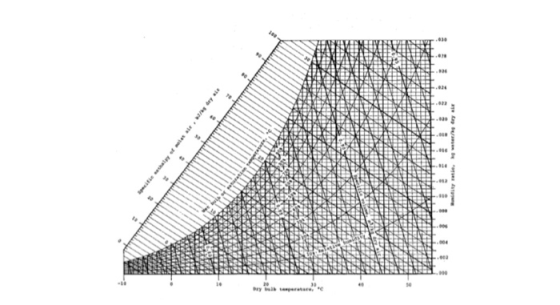
In winters when air is at low dry bulb tempertaure and higher relative humidity the wet bulb temperature of air is very much close to dry bulb temperature resulting in little amount of water evaporation into air to make it saturated hence body secreates less water to saturate air hence we dont feel sweat. But in winter when temperature is high and relative humidity is low the wet bulb temperature is significantly lower than dry bulb hence large amount of water is reuqired to saturate air hence more sweat comes out of body to saturate air in summer This is reason why people sweat more in summer

Add Answer to:
Why
people always sweat in summer but not in winter even winter has
higher relative humidity....
What is the operation principle of an evaporative cooler and what are the limitations of an...
 What is the operation principle of an evaporative cooler and what are the limitations of an evaportive cooler (4%)? Why people always sweat in summer but not in winter even winter has higher relative humidity. Using the Psychometric Chart below to support your answer (8%) $
Consider a “cold” winter day in with an air temperature of 7.22 °C and relative humidity...
Consider a “cold” winter day in with an air temperature of 7.22 °C and relative humidity of about 20% (moisture content 0.001 g H2O/g dry air). A person waiting at a bus stop inhales at an average rate of 8 g dry air/min and exhales air saturated with water at body temperature (37°C) and 1 atm (molal humidity is 6.7%). The heat capacity of dry air is 1.05 J/g- °C. Estimate the rate of heat loss from breathing. Express your...
9. A building has indoor air conditions of 70°F dry bulb temperature and 40% relative humidity....
 9. A building has indoor air conditions of 70°F dry bulb temperature and 40% relative humidity. Determine the direction of water vapor flow under the following outdoor air conditions that represent a dry, heating climate: a. 32°F dry bulb temperature and 40% relative humidity (winter conditions) b. 90°F dry bulb temperature and 20% relative humidity (summer conditions) DO
Moist air at 20° c, 1 atm, and 43% relative humidity and a volumetric flow rate...
 Moist air at 20° c, 1 atm, and 43% relative humidity and a volumetric flow rate of 900 m/hrs. enters a control volume at steady state and flow along a surface maintained at 65 C, through which heat transfer occurs. Liquid water at 20" C is injected at a rate of 5 kg/hr and evaporates into flowing stream. For the control volume, Wa=0, and kinetic and potential energy effects are negligible. Moist air exits at 32c, 1 atm, (a) draw...
Moist air at 30C, 1.0325bar and 50% relative humidity enters a heat exchanger operating at steady...
 Moist air at 30C, 1.0325bar and 50% relative humidity enters a heat exchanger operating at steady state at 1000kg/h. It is cooled at constant pressure to 20C. Ignoring kinetic and potential energy changes, determine the following: A. At approximately what temperature will the water in the moist air condense? (8 of 45 points. Please input your final answer in the box below) B.Does condensation occur? (2 of 45 points. Please input your final answer in the box below) C.Determine the...
Moist air at 20°C, 1 atm, and 43% relative humidity and a volumetric flow rate of...
 Moist air at 20°C, 1 atm, and 43% relative humidity and a volumetric flow rate of 900 m²/hrs. enters a control volume at steady state and flow along a surface maintained at 65°C, through which heat transfer occurs. Liquid water at 20°C is injected at a rate of 5 kg/hr and evaporates into flowing stream. For the control volume, Wev=0, and kinetic and potential energy effects are negligible. Moist air exits at 32°C, 1 atm. (a) draw the system schematic...
Air at 95°F, 1 atm, and 10% relative humidity enters an evaporative cooler operating at steady...
 Air at 95°F, 1 atm, and 10% relative humidity enters an evaporative cooler operating at steady state. The volumetric flow rate of the incoming air is 1765 ft3/min. Liquid water at 68°F enters the cooler and fully evaporates. Moist air exits the cooler at 70°F, 1 atm. There is no significant heat transfer between the device and its surroundings and kinetic and potential energy effects can be neglected. A. Determine the mass flow rate of the dry air in Ibm(dry...
Air at 95°F, 1 atm, and 10% relative humidity enters an evaporative cooler operating at steady...
 Air at 95°F, 1 atm, and 10% relative humidity enters an evaporative cooler operating at steady state. The volumetric flow rate of the incoming air is 1765 ft3/min. Liquid water at 68°F enters the cooler and fully evaporates. Moist air exits the cooler at 70°F, 1 atm. There is no significant heat transfer between the device and its surroundings and kinetic and potential energy effects can be neglected. A. Determine the mass flow rate of the dry air in lbm(dry...
1. (relative humidity) The partial pressure of water vapor in air is usually less than the...
 1. (relative humidity) The partial pressure of water vapor in air is usually less than the equilibrium vapor pressure (or saturation pressure) at the ambient temperature; this is why a cup of water will spontaneously evaporate. The ratio of the partial pressure of water vapor to the equilibrium vapor pressure (at the same temperature) is called the relative humidity. Saturated air, at 100% relative humidity, would be in equilibrium with a cup of liquid water. The saturation pressure depends strongly...
Moist air at 20C and 50% relative humidity enters a duct consisting of a heating section...
 Moist air at 20C and 50% relative humidity enters a duct consisting of a heating section followed by an evaporative cooling process. The air is heated to 35C in the heating section. The air then enters the evaporative cooling section where liquid water is injected into the moist air. The moist air exits the evaporative cooling section at 60% relative humidity. A. Determine the specific humidity at the exit of the heating section. (5 of 45 points. Please input your...
 What is the operation principle of an evaporative cooler and what are the limitations of an evaportive cooler (4%)? Why people always sweat in summer but not in winter even winter has higher relative humidity. Using the Psychometric Chart below to support your answer (8%) $
 9. A building has indoor air conditions of 70°F dry bulb temperature and 40% relative humidity. Determine the direction of water vapor flow under the following outdoor air conditions that represent a dry, heating climate: a. 32°F dry bulb temperature and 40% relative humidity (winter conditions) b. 90°F dry bulb temperature and 20% relative humidity (summer conditions) DO
 Moist air at 20° c, 1 atm, and 43% relative humidity and a volumetric flow rate of 900 m/hrs. enters a control volume at steady state and flow along a surface maintained at 65 C, through which heat transfer occurs. Liquid water at 20" C is injected at a rate of 5 kg/hr and evaporates into flowing stream. For the control volume, Wa=0, and kinetic and potential energy effects are negligible. Moist air exits at 32c, 1 atm, (a) draw...
 Moist air at 30C, 1.0325bar and 50% relative humidity enters a heat exchanger operating at steady state at 1000kg/h. It is cooled at constant pressure to 20C. Ignoring kinetic and potential energy changes, determine the following: A. At approximately what temperature will the water in the moist air condense? (8 of 45 points. Please input your final answer in the box below) B.Does condensation occur? (2 of 45 points. Please input your final answer in the box below) C.Determine the...
 Moist air at 20°C, 1 atm, and 43% relative humidity and a volumetric flow rate of 900 m²/hrs. enters a control volume at steady state and flow along a surface maintained at 65°C, through which heat transfer occurs. Liquid water at 20°C is injected at a rate of 5 kg/hr and evaporates into flowing stream. For the control volume, Wev=0, and kinetic and potential energy effects are negligible. Moist air exits at 32°C, 1 atm. (a) draw the system schematic...
 Air at 95°F, 1 atm, and 10% relative humidity enters an evaporative cooler operating at steady state. The volumetric flow rate of the incoming air is 1765 ft3/min. Liquid water at 68°F enters the cooler and fully evaporates. Moist air exits the cooler at 70°F, 1 atm. There is no significant heat transfer between the device and its surroundings and kinetic and potential energy effects can be neglected. A. Determine the mass flow rate of the dry air in Ibm(dry...
 Air at 95°F, 1 atm, and 10% relative humidity enters an evaporative cooler operating at steady state. The volumetric flow rate of the incoming air is 1765 ft3/min. Liquid water at 68°F enters the cooler and fully evaporates. Moist air exits the cooler at 70°F, 1 atm. There is no significant heat transfer between the device and its surroundings and kinetic and potential energy effects can be neglected. A. Determine the mass flow rate of the dry air in lbm(dry...
 1. (relative humidity) The partial pressure of water vapor in air is usually less than the equilibrium vapor pressure (or saturation pressure) at the ambient temperature; this is why a cup of water will spontaneously evaporate. The ratio of the partial pressure of water vapor to the equilibrium vapor pressure (at the same temperature) is called the relative humidity. Saturated air, at 100% relative humidity, would be in equilibrium with a cup of liquid water. The saturation pressure depends strongly...
 Moist air at 20C and 50% relative humidity enters a duct consisting of a heating section followed by an evaporative cooling process. The air is heated to 35C in the heating section. The air then enters the evaporative cooling section where liquid water is injected into the moist air. The moist air exits the evaporative cooling section at 60% relative humidity. A. Determine the specific humidity at the exit of the heating section. (5 of 45 points. Please input your...
Most questions answered within 3 hours.
-
Where is the error in this code sequence?
String s1 = "Hello";
String s2 = "ello";...
asked 11 months ago -
Financial data for Joel de Paris, Inc., for last year
follow:
Joel de Paris, Inc.
Balance...
asked 11 months ago -
Consider this reaction:
Al2(SO4)3 (aq)+ BaCl3
(aq) Al2Cl6 (aq)- +
3BaSO4(s) . What is the...
asked 11 months ago -
Suppose that Savneet is considering increasing her
recent random sample from 20 car rentals to 40...
asked 11 months ago -
Trucks arrive at an unloading terminal at an average rate of 120
per hour.
Trucks arrive...
asked 11 months ago -
Why are methanol and ethanol completely soluble in water while
octanol is not very little soluble....
asked 11 months ago -
A facilities manager at a university reads in a research report
that the mean amount of...
asked 11 months ago -
When the CuSO4 is rehydrated by adding water to the anhydrous
compound, is this an endothermic...
asked 11 months ago -
A ray of sunlight is passing from diamond into crown glass; the
angle of incidence is...
asked 11 months ago -
A block of mass 0.249 kg is placed on top of a light, vertical
spring of...
asked 11 months ago -
how do the kidneys compensate in the presences of acidosis
a) trigger hyperventilate
b) reserve acid...
asked 11 months ago -
Question 501 pts
The rental rate of capital to the firm increases. Which of the
following...
asked 11 months ago