

Homework Answers
The answer is the 1st option - the picture on the left
A hypotonic solution is a solution in which the concentration of dissolved solutes is lower than the solution inside the cell. A hypotonic solution has a lower solute concentration than another solution. In the picture on the left, external liquid has a lower concentration of solutes compared to the brine shrimp egg. In the picture on the left, the solute concentration is higher inside the cell. A hypotonic solution has higher concentration of water than the solution inside the cell and causes movement of water into the cell.
In the picture in the center, the external liquid has an equal concentration of solutes compared to the brine shrine egg. Inside the cell and outside, the solute concentration is equal. So the external liquid is isotonic.
In the picture on the right, the external liquid has a higher concentration of solutes compared to the solution inside the cell. Solute concentration is higher outside the cell. So the external liquid is hypertonic
Add Answer to:
Using the image below, which external liquid (top/left of each picture) is hypotonic with respect to...
For the image below Ais in the top left, B is in the top right, Cis...
 For the image below Ais in the top left, B is in the top right, Cis in the bottom left, D is in the bottom right. The table below shows how they are arranged. mage A Image B Image D Molecule Functional Group Molecule Functional Group HH o: Н . H 30-H C=C C-H HH OHHH HHHH Hrc=c--- Give your answers in lower case letters only For Image A what is the name of the oxygen containing functional group? For...
QUESTION 23 Refer to the diagram below. On the left, a barrier separates the top and...
 QUESTION 23 Refer to the diagram below. On the left, a barrier separates the top and bottom parts. The left and right images have the same total volume: 100.0 L. On the left side, the top and bottom parts each have a volume of 50.00 L. Each dot represents one mole of an ideal gas: dark circles and light circles are two different gases. The molar mass of the dark gas is 4 times that of the light gas. If...
Predict where each liquid is (top or bottom) and in which liquid the solid is dissolved....
Predict where each liquid is (top or bottom) and in which liquid the solid is dissolved. Please justify your prediction. Your solution consists of benzoic acid, diethyl ether, and 1M NaOH!
(6 points) Consider the simultaneous game below: Left Center Right Top 22 14 13 Mddle 4.0...
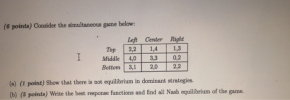 (6 points) Consider the simultaneous game below: Left Center Right Top 22 14 13 Mddle 4.0 330,2 Bottom 3 20 22 (a) (1 point) Show that there is not equilibrium in dominant strategies. (b) (5 points) Write the best response functions and find all Nash equilibrium of the game.
The top left diagram below shows a 1-C positive charge placed in a uniform external electric...
 The top left diagram below shows a 1-C positive charge placed in a uniform external electric field. The electric field in which the charge is placed is represented by field lines (drawn in red), and the resulting electric force on the charge is represented by the blue vector. Suppose the 1-C charge is removed, and is replaced, in turn, by each of the charges shown in the other three diagrams below. Assuming that the external electric field remains the same,...
The top left diagram below shows a 1-C positive charge placed in a uniform external electric...
 The top left diagram below shows a 1-C positive charge placed in
a uniform external electric field. The electric field in which the
charge is placed is represented by field lines (drawn in red), and
the resulting electric force on the charge is represented by the
blue vector. Suppose the 1-C charge is removed, and is replaced, in
turn, by each of the charges shown in the other three diagrams
below. Assuming that the external electric field remains the same,...
The top left diagram below shows a 1-C positive charge placed in
a uniform external electric field. The electric field in which the
charge is placed is represented by field lines (drawn in red), and
the resulting electric force on the charge is represented by the
blue vector. Suppose the 1-C charge is removed, and is replaced, in
turn, by each of the charges shown in the other three diagrams
below. Assuming that the external electric field remains the same,...
The top left diagram below shows a 1-C positive charge placed in a uniform external electric filed. The electr...
 The top left diagram below shows a 1-C positive charge placed in a uniform external electric filed. The electric field in which the charge is placed is represented by field lines (drown in red) and the resulting electric force on the charge is represented by the blue vector.
Using Center of Gravity Identical blocks of unit length are stacked on top of each other...
 Using Center of Gravity Identical blocks of unit length are
stacked on top of each other at the edge of a table. The center of
gravity of the top block must lie over the block below it, the
center of gravity of the top two blocks must lie over the block
below them, and so on (see figure).
(a) When there are three blocks, show that it is possible to
stack them so that the left edge of the top...
Using Center of Gravity Identical blocks of unit length are
stacked on top of each other at the edge of a table. The center of
gravity of the top block must lie over the block below it, the
center of gravity of the top two blocks must lie over the block
below them, and so on (see figure).
(a) When there are three blocks, show that it is possible to
stack them so that the left edge of the top...
The four cases below all show a ball with a charge of −3q at the top...
 The four cases below all show a ball with a charge of −3q at the
top right corner of a square. Then there is either one, two, or
three additional charged balls, each ball located at a different
corner of the square.
(b) In Case D, calculate the magnitude of the net electric field
at the center of the square.
(c) In Case A, calculate the magnitude of the net electric field
at the bottom left corner of the square....
The four cases below all show a ball with a charge of −3q at the
top right corner of a square. Then there is either one, two, or
three additional charged balls, each ball located at a different
corner of the square.
(b) In Case D, calculate the magnitude of the net electric field
at the center of the square.
(c) In Case A, calculate the magnitude of the net electric field
at the bottom left corner of the square....
The top left diagram below shows a 1-C positive charge placed in a uniform external electric field. The electric field...
 The top left diagram below shows a 1-C positive charge placed in
a uniform external electric field. The electric field in which the
charge is placed is represented by field lines (drawn in red), and
the resulting electric force on the charge is represented by the
blue vector. Suppose the 1-C charge is removed, and is replaced, in
turn, by each of the charges shown in the other three diagrams
below. Assuming that the external electric field remains the same,...
The top left diagram below shows a 1-C positive charge placed in
a uniform external electric field. The electric field in which the
charge is placed is represented by field lines (drawn in red), and
the resulting electric force on the charge is represented by the
blue vector. Suppose the 1-C charge is removed, and is replaced, in
turn, by each of the charges shown in the other three diagrams
below. Assuming that the external electric field remains the same,...
 For the image below Ais in the top left, B is in the top right, Cis in the bottom left, D is in the bottom right. The table below shows how they are arranged. mage A Image B Image D Molecule Functional Group Molecule Functional Group HH o: Н . H 30-H C=C C-H HH OHHH HHHH Hrc=c--- Give your answers in lower case letters only For Image A what is the name of the oxygen containing functional group? For...
 QUESTION 23 Refer to the diagram below. On the left, a barrier separates the top and bottom parts. The left and right images have the same total volume: 100.0 L. On the left side, the top and bottom parts each have a volume of 50.00 L. Each dot represents one mole of an ideal gas: dark circles and light circles are two different gases. The molar mass of the dark gas is 4 times that of the light gas. If...
 (6 points) Consider the simultaneous game below: Left Center Right Top 22 14 13 Mddle 4.0 330,2 Bottom 3 20 22 (a) (1 point) Show that there is not equilibrium in dominant strategies. (b) (5 points) Write the best response functions and find all Nash equilibrium of the game.
 The top left diagram below shows a 1-C positive charge placed in a uniform external electric field. The electric field in which the charge is placed is represented by field lines (drawn in red), and the resulting electric force on the charge is represented by the blue vector. Suppose the 1-C charge is removed, and is replaced, in turn, by each of the charges shown in the other three diagrams below. Assuming that the external electric field remains the same,...
 The top left diagram below shows a 1-C positive charge placed in
a uniform external electric field. The electric field in which the
charge is placed is represented by field lines (drawn in red), and
the resulting electric force on the charge is represented by the
blue vector. Suppose the 1-C charge is removed, and is replaced, in
turn, by each of the charges shown in the other three diagrams
below. Assuming that the external electric field remains the same,...
The top left diagram below shows a 1-C positive charge placed in
a uniform external electric field. The electric field in which the
charge is placed is represented by field lines (drawn in red), and
the resulting electric force on the charge is represented by the
blue vector. Suppose the 1-C charge is removed, and is replaced, in
turn, by each of the charges shown in the other three diagrams
below. Assuming that the external electric field remains the same,...
 The top left diagram below shows a 1-C positive charge placed in a uniform external electric filed. The electric field in which the charge is placed is represented by field lines (drown in red) and the resulting electric force on the charge is represented by the blue vector.
 Using Center of Gravity Identical blocks of unit length are
stacked on top of each other at the edge of a table. The center of
gravity of the top block must lie over the block below it, the
center of gravity of the top two blocks must lie over the block
below them, and so on (see figure).
(a) When there are three blocks, show that it is possible to
stack them so that the left edge of the top...
Using Center of Gravity Identical blocks of unit length are
stacked on top of each other at the edge of a table. The center of
gravity of the top block must lie over the block below it, the
center of gravity of the top two blocks must lie over the block
below them, and so on (see figure).
(a) When there are three blocks, show that it is possible to
stack them so that the left edge of the top...
 The four cases below all show a ball with a charge of −3q at the
top right corner of a square. Then there is either one, two, or
three additional charged balls, each ball located at a different
corner of the square.
(b) In Case D, calculate the magnitude of the net electric field
at the center of the square.
(c) In Case A, calculate the magnitude of the net electric field
at the bottom left corner of the square....
The four cases below all show a ball with a charge of −3q at the
top right corner of a square. Then there is either one, two, or
three additional charged balls, each ball located at a different
corner of the square.
(b) In Case D, calculate the magnitude of the net electric field
at the center of the square.
(c) In Case A, calculate the magnitude of the net electric field
at the bottom left corner of the square....
 The top left diagram below shows a 1-C positive charge placed in
a uniform external electric field. The electric field in which the
charge is placed is represented by field lines (drawn in red), and
the resulting electric force on the charge is represented by the
blue vector. Suppose the 1-C charge is removed, and is replaced, in
turn, by each of the charges shown in the other three diagrams
below. Assuming that the external electric field remains the same,...
The top left diagram below shows a 1-C positive charge placed in
a uniform external electric field. The electric field in which the
charge is placed is represented by field lines (drawn in red), and
the resulting electric force on the charge is represented by the
blue vector. Suppose the 1-C charge is removed, and is replaced, in
turn, by each of the charges shown in the other three diagrams
below. Assuming that the external electric field remains the same,...
Most questions answered within 3 hours.
-
Where is the error in this code sequence?
String s1 = "Hello";
String s2 = "ello";...
asked 10 months ago -
Financial data for Joel de Paris, Inc., for last year
follow:
Joel de Paris, Inc.
Balance...
asked 10 months ago -
Consider this reaction:
Al2(SO4)3 (aq)+ BaCl3
(aq) Al2Cl6 (aq)- +
3BaSO4(s) . What is the...
asked 10 months ago -
Suppose that Savneet is considering increasing her
recent random sample from 20 car rentals to 40...
asked 10 months ago -
Trucks arrive at an unloading terminal at an average rate of 120
per hour.
Trucks arrive...
asked 10 months ago -
Why are methanol and ethanol completely soluble in water while
octanol is not very little soluble....
asked 10 months ago -
A facilities manager at a university reads in a research report
that the mean amount of...
asked 10 months ago -
When the CuSO4 is rehydrated by adding water to the anhydrous
compound, is this an endothermic...
asked 10 months ago -
A ray of sunlight is passing from diamond into crown glass; the
angle of incidence is...
asked 10 months ago -
A block of mass 0.249 kg is placed on top of a light, vertical
spring of...
asked 10 months ago -
how do the kidneys compensate in the presences of acidosis
a) trigger hyperventilate
b) reserve acid...
asked 10 months ago -
Question 501 pts
The rental rate of capital to the firm increases. Which of the
following...
asked 10 months ago