
Homework Answers

Add Answer to:
please explain in detail, thank you
Solve the Cauchy problem for the diffusion equation ut =...
(1 point) Solve the nonhomogeneous heat problem ut = Uxx + sin(3x), 0 < x <...
 (1 point) Solve the nonhomogeneous heat problem ut = Uxx + sin(3x), 0 < x < 1, u(0,t) = 0, u1,t) = 0 u(x,0) = 2 sin(4x) u(x, t) = Steady State Solution limt-001(x, t) = ((sin(3x))/9)
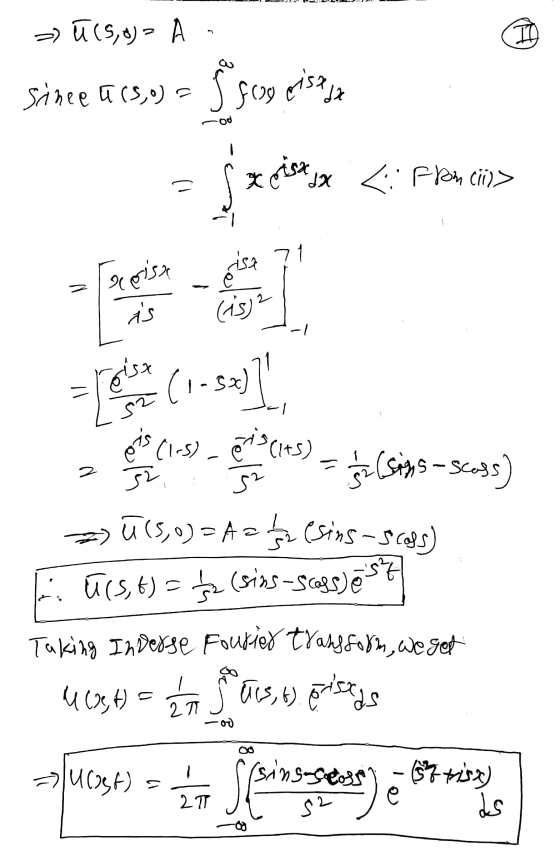
1. Solve the Cauchy problem (2.1)-(2.2) for the following initial condition a) $(x) = 1 if...
 1. Solve the Cauchy problem (2.1)-(2.2) for the following initial condition a) $(x) = 1 if |2<1 and $(x) = 0 if |z| > 1. b) p(x) = e-x, x > 0; $(x) = 0, x < 0. with the heat, or diffusion, equation on the real line. That is, we We begin with the hea sider the initial value problem Ut = kuxx, XER, t > 0, u(x,0) = 0(2), XER. (2.1) (2.2)
1 point) Solve the nonhomogeneous heat problem ut=uxx+4sin(2x), 0<x<π,ut=uxx+4sin(2x), 0<x<π, u(0,t)=0, u(π,t)=0u(0,t)=0, u(π,t)=0 u(x,0)=5sin(5x)u(x,0)=5sin(5x) u(x,t)=u(x,t)= Ste
 1 point) Solve the nonhomogeneous heat problem
ut=uxx+4sin(2x), 0<x<π,ut=uxx+4sin(2x), 0<x<π,
u(0,t)=0, u(π,t)=0u(0,t)=0, u(π,t)=0
u(x,0)=5sin(5x)u(x,0)=5sin(5x)
u(x,t)=u(x,t)=
Steady State Solution limt→∞u(x,t)=limt→∞u(x,t)=
Please show all work.
(1 point) Solve the nonhomogeneous heat problem Ut = Uxx + 4 sin(2x), 0< x < , u(0,1) = 0, tu(T, t) = 0 u(x,0) = 5 sin(52) u(a,t) Steady State Solution limt u(x, t) = Note: You can earn partial credit on this problem. Preview My Answers Submit Answers You have attempted this problem 0 times. You have unlimited attempts...
1 point) Solve the nonhomogeneous heat problem
ut=uxx+4sin(2x), 0<x<π,ut=uxx+4sin(2x), 0<x<π,
u(0,t)=0, u(π,t)=0u(0,t)=0, u(π,t)=0
u(x,0)=5sin(5x)u(x,0)=5sin(5x)
u(x,t)=u(x,t)=
Steady State Solution limt→∞u(x,t)=limt→∞u(x,t)=
Please show all work.
(1 point) Solve the nonhomogeneous heat problem Ut = Uxx + 4 sin(2x), 0< x < , u(0,1) = 0, tu(T, t) = 0 u(x,0) = 5 sin(52) u(a,t) Steady State Solution limt u(x, t) = Note: You can earn partial credit on this problem. Preview My Answers Submit Answers You have attempted this problem 0 times. You have unlimited attempts...
Solve the wave equation on the domain 0 < x < , t > 0 ?...
 Solve the wave equation on the domain 0 < x < , t > 0 ? uxx Utt = with the boundary condition u (0, t) = 0 and the initial conditions u (x,0) = x2 u (x,0) = x
4. (*) Solve the Cauchy problem Ut = 3Uxx, X E R, t> 0, u(x,0) =...
 4. (*) Solve the Cauchy problem Ut = 3Uxx, X E R, t> 0, u(x,0) = Q(x), x E R, for the following initial conditions and write the solutions in terms of the erf function. LS 2, -4 < x < 5 (a) $(x) = { 0, otherwise. (b) (x) = e-la-11 Note: In (b) complete the square with respect to y in the exponent of e to obtain a nice form. You need to split your integral based on...
Please show all steps in detail and as legible as possible. Thank you!!! Consider the two dimensional diffusion of heat in a rectangular section of tissue. Specifically solve for the temperature fiel...
 Please show all steps in detail and as legible as possible.
Thank you!!!
Consider the two dimensional diffusion of heat in a rectangular section of tissue. Specifically solve for the temperature field, u(x,y,t), in the rectangular section with dimensions having (0<x < a) and (0<y < b), which is governed by the following initial-value, boundary-value problem, where a is a constant: (0,y,t) = 0 uy (x,0,t) = 0 14. (a,y,t) = 0 u(x,b,t)-0 11 (x, y,0) = f(x, y)
Consider...
Please show all steps in detail and as legible as possible.
Thank you!!!
Consider the two dimensional diffusion of heat in a rectangular section of tissue. Specifically solve for the temperature field, u(x,y,t), in the rectangular section with dimensions having (0<x < a) and (0<y < b), which is governed by the following initial-value, boundary-value problem, where a is a constant: (0,y,t) = 0 uy (x,0,t) = 0 14. (a,y,t) = 0 u(x,b,t)-0 11 (x, y,0) = f(x, y)
Consider...
Solve the heat problem ut=uxx−cos(x), 0<x<π, ut=uxx−cos(x), 0<x&l...
Solve the heat problem ut=uxx−cos(x), 0<x<π, ut=uxx−cos(x), 0<x<π, ux(0,t)=0, ux(π,t)=0 ux(0,t)=0, ux(π,t)=0 u(x,0)=1u(x,0)=1 u(x,t)= ?
please explain all, thanks Fourier Transforms, please explain in detail Solve the following integral equations for...
 please explain all, thanks
Fourier Transforms, please explain in detail
Solve the following integral equations for an unknown function f(x): (a) exp(-at?) f (x – t)dt = exp(-bx2) b> a > 0 f(t)dt (b) Sca 2 b> a > 0 (x-t)2 +a? 22 +62
please explain all, thanks
Fourier Transforms, please explain in detail
Solve the following integral equations for an unknown function f(x): (a) exp(-at?) f (x – t)dt = exp(-bx2) b> a > 0 f(t)dt (b) Sca 2 b> a > 0 (x-t)2 +a? 22 +62
PDE problem diffusion equation Solve the diffusion equation in the disk of radius a, with u...
 PDE problem diffusion
equation
Solve the diffusion equation in the disk of radius a, with u = t 0, where B is constant B on the boundary and u = 0 when
Solve the diffusion equation in the disk of radius a, with u = t 0, where B is constant B on the boundary and u = 0 when
PDE problem diffusion
equation
Solve the diffusion equation in the disk of radius a, with u = t 0, where B is constant B on the boundary and u = 0 when
Solve the diffusion equation in the disk of radius a, with u = t 0, where B is constant B on the boundary and u = 0 when
 (1 point) Solve the nonhomogeneous heat problem ut = Uxx + sin(3x), 0 < x < 1, u(0,t) = 0, u1,t) = 0 u(x,0) = 2 sin(4x) u(x, t) = Steady State Solution limt-001(x, t) = ((sin(3x))/9)
 1. Solve the Cauchy problem (2.1)-(2.2) for the following initial condition a) $(x) = 1 if |2<1 and $(x) = 0 if |z| > 1. b) p(x) = e-x, x > 0; $(x) = 0, x < 0. with the heat, or diffusion, equation on the real line. That is, we We begin with the hea sider the initial value problem Ut = kuxx, XER, t > 0, u(x,0) = 0(2), XER. (2.1) (2.2)
 1 point) Solve the nonhomogeneous heat problem
ut=uxx+4sin(2x), 0<x<π,ut=uxx+4sin(2x), 0<x<π,
u(0,t)=0, u(π,t)=0u(0,t)=0, u(π,t)=0
u(x,0)=5sin(5x)u(x,0)=5sin(5x)
u(x,t)=u(x,t)=
Steady State Solution limt→∞u(x,t)=limt→∞u(x,t)=
Please show all work.
(1 point) Solve the nonhomogeneous heat problem Ut = Uxx + 4 sin(2x), 0< x < , u(0,1) = 0, tu(T, t) = 0 u(x,0) = 5 sin(52) u(a,t) Steady State Solution limt u(x, t) = Note: You can earn partial credit on this problem. Preview My Answers Submit Answers You have attempted this problem 0 times. You have unlimited attempts...
1 point) Solve the nonhomogeneous heat problem
ut=uxx+4sin(2x), 0<x<π,ut=uxx+4sin(2x), 0<x<π,
u(0,t)=0, u(π,t)=0u(0,t)=0, u(π,t)=0
u(x,0)=5sin(5x)u(x,0)=5sin(5x)
u(x,t)=u(x,t)=
Steady State Solution limt→∞u(x,t)=limt→∞u(x,t)=
Please show all work.
(1 point) Solve the nonhomogeneous heat problem Ut = Uxx + 4 sin(2x), 0< x < , u(0,1) = 0, tu(T, t) = 0 u(x,0) = 5 sin(52) u(a,t) Steady State Solution limt u(x, t) = Note: You can earn partial credit on this problem. Preview My Answers Submit Answers You have attempted this problem 0 times. You have unlimited attempts...
 Solve the wave equation on the domain 0 < x < , t > 0 ? uxx Utt = with the boundary condition u (0, t) = 0 and the initial conditions u (x,0) = x2 u (x,0) = x
 4. (*) Solve the Cauchy problem Ut = 3Uxx, X E R, t> 0, u(x,0) = Q(x), x E R, for the following initial conditions and write the solutions in terms of the erf function. LS 2, -4 < x < 5 (a) $(x) = { 0, otherwise. (b) (x) = e-la-11 Note: In (b) complete the square with respect to y in the exponent of e to obtain a nice form. You need to split your integral based on...
 Please show all steps in detail and as legible as possible.
Thank you!!!
Consider the two dimensional diffusion of heat in a rectangular section of tissue. Specifically solve for the temperature field, u(x,y,t), in the rectangular section with dimensions having (0<x < a) and (0<y < b), which is governed by the following initial-value, boundary-value problem, where a is a constant: (0,y,t) = 0 uy (x,0,t) = 0 14. (a,y,t) = 0 u(x,b,t)-0 11 (x, y,0) = f(x, y)
Consider...
Please show all steps in detail and as legible as possible.
Thank you!!!
Consider the two dimensional diffusion of heat in a rectangular section of tissue. Specifically solve for the temperature field, u(x,y,t), in the rectangular section with dimensions having (0<x < a) and (0<y < b), which is governed by the following initial-value, boundary-value problem, where a is a constant: (0,y,t) = 0 uy (x,0,t) = 0 14. (a,y,t) = 0 u(x,b,t)-0 11 (x, y,0) = f(x, y)
Consider...
 please explain all, thanks
Fourier Transforms, please explain in detail
Solve the following integral equations for an unknown function f(x): (a) exp(-at?) f (x – t)dt = exp(-bx2) b> a > 0 f(t)dt (b) Sca 2 b> a > 0 (x-t)2 +a? 22 +62
please explain all, thanks
Fourier Transforms, please explain in detail
Solve the following integral equations for an unknown function f(x): (a) exp(-at?) f (x – t)dt = exp(-bx2) b> a > 0 f(t)dt (b) Sca 2 b> a > 0 (x-t)2 +a? 22 +62
 PDE problem diffusion
equation
Solve the diffusion equation in the disk of radius a, with u = t 0, where B is constant B on the boundary and u = 0 when
Solve the diffusion equation in the disk of radius a, with u = t 0, where B is constant B on the boundary and u = 0 when
PDE problem diffusion
equation
Solve the diffusion equation in the disk of radius a, with u = t 0, where B is constant B on the boundary and u = 0 when
Solve the diffusion equation in the disk of radius a, with u = t 0, where B is constant B on the boundary and u = 0 when
Most questions answered within 3 hours.
-
Where is the error in this code sequence?
String s1 = "Hello";
String s2 = "ello";...
asked 10 months ago -
Financial data for Joel de Paris, Inc., for last year
follow:
Joel de Paris, Inc.
Balance...
asked 10 months ago -
Consider this reaction:
Al2(SO4)3 (aq)+ BaCl3
(aq) Al2Cl6 (aq)- +
3BaSO4(s) . What is the...
asked 10 months ago -
Suppose that Savneet is considering increasing her
recent random sample from 20 car rentals to 40...
asked 10 months ago -
Trucks arrive at an unloading terminal at an average rate of 120
per hour.
Trucks arrive...
asked 10 months ago -
Why are methanol and ethanol completely soluble in water while
octanol is not very little soluble....
asked 10 months ago -
A facilities manager at a university reads in a research report
that the mean amount of...
asked 10 months ago -
When the CuSO4 is rehydrated by adding water to the anhydrous
compound, is this an endothermic...
asked 10 months ago -
A ray of sunlight is passing from diamond into crown glass; the
angle of incidence is...
asked 10 months ago -
A block of mass 0.249 kg is placed on top of a light, vertical
spring of...
asked 10 months ago -
how do the kidneys compensate in the presences of acidosis
a) trigger hyperventilate
b) reserve acid...
asked 10 months ago -
Question 501 pts
The rental rate of capital to the firm increases. Which of the
following...
asked 10 months ago