Please show all steps in detail and as legible as possible.
Thank you!!!

Homework Answers
Add Answer to:
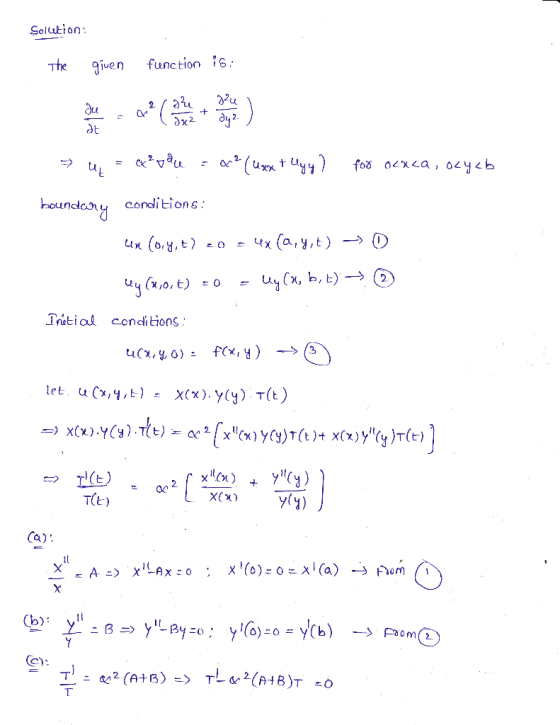
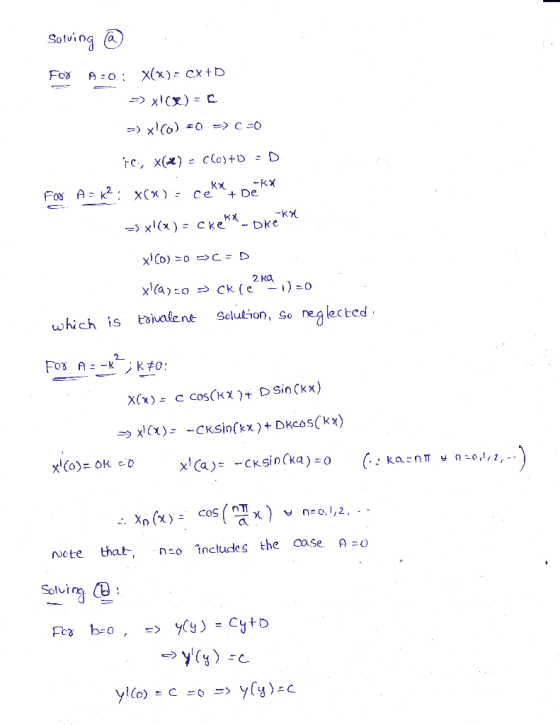
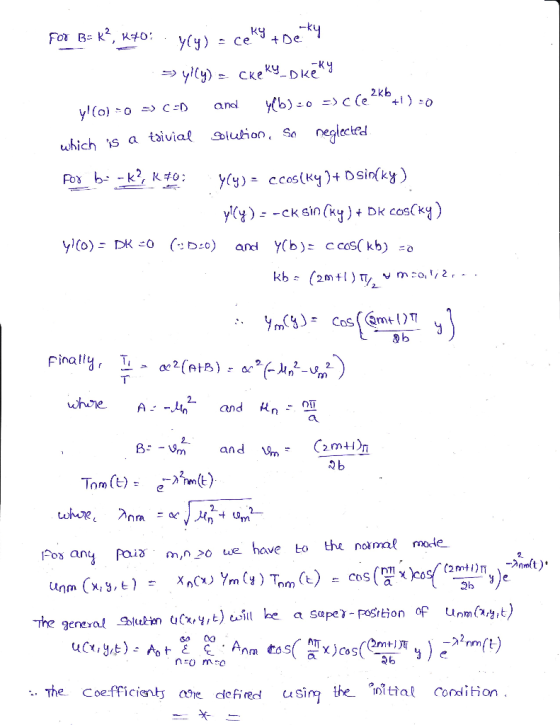
Please show all steps in detail and as legible as possible. Thank you!!! Consider the two dimensional diffusion of heat in a rectangular section of tissue. Specifically solve for the temperature fiel...
Please show all steps and write in a legible way. Thank you beforehand! Fully solve the following PDE. Consider a compre...
 Please show all steps and
write in a legible way. Thank you beforehand!
Fully solve the following PDE. Consider a compressed gas container of length L, divided in half by a baffle To the left of the porous baffle is a gas of species A, and to the right of it is a different gas of species B. Suppose they are at the same pressure, so that when the baffle is removed at time t-0 the two gases proceed to...
Please show all steps and
write in a legible way. Thank you beforehand!
Fully solve the following PDE. Consider a compressed gas container of length L, divided in half by a baffle To the left of the porous baffle is a gas of species A, and to the right of it is a different gas of species B. Suppose they are at the same pressure, so that when the baffle is removed at time t-0 the two gases proceed to...
This is PDE problem. Please show all steps in detail with neat handwriting. Problem . Consider...
 This is PDE problem. Please show all steps in detail with neat
handwriting.
Problem . Consider the function a) Find the full Fourier Series of F(x) a(0, y, t) = u(a, y, t) 0 u(z, 0, t ) = u(z, b, l) = 0 u(z,y,0) = f(z,y), u(x, y,0)-g(x,y), 0<y< b,t0 a) b) Solve the initial-boundary value problem for 2D wave equation. What is the physical interpretation of these boundary conditions
This is PDE problem. Please show all steps in detail with neat
handwriting.
Problem . Consider the function a) Find the full Fourier Series of F(x) a(0, y, t) = u(a, y, t) 0 u(z, 0, t ) = u(z, b, l) = 0 u(z,y,0) = f(z,y), u(x, y,0)-g(x,y), 0<y< b,t0 a) b) Solve the initial-boundary value problem for 2D wave equation. What is the physical interpretation of these boundary conditions
Help me!! Please solve (1) and (2). And I desperately want to know how to solve (2) by using MATLAB. Please teach me Ma...
 Help me!! Please solve (1) and (2).
And I desperately want to know how to solve (2) by using
MATLAB. Please teach me Matlab code in detail.
a rectangular shape Aluminum block (L=10mm, D=3mm) has well
insulated top and bottom. The left surface has thermal boundary
condition, and the right surface has convection boundary
condition.
* the surface temperature Ts=100℃, the ambient air temperature
Ta=20℃, heat transfer coefficient h=120 W/(m^2*K)
* thermal conductivity of Aluminum = 220 W/m*K, density of...
Help me!! Please solve (1) and (2).
And I desperately want to know how to solve (2) by using
MATLAB. Please teach me Matlab code in detail.
a rectangular shape Aluminum block (L=10mm, D=3mm) has well
insulated top and bottom. The left surface has thermal boundary
condition, and the right surface has convection boundary
condition.
* the surface temperature Ts=100℃, the ambient air temperature
Ta=20℃, heat transfer coefficient h=120 W/(m^2*K)
* thermal conductivity of Aluminum = 220 W/m*K, density of...
Consider two-dimensional steady-state heat conduction in a rectangular region of cross-section 2L by 3L subject to...
 Consider two-dimensional steady-state heat conduction in a
rectangular region of cross-section 2L by 3L subject to boundary
conditions shown below. By using a mesh size deltax = deltay = L,
write the finite difference equations for this problem, and
calculate the node temperatures T1, T2, T3 and T4.
2 4 3 yL dee itc ft u esu
Consider two-dimensional steady-state heat conduction in a
rectangular region of cross-section 2L by 3L subject to boundary
conditions shown below. By using a mesh size deltax = deltay = L,
write the finite difference equations for this problem, and
calculate the node temperatures T1, T2, T3 and T4.
2 4 3 yL dee itc ft u esu
PDE. Please show all steps in detail. 2. Consider the 1D heat equation in a rod...
 PDE. Please show all steps in detail.
2. Consider the 1D heat equation in a rod of length with diffusion constant Suppose the left endpoint is convecting (in obedience to Newton's Law of Cooling with proportionality constant K-1) with an outside medium which is 5000. while the right endpoint is insulated. The initial temperature distribution in the rod is given by f(a)- 2000 -0.65 300, 0<<t (a) Set up the initial-boundary value problem modeling this scenario. (b) Set up and...
PDE. Please show all steps in detail.
2. Consider the 1D heat equation in a rod of length with diffusion constant Suppose the left endpoint is convecting (in obedience to Newton's Law of Cooling with proportionality constant K-1) with an outside medium which is 5000. while the right endpoint is insulated. The initial temperature distribution in the rod is given by f(a)- 2000 -0.65 300, 0<<t (a) Set up the initial-boundary value problem modeling this scenario. (b) Set up and...
Section 1.3 3. a. Solve the following initial boundary value problem for the heat equation 0x<L...
 Section 1.3 3. a. Solve the following initial boundary value problem for the heat equation 0x<L t0 at u(r, 0) f() u(0, t)u(L, t) 0, t>0, 9Tr when f(r)6 sin L b. Solve the following initial boundary value problem for the diffusion equation au D 0 L t0 at u(r, 0) f() (0, t) (L, t) 0, t 0, x < L/2 0. when f(r) r > L/2. 1
Section 1.3 3. a. Solve the following initial boundary value problem...
Section 1.3 3. a. Solve the following initial boundary value problem for the heat equation 0x<L t0 at u(r, 0) f() u(0, t)u(L, t) 0, t>0, 9Tr when f(r)6 sin L b. Solve the following initial boundary value problem for the diffusion equation au D 0 L t0 at u(r, 0) f() (0, t) (L, t) 0, t 0, x < L/2 0. when f(r) r > L/2. 1
Section 1.3 3. a. Solve the following initial boundary value problem...
The two-dimensional heat equation reduces to Laplace's equation to = 0 if the temperature u is...
 The two-dimensional heat equation reduces to Laplace's equation to = 0 if the temperature u is steady-state. u(x, y) is defined in 0<x<2 and 0 Sys2 and satisfy u(x,0) = u(x, 2) = u(0, y) = 0 and u(2, y) = 80 sin my. Answer the following questions. (1) Obtain two ODES (Ordinary Differential Equations) by the method of separation of variables. (2) Find u(x, y) satisfying the boundary condition. (3) Obtain the value of u(1,5).
In a steady-state two-dimensional heat flow problem, the temperature, u, at any point in the doma...
 In a steady-state two-dimensional heat flow problem, the temperature, u, at any point in the domain (x, y) satisfies the following differential equation. With the given temperature boundary condition, find the internal temperature at points a, b, and c using a numerical method. 0 4 4
In a steady-state two-dimensional heat flow problem, the temperature, u, at any point in the domain (x, y) satisfies the following differential equation. With the given temperature boundary condition, find the internal temperature at...
In a steady-state two-dimensional heat flow problem, the temperature, u, at any point in the domain (x, y) satisfies the following differential equation. With the given temperature boundary condition, find the internal temperature at points a, b, and c using a numerical method. 0 4 4
In a steady-state two-dimensional heat flow problem, the temperature, u, at any point in the domain (x, y) satisfies the following differential equation. With the given temperature boundary condition, find the internal temperature at...
please explain in detail, thank you Solve the Cauchy problem for the diffusion equation ut =...
 please explain in detail, thank you
Solve the Cauchy problem for the diffusion equation ut = Uxx, xe (-0, 0), t > 0 (b) u(x,0) = x for x € (-1,1) and u(x,0) = 0 for other values of x.
please explain in detail, thank you
Solve the Cauchy problem for the diffusion equation ut = Uxx, xe (-0, 0), t > 0 (b) u(x,0) = x for x € (-1,1) and u(x,0) = 0 for other values of x.
(a) Consider the one-dimensional heat equation for the temperature u(x, t), Ou,02u where c is the...
 (a) Consider the one-dimensional heat equation for the temperature u(x, t), Ou,02u where c is the diffusivity (i) Show that a solution of the form u(x,t)-F )G(t) satisfies the heat equation, provided that 护F and where p is a real constant (ii) Show that u(x,t) has a solution of the form (,t)A cos(pr)+ Bsin(p)le -P2e2 where A and B are constants (b) Consider heat flow in a metal rod of length L = π. The ends of the rod, at...
 Please show all steps and
write in a legible way. Thank you beforehand!
Fully solve the following PDE. Consider a compressed gas container of length L, divided in half by a baffle To the left of the porous baffle is a gas of species A, and to the right of it is a different gas of species B. Suppose they are at the same pressure, so that when the baffle is removed at time t-0 the two gases proceed to...
Please show all steps and
write in a legible way. Thank you beforehand!
Fully solve the following PDE. Consider a compressed gas container of length L, divided in half by a baffle To the left of the porous baffle is a gas of species A, and to the right of it is a different gas of species B. Suppose they are at the same pressure, so that when the baffle is removed at time t-0 the two gases proceed to...
 This is PDE problem. Please show all steps in detail with neat
handwriting.
Problem . Consider the function a) Find the full Fourier Series of F(x) a(0, y, t) = u(a, y, t) 0 u(z, 0, t ) = u(z, b, l) = 0 u(z,y,0) = f(z,y), u(x, y,0)-g(x,y), 0<y< b,t0 a) b) Solve the initial-boundary value problem for 2D wave equation. What is the physical interpretation of these boundary conditions
This is PDE problem. Please show all steps in detail with neat
handwriting.
Problem . Consider the function a) Find the full Fourier Series of F(x) a(0, y, t) = u(a, y, t) 0 u(z, 0, t ) = u(z, b, l) = 0 u(z,y,0) = f(z,y), u(x, y,0)-g(x,y), 0<y< b,t0 a) b) Solve the initial-boundary value problem for 2D wave equation. What is the physical interpretation of these boundary conditions
 Help me!! Please solve (1) and (2).
And I desperately want to know how to solve (2) by using
MATLAB. Please teach me Matlab code in detail.
a rectangular shape Aluminum block (L=10mm, D=3mm) has well
insulated top and bottom. The left surface has thermal boundary
condition, and the right surface has convection boundary
condition.
* the surface temperature Ts=100℃, the ambient air temperature
Ta=20℃, heat transfer coefficient h=120 W/(m^2*K)
* thermal conductivity of Aluminum = 220 W/m*K, density of...
Help me!! Please solve (1) and (2).
And I desperately want to know how to solve (2) by using
MATLAB. Please teach me Matlab code in detail.
a rectangular shape Aluminum block (L=10mm, D=3mm) has well
insulated top and bottom. The left surface has thermal boundary
condition, and the right surface has convection boundary
condition.
* the surface temperature Ts=100℃, the ambient air temperature
Ta=20℃, heat transfer coefficient h=120 W/(m^2*K)
* thermal conductivity of Aluminum = 220 W/m*K, density of...
 Consider two-dimensional steady-state heat conduction in a
rectangular region of cross-section 2L by 3L subject to boundary
conditions shown below. By using a mesh size deltax = deltay = L,
write the finite difference equations for this problem, and
calculate the node temperatures T1, T2, T3 and T4.
2 4 3 yL dee itc ft u esu
Consider two-dimensional steady-state heat conduction in a
rectangular region of cross-section 2L by 3L subject to boundary
conditions shown below. By using a mesh size deltax = deltay = L,
write the finite difference equations for this problem, and
calculate the node temperatures T1, T2, T3 and T4.
2 4 3 yL dee itc ft u esu
 PDE. Please show all steps in detail.
2. Consider the 1D heat equation in a rod of length with diffusion constant Suppose the left endpoint is convecting (in obedience to Newton's Law of Cooling with proportionality constant K-1) with an outside medium which is 5000. while the right endpoint is insulated. The initial temperature distribution in the rod is given by f(a)- 2000 -0.65 300, 0<<t (a) Set up the initial-boundary value problem modeling this scenario. (b) Set up and...
PDE. Please show all steps in detail.
2. Consider the 1D heat equation in a rod of length with diffusion constant Suppose the left endpoint is convecting (in obedience to Newton's Law of Cooling with proportionality constant K-1) with an outside medium which is 5000. while the right endpoint is insulated. The initial temperature distribution in the rod is given by f(a)- 2000 -0.65 300, 0<<t (a) Set up the initial-boundary value problem modeling this scenario. (b) Set up and...
 Section 1.3 3. a. Solve the following initial boundary value problem for the heat equation 0x<L t0 at u(r, 0) f() u(0, t)u(L, t) 0, t>0, 9Tr when f(r)6 sin L b. Solve the following initial boundary value problem for the diffusion equation au D 0 L t0 at u(r, 0) f() (0, t) (L, t) 0, t 0, x < L/2 0. when f(r) r > L/2. 1
Section 1.3 3. a. Solve the following initial boundary value problem...
Section 1.3 3. a. Solve the following initial boundary value problem for the heat equation 0x<L t0 at u(r, 0) f() u(0, t)u(L, t) 0, t>0, 9Tr when f(r)6 sin L b. Solve the following initial boundary value problem for the diffusion equation au D 0 L t0 at u(r, 0) f() (0, t) (L, t) 0, t 0, x < L/2 0. when f(r) r > L/2. 1
Section 1.3 3. a. Solve the following initial boundary value problem...
 The two-dimensional heat equation reduces to Laplace's equation to = 0 if the temperature u is steady-state. u(x, y) is defined in 0<x<2 and 0 Sys2 and satisfy u(x,0) = u(x, 2) = u(0, y) = 0 and u(2, y) = 80 sin my. Answer the following questions. (1) Obtain two ODES (Ordinary Differential Equations) by the method of separation of variables. (2) Find u(x, y) satisfying the boundary condition. (3) Obtain the value of u(1,5).
 In a steady-state two-dimensional heat flow problem, the temperature, u, at any point in the domain (x, y) satisfies the following differential equation. With the given temperature boundary condition, find the internal temperature at points a, b, and c using a numerical method. 0 4 4
In a steady-state two-dimensional heat flow problem, the temperature, u, at any point in the domain (x, y) satisfies the following differential equation. With the given temperature boundary condition, find the internal temperature at...
In a steady-state two-dimensional heat flow problem, the temperature, u, at any point in the domain (x, y) satisfies the following differential equation. With the given temperature boundary condition, find the internal temperature at points a, b, and c using a numerical method. 0 4 4
In a steady-state two-dimensional heat flow problem, the temperature, u, at any point in the domain (x, y) satisfies the following differential equation. With the given temperature boundary condition, find the internal temperature at...
 please explain in detail, thank you
Solve the Cauchy problem for the diffusion equation ut = Uxx, xe (-0, 0), t > 0 (b) u(x,0) = x for x € (-1,1) and u(x,0) = 0 for other values of x.
please explain in detail, thank you
Solve the Cauchy problem for the diffusion equation ut = Uxx, xe (-0, 0), t > 0 (b) u(x,0) = x for x € (-1,1) and u(x,0) = 0 for other values of x.
 (a) Consider the one-dimensional heat equation for the temperature u(x, t), Ou,02u where c is the diffusivity (i) Show that a solution of the form u(x,t)-F )G(t) satisfies the heat equation, provided that 护F and where p is a real constant (ii) Show that u(x,t) has a solution of the form (,t)A cos(pr)+ Bsin(p)le -P2e2 where A and B are constants (b) Consider heat flow in a metal rod of length L = π. The ends of the rod, at...
Most questions answered within 3 hours.
-
Where is the error in this code sequence?
String s1 = "Hello";
String s2 = "ello";...
asked 11 months ago -
Financial data for Joel de Paris, Inc., for last year
follow:
Joel de Paris, Inc.
Balance...
asked 11 months ago -
Consider this reaction:
Al2(SO4)3 (aq)+ BaCl3
(aq) Al2Cl6 (aq)- +
3BaSO4(s) . What is the...
asked 11 months ago -
Suppose that Savneet is considering increasing her
recent random sample from 20 car rentals to 40...
asked 11 months ago -
Trucks arrive at an unloading terminal at an average rate of 120
per hour.
Trucks arrive...
asked 11 months ago -
Why are methanol and ethanol completely soluble in water while
octanol is not very little soluble....
asked 11 months ago -
A facilities manager at a university reads in a research report
that the mean amount of...
asked 11 months ago -
When the CuSO4 is rehydrated by adding water to the anhydrous
compound, is this an endothermic...
asked 11 months ago -
A ray of sunlight is passing from diamond into crown glass; the
angle of incidence is...
asked 11 months ago -
A block of mass 0.249 kg is placed on top of a light, vertical
spring of...
asked 11 months ago -
how do the kidneys compensate in the presences of acidosis
a) trigger hyperventilate
b) reserve acid...
asked 11 months ago -
Question 501 pts
The rental rate of capital to the firm increases. Which of the
following...
asked 11 months ago