
Homework Answers
Add Answer to:
Q4 (20 pts): Water flows steadily through the funnel shown in the figure below. Throughout most...
3. Oil flows in the pipe shown. The orifice in the pipe has a coefficient of...
 3. Oil flows in the pipe shown. The orifice in the pipe has a coefficient of discharge of 0.64. Compute the discharge of the oil in the pipe CE311 Fluid Mechanics Winter 2019, Assignment 5, Due March 1 4. Water flows steadily through the funnel shown in the figure below. Throughout most of the funnel the flow is approximately radial (along rays from O) with a velocity of V- cr where r is the radial coordinate and c is a...
Q4) Water (y 9810 N/m3) flows steadily with negligible viscous effects through a pipe as shown...
 Q4) Water (y 9810 N/m3) flows steadily with negligible viscous effects through a pipe as shown below, pressure and velocity at point (1) are 110 kPa and 1m/s respectively. Find the pressure at point (2) in kPa if velocity at that point is 5 m/s. 2 m Answer (round to 1 decimal place):
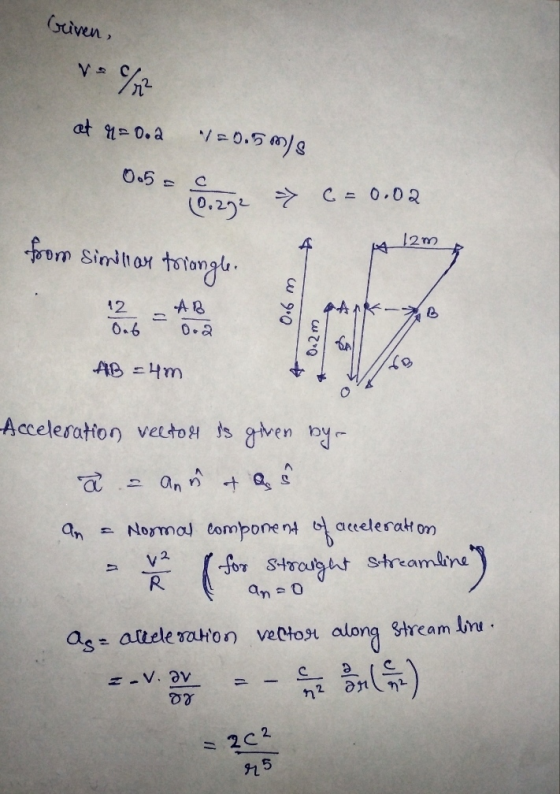
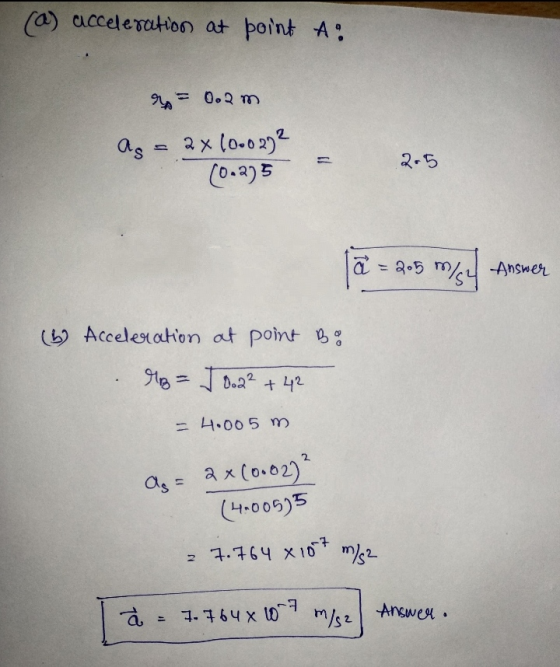
Streamlines and conical funnel. unsure how to start this question, part a) is confusing. The streamlines in the conical nozzle shown in Figure 1 are essentially radial lines emanating from point A an...
 Streamlines and conical funnel.
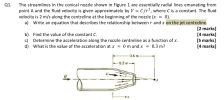
unsure how to start this question, part a) is confusing.
The streamlines in the conical nozzle shown in Figure 1 are essentially radial lines emanating from point A and the fluid velocity is given approximately by V C/r2, where C is a constant. The fluid velocity is 2 m/s along the centreline at the beginning of the nozzle (x 0) Q1. a) Write an equation that describes the relationship between r and x on the jet...
Streamlines and conical funnel.
unsure how to start this question, part a) is confusing.
The streamlines in the conical nozzle shown in Figure 1 are essentially radial lines emanating from point A and the fluid velocity is given approximately by V C/r2, where C is a constant. The fluid velocity is 2 m/s along the centreline at the beginning of the nozzle (x 0) Q1. a) Write an equation that describes the relationship between r and x on the jet...
Water flows steadily from an open tank as shown in the figure. The elevation of...
 Water flows steadily from an open tank as shown in the figure.
The elevation of
point 1 is H = 13 m ,
and the elevation of points 2 and 3 is h = 2 m .
The cross-sectional area at point 2 is 0.00069 m 2
; at point 3, where the water is
discharged, it is 0.00158 m 2 . The
cross-sectional area of the tank is very large compared with the
cross-sectional area of the pipe. Find...
Water flows steadily from an open tank as shown in the figure.
The elevation of
point 1 is H = 13 m ,
and the elevation of points 2 and 3 is h = 2 m .
The cross-sectional area at point 2 is 0.00069 m 2
; at point 3, where the water is
discharged, it is 0.00158 m 2 . The
cross-sectional area of the tank is very large compared with the
cross-sectional area of the pipe. Find...
Q9 (5 pts): Water flows under the sluice gate as shown in the figure below. If...
 Q9 (5 pts): Water flows under the sluice gate as shown in the figure below. If V2 = 1 m/s what is the normal acceleration at point (1)? Sluice gate R = 0.12 m (1) Vi
Water flows steadily from a large tank as shown in the figure. The height of water...
 Water flows steadily from a large tank as shown in the figure. The height of water in the tank is H = 4 m represents the height from the centerline of the horizontal pipe to the surface of the water in the tank. The water flows out of the tank through a pipe with diameter of 4 cm. The stream of water flows through a bend (= 30 degrees, L = 2.88 m) and exits as a free jet through...
2. Water flows over a flat surface at 8 m/s, as shown in figure. A pump...
 2. Water flows over a flat surface at 8 m/s, as shown in figure. A pump draws off water through a narrow slit at a volume rate of 0.2 m2/s per meter length of the slit. Assume that the fluid is incompressible and inviscid and can be represented by the combination of a uniform flow and a sink. a) Based on method of superposition, propose a general expression for stream function ψ velocity potential ф, and velocity components of v,...
I. Water flows steadily at 90 gal/min through a 2" diameter pipe as shown in the figure below. Th...
 I. Water flows steadily at 90 gal/min through a 2" diameter pipe as shown in the figure below. The pipe extends 13 inches from the wall (x-direction), the turns 90° to the right (out of the page in the -y direction) for 24 inches, and then turns 90° down (-z direction) for 9.5 inches. Horizontal section of pipe is 24 in 13 in 9.5 in Pipe supported by wall Q = 90 gal/min A. Compute all three reaction forces (R,...
Carbon dioxide flows steadily through a varying cross-sectional area duct such as a nozzle at a...
Carbon dioxide flows steadily through a varying cross-sectional area duct such as a nozzle at a mass flow rate of 3.00 kg/s. The carbon dioxide enters the duct at a pressure of 1400 kPa and 200?C with a low velocity and expands in the nozzle to a pressure of 1200 kPa. The duct is designed so that the flow can be approximated as isentropic. Determine the density, velocity, flow area, and Mach number at each location along the duct that...
Fluid shown in (Figure 1) flows through the curved pipe such that fluid particles move along...
 Fluid shown in (Figure 1) flows through the curved
pipe such that fluid particles move along the center streamline
with the velocity of V=(14s^2 + 1000t^3/2 +4)m/s, where s is in
meters and t is in seconds
Part A
Determine the magnitude of the acceleration of a particle at point
A, where s= 0.3m, if it arrives t = 0.02s
a=
Fundamental Problem 3.8 Fluid shown in (Figure 1) flows through the curved pipe Y Pa such that fluid particles...
Fluid shown in (Figure 1) flows through the curved
pipe such that fluid particles move along the center streamline
with the velocity of V=(14s^2 + 1000t^3/2 +4)m/s, where s is in
meters and t is in seconds
Part A
Determine the magnitude of the acceleration of a particle at point
A, where s= 0.3m, if it arrives t = 0.02s
a=
Fundamental Problem 3.8 Fluid shown in (Figure 1) flows through the curved pipe Y Pa such that fluid particles...
 3. Oil flows in the pipe shown. The orifice in the pipe has a coefficient of discharge of 0.64. Compute the discharge of the oil in the pipe CE311 Fluid Mechanics Winter 2019, Assignment 5, Due March 1 4. Water flows steadily through the funnel shown in the figure below. Throughout most of the funnel the flow is approximately radial (along rays from O) with a velocity of V- cr where r is the radial coordinate and c is a...
 Q4) Water (y 9810 N/m3) flows steadily with negligible viscous effects through a pipe as shown below, pressure and velocity at point (1) are 110 kPa and 1m/s respectively. Find the pressure at point (2) in kPa if velocity at that point is 5 m/s. 2 m Answer (round to 1 decimal place):
 Streamlines and conical funnel.
unsure how to start this question, part a) is confusing.
The streamlines in the conical nozzle shown in Figure 1 are essentially radial lines emanating from point A and the fluid velocity is given approximately by V C/r2, where C is a constant. The fluid velocity is 2 m/s along the centreline at the beginning of the nozzle (x 0) Q1. a) Write an equation that describes the relationship between r and x on the jet...
Streamlines and conical funnel.
unsure how to start this question, part a) is confusing.
The streamlines in the conical nozzle shown in Figure 1 are essentially radial lines emanating from point A and the fluid velocity is given approximately by V C/r2, where C is a constant. The fluid velocity is 2 m/s along the centreline at the beginning of the nozzle (x 0) Q1. a) Write an equation that describes the relationship between r and x on the jet...
 Water flows steadily from an open tank as shown in the figure.
The elevation of
point 1 is H = 13 m ,
and the elevation of points 2 and 3 is h = 2 m .
The cross-sectional area at point 2 is 0.00069 m 2
; at point 3, where the water is
discharged, it is 0.00158 m 2 . The
cross-sectional area of the tank is very large compared with the
cross-sectional area of the pipe. Find...
Water flows steadily from an open tank as shown in the figure.
The elevation of
point 1 is H = 13 m ,
and the elevation of points 2 and 3 is h = 2 m .
The cross-sectional area at point 2 is 0.00069 m 2
; at point 3, where the water is
discharged, it is 0.00158 m 2 . The
cross-sectional area of the tank is very large compared with the
cross-sectional area of the pipe. Find...
 Q9 (5 pts): Water flows under the sluice gate as shown in the figure below. If V2 = 1 m/s what is the normal acceleration at point (1)? Sluice gate R = 0.12 m (1) Vi
 Water flows steadily from a large tank as shown in the figure. The height of water in the tank is H = 4 m represents the height from the centerline of the horizontal pipe to the surface of the water in the tank. The water flows out of the tank through a pipe with diameter of 4 cm. The stream of water flows through a bend (= 30 degrees, L = 2.88 m) and exits as a free jet through...
 2. Water flows over a flat surface at 8 m/s, as shown in figure. A pump draws off water through a narrow slit at a volume rate of 0.2 m2/s per meter length of the slit. Assume that the fluid is incompressible and inviscid and can be represented by the combination of a uniform flow and a sink. a) Based on method of superposition, propose a general expression for stream function ψ velocity potential ф, and velocity components of v,...
 I. Water flows steadily at 90 gal/min through a 2" diameter pipe as shown in the figure below. The pipe extends 13 inches from the wall (x-direction), the turns 90° to the right (out of the page in the -y direction) for 24 inches, and then turns 90° down (-z direction) for 9.5 inches. Horizontal section of pipe is 24 in 13 in 9.5 in Pipe supported by wall Q = 90 gal/min A. Compute all three reaction forces (R,...
 Fluid shown in (Figure 1) flows through the curved
pipe such that fluid particles move along the center streamline
with the velocity of V=(14s^2 + 1000t^3/2 +4)m/s, where s is in
meters and t is in seconds
Part A
Determine the magnitude of the acceleration of a particle at point
A, where s= 0.3m, if it arrives t = 0.02s
a=
Fundamental Problem 3.8 Fluid shown in (Figure 1) flows through the curved pipe Y Pa such that fluid particles...
Fluid shown in (Figure 1) flows through the curved
pipe such that fluid particles move along the center streamline
with the velocity of V=(14s^2 + 1000t^3/2 +4)m/s, where s is in
meters and t is in seconds
Part A
Determine the magnitude of the acceleration of a particle at point
A, where s= 0.3m, if it arrives t = 0.02s
a=
Fundamental Problem 3.8 Fluid shown in (Figure 1) flows through the curved pipe Y Pa such that fluid particles...
Most questions answered within 3 hours.
-
Where is the error in this code sequence?
String s1 = "Hello";
String s2 = "ello";...
asked 10 months ago -
Financial data for Joel de Paris, Inc., for last year
follow:
Joel de Paris, Inc.
Balance...
asked 10 months ago -
Consider this reaction:
Al2(SO4)3 (aq)+ BaCl3
(aq) Al2Cl6 (aq)- +
3BaSO4(s) . What is the...
asked 10 months ago -
Suppose that Savneet is considering increasing her
recent random sample from 20 car rentals to 40...
asked 10 months ago -
Trucks arrive at an unloading terminal at an average rate of 120
per hour.
Trucks arrive...
asked 10 months ago -
Why are methanol and ethanol completely soluble in water while
octanol is not very little soluble....
asked 10 months ago -
A facilities manager at a university reads in a research report
that the mean amount of...
asked 10 months ago -
When the CuSO4 is rehydrated by adding water to the anhydrous
compound, is this an endothermic...
asked 10 months ago -
A ray of sunlight is passing from diamond into crown glass; the
angle of incidence is...
asked 10 months ago -
A block of mass 0.249 kg is placed on top of a light, vertical
spring of...
asked 10 months ago -
how do the kidneys compensate in the presences of acidosis
a) trigger hyperventilate
b) reserve acid...
asked 10 months ago -
Question 501 pts
The rental rate of capital to the firm increases. Which of the
following...
asked 10 months ago